25-year shelf life food: what really lasts, and do you need it?
What a 25-year shelf life really promises, which foods keep for years, what heat, air, light and damp do, the cost per 1,000 kcal and what GOV.UK asks for.
Some freeze-dried food really is sold with a shelf life of up to 25 years, but that is the maker’s best case for a sealed pack kept cool and dry, and it is a best before date, which GOV.UK says relates to quality, not safety. Tins, dry staples such as rice and pasta, ready-to-eat pouches and honey all keep for a long time if they are stored as the label says. Most UK households don’t need 25-year food: GOV.UK Prepare plans for an emergency lasting a few days and asks for non-perishable food that doesn’t need cooking, such as ready-to-eat tins, which you can build up with your normal shopping and eat in date order.
By Tom Calder · Updated 24 September 2026 · Sourced to the FSA, GOV.UK, Ready Scotland, the British Red Cross, the NHS, legislation.gov.uk & manufacturers
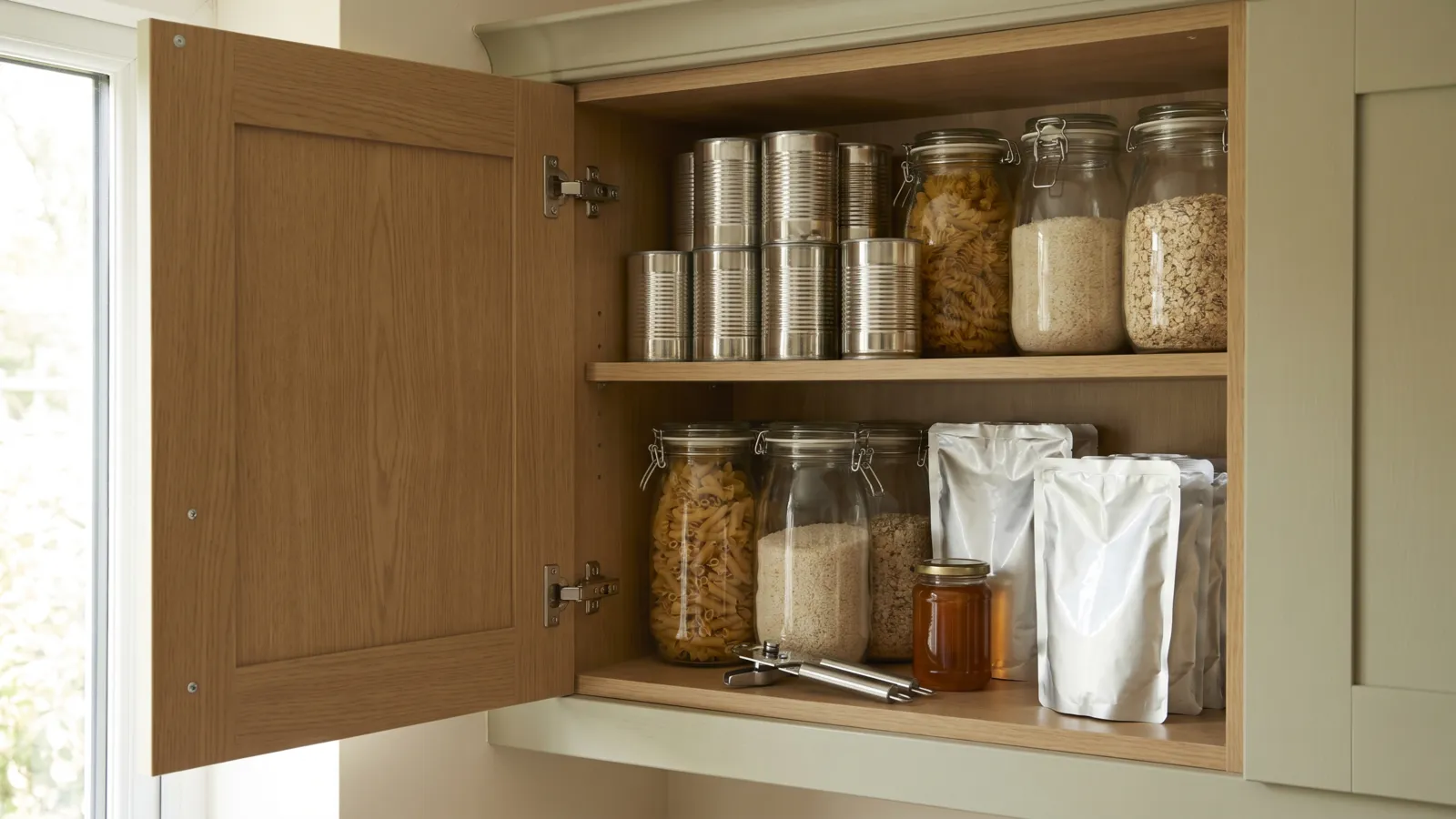
What a 25-year date actually promises
A 25-year shelf life is a best before date set a long way ahead, and a best before date is about quality. GOV.UK’s food labelling guidance puts the difference plainly: “Use-by dates relate to the safety of food, whereas best before dates relate to quality.” Manufacturers decide which kind of date a food carries, depending on how likely it is to become unsafe over time, and dried and tinned foods carry best before dates. After that date, GOV.UK says, food “is usually safe to eat but may not be of the same quality”; the Food Standards Agency (FSA) adds that it may not taste as good as it did.
The number is also a ceiling rather than a promise. ReadyWise, which sells its buckets in the UK through its own shop, says its sealed pouches keep food fresh for up to 25 years, and Expedition Foods gives its Survivor Foods tins a shelf life of up to 25 years. How close a pack gets to that depends on how it is kept.
The conditions behind the number
The makers say what their figures assume. ReadyWise says its food is affected by temperature, moisture, oxygen and light, and that for the longest storage life it should be kept somewhere cool and dry, such as a basement, at room temperatures of 50 to 55 degrees (Fahrenheit, so about 10 to 13°C). Expedition Foods tells buyers of its 25-year tins to keep them in a cool area, avoid long-term storage above 22°C and take care not to puncture the tin; under those conditions, it says, the food keeps its quality, flavour and nutritional value for its shelf life.
The long date is for a sealed pack. Expedition Foods says an opened tin should be used straight away, though contents resealed under its plastic lid have been found acceptable for up to a week, and ReadyWise packs its bucket in pouches of four servings to avoid waste. The same rule covers everything on the shelf: GOV.UK says food that isn’t stored properly could reduce in quality before its best before date.
What a long date doesn’t promise
Where makers talk about taste and nutrition over time, they tie it to storage and to the date. Expedition Foods says its tins keep their quality, flavour and nutritional value for their shelf life under its storage conditions. Firepot, which gives most of its meals a five-year best before date, says that doesn’t mean the food won’t last longer, but recommends eating it within that time for the best taste, and says the date marks a subtle change in flavour. Princes, the tinned food brand, says it only guarantees its products’ quality up to the best before date.
That is the official picture for every best before food: GOV.UK says the date tells you when food might start to reduce in quality, and that after it you can use sight, taste or smell to decide whether to eat it. Use-by dates are a different thing. They go on foods that go off quickly, and eating food after its use-by date could make you ill, which is why nothing with a use-by date belongs in a long-term store. Our guide to use-by and best before dates has the detail.
Foods that genuinely keep for years
Freeze-dried buckets and tins. These carry the longest dates: up to 25 years for ReadyWise’s buckets and for Expedition Foods’ Survivor Foods tins, which hold oxygen absorbers that the maker says keep the food fresh. Freeze-dried and dehydrated pouches are dated far shorter: Expedition Foods puts its emergency ration packs at up to five years, and Firepot gives most of its meals five years, or one year in its compostable packaging. Our freeze-dried meals comparison sets them side by side.
Ready-to-eat pouches. Wayfayrer cooks and sterilises its meals inside a sealed foil pouch, which it says keeps out oxygen and light, and gives them a three-year shelf life. Unlike dry rations, it says, they are ready to serve hot or cold, which is what GOV.UK’s list asks of emergency food: something that doesn’t need cooking.
Tins. Canned Food UK, which is run by the Metal Packaging Manufacturers Association, says canned food has a shelf life of up to three years. How long a tin stays acceptable after its best before date depends on the product, the storage conditions and the brand, the FSA says. Judge the can as well as the date: the FSA says a shallow dent is fine if the can is otherwise undamaged, but a deep dent may hide a split or a broken seal, and food from a can in that state, from a can that has rusted where it was dented, or from a visibly bulging can shouldn’t be eaten. Many tinned foods meant to be heated are safe to eat cold, it adds, depending on the product, so follow the maker’s instructions. See our tinned food comparison.
Dry staples. Rice, pasta, oats and other dried foods are best before foods too; GOV.UK names pasta and rice as examples. The date is the maker’s, so check your own packs, and keep them dry: Tilda advises storing dry rice in a cool, dry place, ideally in an airtight container in a cupboard, and says darker grains or an unpleasant smell are signs it has spoiled. Cooked rice is another matter: the FSA says to keep it in the fridge for no more than a day before reheating.
Honey. Rowse Honey says honey “never really goes off” because it is so high in natural sugar, though it still prints a best before date, recommends eating the honey before it, and suggests keeping the jar in a cupboard at room temperature. Crystals are harmless, it says, and dissolve if you stand the jar in hot water; the Honey (England) Regulations 2015 say honey’s consistency can be fluid, viscous or partly or entirely crystallised. The NHS says not to give honey to a child under 1.
What storage does: heat, air, light and damp
ReadyWise names four things that affect its food: temperature, moisture, oxygen and light. The makers’ packaging is designed to keep the last three out: ReadyWise uses a metallised film that it says is a barrier to oxygen and moisture, Wayfayrer says its foil pouches keep out oxygen and light, and Expedition Foods puts oxygen absorbers in its tins. The packaging matters as much as the food: Firepot gives most of its meals five years in its standard packaging, but says its compostable packaging keeps food fresh for one year.
Heat is the one you control. Use the coolest dry cupboard you have, away from the oven, boiler, radiators and sunny windows, and remember the makers’ own reference points: below 22°C for Expedition Foods’ tins, and 10 to 13°C for ReadyWise’s longest storage life. Keep packs sealed and undamaged, keep tins dry, and once a bag of rice or pasta is open, move it into an airtight container, as Tilda advises for rice.
What the government actually asks for
Official advice works to a much shorter horizon. GOV.UK Prepare asks households to think about the supplies they would need “during an emergency lasting a few days, such as a power cut or water outage”, and its kit list asks for non-perishable food that doesn’t need cooking, “such as ready-to-eat tinned meat, fruit or vegetables (and a tin opener)”, adding that how much you need will vary with your circumstances. Ready Scotland suggests 3 days’ supply of bottled water and food that doesn’t need cooking and won’t go off, and the British Red Cross also suggests three days of water and long-life, ready-to-eat food.
None of them asks for 25-year food, and freeze-dried meals fit the brief less well than they seem to. They need water: ReadyWise says each serving takes about a cup, and its 120-serving bucket about 120 cups, roughly 28 to 30 litres. That is more than a week of the 2.5 to 3 litres of drinking water a day that GOV.UK Prepare quotes as the World Health Organisation’s minimum for one person’s survival, and a water outage takes away exactly that. ReadyWise says hot water speeds things up, though many of its meals will rehydrate at any temperature. If you would heat water on a camping stove in a power cut, that is an outdoor job: the NHS says not to use one indoors or inside a tent. Our guide to cooking without power covers the safe options.
A cupboard you eat from does the job better. GOV.UK suggests adding to your kit when you can rather than buying everything at once, and the Red Cross suggests one item at a time, for example with the weekly shop. Check the dates when you buy, as the FSA suggests, then put new tins at the back and eat from the front, and the store stays in date with little waste. Our guide to how much food to store turns the official figures into a shopping list, and the kit builder sizes it to your household.
What it costs per 1,000 kcal
Prices move, so we quote only what our own price checks recorded, with the date. On 24 September 2026, ReadyWise’s UK shop listed its 120-serving bucket at £329.99. ReadyWise puts the bucket’s total at 24,360 kcal, which it describes as 13 days of food at 1,800 kcal a day; at 2,000 kcal, the UK reference intake for an adult, that is about 12 days for one person. It works out at about £13.55 per 1,000 kcal, or roughly £27 to feed one adult for a day.
The same day, Firepot’s own shop listed a regular 600 kcal pouch of its chilli con carne and rice at £10.49: about £17.48 per 1,000 kcal, or about £35 for 2,000 kcal. The pouch costs more per calorie than the bucket, but you can buy only as many as you will eat.
We haven’t priced supermarket tins for this guide, so there is no tin figure here. The sum is easy to do yourself: multiply the kcal per 100g on the nutrition label by the tin’s weight and divide by 100, then divide the price by that total and multiply by 1,000. Current prices for the products we compare are on our emergency food and tinned food pages.
When long-life food makes sense, and when it doesn’t
There are good reasons to keep some. Ready Scotland points out that rural areas are more likely to be cut off from the shops during snow. Light, long-dated food also suits a bag you might have to carry or a kit in the car, and a store that sits untouched is better than none if you know you won’t rotate a cupboard. If you do buy, choose meals you would eat anyway, store the water to make them up, keep them cool, and compare the price per 1,000 kcal rather than the number of servings.
It is harder to justify if the only space you have is warm, if you have no safe way to heat water, or if the bucket would simply sit unopened until its date. A few days of ready-to-eat tins you actually eat, with a tin opener, is what the government asks for; pasta and rice are useful extras if you can cook. For a supermarket version, see our 72-hour supermarket kit.
Common questions
Does 25-year emergency food really last 25 years?
The makers say it can, but the figure is a best case. ReadyWise and Expedition Foods both say their long-life ranges last up to 25 years, and both tie that to storage: somewhere cool and dry, with ReadyWise suggesting about 10 to 13°C and Expedition Foods saying to avoid long-term storage above 22°C and not to puncture the tin. It is a best before date, which GOV.UK says relates to quality, not safety. Once a tin is open, Expedition Foods says to use it straight away, or within a week if it is resealed with its lid.
Is food safe to eat after its best before date?
Usually. GOV.UK says that after the best before date food is usually safe to eat but may not be of the same quality, and that you can use sight, taste or smell to decide. Use-by dates are different: eating food after its use-by date could make you ill. For tins, the FSA says how long they stay acceptable after the date depends on the product, the storage conditions and the brand, and not to eat from a visibly bulging can or one that has rusted where it was dented.
How long does tinned food last?
Canned Food UK, which is run by the can makers’ trade association, says canned food has a shelf life of up to three years, and the best before date on each tin is the maker’s own. After it, the FSA says, it depends on the product, the storage conditions and the brand. Keep tins cool and dry, check them for deep dents, rust and bulging, and don’t keep leftovers in an opened can: the FSA says to move them into a bowl or container in the fridge.
Does honey go off?
Rowse Honey says honey never really goes off because it is so high in natural sugar, but it prints a best before date, recommends eating the honey before it and suggests keeping the jar in a cupboard at room temperature. Crystallised honey is harmless, it says, and turns runny again if you stand the jar in hot water. The NHS says not to give honey to children under 1.
Do I need 25-year food for an emergency kit?
Most households don’t. GOV.UK Prepare plans for an emergency lasting a few days and asks for non-perishable food that doesn’t need cooking, such as ready-to-eat tinned meat, fruit or vegetables, with a tin opener; Ready Scotland and the British Red Cross suggest three days. Freeze-dried food also needs water, about a cup a serving for ReadyWise’s meals, which is what a water outage takes away. Long-life food earns its place if you are likely to be cut off, need something light for a bag or car, or know you won’t rotate a cupboard.
Where should I store long-life food?
Somewhere cool, dry and dark. ReadyWise says its food is affected by temperature, moisture, oxygen and light, and Expedition Foods says to avoid long-term storage above 22°C. A cupboard away from the oven, boiler and radiators suits most of it. Keep packs sealed and undamaged, move opened rice and pasta into airtight containers, as Tilda advises for rice, and put new stock at the back so the oldest is eaten first.
Sources (23)
- GOV.UK — Understanding food labelling: best before and use-by datesthe Food Standards Agency’s page on dates now redirects to this GOV.UK guide; checked 24 September 2026
- Food Standards Agency — Home food fact checkerbest before, cooked rice, dented and bulging cans, eating canned food cold, opened cans; updated 21 August 2026
- GOV.UK Prepare — Get prepared for emergenciesa few days, food that doesn’t need cooking, water figures, building a kit over time
- Ready Scotland — Make an emergency kit3 days’ supply; rural areas cut off by snow; updated 24 March 2026
- British Red Cross — Prepare an emergency kit3 days’ long-life, ready-to-eat food; one item at a time
- Regulation (EU) No 1169/2011, Annex XIII Part B: reference intake for an adult, 8,400 kJ/2,000 kcal, legislation.gov.uk
- The Honey (England) Regulations 2015, Schedule 1 (compositional criteria), legislation.gov.uk
- NHS — Foods to avoid giving babies and young children (honey)
- NHS — Carbon monoxide poisoning (camping stoves indoors or inside a tent)
- ReadyWise UK — 120-serving lunch and dinner bucketup to 25 years; 24,360 kcal; about 120 cups of water; £329.99 on 24 September 2026
- ReadyWise UK — Frequently asked questionsstorage conditions, water per serving, hot water
- ReadyWise UK — Quality control (barrier packaging)
- Expedition Foods — Spaghetti Bolognese, Survivor Foods rangeup to 25 years, storage below 22°C, oxygen absorbers, once opened
- Expedition Foods — Emergency rations (shelf life up to five years)
- Firepot — What is the shelf-life of your products?
- Firepot — Is the shelf-life shorter for dehydrated vs freeze-dried food?
- Firepot — Chilli con Carne and Riceregular serving 135g/600 kcal; £10.49 on 24 September 2026
- Wayfayrer — Frequently asked questionssterilised foil pouch, three-year shelf life, eating cold
- Canned Food UK — Why cans? (shelf life up to three years)
- Canned Food UK — About us (run by the Metal Packaging Manufacturers Association)
- Princes — FAQs (quality guaranteed within the best before date)
- Tilda — FAQs (storing dry rice, signs of spoiled rice)
- Rowse Honey — FAQs (shelf life, storage, crystallisation)
PreparedBritain is independent and not affiliated with HM Government.
The Emergency Kit Checklist
The GOV.UK Prepare essentials on one printable page — tick them off as you go and keep it with the kit. Free, no catch.
Download it straight away. We'll also send the occasional briefing when something genuinely matters — severe weather, live incidents, real price drops. Nothing else.
Keep reading
All food & growing guides →Does the UK only have a few days of gas? What the storage headlines mean
Headlines keep counting Britain’s gas in “days”. The number is real, but it measures what is sitting in storage on…
Will there be food shortages this Christmas?
Most years bring a “Christmas shortage” headline. Here is what actually happened in 2021, 2022, 2023 and 2025, where…
Is there going to be a milk shortage in the UK?
A “milk shortage warning” is in the headlines as drought cuts what dairy farms produce. Deliveries are down a few…