The £30 supermarket 72-hour kit
A genuine three-day emergency kit from one supermarket shop, for about thirty pounds — what to buy, what it costs, and the two upgrades worth making later.
By Tom Calder · Updated 19 July 2026 · Prices checked July 2026 — they move; treat as approximate
The premise: preparedness at own-brand prices
The Government's emergency kit list survives contact with a budget remarkably well, because most of it is ordinary groceries. This page builds the 72-hour version for one to two people from a single supermarket shop — own-brand throughout — for roughly thirty pounds. Prices below were checked in July 2026 and will drift; treat them as bands, not promises.
One honest carve-out up front: the battery or wind-up radio on the official list isn't really a supermarket item — the realistic cheapest routes are a basic battery FM radio from Argos (around £8) or a wind-up model online (from around £13). It's listed here as the add-on that takes the kit from ~£30 to ~£40, not hidden inside the headline.
The trolley, item by item
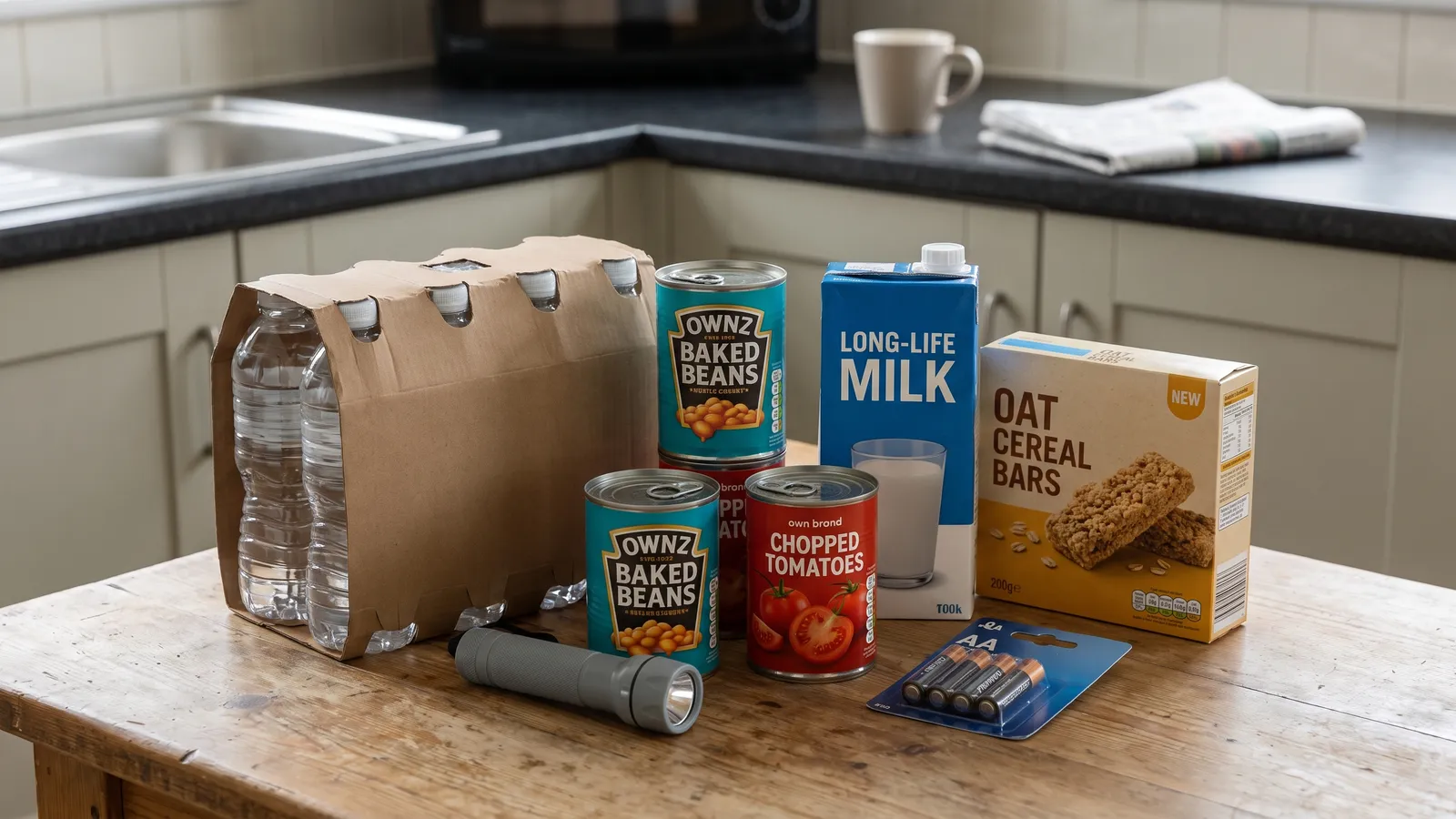
Water — 12 litres of own-brand still water (the 2L and 5L bottles are cheapest per litre): £3–5. That's the three-day drinking minimum for one, or a tight allowance for two alongside tap-filled containers.
Food that needs no cooking — six mixed tins (beans from ~27p, soup ~60p, tinned meals £1.20–2): £4–6.50. Two litres of UHT milk: £2–2.70. Two multipacks of cereal bars: £2–3. Dried fruit and nuts, two bags: £3–5. That's three days of unexciting but complete eating for one to two people, all of it rotating happily into normal life afterwards.
Light and power — a basic LED torch (supermarket floor price £1.25–1.50, better ones to £5) and a 4-pack of AA batteries (£1.75–3): call it £3–8 depending on how far you upgrade the torch.
Health and hygiene — own-brand plasters and antiseptic (£2.75–3.50) and a big pack of wet wipes (55p–£1.20). The first-aid shelf won't match a proper kit, but it covers the basics until you buy one.
The receipt, and what it buys
Totalled honestly: the basket lands between about £20 and £36 depending on supermarket and choices, with a realistic middle of £26–30. For that you have the official list's core — water, no-cook food, light, first aid basics, hygiene — sitting in a cupboard, purchased in one shop, with nothing exotic and nothing wasted.
What it doesn't buy: the radio (add £8–13 from Argos or online), a power bank if you don't already own one (£15–25 buys a decent 20,000mAh), and the personal layer no shop can sell — your medicines, copies of documents, a little cash. Add those over the following paydays and the kit is genuinely complete.
The two upgrades worth making later
First, the torch situation: the £1.25 supermarket torch works, but a £15–25 LED torch or head torch is brighter, tougher and runs longer — and a torch per adult is the real standard. Second, a proper first aid kit (£15–25 buys a BS 8599-1-informed kit) replaces the plasters-and-antiseptic stopgap.
Beyond that, the upgrade path is the one this site maps everywhere: a power bank, then a wind-up radio, then — if your budget and needs justify it — the power station tier. None of it invalidates the £30 start; it builds on it.
Common questions
Can you really build an emergency kit for £30?
The core of one, yes — water, three days of no-cook food, light, and hygiene/first-aid basics land at roughly £26–30 in own-brand ranges (checked July 2026). The radio and power bank are the honest add-ons that take a complete kit nearer £50–60.
What's deliberately left out?
The battery/wind-up radio (not really a supermarket item — £8–13 from Argos or online), a power bank, a proper first aid kit, and your personal layer: medicines, documents, cash. The guide prices them as add-ons rather than pretending they fit under £30.
Is supermarket own-brand food good enough for an emergency store?
Completely. Emergency food is just food that keeps — own-brand tins, UHT milk and cereal bars do the job at the lowest cost per meal, and rotate into normal eating so nothing is wasted. Premium 'emergency rations' buy shelf life and compactness, not nutrition.
How much water does £3–5 actually cover?
Twelve litres — the 2.5–3L per person per day minimum for one person over three days, or a tight two-person allowance if you also fill clean containers from the tap before any interruption. Water is the item to be least stingy about scaling up.
Will these prices still be right when I shop?
Treat them as bands — they were checked across UK supermarkets in July 2026 and own-brand prices move (bottled water in particular has risen in recent years). The structure of the kit holds even when individual prices drift a pound either way.
What should the next £30 buy?
In order: a decent torch per adult (or head torch), a 20,000mAh power bank, and a proper first aid kit — then the wind-up radio if you didn't add it first time. That sequence tracks what actually gets used in UK incidents: light, phone charge, minor injuries, information.
Sources: GOV.UK Prepare — get prepared for emergencies · Supermarket own-brand price checks (Trolley.co.uk / retailer sites), July 2026. PreparedBritain is independent and not affiliated with HM Government.
The Blackout Briefing
One calm email when something genuinely matters — severe weather, live incidents, real price drops. No noise.
Keep reading
All money & bills guides →Council tax help: reductions, discounts and how to challenge your band
Four routes to a lower council tax bill — means-tested reduction, discounts, the disabled band scheme and a VOA band…
The Warm Homes Loan explained: who'll qualify and what it covers from September
Who qualifies for the Warm Homes Loan, what it covers from September 2026, and how it works with the Boiler Upgrade…
Water social tariffs: the scheme your water company runs
You can't switch water company — so the low-income scheme you can apply for depends entirely on who supplies you.…