Survival seeds in the UK: are seed vaults worth it?
What survival seed kits and ‘seed vaults’ are, heirloom and open-pollinated seed versus F1, how long seeds really last, and what UK growers should buy instead.
A survival seed kit, often sold as a ‘seed vault’, is a sealed tin or pouch of many vegetable varieties, usually labelled heirloom or open-pollinated so you can save your own seed. Many are packed for American gardens, with US sowing dates. Open-pollinated seed matters if you want to save seed: the RHS says seed saved from F1 hybrids will not come true to the parent. But seed doesn’t keep forever. Stored dry and cool, most vegetable seed lasts a few years (parsnips and onions much less), and a tin of seeds is not a food plan: crops need ground, compost, water and months before they feed you. For most UK households the better buy is fresh packets from a UK supplier for crops you already eat, sown by a UK calendar, and the Heritage Seed Library or a local seed swap if you want rare varieties.
By Tom Calder · Updated 4 November 2026 · Sourced to the RHS, Garden Organic’s Heritage Seed Library, Royal Botanic Gardens Kew, Plantlife, GOV.UK’s plant import rules & the Wildlife and Countryside Act
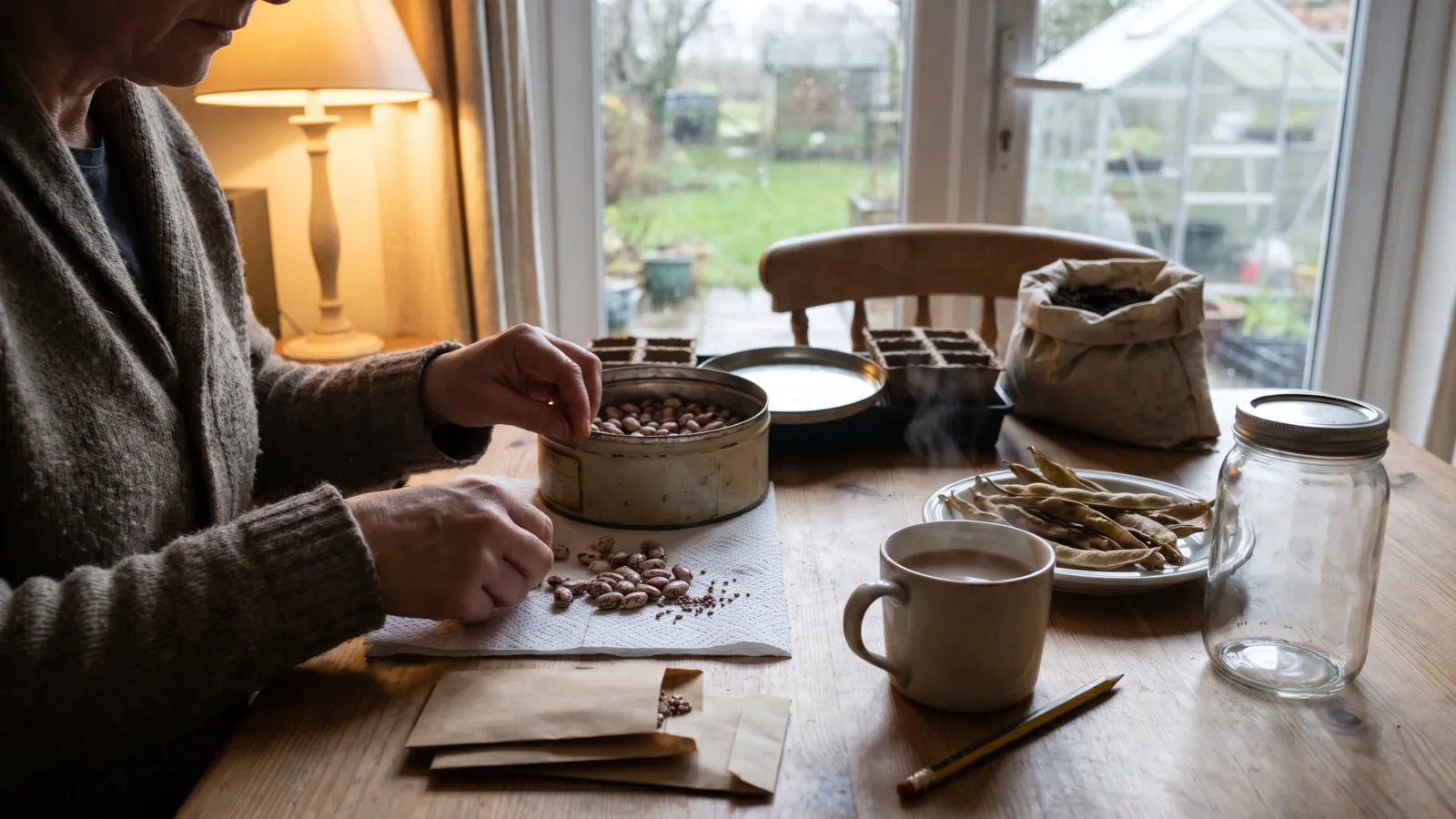
What survival seeds and seed vaults are
Search for survival seeds and you will find tins, buckets and foil pouches sold as a ‘survival seed vault’ or ‘open seed vault’: dozens of vegetable and herb varieties in one sealed pack, usually labelled heirloom, open-pollinated and non-GMO, and sold on the promise that they will keep for years until you need them. The idea is sound in part. Open-pollinated seed lets you save seed from your own crop and sow it again next year.
The catch for UK buyers is that many of these kits are put together for gardens in the United States. Read the packet before you buy: if it gives USDA hardiness zones, frost dates for American states or a US address, the varieties and sowing dates were chosen for a different climate. A UK seed packet tells you when to sow here, which is most of what makes a crop succeed.
The name borrows from real seed banks, which work very differently. The Svalbard Global Seed Vault in Norway keeps backup copies of seed from gene bank collections only; it does not take seed from individuals, who it encourages to offer valuable seed to their nearest gene bank. In Sussex, Kew’s Millennium Seed Bank holds over 2.5 billion seeds from wild plants, representing over 40,000 species and taxa. Neither is a store of garden seed for households.
Survival seeds from abroad: the import rules
A kit posted to you from outside Great Britain falls under plant health rules. GOV.UK says the rules apply if you are travelling with plants or have ordered them to arrive by post, and that Border Force can seize plants or products that don’t meet them. Seed for sowing counts: the plant health law in force in Great Britain defines plants to include seeds, other than those not intended for planting.
From outside the EU, Switzerland and Liechtenstein, GOV.UK says you need a phytosanitary (plant health) certificate for all plants for planting, which covers a seed kit shipped from the US. From the EU, Switzerland or Liechtenstein, a certificate is needed for the seed of some crops, including potato, tomato, chilli, onion, leek, sunflower, runner bean, French bean, green pea and broad bean; other seed must still be free from pests and diseases and for your own use. Northern Ireland has different rules. Buying from a UK seed company avoids the question altogether.
Heirloom seeds, open-pollinated and F1: why it matters for seed saving
The RHS explains the difference. An F1 hybrid is produced by crossing two stable seed lines, which gives greater uniformity and vigour, but seeds saved from F1 hybrid plants will not produce plants that are true to the parent type. F1 seed has to be made again by crossing the parent lines each time, which is why it costs more.
Open-pollinated seed comes from selected plants grown together and allowed to pollinate each other freely. The RHS says it is usually less uniform, vigorous and productive than F1 seed, but relatively inexpensive and can often be readily collected by home gardeners. ‘Heirloom’ and ‘heritage’ are not the RHS’s terms; on a packet they usually mean an older open-pollinated variety, so check the packet actually says open-pollinated (or doesn’t say F1) if seed saving is your aim.
F1 isn’t a bad buy. For a reliable crop this year, an F1 variety bred for disease resistance or uniformity is often the better choice. It only matters if you plan to save seed and sow it again.
NewSee this for your own homeHome Alerts: your postcode's power cuts, warnings and floods, on one screen. Free for your own home. Sign up in a minute.Start free →How long do seeds last? Viability and storage
Seed is alive, and it slowly loses the ability to germinate. Real Seeds, a UK seed company, gives these rough lifespans for properly dried seed stored cool, dry and dark, counted from the year it was harvested: parsnips 2 years at most; onions and leeks usually 1, up to 3 at most; carrots up to 3; beetroot and chard 2 to 3; courgettes and squash 2 to 4; lettuce 2 to 5; peas and beans 3 to 4 or more; brassicas such as cabbage and kale 3 to 6; tomatoes up to 6, most commonly 3; cucumbers up to 10. It notes that bought seed is already into its first year when it reaches you, and that germination falls gradually with age rather than stopping all at once. For parsnips the RHS’s advice is plain: always use fresh seed, because old seed germinates poorly.
Storage makes the biggest difference. The RHS suggests putting dry seed in labelled paper packets or envelopes inside an airtight container with some desiccant, such as silica gel, and keeping it in a fridge at 5°C; most seed, it says, will remain viable this way for many years, though viability depends on the condition of the seed when it was first stored. Damp or warmth can make seed deteriorate or rot.
Kew’s Millennium Seed Bank shows why cool and dry work. Its drying room is kept at 18°C and 15% relative humidity, which on its own increases a seed’s life by around 40 times, and the seeds then go into airtight containers at -20°C. Kew says that for every five degrees you cool dry seeds, their longevity doubles. A home can’t copy a seed bank, but a dry jar in the fridge or a cool cupboard is the same idea on a small scale.
To check an old packet before you rely on it, Real Seeds suggests a simple test: put a few seeds on damp kitchen paper in a loosely sealed plastic bag somewhere warm and see how many sprout after several days.
What to buy instead of a survival seed kit
Buy fresh packets from a UK seed company for the crops your household already eats, in the quantity you will sow this year and next. Each packet gives UK sowing months, and our month-by-month sowing calendar shows what to sow now, under cover and outdoors. Our vegetable seeds comparison covers beginner collections and the propagation kit worth having.
Then put the money where food actually comes from: growing space and practice. A raised bed gives good soil on any plot or patio, and a greenhouse or cold frame stretches the short British season. Grow a few easy crops well this year, and you will know far more than any tin can tell you.
If you want to save seed, choose a few open-pollinated varieties of crops you like and store the seed as above. Keep a modest spare stock of the longer-lived seed, such as peas, beans and tomatoes, in an airtight jar, and replace short-lived seed like parsnips and onions every year.
The Heritage Seed Library
For rare and old varieties, the UK has its own seed library. Garden Organic’s Heritage Seed Library looks after more than 800 heritage, heirloom and ex-commercial vegetable varieties that growers can no longer get anywhere else. Each year around 150 of them go into a Seed List for members, who choose six packets (12 for groups); you join Garden Organic and the Heritage Seed Library to take part. A network of more than 200 volunteer Seed Guardians grow varieties and send seed back to keep the collection going. Garden Organic says its 2027 Seed List launches in November 2026.
It is the opposite of a sealed survival tin: the seed is grown out, saved and shared every year, which is how a variety actually survives.
Seed swaps
Seed swaps are the cheapest way to try open-pollinated varieties and meet growers near you. Garden Organic keeps a page of UK seed swap events, and organisers can ask to have theirs listed; Seedy Sunday in Brighton is described as the largest and longest-running. Bring seed you have saved, labelled with the variety and year, and take home a few packets of something new. Swapped seed is for growing yourself, not for selling on.
Seed bombs: wildflowers, natives and where it’s allowed
Seed bombs are small balls of seed and compost or clay thrown onto bare ground, usually to grow wildflowers. Plantlife says seed bombing can certainly work, but there are better ways: the best time to sow wildflower seed in the UK is between August and October, you only need 1 or 2 teaspoons of seed per square metre, and it is best to buy native seed from a supplier in the country where you will sow it, ideally sourced locally. Poppies and cornflowers are annuals, so they won’t necessarily come back the next year.
On where you can throw them: the RHS says there are no laws specifically about guerrilla gardening, and that in public spaces it generally comes down to what the council will permit, so ask the council or landowner first; your own garden is the easy place to start. Stick to native species. In England and Wales it is an offence to plant or otherwise cause to grow in the wild any plant listed in Part II of Schedule 9 to the Wildlife and Countryside Act 1981; in Scotland the offence covers causing any plant to grow in the wild outside its native range. A cheap mix of non-native ‘wildflowers’ is the wrong thing to scatter on a verge.
The bigger picture
Seeds are a good part of household resilience because they are cheap and the skill compounds year on year. Our grow your own guide sets out what a garden can and can’t do, and the harvest tracker follows how UK farms and food prices are faring this season.
Common questions
Are survival seed vaults worth it in the UK?
Usually not as a sealed emergency store. Many are packed for American gardens, with US varieties and sowing dates, and seed loses viability over the years, faster if kept warm or damp. Fresh packets from a UK supplier for crops you eat, plus somewhere to grow them, are the better buy.
What are heirloom seeds?
Heirloom (or heritage) usually means an older open-pollinated variety. The RHS’s distinction is between open-pollinated seed, which can often be saved by home gardeners, and F1 hybrids, whose saved seed will not produce plants true to the parent type.
Can I save seed from F1 plants?
You can, but the RHS says seed saved from F1 hybrid plants will not produce plants that are true to the parent type. To save seed that comes back the same, grow open-pollinated varieties.
How long do vegetable seeds last?
It depends on the crop and storage. Real Seeds gives, from harvest: parsnips 2 years at most, onions usually 1, carrots up to 3, peas and beans 3 to 4 or more, tomatoes most commonly 3, cucumbers up to 10. The RHS suggests an airtight container with desiccant in a fridge at 5°C.
Can I import seeds from the US?
GOV.UK says plants for planting from outside the EU, Switzerland and Liechtenstein need a phytosanitary certificate, including items ordered by post, and Border Force can seize them. Seed for sowing counts as a plant for planting. Buying from a UK seed company avoids this.
Are seed bombs legal in the UK?
There’s no law specifically about seed bombs or guerrilla gardening, the RHS says; on public land it comes down to what the council permits, so ask first. Use native seed: in England and Wales it is an offence to cause plants listed in Schedule 9 of the Wildlife and Countryside Act to grow in the wild, and in Scotland any plant outside its native range.
What is the Heritage Seed Library?
Garden Organic’s collection of more than 800 heritage and heirloom vegetable varieties that are no longer available elsewhere. Members choose six packets a year from its Seed List, and volunteer Seed Guardians grow and return seed.
Sources (19)
- RHS — F1 hybrids (F1 and open-pollinated seed; saved F1 seed not true to type), read 4 November 2026
- RHS — Seed: collecting and storing (paper packets, airtight container, desiccant, fridge at 5°C, viability), read 4 November 2026
- RHS — Parsnips (always use fresh seed; sow March to May; harvest in autumn), read 4 November 2026
- RHS — Potatoes (planting times, harvest windows, maincrop spacing), read 4 November 2026
- RHS — Guerrilla gardening (no specific laws; council permission; native species), read 4 November 2026
- Real Seeds — How long do vegetable seeds last? (seed life by crop; germination test), read 4 November 2026
- Royal Botanic Gardens, Kew — How to preserve seeds for the future (drying at 18°C and 15% RH, -20°C storage, five degrees cooler doubles longevity), read 4 November 2026
- Royal Botanic Gardens, Kew — Millennium Seed Bank (over 2.5 billion seeds, over 40,000 species), read 4 November 2026
- Svalbard Global Seed Vault — For the general public (gene bank copies only), read 4 November 2026
- Garden Organic — Heritage Seed Library (collection, Seed List, Seed Guardians), read 4 November 2026
- Garden Organic — How the Heritage Seed Library works (six packets, 12 for groups; membership), read 4 November 2026
- Garden Organic — The 2027 Seed List is coming, read 4 November 2026
- Garden Organic — Seed swaps, read 4 November 2026
- Plantlife — When and how to sow wildflower seeds (seed bombs, August to October, native and local seed, 1–2 teaspoons per m²), read 4 November 2026
- GOV.UK — Bringing plants and wood into Great Britain (by post; seizure), read 4 November 2026
- GOV.UK — Plants from outside the EU (phytosanitary certificate for all plants for planting), read 4 November 2026
- GOV.UK — Plants from the EU, Switzerland and Liechtenstein (seeds needing a certificate), read 4 November 2026
- legislation.gov.uk — Regulation (EU) 2016/2031 as it applies in Great Britain, Article 2 (seeds intended for planting are plants), read 4 November 2026
- legislation.gov.uk — Wildlife and Countryside Act 1981, section 14 (planting in the wild: Schedule 9 in England and Wales; native range in Scotland), read 4 November 2026
PreparedBritain is independent and not affiliated with HM Government.
The Emergency Kit Checklist
The GOV.UK Prepare essentials on one printable page — tick them off as you go and keep it with the kit. Free, no catch.
Download it straight away. We'll also send the occasional briefing when something genuinely matters — severe weather, live incidents, real price drops. Nothing else.
Latest from our live data
All stories → News · 3 NovVampire devices: the '£200' is 13 gadgets added up; turning a home off standby saves about £45
 News · 2 NovCold Weather Payment opens: £25 a freezing week; last winter 40 of 71 stations triggered none
 News · 31 OctEarliest polar vortex breakdown on record forecast for November: what it means for the UK
Keep reading
All food & growing guides →UK inflation picks up more than expected to 3.5%: food held at 1.3%, wholesale veg up a third
UK inflation rose to 3.5% in September from 3.1%, with motor fuels the biggest push. Food inflation did not move:…
England's barley and oat harvests are the smallest since 2012, Defra figures show
Defra's provisional estimates give England its smallest barley and oat harvests since 2012 after a hot, dry growing…
25-year shelf life food: what really lasts, and do you need it?
What a 25-year shelf life really promises, which foods keep for years, what heat, air, light and damp do, the cost…
