How to prepare for food shortages in the UK
What UK food security actually looks like, why shelves occasionally gap, and the calm two-week larder that makes shortages a non-event — sourced to Defra and the ONS.
By Tom Calder · Updated 19 September 2026 · Sourced to Defra's UK Food Security Report & the ONS
Start with the facts, not the headlines
The UK's food supply is, by the government's own statutory assessment, broadly stable. Defra's UK Food Security Report — which the law requires at least every three years, most recently published in December 2024 — found no sustained food shortages even across three unusually turbulent years of pandemic aftermath, war in Ukraine and energy price spikes. Its worries are long-term ones: climate change and geopolitics, not empty shelves next week.
The headline numbers are steadier than the discourse. The UK produces the equivalent of 62% of all the food it consumes, and 75% of the food that can be grown here; by value, 57% of what we eat is home-produced, a quarter comes from the EU and the rest from further afield. And food price inflation — the thing that actually stresses household budgets — was running at 2.2% in the year to May 2026, low single digits and easing. Preparing for food disruption is sensible; panicking about it is not supported by the data.
So why do shelves sometimes gap?
Because the system is efficient, not deep. UK grocery retail runs on just-in-time logistics: government figures (using industry IGD data) put roughly ten days of food in the retail supply chain, and for some fresh lines as little as twenty-four hours, replenished by daily deliveries. That efficiency keeps prices down — and it means any interruption shows on shelves within days, and any burst of stockpiling within hours.
Recent gaps show the pattern. In February 2023, supermarkets rationed tomatoes, peppers and cucumbers after cold weather and rain hit harvests in Morocco and southern Spain — the UK imports around 95% of its winter tomatoes — while energy costs had emptied UK and Dutch glasshouses; normal supply returned within weeks. In autumn 2021, a spike in gas prices halted the fertiliser plants that supply around 60% of the UK's food-grade CO2, briefly threatening meat processing and packaging until a government-brokered restart. In late 2022, avian flu had supermarkets limiting egg boxes. Each was real, disruptive, temporary — and each rewarded households that could simply skip the affected aisle for a fortnight.
The goal: a two-week larder you already eat
The rational response to 'shallow but efficient' is a modest buffer: around two weeks of ordinary food your household genuinely eats, bought gradually and rotated through normal meals. Not a bunker wall of novelty rations — a slightly deeper store cupboard.
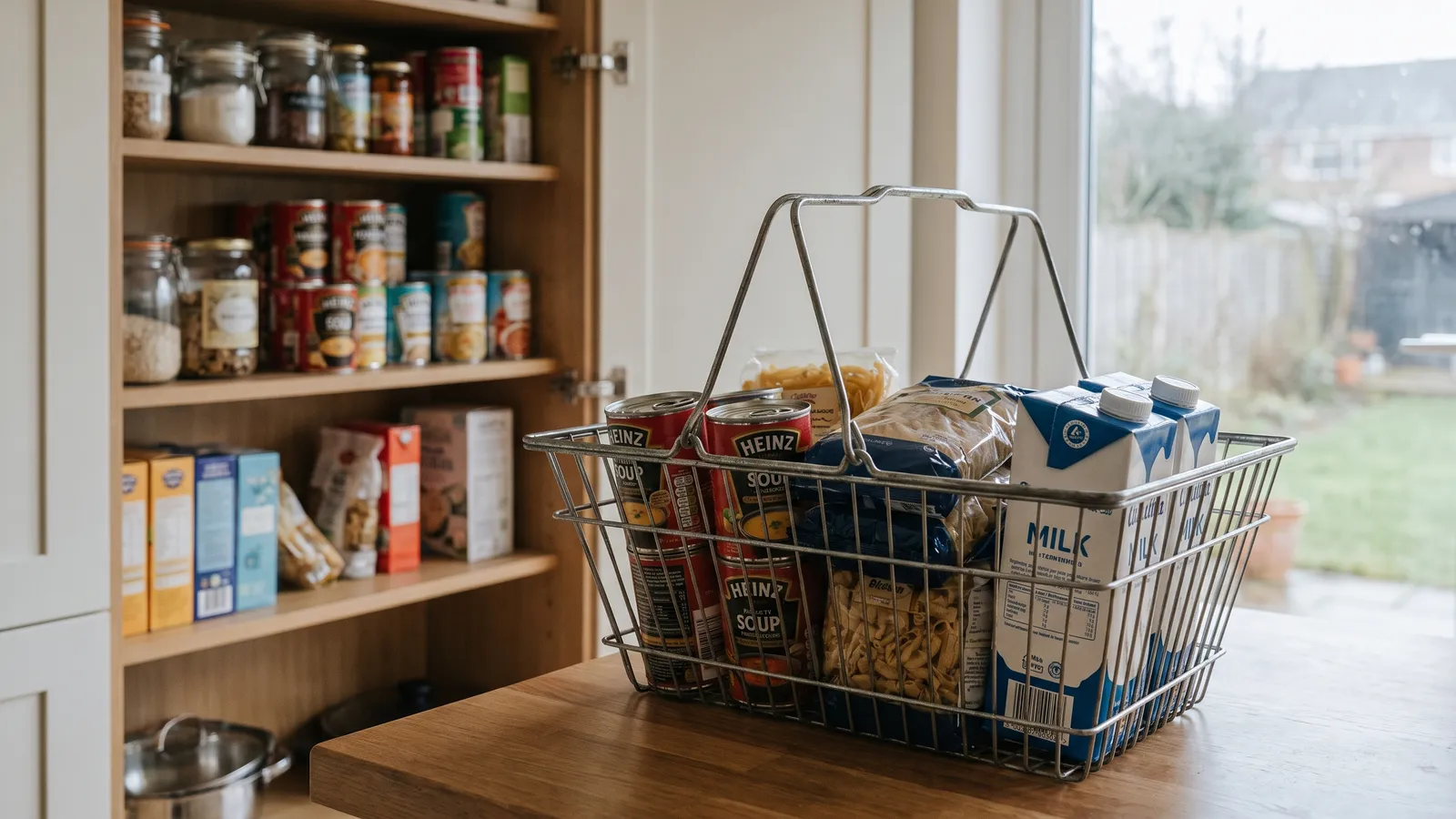
Build it a few pounds at a time: every big shop, add two or three long-life items you already use — tinned meals, pasta and sauce, rice, UHT milk, cereal, tinned fruit and veg, coffee. Within a couple of months you'll have a buffer that turns any shortage story into a non-event, at supermarket prices, with nothing wasted because it all rotates.
What to actually stock
Anchor on the meals, not the ingredients: count how many dinners, lunches and breakfasts two weeks means for your household, then stock complete answers — a tin of chilli plus a pouch of rice is dinner; porridge plus UHT milk is breakfast. Add the quiet essentials that vanish first in any disruption: cooking oil, salt, tea and coffee, and anything your children or pets are fussy about.
Balance matters more in a longer disruption: tinned fish and beans for protein, tinned fruit and veg for the rest, and a multivitamin as cheap insurance. Don't forget the tin opener — and remember a few days of it should need no cooking at all, which is where the store cupboard meets your power-cut kit.
Long-life kits: where they do and don't fit
Freeze-dried and 25-year kits solve a different problem: set-and-forget resilience for people who won't rotate a store cupboard, compact calories for grab bags, and cover beyond the two-week horizon. They cost several times supermarket prices per calorie and most need hot water.
If that trade suits you, buy honestly — check the real calories per day rather than claimed 'servings'. For most households, the supermarket larder does nine-tenths of the job for a fraction of the money.
Water, and the other halves of the larder
Food disruption and water disruption are different events, but the same cupboard serves both. Keep the water side honest too: 2.5–3 litres of drinking water per person per day as a minimum, which for most homes means a couple of extra multipacks rotated through normal use.
And two non-food items earn their place in any shortage: a way to cook without mains power (a camping stove, used outdoors only), and enough of your prescription medicines to ride out a disrupted fortnight — pharmacies sit on the same just-in-time logistics as supermarkets.
During an actual shortage: how to behave
Buy your normal shop. The 2021 fuel queues and 2020 pasta aisles taught the same lesson: shortages of things Britain has plenty of are created at the checkout, by buying ahead of need. A household with a two-week larder has no reason to join the queue — which is precisely the point of having one.
Substitute cheerfully (the 2023 salad gap was survivable with frozen veg), watch the per-customer limits do their job, and treat the whole thing as the larder's occasional payoff. If a disruption ever genuinely outlasts a fortnight, government and retailers will be managing supply publicly — follow the official guidance of the moment rather than social media.
Common questions
Is the UK actually at risk of running out of food?
No — Defra's statutory UK Food Security Report (December 2024) assesses supply as broadly stable, with no sustained shortages even through the pandemic, the war in Ukraine and the energy crisis. The realistic risk is short, item-specific gaps, which a modest larder rides out comfortably.
How much of its food does the UK produce?
The equivalent of 62% of everything consumed, and 75% of the foods that can be grown here (Defra, 2024). By value, 57% of food eaten in the UK is home-produced, about 25% comes from the EU and 18% from the rest of the world.
How much food should I store?
Around two weeks of ordinary meals your household actually eats, rotated through normal shopping — plus at least three days of it needing no cooking, which doubles as your power-cut kit. More than that is a lifestyle choice, not a necessity.
Why did supermarkets run short of tomatoes in 2023?
Bad weather cut harvests in Morocco and southern Spain — which supply most of Britain's winter salad — while high energy costs had emptied UK and Dutch glasshouses. Rationing lasted weeks, not months, and normal supply returned. It's the model modern UK shortage: sharp, specific, temporary.
Should I buy a 25-year freeze-dried food kit?
Only for what it's genuinely for: set-and-forget storage if you'll never rotate a cupboard, or compact calories for a grab bag. Per calorie it costs several times supermarket food and usually needs hot water. The two-week supermarket larder is the better first £50.
What should I do when a shortage is in the news?
Your normal shop. Panic buying is how Britain turns a supply hiccup into empty shelves — and a stocked larder exists precisely so you never need to join it. Substitute where an item's gapped, and let the per-customer limits work.
Sources: Defra — United Kingdom Food Security Report 2024 · ONS — Consumer price inflation, May 2026 · GOV.UK — 2021 CO2 supply agreement · Full Fact — UK food supply chain stocks. PreparedBritain is independent and not affiliated with HM Government.
The Emergency Kit Checklist
The GOV.UK Prepare essentials on one printable page — tick them off as you go and keep it with the kit. Free, no catch.
Download it straight away. We'll also send the occasional briefing when something genuinely matters — severe weather, live incidents, real price drops. Nothing else.
Keep reading
All food & growing guides →Use-by vs best before: which food dates actually matter
The FSA's rule: use-by is safety, best before is quality. Which foods are genuinely fine past the date — tins, dried…
How much emergency food should you store? A per-person guide
The maths done for you: turn about 2,000 kcal and 3 litres of water per person per day into concrete food and water…
What to sow and plant this month: the UK vegetable calendar
A month-by-month UK guide to what vegetables to sow and plant — indoors and out — from January to December. Jump to…