Best fridge and freezer thermometers UK (2026): dial, digital and alarm types
The Food Standards Agency says a fridge should sit between 0 and 5°C and a freezer at around -18°C, and that a fridge thermometer, checked once a week, is the best way to keep it there. The dial on the appliance only shows a setting, not the temperature your food is at, and in a power cut it tells you nothing. This page compares UK thermometers on what separates them: whether they need a battery, whether they read through a shut door, and whether they sound an alarm or keep a max/min record. We have not tested any of them; figures are credited to the maker or a retailer.
By Tom Calder · Updated 21 October 2026 · 3 products, all price-tracked
All 3 compared
| Thermometer | Type | Range | Alarm | Power | Price |
|---|---|---|---|---|---|
 Digital, remote probe · -49.9 to 69.9 C · Audible high/low, max/min · 1 x AAA (ETI quotes 5,000 hours) Households that want a sounding alarm on the appliance itself, with a probe lead that stays inside the fridge or freezer. | Digital, remote probe | -49.9 to 69.9 C | Audible high/low, max/min | 1 x AAA (ETI quotes 5,000 hours) | £25 at Amazon as of 21 Oct 2026, 10:37 BST · DetailsProduct prices and availability are accurate as of the date/time indicated and are subject to change. Any price and availability information displayed on Amazon.co.uk at the time of purchase will apply to the purchase of this product.In stockCheck price → |
Our verdictOur verdictResearched ETI's 810-210 pairs a display that sits outside the appliance with a sensor on a 1 m PVC lead, so you can read the temperature without opening the door. ETI lists a programmable high/low alarm at 68 dB, max/min memory and 0.1 C resolution, with accuracy of plus or minus 1 C. The Food Standards Agency's power-cut advice says that if a fridge reaches 8 C or above and the power is not back within 4 hours, chilled food should be thrown away, and an outside display lets you watch for that with the door shut. The alarm is local only, so it will not reach you when you are out. Best for Households that want a sounding alarm on the appliance itself, with a probe lead that stays inside the fridge or freezer. Good
Worth knowing
Who shouldn't buy it: Don't buy it if you are often away from home for days and need to be told remotely. | |||||
 Analogue dial, bimetal · -30 to 30 C · None · None (no battery) Anyone who wants a low-cost fridge and freezer check that keeps reading through a power cut, because it needs no battery. | Analogue dial, bimetal | -30 to 30 C | None | None (no battery) | £3.99 at Amazon as of 21 Oct 2026, 10:37 BST · DetailsProduct prices and availability are accurate as of the date/time indicated and are subject to change. Any price and availability information displayed on Amazon.co.uk at the time of purchase will apply to the purchase of this product.In stockCheck price → |
Our verdictOur verdictResearched The 800-100 is a plain 52mm dial with colour-coded zones and a built-in hook. ETI says it reads from -30 to 30 C in 1 C steps with accuracy of plus or minus 1 C, and a specialist retailer describes it as a bimetal dial that needs no batteries. That is enough to check a fridge against the Food Standards Agency's 0 to 5 C guidance and a freezer against its figure of around -18 C. It records nothing and cannot alert you, so you only know the temperature when you open the door and look. Best for Anyone who wants a low-cost fridge and freezer check that keeps reading through a power cut, because it needs no battery. Good
Worth knowing
Who shouldn't buy it: Don't buy it if you want an alert on your phone or a record of what happened overnight. | |||||
 Horizontal analogue scale · -30 to 40 C · None · None (no battery) People who want a simple battery-free thermometer that lies flat on a fridge shelf, with the recommended storage zones marked on the scale. | Horizontal analogue scale | -30 to 40 C | None | None (no battery) | £11 at Amazon as of 21 Oct 2026, 10:37 BST · DetailsProduct prices and availability are accurate as of the date/time indicated and are subject to change. Any price and availability information displayed on Amazon.co.uk at the time of purchase will apply to the purchase of this product.In stockCheck price → |
Our verdictOur verdictResearched Brannan describes this as a 130mm white horizontal thermometer whose blue scale marks the recommended food-storage zones, covering -30 to 40 C in 2 C divisions with accuracy of plus or minus 1 C at 10 C. Rapid Electronics lists the country of origin as the United Kingdom. It is a read-it-when-you-look instrument with no memory or alarm, so it will not tell you what happened while you were away. Best for People who want a simple battery-free thermometer that lies flat on a fridge shelf, with the recommended storage zones marked on the scale. Good
Worth knowing
Who shouldn't buy it: Don't buy it if you need to know whether the freezer warmed up overnight. | |||||
ⓘ As an Amazon Associate, PreparedBritain earns from qualifying purchases. We may earn a commission when you buy, or a fee when you request a quote, through our links — it never affects what we recommend. Amazon prices come from Amazon's own product data and show the date and time they were retrieved. Prices at other retailers are checked by us, less often. Prices and stock can change at any time, so always check the retailer's price before you buy.
Before you buy
Start with what the FSA asks of you.
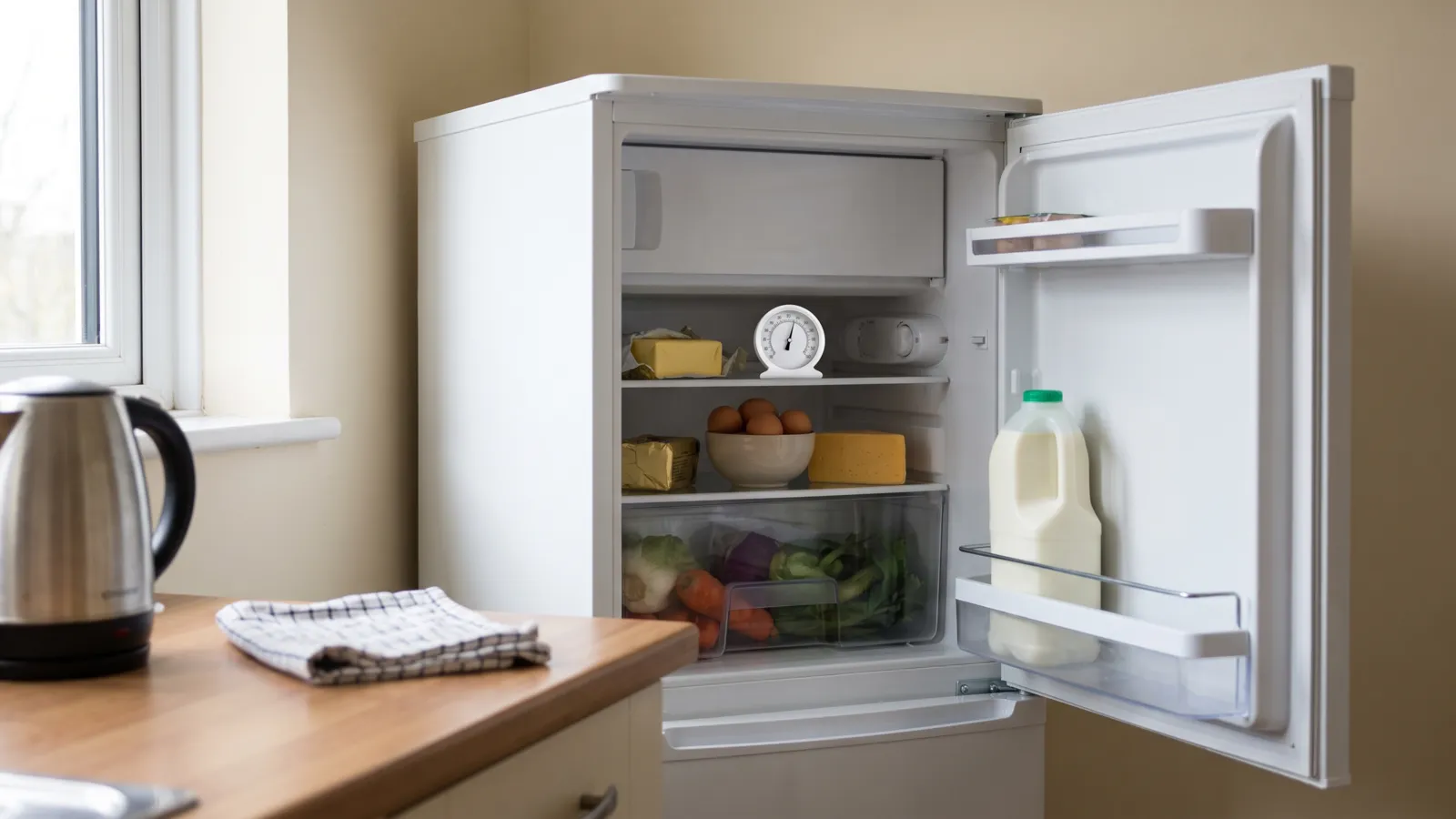
Its chilling guidance says the fridge should be between 0 and 5°C, the freezer around -18°C, and that a fridge thermometer checked weekly is the best way to hold that. Put the thermometer where food sits, not in the door, and read it after the fridge has been shut for a while. Check a couple of shelves: if the warmest place food sits reads above 5°C, set the fridge a step colder and check again the next day. The appliance's setting dial is not a temperature; a 3 on one make and a 3 on another mean different things.
Then decide between no battery and more information.
The ETI 800-100 dial and the Brannan horizontal scale are analogue instruments that need no power, so they keep reading through a long cut and never go flat; both are read-it-when-you-look devices with no memory. The ETI 810-210 is digital, with the display outside the appliance and a sensor on a one-metre lead inside, so you can check the temperature with the door shut. ETI lists an audible high/low alarm and a max/min memory, which shows the warmest point reached while you were out. ETI quotes about 5,000 hours from one AAA, so roughly two battery changes a year.
Judge the figures the makers quote.
ETI gives plus or minus 1°C for both its models, and Brannan plus or minus 1°C at 10°C with 2°C divisions on the scale. That matters at the boundary: a dial reading 5°C could be 4 or 6, so if a reading sits right on the FSA limit, set the fridge a step colder rather than argue with it. Resolution and accuracy are different things; the 810-210 shows tenths of a degree, but ETI's accuracy claim is still a whole degree. Make sure the range covers the freezer as well: anything that stops at -20°C has little margin at -18.
In a power cut, the thermometer becomes your decision tool.
The FSA says a cut of under 4 hours is unlikely to affect chilled or frozen food. Keep fridge and freezer doors shut: the FSA estimates a fridge stays cold for up to 4 hours, and food in a full freezer stays frozen for up to 48 hours, or 24 hours if half full, figures that vary by make and model. Chilled food needs to stay below 8°C. If the fridge has reached 8°C or above, the FSA says that food should be thrown away after 4 hours unless the power comes back within that time.
Smart thermometers that alert your phone are Wi-Fi or hub-linked sensors that log temperature and push a warning when a limit is crossed.
For anyone keeping medicines in the fridge, or often away for days, that remote alert is the real benefit. None of the three thermometers here does it, and we have not researched specific smart models to the standard this page needs, so we do not recommend one. If you go that route, check the sensor’s stated range reaches -18°C, how it is powered, whether alerts need a subscription, and whether the app still works without your home router, which is exactly what fails in a power cut.
We verify every product's specifications against at least two independent sources, re-check its UK price and stock on a schedule where we can track it automatically, and cross-check safety-relevant claims against official guidance. Every review is labelled Researched or Used and reviewed by us: where we've bought a product, or been sent it free, and used it ourselves, its review says which; where we haven't, our verdict is a considered spec-and-evidence comparison, not a hands-on test — and commissions never change a ranking either way. Read our full methodology →
Related kit comparisons
Guides that go with this
How long fridge and freezer food stays safe in a power cut — with an interactive checker, from official Food S…
The free number to save today, what to have ready, food safety, staying warm safely, and the compensation you …
NHS-sourced temperature windows for insulin and fridge medicines in a power cut or heatwave, correct cool-bag …
The FSA's rule: use-by is safety, best before is quality. Which foods are genuinely fine past the date — tins,…
What a fridge freezer really draws, why a power station’s output rating decides whether the compressor starts,…
Common questions
What temperature should a fridge and freezer be in the UK?
The Food Standards Agency says your fridge should be between 0 and 5°C and your freezer around -18°C. It recommends using a fridge thermometer and checking it about once a week, because the setting dial on the appliance is not a temperature reading. Put the thermometer where the food sits, give the fridge time with the door shut, then read it; if it is above 5°C, set the fridge a step colder and check again the next day.
How long does food stay safe in a power cut?
The FSA says a cut of under 4 hours is unlikely to affect chilled or frozen food. Keep the doors closed: it estimates a fridge stays cold for up to 4 hours, and a full freezer keeps food frozen for up to 48 hours, or 24 hours if half full, figures that vary by make and model. If the fridge has reached 8°C or above, the FSA says chilled food should be thrown away after 4 hours unless the power returns within that time.
Can I refreeze food that thawed during a power cut?
The FSA's line is not to refreeze food once it has fully defrosted. Raw meat, poultry and fish that have thawed can be refrozen only after they have been cooked thoroughly. Use fully defrosted food within 24 hours. The idea that food with ice crystals left can always go back in the freezer comes from US guidance, not the FSA. If you are unsure how long something sat warm, throw it away; never taste food to test it. Our power cut food safety guide has the full list.
Do I need a battery-free thermometer for power cuts?
It helps but is not essential. An analogue thermometer such as the ETI 800-100 or the Brannan scale keeps reading with no power and never goes flat, but you still have to open the door to see it, which lets cold out. A battery digital model with an outside display, such as the ETI 810-210, lets you read the inside temperature with the door shut, and its max/min memory shows the warmest point reached. ETI quotes about 5,000 hours from one AAA cell.
Where should I put a fridge thermometer?
In the main body of the fridge among the food, on a middle shelf, not in the door or against the back wall where it reads coldest. For a freezer, place it between packets rather than on top. A probe on a lead, like the ETI 810-210's, can be fed through the door seal so the display stays outside; ETI rates that display for room temperatures, so it should not go inside. Let the appliance settle for a few hours before you trust the first reading.
Is a smart fridge thermometer that alerts my phone worth it?
For medicines kept in the fridge, or for anyone away for days, a remote alert is the one feature a plain thermometer cannot offer. None of the models on this page does it, and we have not researched specific smart sensors well enough to recommend one. If you shop for one, check its stated range reaches -18°C, how it is powered and whether alerts need a subscription, and remember that a Wi-Fi sensor depends on your router, which goes off in the same power cut it should warn you about.
