BLUETTI vs Jackery: which power station brand for a UK home?
BLUETTI or Jackery for a UK home? The Elite 100 V2 and 200 V2 against the Explorer 1000 v2 and 2000 v2 on output, cycles, weight, charging, switchover, warranty and UK support.
Neither brand wins outright for a UK home. Pick BLUETTI for headroom and longer paper life: the Elite 100 V2 and Elite 200 V2 are rated at 1,800W and 2,600W against 1,500W and 2,200W for Jackery’s Explorer 1000 v2 and 2000 v2, switch to battery within 10 and 15 milliseconds against Jackery’s 20, accept up to 1,000W of solar against 400W, carry a flat five-year warranty, and the Elite 200 V2 is rated for 6,000+ cycles against 4,000. Pick Jackery if you will be carrying it: the Explorer 2000 v2 weighs 17.5kg against 24.2kg, both Explorers print a surge figure, and its list prices are often reduced, though the extra two years run through a registration form. None of the four takes an extra battery. Whichever you choose, switch off BLUETTI’s ECO mode or Jackery’s Energy Saving Mode before a cut, or a router, CPAP or fridge can be shut off.
By Tom Calder · Updated 12 October 2026 · Sourced to BLUETTI, Jackery, ResMed, the FSA & Companies House
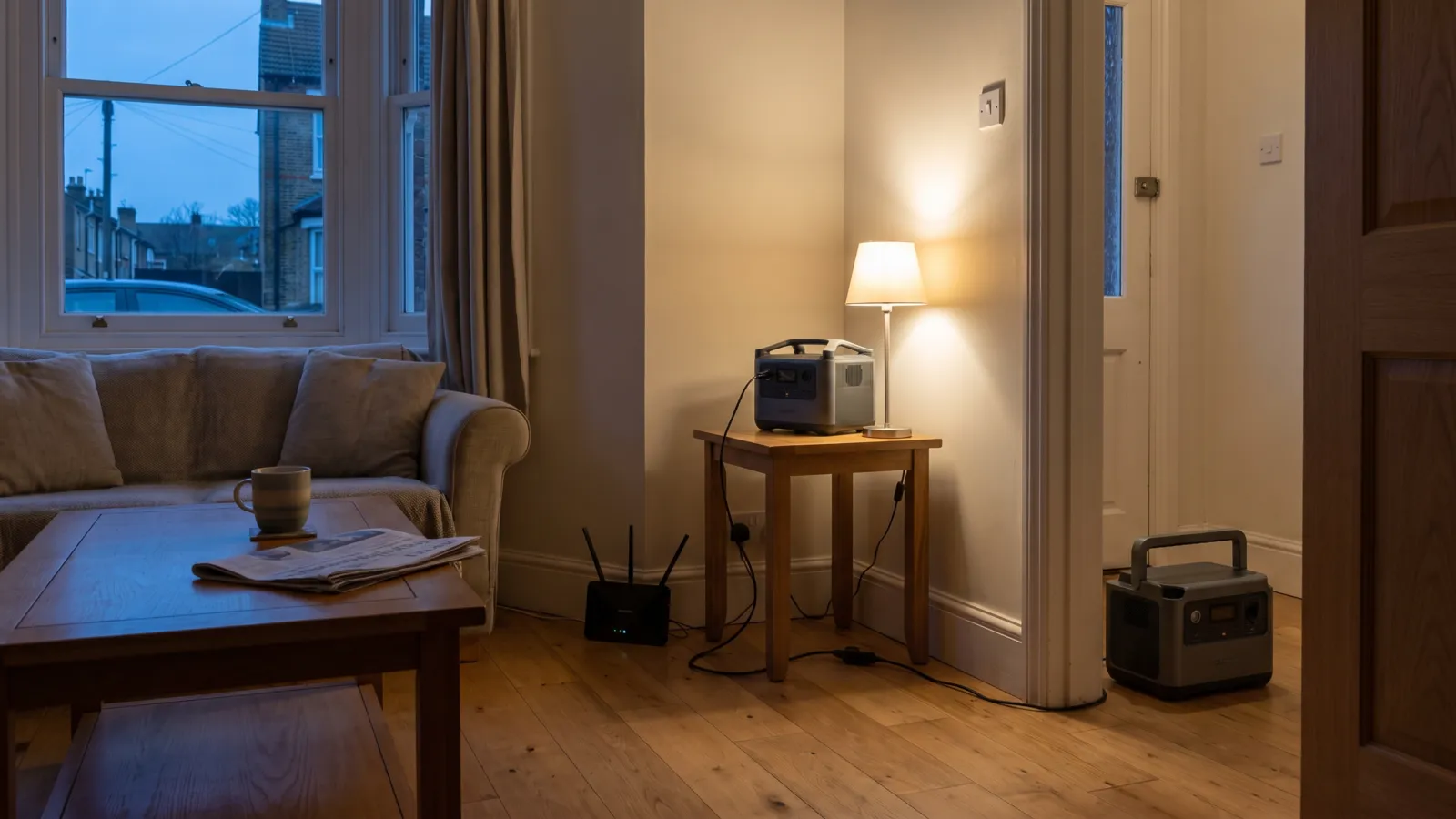
How the two ranges line up
BLUETTI and Jackery meet at two sizes in the UK catalogue we track: about 1kWh, where the Elite 100 V2 (1,024Wh, 1,800W) sits against the Explorer 1000 v2 (1,070Wh, 1,500W rated), and about 2kWh, where the Elite 200 V2 (2,073.6Wh, 2,600W) sits against the Explorer 2000 v2 (2,042Wh, 2,200W rated). All four use lithium iron phosphate cells, none takes an extra battery, and all can sit between the wall and a router or fridge and switch to battery when the mains fails: in 10 milliseconds or under on the Elite 100 V2 and 15 on the Elite 200 V2 by BLUETTI’s figures, within 20 on both Jackery units by Jackery’s.
Capacity is a near tie at both sizes, so the decision turns on the smaller print: continuous output, rated cycles, weight, how much solar each will accept, what the warranty actually requires, and which default settings you must change before a cut. If you haven’t settled on a size, start with what size power station do I need. Both brands change list prices often; the cards on this page show live prices and stock.
About 1kWh: Elite 100 V2 vs Explorer 1000 v2
The Explorer 1000 v2 holds slightly more, 1,070Wh to 1,024Wh, and weighs slightly less, 10.8kg to 11.5kg on the makers’ figures, with a handle that folds flat. The Elite 100 V2 puts out more: 1,800W continuous against Jackery’s 1,500W rating, with 3,600W surge quoted by BLUETTI and 3,000W by Jackery. Both have two UK mains sockets. BLUETTI fits two USB-C ports (140W and 100W) and two USB-A; Jackery one 100W and one 30W USB-C and a single USB-A. Both keep a 12V car socket, which matters for a CPAP (below). Cycle ratings are close: BLUETTI says over 4,000, Jackery 4,000 to at least 70% capacity.
Charging is roughly a tie from the mains. BLUETTI’s Turbo mode takes the Elite 100 V2 to 80% in 45 minutes from a 1,200W input and full in about 70; Jackery quotes 1.7 hours as standard and about an hour with emergency charging switched on in the app. Solar is where the specs part: BLUETTI lists up to 1,000W of input (its Elite 100 V2 manual caps this at 600W outside Turbo mode), where Jackery’s UK comparison lists a 400W maximum and its UK review page quotes 7.5 hours from two 100W SolarSaga panels. That gap only decides it if you plan to run more than 400W of panels.
This is the size that keeps a fridge-freezer cold. Our sizing guide plans on an average draw of 40–80W; for your own model, divide the kWh/annum on its energy label by 8.76. BLUETTI’s runtime formula for the Elite 100 V2, capacity × 90% usable × 90% inverter efficiency ÷ (load + the roughly 10W the unit draws itself), gives roughly 9–17 hours at 40–80W. Jackery’s sum, capacity × 0.85 ÷ watts, gives roughly 11–23 hours for the Explorer 1000 v2 but omits self-draw, and Jackery’s own table gives a 60W portable fridge 11.7 hours, so expect less. BLUETTI warns compressors may start at two to four times rated power.
Neither is a full-size kettle unit. Jackery’s own comparison treats a full kettle as 3,000W and marks it beyond the Explorer 1000 v2’s rating, while an 800W travel kettle runs on either. The Elite 100 V2 can run a kettle rated up to 2,700W through Power Lifting, more slowly (below). Choose the Elite 100 V2 for the extra 300W of headroom, the faster switchover and the bigger solar ceiling. Choose the Explorer 1000 v2 if lighter weight and a little more capacity matter more than output, and if the card shows it reduced. Read power cut food safety before deciding to power a fridge at all.
About 2kWh: Elite 200 V2 vs Explorer 2000 v2
The headline capacities match, 2,073.6Wh against 2,042Wh, then the two diverge. The Elite 200 V2 is rated at 2,600W continuous to the Explorer 2000 v2’s 2,200W, and BLUETTI rates its pack for 6,000+ cycles where Jackery gives 4,000 to at least 70% capacity. The Explorer 2000 v2 is much lighter, 17.5kg against 24.2kg, and a little smaller overall, though not in every dimension. Jackery quotes 4,400W surge; BLUETTI prints no surge figure here and its manual says to allow two to four times a motor’s rated power. Jackery lists two mains sockets; BLUETTI says the Elite 200 V2 powers up to seven devices but prints no socket count.
Mains charging is close: BLUETTI’s TurboBoost reaches 80% in about 1.1 hours from a 2,300W input; Jackery quotes 1.7 hours to full as standard and 1.33 with emergency charging on. Solar again favours BLUETTI on paper, 1,000W against 400W, and Jackery says 5.5 hours from two SolarSaga 200W panels. Neither is expandable: BLUETTI’s page says the Elite 200 V2 has no expansion and no power-bank mode, and Jackery’s own comparison marks the Explorer 2000 v2 as not expandable, pointing to its heavier 2000 Plus v2 for that. Both have apps and switch to battery within 15 (BLUETTI) or 20 (Jackery) milliseconds.
On the makers’ own sums, a fridge-freezer averaging 40–80W runs roughly 18–32 hours on the Elite 200 V2 using BLUETTI’s UK-page formula (90% usable, 85% inverter efficiency, plus about 10W the unit draws itself) and roughly 20–41 hours on the Explorer 2000 v2 using Jackery’s × 0.8 factor for this model, which omits self-draw. Kettles divide them: Jackery’s comparison table marks a 3kW kettle as exceeding the Explorer 2000 v2’s continuous rating, so only a kettle rated up to 2,200W runs on it. The Elite 200 V2 runs one rated under 2,600W within its rating, and a 3kW kettle through Power Lifting, more slowly, once switched on.
Choose the Elite 200 V2 if you will cycle it often, say daily with solar, want the higher 2,600W rating, or value the published 6,000+ cycle figure and 15ms switchover. Choose the Explorer 2000 v2 if you have to carry it up stairs or lift it into a cupboard: 6.7kg less is a real difference on stairs, and several BLUETTI reviewers on Trustpilot mention how heavy their units are to move. For a few power cuts a year, cycle ratings matter far less than the settings below.
NewSee this for your own homeHome Alerts: your postcode's power cuts, warnings and floods, on one screen. Free for your own home. Opening in October; the first 100 on the list get in first.Join the list →Where Jackery is the better choice
Weight is the clearest case. At 2kWh the Explorer 2000 v2’s 17.5kg against the Elite 200 V2’s 24.2kg is a different class of object to move between rooms, and at 1kWh Jackery is still the lighter of the pair by 0.7kg with a fold-flat handle. Jackery markets the Explorer 2000 v2 as the lightest and smallest 2kWh LFP power station; treat that as a claim, but the weights are published numbers.
Jackery is also better documented where it matters for motors: it prints a surge figure for both units, 3,000W and 4,400W, where BLUETTI prints one only for the Elite 100 V2. Its emergency charge mode makes mains charging a near tie: Jackery quotes about an hour to full on the Explorer 1000 v2, against BLUETTI’s 70 minutes for the Elite 100 V2. Jackery’s UK user-guides page lists a UK-only freephone with seven-day hours, though its policy page gives weekday hours, so check. Jackery’s list prices are often reduced: compare the live card, not the RRP. Both brands sell matched solar bundles, so panels are not a tiebreak.
Where BLUETTI leads: 300W more output at 1kWh and 400W more at 2kWh, a faster published switchover (10 and 15 milliseconds against 20), a 6,000+ cycle rating on the Elite 200 V2, a higher solar input ceiling, and a flat five-year warranty against Jackery’s three plus two. If you are also weighing EcoFlow, EcoFlow vs BLUETTI covers the third brand against the same BLUETTI units.
Power Lifting and surge: what the big numbers mean
BLUETTI prints a second, larger wattage on both units: 2,700W Power Lifting on the Elite 100 V2 and 3,900W on the Elite 200 V2. It is not extra continuous power and it is not a surge rating. BLUETTI’s Elite 200 V2 manual says Power Lifting is only for pure resistive loads, such as kettles and heaters, and that actual output is still 2,600W; its Elite 100 V2 manual says the same at 1,800W. It is off by default on both, so switch it on before you need it. Jackery publishes no equivalent mode for these two units; its 3,000W and 4,400W figures are surge peaks, which is a different thing.
So compare like with like. Whether a fridge or freezer compressor will start depends on the surge rating, and BLUETTI’s manuals warn motors may start at two to four times their rated power. Whether a kettle or heater rated above the continuous output will run, slowly, depends on Power Lifting on the BLUETTI and on nothing on the Jackery: the Explorer 2000 v2 will not run a 3kW kettle, and the Explorer 1000 v2 will not run an 1,800W one. Check an appliance’s input on its rating plate, not the cooking or heating power on the front: a microwave draws more from the socket than it delivers to the food.
The Power Cut Action Card
One page for the kitchen drawer: what to do first, what to have ready, how long food keeps, and how to stay warm without risking carbon monoxide. Free, no catch.
Download it straight away. We'll also send the occasional briefing when something genuinely matters — severe weather, live incidents, real price drops. Nothing else.
Switchover, apps and the light-load trap
All four units pass mains through until it fails and then switch to battery, so any of them can sit behind a router or a fridge. BLUETTI quotes 10 milliseconds or under on the Elite 100 V2 and within 15 on the Elite 200 V2, with UPS modes you choose in its app; Jackery quotes within 20 on both Explorers, and its manuals say the units do not support 0ms switching and to test compatibility first. BLUETTI’s manuals say its UPS is not for data servers or workstations that need a high-performance UPS. Test yours with the router before the first cut.
The trap with both brands is the light load. BLUETTI’s manuals say ECO mode is on by default and to switch it off for devices under 60W and for fridges, or the unit can shut off between compressor cycles; a router or CPAP is exactly that kind of load. Jackery’s manuals say Energy Saving Mode is on by default and switches all outputs off after 12 hours at 25W or less on the mains sockets, or 2W or less on the car port. Turn both off before a cut. The apps are optional, but these settings and Jackery’s emergency charging live in them, so set them up now.
Power stations are electrical equipment, not generators, so they produce no carbon monoxide and can run indoors; carbon monoxide only comes into it if you charge from a petrol or diesel generator or a running car engine, which belong outdoors (see how to use a generator safely). For a CPAP, ResMed’s battery guide puts its AirMini and AirSense 10 at roughly 4–20W from 12V with the humidifier off, recommends its DC converter over an inverter, and says most of its heated humidifiers must not be used with inverters; ask your sleep service first. Run any medical device only as its maker allows: see running medical equipment in a power cut.
UK warranty and support: what each brand publishes
BLUETTI’s UK product pages give the Elite 100 V2 and Elite 200 V2 a flat five-year warranty. Jackery’s UK pages print “3+2 Years Warranty” on both Explorers, and the Explorer 2000 v2 page points buyers to an extended-warranty registration form whose instructions cover purchases from Jackery’s channel partners, so if you buy through a retailer rather than Jackery’s own site, register the unit and keep the receipt. Jackery’s UK warranty and policy pages set the conditions; read them before buying from a third party. Those terms, not the headline years, are what you will be relying on.
BLUETTI’s UK imprint names Poweroak Energy UK Co., Ltd with its registration number and a UK freephone, and Companies House lists that company as active with a registered office in Chesterfield. Jackery’s UK terms of service give a company number that Companies House lists as Jackery UK Ltd, active, with a registered office in London, and Jackery publishes a UK freephone. None of that is evidence about service quality. Owners of both brands on Trustpilot split on after-sales: several praise quick replacements, several describe slow replies and long warranty or refund waits.
Waiting for a sale? Black Friday power stations tracks genuine drops against each unit’s price history, and the cards below show today’s prices from the stores we track.
Common questions
Is BLUETTI or Jackery the better brand for a UK home?
Neither outright. At both sizes the pairs match on capacity and cell chemistry. BLUETTI’s Elite 100 V2 and Elite 200 V2 have more continuous output (1,800W and 2,600W against 1,500W and 2,200W), faster published switchover, a higher solar input ceiling and a flat five-year warranty, and the Elite 200 V2 carries a 6,000+ cycle rating. Jackery’s Explorer 2000 v2 is 6.7kg lighter, both Explorers print a surge figure, and Jackery’s list prices are often reduced. Pick on the differences that apply to you, then change the defaults before a cut.
Will a BLUETTI or Jackery power station run a fridge freezer?
All four will; the question is for how long. A fridge-freezer’s compressor cycles, so our sizing guide plans on an average of 40–80W (your energy label’s kWh/annum ÷ 8.76 gives your model’s figure). On BLUETTI’s formulas, which count the unit’s own draw, the Elite 100 V2 gives roughly 9–17 hours and the Elite 200 V2 roughly 18–32. Jackery’s sums give roughly 11–23 hours for the Explorer 1000 v2 and 20–41 for the 2000 v2, but omit self-draw, so expect less. Switch off ECO or Energy Saving Mode first.
Which is best for a CPAP machine overnight?
Any of the four, once your CPAP’s maker or sleep service has agreed. ResMed’s battery guide puts its AirMini and AirSense 10 at roughly 4–20W from 12V with the humidifier off, and strongly recommends its DC converter over an inverter; all four units have the 12V car socket that needs. ResMed also says most of its heated humidifiers must not be used with an inverter, and a power station’s mains socket is one, so ask before running a humidified CPAP from it. Turn off ECO or Energy Saving Mode first.
How long are the UK warranties?
Five years on the Elite 100 V2 and Elite 200 V2, on BLUETTI’s UK product pages. Jackery’s UK pages print “3+2 Years Warranty” on the Explorer 1000 v2 and 2000 v2, and the 2000 v2 page points buyers to an extended-warranty registration form, so register the unit to be sure of the full five, especially if you bought it through a retailer. Jackery’s UK warranty and policy pages set the conditions; read them before buying from a third party.
Can I add a battery later?
No, on any of these four. BLUETTI’s UK page says the Elite 200 V2 is not expandable and has no power-bank mode; the Elite 100 V2 can be topped up from a separately sold B80 battery through its DC input, which is not integrated expansion. Jackery’s own comparisons mark both the Explorer 1000 v2 and 2000 v2 as not expandable, pointing to its Plus models for that. If adding storage later matters, look at a unit built for it, such as a Jackery Plus model or EcoFlow’s DELTA 3 Plus.
Can either run a kettle?
Not a full-size UK kettle on either Jackery: the Explorer 1000 v2 is rated at 1,500W and the 2000 v2 at 2,200W, and Jackery’s own comparisons mark a 3,000W kettle as beyond both. An 800W travel kettle runs on either. The Elite 100 V2 runs a kettle up to 1,800W within its rating and up to 2,700W through Power Lifting, more slowly; the Elite 200 V2 runs one under 2,600W within its rating and a 3kW one through Power Lifting. Power Lifting is off by default on both.
Sources (25)
- BLUETTI UK — Elite 100 V21,024Wh, 1,800W, 3,600W surge, 2,700W Power Lifting, 9 ports, 11.5kg, 10ms UPS, 30dB at 600W, over 4,000 cycles, 1,000W solar, Turbo 80% in 45 min and full in about 70 at 1,200W, B80 top-up, runtime formula, 5-year warranty
- BLUETTI UK — Elite 200 V22,073.6Wh, 2,600W, 3,900W Power Lifting, 6,000+ cycles, 24.2kg, within 15ms UPS, TurboBoost 80% in 1.1h from 2,300W, 1,000W solar, runtime formula 90% DoD × 85% efficiency ÷ (load + about 10W), not expandable, no power-bank mode, up to 7 devices, 5-year warranty
- BLUETTI — Elite 200 V2 user manualUS edition; cited only for Power Lifting as resistive-only with output still 2,600W, ECO mode, app settings, UPS not for high-performance needs, compressor start-up at 2–4× rated power
- BLUETTI — Elite 100 V2 user manual, EU editionsolar 1,000W in Turbo, 600W in Standard and Silent; Power Lifting pure resistive only, off by default, output still 1,800W; ECO modes on by default, disable under 60W and for fridges; UPS 10ms or less, not for high-performance UPS needs; compressors 2–4× rated power
- BLUETTI UK — ImprintPoweroak Energy UK Co., Ltd, registration number 13269849, UK freephone
- Companies House — POWEROAK ENERGY UK CO., LTD13269849; active; registered office in Chesterfield
- Jackery UK — Explorer 1000 v21,070Wh, 1,500W, emergency charging to full in as fast as 1 hour, under 22dB in Silent mode, 4,000 cycles, 3+2 Years Warranty, SolarSaga bundles
- Jackery UK — Explorer 1000 v2 reviewspec table: 4,000 cycles to 70%, 10.8kg, 2 AC ports 1,500W rated / 3,000W surge peak, USB-C 100W and 30W, USB-A 18W, 12V 10A, 1.7h wall / 1h emergency / 7.5h from 2×100W solar / 12h car, UPS under 20ms, fold-flat handle; 60W portable fridge 11.7h
- Jackery UK — Explorer 1000 Plus v2 vs 1000 v21000 v2 column: non-expandable, 400W maximum solar, about 60 min emergency charge, UPS 20ms or less; 3,000W kettle exceeds rating, 800W travel kettle within rating; runtimes at constant loads
- Jackery — Explorer 1000 v2 user manualswitch to battery within 20ms; no 0ms switching, test compatibility first; Energy Saving Mode defaults
- Jackery UK — Explorer 2000 v22,042Wh, 2,200W, 38.6 lbs, 400W solar in 5.5h, emergency charging 1.33h, 3+2 Years Warranty, extended-warranty registration FAQ, household fridge 3.2–72h, SolarSaga bundles
- Jackery UK — Explorer 2000 Plus v2 vs 2000 v22000 v2 column: 2,042Wh, 2,200W, not expandable, 4,000 cycles to 70%, 17.5kg, 33.5 × 26.4 × 29.2cm, 400W solar, 1.7h AC / 1.33h emergency / 24h car; 3kW kettle exceeds continuous rating
- Jackery UK — Introducing the Explorer 2000 v2spec table: 2 AC outlets 230V 10A, 4,400W surge peak, UPS 20ms, 5.5h from 2× SolarSaga 200W, runtime figures at 2,042Wh × 0.8 ÷ watts
- Jackery — Explorer 2000 v2 user manualswitch to battery within 20ms; no 0ms switching, test compatibility first; Energy Saving Mode
- Jackery UK — How many watts does an electric blanket useJackery’s runtime sum: capacity × 0.85 ÷ watts
- Jackery UK — User guides and support (UK-only freephone, Mon–Sun hours; product manuals)
- Jackery UK — Warranty & Return
- Jackery UK — Policy (warranty and shipping; UK freephone with Mon–Fri hours)
- Jackery — Extended-warranty request formseparate request per product for channel-partner orders
- Jackery UK — Terms of service (company number 13075001, London address)
- Companies House — JACKERY UK LTD (13075001; active; registered office in London)
- Trustpilot — Jackery United Kingdom (company-service reviews; not a product rating)
- Trustpilot — BLUETTI UK (company-service reviews; not a product rating)
- ResMed — Battery guideCPAP draw at 12V DC; DC converter recommended; heated humidifiers not to be used with inverters
- Food Standards Agency — Food safety in a power cut
PreparedBritain is independent and not affiliated with HM Government.
Latest from our live data
All stories → News · 21 OctOnly 4 in 100 adults have three days of bottled water at home, the government's survey shows
 News · 21 OctFood inflation held at 1.3%. Wholesale cabbage and cauliflower are up a third. Both are true
 News · 21 OctAldi recall: shoppers warned of hairdryer electric shock or fire risk. How to check yours
Keep reading
All power cuts & energy guides →BLUETTI Elite 200 V2 vs EcoFlow DELTA 3 Max: which 2kWh power station should you buy?
Three 2kWh power stations compared on what actually differs: output, solar, charging, expansion, cycle rating,…
Boiler not working after a power cut? What to check, safely
Power is back but the boiler is not. The safe checks in order: wait, clock and timer, pressure gauge, one reset, a…
EcoFlow DELTA 3 vs DELTA 3 Plus vs DELTA 3 Classic: which one should you buy?
Three EcoFlow 1kWh power stations with the same battery and the same 1,800W output, compared on what actually…
