EcoFlow DELTA 3 vs DELTA 3 Plus vs DELTA 3 Classic: which one should you buy?
Three EcoFlow 1kWh power stations with the same battery and the same 1,800W output, compared on what actually differs: expansion, sockets, the 12V outlet, solar input and charging speed.
All three EcoFlow DELTA 3 units share a 1,024Wh LFP battery, 1,800W output and 10ms switchover, so a fridge-freezer or router runs for about the same time on each. Pick the DELTA 3 for most homes: four mains sockets, a 12V socket for a CPAP's DC converter, 1,500W mains charging and EcoFlow's 1–5kWh expansion, with 500W of solar. Pay for the DELTA 3 Plus only if you own or plan more than 500W of solar panel (1,000W input, 70-minute solar charge) or want 140W USB‑C. Pick the DELTA 3 Classic, EcoFlow's best-value pitch, if two sockets, no 12V socket, 500W solar and a capacity fixed forever are fine, which they are for a fridge, router and lights through a typical cut.
By Tom Calder · Updated 12 October 2026 · Sourced to EcoFlow, BLUETTI, ResMed, BT, Bosch, the European Commission, the NHS and the Food Standards Agency
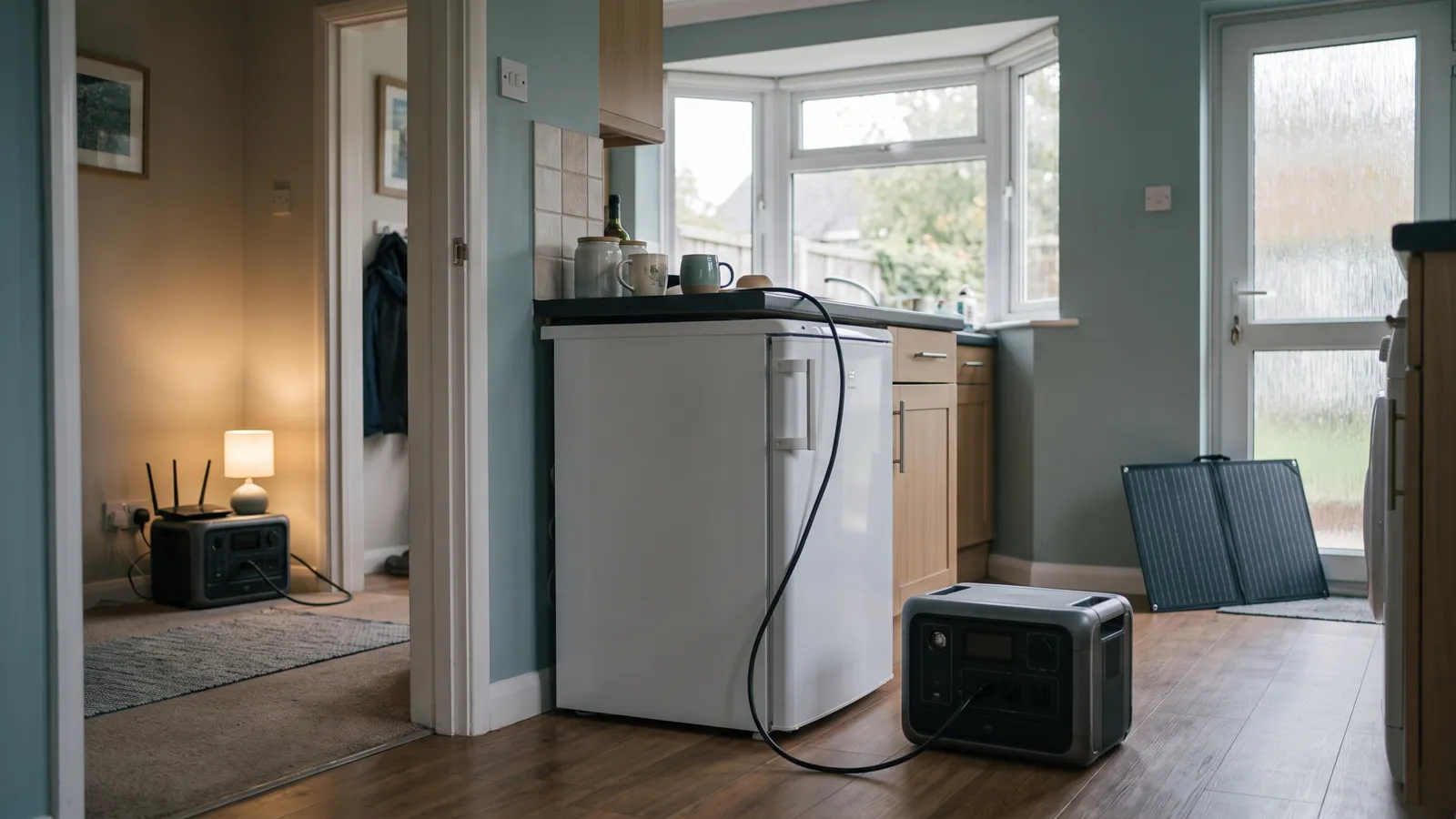
Same battery, same output: the three differ around the edges
EcoFlow sells three 1kWh DELTA 3 units in the UK, and its spec pages give all three the same core: a 1,024Wh lithium iron phosphate (LFP) battery, 1,800W of continuous AC output, a 3,600W surge figure for motor start-up and 2,400W with X‑Boost. The DELTA 3 and DELTA 3 Plus share one UK product page with two-column spec lines; the DELTA 3 Classic has its own page and its own comparison table. On paper a fridge-freezer, a router or a lamp runs for about the same time on any of them.
What differs is everything around that battery: whether you can add a second one later, how many mains sockets you get, whether there is a 12V car-style socket, how much solar the unit accepts and how quickly it charges. On EcoFlow's own comparison tables the Classic has the fewest of those extras, the DELTA 3 sits in the middle and the Plus adds faster solar and USB. If you have not settled on 1kWh yet, read what size power station do I need first; for phones, a torch and a radio alone, a power bank may be all you need.
X‑Boost is not extra power. EcoFlow's manuals describe it as lowering the output voltage so a heating appliance rated above 1,800W, up to 2,400W at 230V, runs at reduced power rather than tripping the unit, and say it is unavailable while the unit is charging or passing mains through. It suits kettles and heaters, not anything with a compressor or motor. EcoFlow's comparison table, Classic page and manuals also give all three the same switchover as a standby UPS, about 10 milliseconds, so none has an advantage for keeping a router up through the first second of a cut.
Expandability: the Classic is fixed for life, the other two can grow
This is the clearest dividing line. EcoFlow's UK series page says the DELTA 3 and DELTA 3 Plus take the DELTA 3 Extra Battery (1kWh) for about 2kWh, and its larger DELTA Pro 3 Extra Battery for up to 5kWh; the page's description also lists the older DELTA 2 and DELTA 2 Max extra batteries as compatible. EcoFlow's own three-model comparison states this for both the DELTA 3 and the Plus, and the comparison table on its UK Classic page shows the same. If you can picture wanting roughly twice as long on fridge and router, these are the two that let you buy that later.
The DELTA 3 Classic cannot. EcoFlow's UK Classic page lists no extra-battery port, and its comparison marks the Classic as not expandable, so its 1,024Wh is what you have for the life of the unit. That is fine if a fridge-freezer, a router and some lights through a typical cut is the whole job. It is the wrong buy if you already doubt 1kWh is enough: EcoFlow's own runtime example gives a household fridge averaging 80W about 11 hours on 1,024Wh and about 22 hours on 2,048Wh. To work out hours for your own fridge, see power station for a fridge-freezer.
Sockets and ports: four mains outlets and a 12V socket, or two and none
EcoFlow's UK series page lists four mains sockets sharing the 1,800W on the DELTA 3 and the DELTA 3 Plus, plus a 12V car-style socket rated at 12.6V and 10A (126W) and two DC5521 barrel outputs at 12.6V and 3A; EcoFlow's DELTA 3 Plus manual puts the 12V outputs at 126W in total. The two differ only on USB: EcoFlow lists two 18W USB‑A and two 100W USB‑C ports on the DELTA 3, against two 36W USB‑A and two 140W USB‑C on the Plus. For phones and tablets neither matters; 140W only counts if you charge a large laptop from USB‑C at full speed.
The Classic drops to two mains sockets, one 18W USB‑A and two USB‑C (100W and 30W), and its UK spec lists no 12V DC output and no DC5521 outlets. In practice that means fridge and router take both sockets, with nothing spare for a mains lamp without an extension lead (phones go on USB), and no 12V socket for a CPAP's DC converter (see below). Eleven outputs on the DELTA 3 and Plus against five on the Classic is a real difference in a cut, when everything in the house wants charging at once.
On size and weight EcoFlow's pages put all three within a few hundred grams and a millimetre of each other: 12.5kg or less at 398 × 200 × 284mm for the DELTA 3 and Plus, and 12.1kg (plus or minus 0.3kg) at 398 × 200 × 283mm for the Classic. All are a two-handed carry up stairs. EcoFlow's series page gives an IP65 rating against splashes and dust in the spec column it shares between the DELTA 3 and Plus, without separating the two; its Classic page gives IP20 for the complete product, which means no protection against water. Keep any of them indoors and dry.
NewSee this for your own homeHome Alerts: your postcode's power cuts, warnings and floods, on one screen. Free for your own home. Opening in October; the first 100 on the list get in first.Join the list →Charging: mains, solar and car
From the mains, EcoFlow quotes 1,500W input and a full charge in 56 minutes for both the DELTA 3 and the DELTA 3 Plus. The Classic takes 1,400W, which EcoFlow says reaches 80 per cent in 45 minutes in its Fast mode and 100 per cent in 60. The gap is four minutes, so on mains charging there is nothing to choose between the three. EcoFlow's manuals say the charging speed can be turned down in its app, which is worth trying if a fast overnight recharge is too loud.
Solar is the one place the Plus pulls clear. EcoFlow's series page lists two 500W MPPT inputs (11–60V) on the Plus for 1,000W in total and a full charge in 70 minutes, against one 500W input on the DELTA 3 that it says takes 130 minutes. The Classic's page lists 500W maximum through one XT60 port and a 2.5-hour full charge. With one or two typical portable solar panels, 500W or less, the panels set the pace on all three; the Plus's second input only matters above 500W of panel. EcoFlow's Plus manual says its solar cable is sold separately. See solar backup for a power cut.
From a car, none is quick out of the box: EcoFlow's manuals give 12V at up to 8A (about 96W) through a cigarette-lighter socket, car cable sold separately, so a full charge takes most of a day's driving. EcoFlow's alternator chargers wire to the vehicle battery instead: 800W and 1.3 hours to full for the DELTA 3 and Plus, says its series page, and 500W with 80 per cent in 1.8 hours for the Classic. Have one fitted by an auto electrician. Never run a car engine in a garage or any enclosed space: the NHS says that causes a build-up of carbon monoxide (see carbon monoxide poisoning symptoms).
Noise, fans and what owners keep mentioning
EcoFlow's series page says the DELTA 3 and Plus run under 30dB at 600W of output and under 40dB at 1,200W; its Classic page gives under 30dB at 600W and up to 50dB at maximum output. Those are EcoFlow's figures, and they describe fan noise rising with load, which matches the most repeated theme in owner comments and reviews of the Plus: quiet at a fridge's draw, but a fan that becomes noticeable once the load climbs. T3's reviewer names the fan noise as the Plus's one real flaw, and How-To Geek lists a loud fan at high output among its drawbacks.
The counter-view comes from one owner on a US deals forum, who says the fan stays off below roughly 600W and that the DELTA 3 is quieter than the DELTA 2; StorageReview also calls the Plus quieter than earlier generations. Both fit EcoFlow's numbers: a fridge, router and lights sit well under 600W, a kettle or heater does not. In a bedroom, keep the unit away from the bed and run high loads in the daytime. The Classic and base DELTA 3 have drawn far less comment, and none of the reviews cited here reports app or build problems specific to any of the three.
Cell life and cover are close on paper. EcoFlow's series page rates the DELTA 3 Plus's LFP cells at 4,000 cycles to 80 per cent capacity and quotes up to ten years of use; its Classic page claims over ten years without a cycle count. EcoFlow's UK warranty-policy table lists the DELTA 3, DELTA 3 Classic and DELTA 3 Plus at five years, while the Classic's own product page lists '3+2 years', which EcoFlow's comparison explains as three years plus two on registering in the EcoFlow app, so register whichever you buy. For storing and charging any lithium battery safely at home, read lithium battery fire safety.
What they will actually run: fridge-freezer, CPAP, router
Before buying any of them for food, note the Food Standards Agency's guidance: in a power cut a fridge should stay cold for up to 4 hours with the door shut, and a full freezer keeps food frozen for up to 48 hours (24 if half full). A cut of a few hours needs no power station at all; see power cut food safety. The 3,600W surge EcoFlow quotes for all three is headroom for a fridge-freezer's compressor starting, and EcoFlow's manuals say to set the AC timeout to 'never' in its app so the unit does not switch off between compressor cycles.
Runtimes are close because the capacity is identical. EcoFlow publishes no self-draw figure for the DELTA 3 units, so the hours here use BLUETTI's published method, as in our DELTA 3 Plus vs BLUETTI Elite 100 V2 guide: 1,024Wh × 0.9 usable × 0.9 inverter efficiency ÷ (average watts + about 10W for the unit itself, BLUETTI's figure). Bosch rates its class A KGN392LAF at 104kWh a year, about 12W averaged: roughly 38 hours. The European Commission's 2020 EU average of 181kWh (about 21W) gives roughly 27 hours, its 1990 average of 477kWh (about 54W) roughly 13. Similar, not identical, across the three.
CPAP: ResMed's battery guide lists the AirMini at about 4.4–9.1W and the AirSense 10 at about 8.4–19.9W, blower only, through ResMed's own DC/DC converter. ResMed strongly recommends running its machines from a battery through that converter rather than an inverter, and warns that, apart from three older humidifier models, its heated humidifiers must not be used with an inverter because damage to the unit or serious injury may result. On the DELTA 3 or Plus, use the 12V socket and ResMed's converter. The Classic has none, so a CPAP would run through its inverter, which ResMed's guide does not cover: ask your sleep service first.
EcoFlow's manuals say its power stations are not intended for life-sustaining medical equipment and to consult the equipment's maker before using one for any other medical device. If anyone at home depends on a CPAP or other powered equipment, join the Priority Services Register and read running medical equipment in a power cut; for insulin and other cold-chain medicines see fridge medicines in a power cut. Router: BT's Smart Hub 2 draws 14.1W in operation and 8.5W in network standby, so on BLUETTI's method any of the three keeps it up for roughly 34 to 45 hours. Test the switchover by turning off the wall socket first.
Who should pick which
Pick the EcoFlow DELTA 3 if you want the four mains sockets, the 12V socket and the option of adding a battery later, and your solar plans stop at one or two panels. On EcoFlow's spec pages it matches the Plus on capacity, output, mains charging, expansion, weight and warranty, giving up only the second solar input and the faster USB ports. For most households planning for power cuts that is the sensible middle; weigh the extra outlay for the Plus against how much solar you really expect to own. EcoFlow sells it through the same UK series page as the Plus, so check stock there before you decide.
Pick the DELTA 3 Plus if you own or intend to own more than 500W of solar panel, because EcoFlow's 1,000W input and 70-minute solar charge are the real reasons to pay more, or if you want 140W USB‑C for a large laptop. It is the same battery and the same inverter otherwise. The fan-noise comments above are mostly about the Plus because it is the model most reviewed; EcoFlow gives the DELTA 3 the same noise figures.
Pick the DELTA 3 Classic, which EcoFlow's UK site pitches as its best-value 1kWh unit, if you want the same battery and the same 1,800W, and can live with two mains sockets, five ports, no 12V socket (so not the unit for a CPAP) and a capacity fixed forever. For a fridge-freezer, a router and lights through a typical cut it is not a compromise. EcoFlow listed it for pre-order, shipping from 12 October 2026, so check stock on the card below. If cuts where you live are rare and short, check the power cuts tracker first; our power stations and BLUETTI power stations pages cover the alternatives.
Common questions
What is the difference between the EcoFlow DELTA 3 and the DELTA 3 Plus?
Solar and USB, according to EcoFlow's UK spec page. The Plus has two 500W solar inputs for 1,000W in total and a 70-minute solar charge; the DELTA 3 has one 500W input and takes 130 minutes. The Plus's USB ports are faster (two 36W USB‑A and two 140W USB‑C against two 18W and two 100W). Capacity, 1,800W output, 3,600W surge, 1,500W mains charging, four mains sockets, the 12V socket, weight, expansion to 5kWh and the five-year warranty are the same on both.
What does the DELTA 3 Classic lose compared with the DELTA 3?
EcoFlow's UK pages list the Classic with two mains sockets instead of four, one USB‑A and two USB‑C (100W and 30W) instead of two and two, no 12V car-style socket, no DC5521 outputs, 1,400W mains charging instead of 1,500W and no extra-battery port, so it cannot be expanded. Battery capacity, 1,800W output, 3,600W surge, 500W solar input, 10ms UPS switchover and size are the same. Its IP rating is IP20 for the whole product.
Can I add an extra battery to the EcoFlow DELTA 3?
Yes, according to EcoFlow. Its UK series page says the DELTA 3 and DELTA 3 Plus take the DELTA 3 Extra Battery (1kWh) for about 2kWh and the DELTA Pro 3 Extra Battery for up to 5kWh, and its comparison tables mark both as expandable from 1 to 5kWh. The DELTA 3 Classic has no extra-battery port and EcoFlow marks it as not expandable.
Will all three run a fridge-freezer through a power cut?
Yes, for broadly similar times, because all three hold 1,024Wh and EcoFlow quotes 1,800W with a 3,600W surge on each. On BLUETTI's published method, which allows about 10W for the unit itself, a class A fridge-freezer averaging about 12W runs for around a day and a half, the 2020 EU average (about 21W) for about a day, and a 1990-average one (about 54W) for around 13 hours. EcoFlow's manuals say to set the AC timeout to 'never' in its app first, or the unit may switch off between compressor cycles.
Which EcoFlow DELTA 3 is best for a CPAP machine?
The DELTA 3 or the DELTA 3 Plus, because both have a 12V socket for ResMed's DC/DC converter, which ResMed strongly recommends over running a CPAP through an inverter. The Classic has no 12V socket, so a CPAP on it would run through the inverter, which ResMed's battery guide does not cover for the AirSense 10 or AirMini: ask your sleep service first and never run a heated humidifier that way. EcoFlow says its power stations are not for life-sustaining medical equipment; confirm with your device maker first.
Is the DELTA 3 Plus noisy?
EcoFlow says the DELTA 3 and Plus run under 30dB at 600W and under 40dB at 1,200W, and the Classic under 30dB at 600W rising to 50dB at full output. Fan noise at high loads is the drawback reviewers mention most for the Plus, while one owner says the fan stays off below about 600W. A fridge, router and lights are well under that; a kettle or heater is not. Keep it off the bedside and run high loads in the daytime.
Sources (16)
- EcoFlow UK — DELTA 3 Series product page and spec tableDELTA 3 and DELTA 3 Plus: 1,024Wh; 4 × 1,800W AC, surge 3,600W; 2,400W X‑Boost; 1,500W AC, 56 min; DELTA 3 1 × 500W solar 130 min, Plus 2 × 500W 70 min, 11–60V; 800W alternator charger 1.3 h; DELTA 3 2 × 18W USB‑A and 2 × 100W USB‑C, Plus 2 × 36W and 2 × 140W; 12.6V 10A 126W car socket; 2 × DC5521 12.6V 3A; ≤12.5kg, 398 × 200 × 284mm; IP65 (shared spec column); 600W <30dB, 1,200W <40dB; 4,000 cycles to 80%, up to 10 years; 5-year warranty; expandable 1–5kWh with DELTA 3, DELTA Pro 3, DELTA 2 and DELTA 2 Max extra batteries
- EcoFlow UK — DELTA 3 Classic product page and three-model comparison2 AC outlets, 1,800W, surge 3,600W, 2,400W X‑Boost; 1 × 18W USB‑A, 100W and 30W USB‑C; no 12V DC output; 1,400W AC, Fast mode 80% in 45 min, 100% in 60 min; 500W solar, 2.5 h; 500W Alternator Charger, 80% in 1.8 h, full in 2.5 h; 10ms UPS; 12.1kg ± 0.3kg, 398 × 200 × 283mm; IP20 for complete product; 600W <30dB, maximum 50dB; over 10 years; 3+2-year warranty; 'Best Value' 1kWh positioning; comparison columns Classic / DELTA 3 / DELTA 3 Plus for USB, AC input 1,400/1,500/1,500W, solar 500/500/1,000W and expandability; pre-order shipping from 12 October 2026
- EcoFlow — DELTA 3 Series comparisonDELTA 3 and DELTA 3 Plus both expandable up to 5kWh; DELTA 3 solar 500W vs Plus 1,000W; both ~1,500W AC in ~56 min; <10ms UPS; 5-year warranty; Classic not expandable, 3 years plus 2 with app registration; household fridge at 80W ≈ 11 h on 1,024Wh and ≈ 22 h on 2,048Wh
- EcoFlow UK — Warranty policy table (DELTA 3, DELTA 3 Classic and DELTA 3 Plus: 5 years)
- EcoFlow — DELTA 3 Plus user manual, EU editionpure sine wave; standby UPS with 10ms transfer; X‑Boost 2,400W at 230V, unavailable while charging or in bypass; AC timeout 'never' for fridges; not for life-sustaining medical equipment; charging speed settable in the app; car input 12V 8A, car cable sold separately; Solar to XT60i cable sold separately
- EcoFlow — DELTA 3 Classic user manual, EU editionpure sine wave; 10ms standby UPS; X‑Boost 2,400W at 230V; AC timeout 'never' for fridges; medical equipment limit; car input 12V 8A 96W, car cable sold separately; solar 500W max
- T3 — EcoFlow DELTA 3 Plus reviewheadline: fast charging 'with a noisy flaw'; 11 outputs
- How-To Geek via Yahoo Tech — EcoFlow DELTA 3 Plus reviewloud fan at high output among drawbacks; workable for short cuts
- StorageReview — EcoFlow DELTA 3 Plus reviewquieter than earlier generations; 30dB/40dB figures
- BLUETTI UK — Elite 100 V2 product pageFAQ A17 runtime method: capacity × 90% DoD × η ÷ (load + about 10W self-consumption)
- ResMed — Battery guide 198103DC/DC converters strongly recommended over inverters; AirMini and AirSense 10 draw at 12V DC by pressure; heated humidifier inverter warning
- BT — Smart Hub 2 power consumption (14.10W in operation, 8.48W network standby)
- Bosch — KGN392LAF specification sheet (class A, 104 kWh/annum)
- European Commission — Fridges and freezers: average refrigerator-freezer sold used 477 kWh/a in 1990 and 181 kWh/a in 2020
- GOV.UK / Food Standards Agency — Food safety in a power cutfridge cold for up to 4 hours; full freezer frozen for up to 48 hours, 24 if half full
- NHS — Carbon monoxide poisoningvehicle engines in an enclosed space such as a garage cause a build-up of carbon monoxide
PreparedBritain is independent and not affiliated with HM Government.
The Power Cut Action Card
One page for the kitchen drawer: what to do first, what to have ready, how long food keeps, and how to stay warm without risking carbon monoxide. Free, no catch.
Download it straight away. We'll also send the occasional briefing when something genuinely matters — severe weather, live incidents, real price drops. Nothing else.
Latest from our live data
All stories → News · 21 OctOnly 4 in 100 adults have three days of bottled water at home, the government's survey shows
 News · 21 OctFood inflation held at 1.3%. Wholesale cabbage and cauliflower are up a third. Both are true
 News · 21 OctAldi recall: shoppers warned of hairdryer electric shock or fire risk. How to check yours
Keep reading
All power cuts & energy guides →BLUETTI Elite 30 V2 vs EcoFlow RIVER 3 Plus: which small power station for a router, phones and lights?
Two near-identical 288Wh and 286Wh power stations compared on what differs: sockets, USB-C, weight, charging,…
Anker SOLIX C1000 Gen 2 vs EcoFlow DELTA 3 Classic: which 1kWh power station should you buy?
Two 1,024Wh power stations compared on what differs: 2,000W against 1,800W, a 12V socket against none, 49-minute…
Is Britain ‘one shock away’ from an energy crisis? What the experts said, and what it means for your home
GB News says Britain is ‘one shock away’ from an energy crisis. The experts it quotes are talking about prices and…
