Anker SOLIX C1000 Gen 2 vs EcoFlow DELTA 3 Classic: which 1kWh power station should you buy?
Two 1,024Wh power stations compared on what differs: 2,000W against 1,800W, a 12V socket against none, 49-minute against 60-minute charging, 600W against 500W of solar. Runtimes for a fridge-freezer, CPAP and router, working shown.
Pick the Anker SOLIX C1000 Gen 2 if you need a 12V socket (the route for ResMed’s DC/DC converter on a CPAP), 2,000W rather than 1,800W, 49-minute mains charging or 600W of solar; it is also about 0.8kg lighter and has more ports. Pick the EcoFlow DELTA 3 Classic if you want the higher 3,600W surge figure for compressor start-up and a clearly stated five-year warranty on registration, and can live with five ports, no 12V socket and 500W of solar. Both hold 1,024Wh, so a fridge-freezer or router runs for broadly similar times on either, and neither can take an extra battery. Compare live prices on the cards.
By Tom Calder · Updated 12 October 2026 · Sourced to Anker, EcoFlow, BLUETTI, ResMed, BT, Bosch, the European Commission, the NHS, Ofcom and the Food Standards Agency, with reviewers’ own measurements from Notebookcheck and The Solar Lab
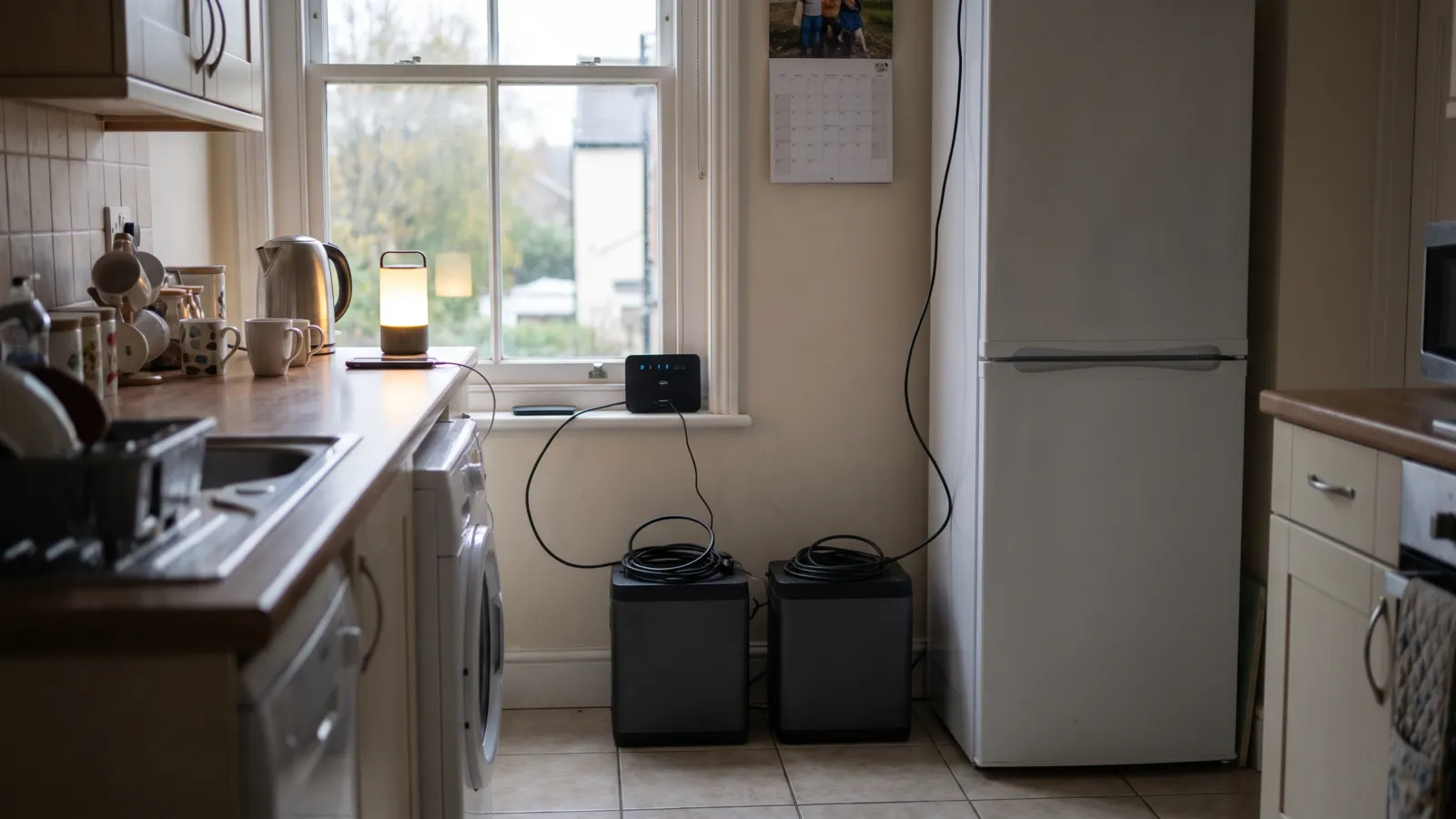
Same 1,024Wh battery, so the differences are everything around it
Both are 1,024Wh lithium iron phosphate (LFP) power stations, so a fridge-freezer or a router runs for broadly similar times on either. Anker’s UK page rates the SOLIX C1000 Gen 2 at 2,000W continuous with a 3,000W peak; EcoFlow’s UK page rates the DELTA 3 Classic at 1,800W with a 3,600W surge. The Anker charges faster from the mains, accepts more solar, weighs about 0.8kg less and has a 12V car-style socket. The Classic has fewer ports and no 12V output. Neither takes an extra battery, so the capacity you buy is the capacity you keep.
If you have not settled on this size, read what size power station do I need first; if your only need is phones, a torch and a radio, a power bank may do the job. Both units sit in our power stations comparison, and the Classic’s siblings are covered in EcoFlow DELTA 3 Plus vs BLUETTI Elite 100 V2, which explains why the Classic is the budget member of EcoFlow’s range.
Output and surge: 2,000W against 1,800W, and what the peak figures mean
Anker gives the C1000 Gen 2 a 2,000W continuous output and a 3,000W peak. EcoFlow gives the DELTA 3 Classic 1,800W continuous, a 3,600W surge and a 2,400W X‑Boost figure. X‑Boost is not extra power: EcoFlow’s own explainer says it lowers the voltage so a higher-rated appliance runs on the 1,800W inverter, which suits heating elements. It can be switched on or off in EcoFlow’s app, and EcoFlow says it does not work while the unit is charging or passing mains through. Anker’s Gen 2 UK page lists no equivalent mode, so plan on 2,000W as the Anker’s limit.
For a kettle, check its rating plate: EcoFlow’s UK page lists kettles at 1,200–3,000W. One rated at 2,000W or less runs at full power on the Anker; on the Classic, anything between 1,800W and 2,400W boils more slowly under X‑Boost, and anything above 2,400W is beyond it. Surge is the opposite story. BLUETTI’s manual, for one, warns that motors and compressors may start at two to four times their rated power, and EcoFlow’s 3,600W gives more headroom than Anker’s 3,000W. Multiply your fridge-freezer’s rating-plate watts by four and check the result sits under the figure for the unit you choose.
Switchover: both work as a basic UPS at about 10 milliseconds
With the unit between the wall and a router, it passes mains through until a cut, then switches to battery. Anker’s US product page gives the C1000 Gen 2 a UPS switchover of under 10 milliseconds. EcoFlow’s UK page gives the Classic a “10ms auto-switch” and its manual describes a standby UPS with a 10-millisecond transfer. That is quick enough for most routers but not a guarantee for a computer: switch the wall socket off while the router runs from it and see what happens. Anker’s US page markets the UPS for CPAP machines, but before relying on pass-through for one, ask the machine’s maker or your sleep service.
One setting matters more than the switchover time. Power stations can switch off light or fluctuating loads to save power, and a fridge is both. EcoFlow’s DELTA 3 manuals say to set the AC timeout to ‘never’ in the EcoFlow app for a fridge. Anker’s UK page does not describe a low-load shut-off, but Notebookcheck’s review lists energy-saving settings in the Anker app, so check those and run your fridge from the Anker through at least one full compressor cycle before trusting it overnight.
NewSee this for your own homeHome Alerts: your postcode's power cuts, warnings and floods, on one screen. Free for your own home. Opening in October; the first 100 on the list get in first.Join the list →Charging: mains, solar and car
From the mains, the Anker is quicker on paper: Anker’s UK page gives 1,600W input and a full charge in 49 minutes with UltraFast mode, switched on in the Anker app. Anker’s US page adds that UltraFast only works with the battery above 20°C, and that charging at 0–20°C is significantly slower, worth knowing for a unit kept in a cold garage. EcoFlow gives the Classic 1,400W, 80 per cent in 45 minutes in Fast Mode and 100 per cent in 60. Reviewers’ timings land closer: Notebookcheck’s Gen 2 charged in about 55 minutes without the boost mode; The Solar Lab’s US Classic took just under 55 minutes.
Both apps can slow mains charging, which is kinder on your ears: Notebookcheck measured the Anker’s fan at about 45 decibels at a metre while fast charging.
Solar is a modest Anker win, and only with a lot of panel. Anker’s UK page gives 600W maximum at up to 60V (11–28V at 8.2A or 29–60V at 14.5A); Anker’s US page puts a full charge on 600W of solar at 1.8 hours. EcoFlow caps the Classic at 500W through one XT60 port and says 500W of solar fills it in 2.5 hours; check whether a solar cable comes in the box with either. With one or two typical portable solar panels, 500W or less, there is no difference. See solar backup for a power cut for what panels deliver in a British winter.
Neither is quick from a car’s cigarette-lighter socket. EcoFlow’s Classic manual gives 12V at up to 8A, about 96W, car cable sold separately; EcoFlow’s UK page quotes 80 per cent in 1.8 hours with its separately sold 500W Alternator Charger (have an auto electrician fit it). Notebookcheck confirms the Anker charges from a car socket while driving. Charge while you drive: do not leave the engine idling just to charge, and never run a car engine in a garage or any enclosed space, where the NHS says carbon monoxide builds up (see carbon monoxide poisoning symptoms). For generators, read how to use a generator safely.
The Power Cut Action Card
One page for the kitchen drawer: what to do first, what to have ready, how long food keeps, and how to stay warm without risking carbon monoxide. Free, no catch.
Download it straight away. We'll also send the occasional briefing when something genuinely matters — severe weather, live incidents, real price drops. Nothing else.
Ports, weight, expansion, noise and warranty
On ports the Anker is the fuller unit. Anker’s UK page lists a 12V 10A car-style socket (120W), a USB‑C port up to 140W, further USB outputs rated at 20W and 12W, and UK mains sockets sharing the 2,000W, and says the output comes through ten ports; Anker’s European page says nine, and Notebookcheck counted four mains sockets, three USB‑C and one USB‑A on its European unit. We have not confirmed the UK mains-socket count, so check the listing before you buy if it matters. EcoFlow’s UK page lists the Classic’s five: two mains outlets, one 18W USB‑A and two USB‑C at 100W and 30W, with no 12V DC output.
Anker lists the Gen 2 at 11.29kg and about 38 × 21 × 24cm on its UK page. EcoFlow lists the Classic at 12.1kg, give or take 0.3kg, and 398 × 200 × 283mm. Notebookcheck’s review says the Gen 2 is 1.6kg lighter than the original C1000, but also lists what it gave up: capacity down from 1,056Wh to 1,024Wh, no expansion, no built-in light, and only the 12V socket has a cover. Neither unit expands. Anker’s Gen 2 page offers no expansion battery and Notebookcheck notes the original C1000 could take one but the Gen 2 cannot; EcoFlow’s UK comparison table marks the Classic as not expandable.
On noise, read the small print. Anker’s UK page headlines under 20 decibels without saying at what load; Notebookcheck measured about 45 decibels at a metre under heavy output and fast charging, and found it far quieter at low loads. EcoFlow’s UK page calls the Classic “quiet 30dB” and its spec table lists under 30 and under 40 decibels at two output levels, 50 at maximum; The Solar Lab called its unit very quiet but gave no decibel figure. The practical reading is the same for both: quiet running a fridge or router, audible when charging fast or near full output.
Battery life and cover: Anker’s US page rates the Gen 2 to keep at least 80 per cent of its capacity after 4,000 cycles; EcoFlow gives the Classic a ten-year lifespan and no cycle count on its UK page. EcoFlow’s UK spec table gives the Classic “3+2 years”, three standard plus two on registering in the EcoFlow app, and its page description calls that a five-year warranty, so register it. Anker’s UK, US and European product pages name a warranty policy but give no length in the specification we could read. Check Anker’s UK warranty terms, or the warranty card in the box, before you rely on a figure.
What they will actually run: fridge-freezer, CPAP, router
Neither maker publishes how much power the unit uses for itself, so the hours below are a guide, not a promise. EcoFlow’s runtime guide says to use 80–90 per cent of capacity for mains output as a first pass and warns that very small loads lower efficiency. Reviewers’ measurements sit inside that: Notebookcheck drew about 850Wh from the Anker at roughly 250W, about 83 per cent; The Solar Lab measured about 83 per cent inverter efficiency and about 17W idle draw on a US Classic. The cautious working below uses 850Wh divided by the appliance’s average watts plus that 17W, for both units, since Anker gives no idle figure.
Fridge-freezer: a class A 60cm model such as Bosch’s KGN392LAF is rated at 104kWh a year, about 12W averaged over a day; the average fridge-freezer sold in the EU in 2020 used 181kWh (about 21W), and the 1990 average 477kWh (about 54W). That gives 850Wh ÷ (12W + 17W) ≈ 29 hours, ÷ (21W + 17W) ≈ 22 hours, and ÷ (54W + 17W) ≈ 12 hours on either unit. Before powering a fridge at all, read power cut food safety and our power station for a fridge-freezer guide; for insulin and other cold-chain medicines see fridge medicines in a power cut.
CPAP: ResMed’s battery guide lists the AirMini at about 4.4–9.1W and the AirSense 10 at about 8.4–19.9W, blower only, at 12V DC through ResMed’s DC/DC converter. ResMed strongly recommends running its machines from a battery through that converter rather than an inverter, and warns that its heated humidifiers (apart from three older models) must not be used with an inverter because damage or serious injury may result. The Anker’s 12V socket gives that route. The Classic has none, so a CPAP on it runs through the mains inverter, which ResMed’s guide does not cover for these machines: ask your sleep service first, and never run a heated humidifier that way.
On the working above, from the Anker’s 12V socket a blower-only AirSense 10 runs roughly 850Wh ÷ (19.9W + 17W) ≈ 23 hours to 850Wh ÷ (8.4W + 17W) ≈ 33 hours, likely longer, as the 17W is a mains-output figure. EcoFlow’s manuals say its power stations are not intended for life-sustaining medical equipment and to consult the equipment’s maker first; Anker’s UK page carries no equivalent statement, so ask Anker and your device maker rather than assuming. If anyone at home depends on a powered medical device, join the Priority Services Register and read power station for a CPAP and running medical equipment in a power cut.
Router: BT’s Smart Hub 2 draws 14.1W in operation and 8.5W in network standby, so 850Wh ÷ (14.1W + 17W) ≈ 27 hours to 850Wh ÷ (8.5W + 17W) ≈ 33 hours from a mains socket. A 12V lead from the Anker’s car socket can save the inverter loss, but only if the router’s own adapter label says 12V DC and the plug and polarity match; if in doubt, use the adapter. On a digital landline, Ofcom requires your provider to offer at least one solution, such as a battery backup unit, giving landline-dependent customers at least one hour of emergency access in a power cut; ask what yours is.
Who should pick which
Pick the Anker SOLIX C1000 Gen 2 if you need the 12V socket for ResMed’s DC/DC converter, the route ResMed recommends for a CPAP, if you want 2,000W rather than 1,800W for a kettle, or if 49-minute mains charging and 600W of solar matter to you. It is about 0.8kg lighter and has more ports. Accept that it cannot expand, confirm the UK mains-socket count on the listing, and check Anker’s warranty terms, because its product pages give no length that we could find.
Pick the EcoFlow DELTA 3 Classic if you want the higher 3,600W surge figure for compressor start-up and EcoFlow’s clearly stated five-year cover on registration, and can live with five ports, no 12V socket (so not the one for a CPAP), 500W of solar and a capacity fixed for life. EcoFlow said pre-orders would ship from 12 October 2026; compare live prices and stock on the cards above. If cuts where you live are rare and short, check the power cuts tracker and power cuts this winter before buying either; the kit builder shows what a basic household kit needs.
Common questions
Is the Anker SOLIX C1000 Gen 2 more powerful than the EcoFlow DELTA 3 Classic?
On continuous output, yes: Anker rates it at 2,000W against EcoFlow’s 1,800W for the Classic, so a kettle rated up to 2,000W runs at full power on the Anker. On surge, the Classic is higher: EcoFlow quotes 3,600W against Anker’s 3,000W peak, which is headroom for a compressor starting. The Classic’s 2,400W X‑Boost is not extra power; EcoFlow says it lowers the voltage so a heating appliance runs on the 1,800W inverter. Both hold the same 1,024Wh.
Will either run a fridge-freezer, and for how long?
Yes, for similar times, as both hold 1,024Wh. Using 850Wh usable (about 83 per cent, as Notebookcheck and The Solar Lab each measured) and the 17W idle draw The Solar Lab measured on a Classic, a class A fridge-freezer averaging about 12W runs around 29 hours, the average 2020 EU model (about 21W) about 22 hours, and an old 54W one about 12. On the Classic, set the AC timeout to ‘never’ in EcoFlow’s app first; on the Anker, check the app’s energy-saving settings and run a full compressor cycle.
Which is better for a CPAP machine?
The Anker, because it has a 12V socket for ResMed’s DC/DC converter, which ResMed strongly recommends over running a CPAP through an inverter. The Classic has no 12V socket, so a CPAP on it runs through the mains inverter, which ResMed’s guide does not cover for the AirSense 10 or AirMini: ask your sleep service first, and never use a heated humidifier that way. EcoFlow says its power stations are not for life-sustaining medical equipment; Anker’s page carries no equivalent line. Ask your device maker before relying on either.
Which charges faster?
The Anker on paper: Anker gives 1,600W input and a full charge in 49 minutes with UltraFast mode switched on in its app (only with the battery above 20°C), against EcoFlow’s 1,400W, 80 per cent in 45 minutes and 100 per cent in 60 for the Classic. Reviewers’ own timings were closer, at about 55 minutes for each in separate tests. From solar, Anker accepts up to 600W and EcoFlow caps the Classic at 500W, which only matters if you have more than 500W of panels.
Can I add an extra battery to either?
No. Anker’s Gen 2 page offers no expansion battery, and Notebookcheck’s review notes the Gen 2 can no longer take an extra battery, unlike the original C1000. EcoFlow’s UK comparison table marks the Classic as not expandable. If you might want two days of fridge and router rather than one, look at the EcoFlow DELTA 3 Plus instead, which takes an extra battery.
How noisy are they?
Both makers quote low figures: Anker’s UK page says under 20 decibels without naming a load; EcoFlow lists under 30 and under 40 decibels at two output levels and 50 at maximum. Under heavy output or fast charging, Notebookcheck measured the Anker at about 45 decibels at a metre; The Solar Lab called the Classic very quiet but published no decibel figure. Expect quiet running with a fridge or router and an audible fan during a fast recharge; both apps can slow the charge to quieten it.
Sources (19)
- Anker SOLIX UK — C1000 Gen 2 product page1,024Wh; 2,000W, 3,000W peak; 1,600W AC input, 49 min with UltraFast enabled in the Anker app; 600W solar at up to 60V, 11–28V 8.2A and 29–60V 14.5A; 12V 10A 120W car socket; USB‑C 140W, 20W and 12W USB outputs; <20 dB operation; 38 × 20.8 × 24.4cm and 38 × 20 × 24.4cm; 11.29kg; output ‘via 10’ ports; warranty policy named, no length stated
- Anker SOLIX US — C1000 Gen 2 product pageunder 10ms UPS switchover, marketed for CPAP machines and laptops; at least 80% capacity after 4,000 cycles; 600W solar recharges fully in 1.8 hours; UltraFast charging only above 20°C battery temperature, significantly slower at 0–20°C; Safety and Warranty Card in the box
- Anker SOLIX EU — C1000 Gen 2 product page2,000W output ‘via 9’ ports; 38.4 × 20.8 × 24.4cm; 11.3kg
- EcoFlow UK — DELTA 3 Classic product page1,024Wh; 1,800W, 3,600W surge, 2,400W X‑Boost; 2 AC outlets, 1 × 18W USB‑A, 100W and 30W USB‑C, no 12V DC output; 1,400W AC, 80% in 45 min, 100% in 60 min; 500W solar, full in 2.5h; 500W Alternator Charger 80% in 1.8h; 10ms auto-switch; ‘quiet 30dB’, 600W <30dB, 200W <40dB, maximum 50dB; 12.1kg ±0.3kg, 398 × 200 × 283mm; 10-year lifespan; not expandable; 3+2-year warranty; IP20; pre-orders shipping from 12 October 2026
- EcoFlow — DELTA 3 Classic user manual, EU edition10ms standby UPS; X‑Boost 2,400W at 230V, unavailable while charging or in bypass; AC timeout ‘never’ for fridges; not intended for life-sustaining medical equipment; charging speed settable in the app; car input 12V 8A 96W, car cable sold separately
- EcoFlow UK — DELTA 3 Series product page (kettles listed at 1,200–3,000W)
- EcoFlow UK — Warranty policy table (DELTA 3 Classic: 5 years)
- EcoFlow — X‑Boost explainer, US pageX‑Boost reduces the voltage so a higher-rated appliance runs on a lower-rated inverter
- EcoFlow — How to test power station runtime0.80–0.90 AC efficiency as a first pass; very small loads lower efficiency; use DC ports for routers and phones
- BLUETTI — Elite 100 V2 user manual, EU editionFAQ Q1: devices with motors or compressors may start at two to four times rated power
- Notebookcheck — Anker SOLIX C1000 Gen 2 practical test, in Germanown measurements: about 45 dB at 1m under high output and fast AC charging; about 55 min AC charge without boost mode; about 850Wh delivered at roughly 250W, 83%; 11.3kg, 1.6kg lighter than the original C1000’s 12.9kg; capacity down from 1,056Wh; no longer expandable, the original was; no light; only the 12V socket covered; 4 AC, 3 USB‑C, 1 USB‑A, 1 car socket on the European unit; charges from a car socket while driving; app energy-saving and charge-speed settings
- The Solar Lab — EcoFlow DELTA 3 Classic review, US 120V unitown measurements: wall charge in just shy of 55 minutes; about 83% inverter efficiency; idle draw about 17W; very quiet, no dB figure; no 12V socket, not expandable, 500W solar
- ResMed — Battery guide 198103DC/DC converters strongly recommended over inverters; AirMini and AirSense 10 current draw at 12V DC by pressure; heated humidifier inverter warning
- BT — Smart Hub 2 power consumption (14.10W in operation, 8.48W network standby)
- Bosch — KGN392LAF specification sheet (class A, 104 kWh/annum, 203 × 60cm)
- European Commission — Fridges and freezers: average refrigerator-freezer sold used 477 kWh/a in 1990 and 181 kWh/a in 2020
- GOV.UK / Food Standards Agency — Food safety in a power cutfridge cold for up to 4 hours; full freezer frozen for up to 48 hours, 24 if half full
- NHS — Carbon monoxide poisoningvehicle engines in an enclosed space such as a garage cause a build-up of carbon monoxide
- Ofcom — Letter on the PSTN switch-off: providers must have at least one solution giving landline-dependent customers a minimum of one hour of emergency access in a power cut
PreparedBritain is independent and not affiliated with HM Government.
Latest from our live data
All stories → News · 21 OctOnly 4 in 100 adults have three days of bottled water at home, the government's survey shows
 News · 21 OctFood inflation held at 1.3%. Wholesale cabbage and cauliflower are up a third. Both are true
 News · 21 OctAldi recall: shoppers warned of hairdryer electric shock or fire risk. How to check yours
Keep reading
All power cuts & energy guides →Is Britain ‘one shock away’ from an energy crisis? What the experts said, and what it means for your home
GB News says Britain is ‘one shock away’ from an energy crisis. The experts it quotes are talking about prices and…
EcoFlow DELTA 3 Plus vs BLUETTI Elite 100 V2: which 1kWh power station should you buy?
Two popular 1kWh power stations, plus EcoFlow’s cheaper DELTA 3 Classic, compared on the things that actually…
EcoFlow vs BLUETTI: which power station brand for a UK home?
EcoFlow or BLUETTI for a UK home? The three matched pairs compared on capacity, output, cycles, charging,…
