EcoFlow DELTA 3 Plus vs BLUETTI Elite 100 V2: which 1kWh power station should you buy?
Two popular 1kWh power stations, plus EcoFlow’s cheaper DELTA 3 Classic, compared on the things that actually differ. Capacity and output are the same on all three, so this guide is about expansion, solar, ports, weight and charging, with honest runtimes for a fridge-freezer, a CPAP and a router, working shown.
Pick the EcoFlow DELTA 3 Plus if there is any chance you will add a second battery; pick the BLUETTI Elite 100 V2 if you want the lightest of the three, with a named Silent charging mode, and will not need more capacity; the DELTA 3 Classic is the same battery and output with fewer ports, no 12V socket, half the Plus’s solar input and no way to grow. All three hold 1,024Wh and deliver 1,800W, so a fridge-freezer or router runs for broadly similar times on each; for a CPAP, only the Plus and the Elite 100 V2 have the 12V socket for ResMed’s DC converter. Choose on expansion, ports, weight and charging.
By Tom Calder · Updated 22 September 2026 · Sourced to EcoFlow, BLUETTI, ResMed, BT, Bosch, the European Commission, the NHS, Ofcom and the Food Standards Agency
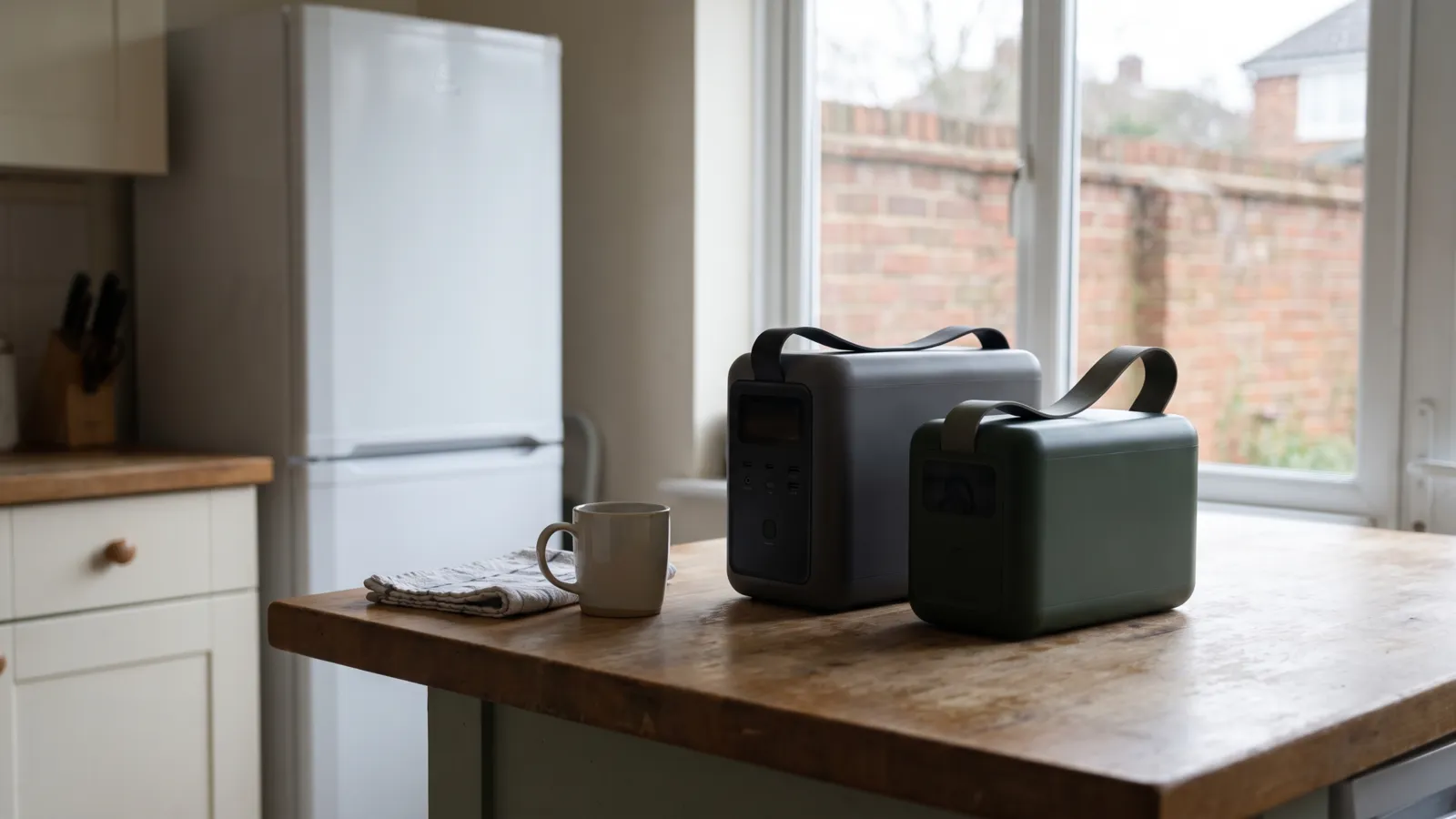
Same battery, same output, so what actually differs?
At the core, all three are the same proposition: a 1,024Wh lithium iron phosphate (LFP) battery behind an inverter rated at 1,800W continuous, with a 3,600W surge figure for motor start-up. That is why the runtimes further down are broadly similar, though not identical: at small loads each unit’s own draw matters, and only two of the three have a 12V socket.
What differs is everything around the battery: whether you can add a second one later, how much solar it accepts, how many sockets it has, how heavy it is and how it charges. Choose on those. If you have not settled on this size yet, read what size power station do I need first; if your only need is phones, a torch and a radio, a power bank may do the job.
Output, surge, and what X‑Boost and Power Lifting really do
All three deliver 1,800W continuously. Each also advertises a figure above that: X‑Boost of 2,400W on the DELTA 3 Plus and the DELTA 3 Classic (EcoFlow’s 230V figure for UK units); Power Lifting of 2,700W on the Elite 100 V2. Neither is extra power. BLUETTI limits Power Lifting to pure resistive loads such as kettles and heaters; EcoFlow’s X‑Boost lowers the voltage so a higher-rated appliance runs on the 1,800W inverter, which suits heating elements best. Either way, an appliance rated above 1,800W runs at reduced power rather than tripping the unit.
BLUETTI’s manual says so: Power Lifting is for pure resistive loads rated 1,800–2,700W, and “its actual output power is still 1,800W”. A kettle rated within the limit boils, but slowly. Check its rating plate first, because EcoFlow’s own UK page lists kettles at 1,200–3,000W: one rated above 2,400W is beyond X‑Boost (the most EcoFlow’s spec table allows), and one above 2,700W is beyond Power Lifting too. Power Lifting is off by default and X‑Boost can be switched on or off in EcoFlow’s app; on the EcoFlow units X‑Boost does not work while the unit is charging or passing mains through, so it is unavailable while the unit sits on mains as a UPS. Do not plan around either mode for a fridge or anything else with a compressor, and do not read 2,700W against 2,400W as a real difference. On waveform, EcoFlow’s manuals give both DELTA 3 units a pure sine wave output; BLUETTI’s UK page and manual do not state the Elite 100 V2’s.
Surge is different. BLUETTI’s manual warns that devices with motors or compressors may start at two to four times their rated power, which could overload the unit, and says to keep the total AC load below 1,800W. The 3,600W surge figure is short-term headroom for that start-up spike. EcoFlow quotes 3,600W for both DELTA 3 units; BLUETTI quotes it on the Elite 100 V2 product page, though the manual’s spec table lists no surge figure. Taking the top of BLUETTI’s range, multiply the rated watts on your fridge-freezer’s rating plate by four for the start-up surge to plan for, and check it is under 3,600W.
Switchover: all three work as a basic UPS, at about 10 milliseconds
With the unit between the wall and the router or CPAP, it passes mains through until a cut, then switches to battery. EcoFlow’s manuals describe both DELTA 3 units as a standby UPS with a 10-millisecond transfer time (its UK DELTA 3 Plus spec table says under 10ms); BLUETTI’s manual gives 10 milliseconds or less for the Elite 100 V2. That is quick enough for most routers, but it is not a guarantee: BLUETTI markets the Elite 100 V2 for CPAPs, yet its manual says the UPS is not for data servers or workstations that need a high-performance UPS. Test a router or computer by switching off the wall socket before you rely on it, and before relying on pass-through for a CPAP, check with the machine’s maker or your sleep service.
One setting matters more. Power stations can switch off light or fluctuating loads to save power. BLUETTI’s Elite 100 V2 manual says its ECO modes are on by default and should be switched off for devices under 60W and for critical appliances such as fridges; check the setting on yours. EcoFlow’s DELTA 3 manuals say to set the AC timeout to ‘never’ in the EcoFlow app for a fridge. Change these before you rely on the unit overnight.
Charging: mains, solar and car
From the mains, the DELTA 3 Plus is fastest: 1,500W input and full in 56 minutes. The DELTA 3 Classic takes 1,400W, reaching 80 per cent in 45 minutes and full in 60. The Elite 100 V2 has three named modes: Standard at up to 600W in about two hours, Turbo at up to 1,200W for 80 per cent in 45 minutes and full in around 70, and Silent (switched on in BLUETTI’s app), also 600W over about two hours, for quieter operation. EcoFlow’s app can also slow the DELTA 3 units’ mains charging, though without a named mode.
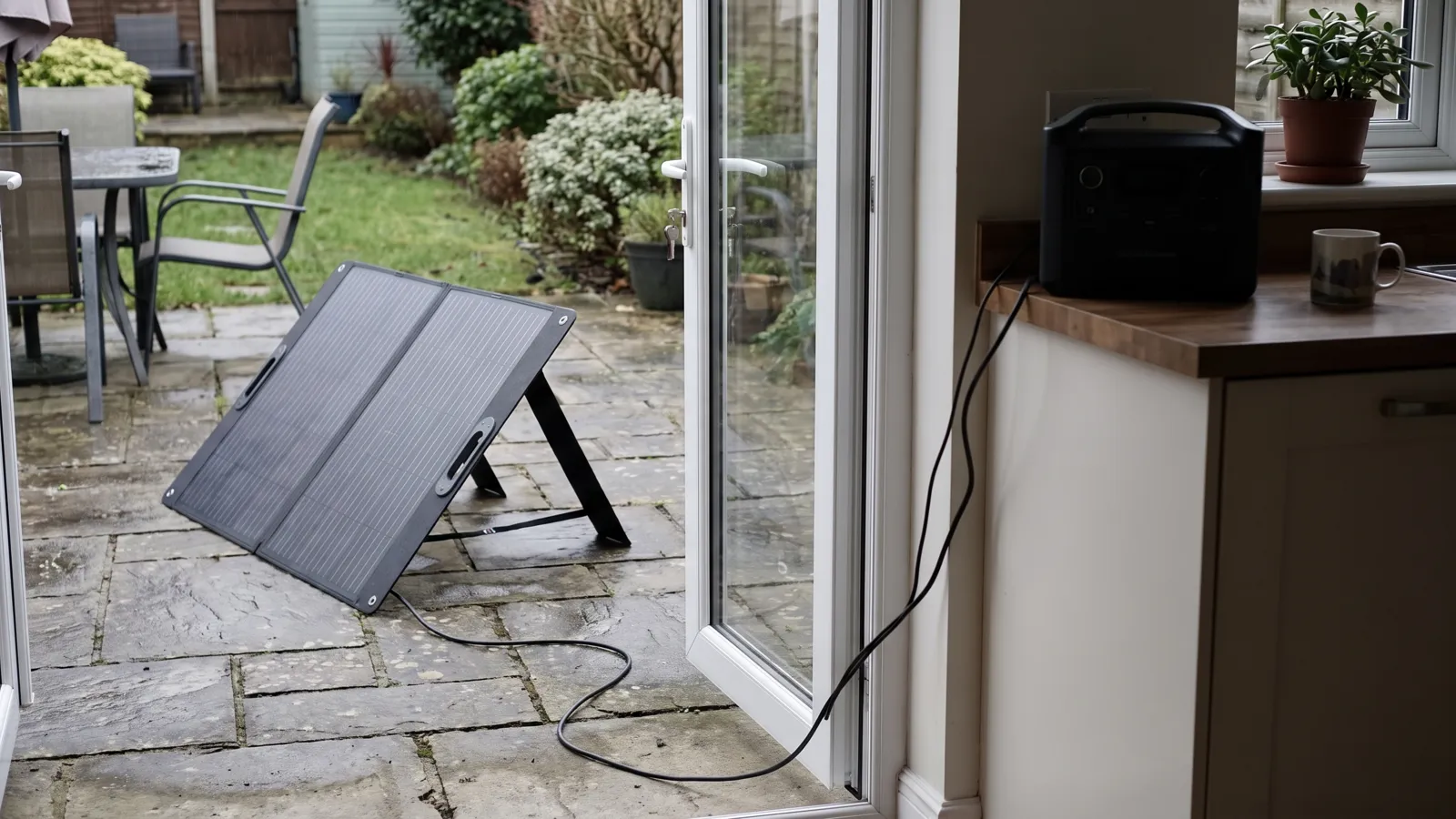
Solar is where the Classic gives ground, but only if you have a lot of panel. The DELTA 3 Plus accepts up to 1,000W through two XT60i solar inputs of 500W each (11–60V, 15A per port). The Elite 100 V2 takes up to 1,000W through one XT60 DC input (12–60V, 20A, never above 60V open-circuit), using a cable that joins two sets of panels in parallel, but only in Turbo charging mode; in its default Standard mode, and in Silent mode, solar is capped at 600W. Neither comes with the solar cable: EcoFlow sells its Solar to XT60i Charging Cable separately, and BLUETTI’s manual lists its MC4-to-XT60 cable as an optional accessory. The DELTA 3 Classic is capped at 500W through its single solar input: with more than 500W of portable solar panels it charges more slowly than the other two, and with one or two typical panels, 500W or less, there is no difference. See solar backup for a power cut.
From a car, none of the three is quick out of the box. Through a cigarette-lighter socket, the DELTA 3 units accept 12V at up to 8A (about 96W) and the Elite 100 V2 accepts 12V or 24V, and none of the three includes a car charging cable: EcoFlow says to buy its car cable separately, and BLUETTI’s manual lists the Elite 100 V2’s cigarette-lighter cable as an optional accessory. Faster car charging needs a separately sold alternator charger that is wired to the vehicle’s battery rather than plugged into the 12V socket: EcoFlow quotes 800W for the DELTA 3 Plus and 500W for the Classic with its own chargers, and BLUETTI’s Charger 1 is rated at 560W. Have one fitted by an auto electrician. Charge from the car while you are driving: BLUETTI’s manual asks for the engine to be running so the car’s own battery is not flattened, but do not sit with the engine idling just to charge, and never run a car engine in a garage or any enclosed space, where carbon monoxide builds up (see carbon monoxide poisoning symptoms). If a generator is part of your plan, read how to use a generator safely: outdoors only, never in the house, garage, shed or porch, and at least 6 metres from the building with the exhaust pointing away from windows and doors.
Expandability: the real dividing line
Only the DELTA 3 Plus can grow. It has an extra-battery port, and EcoFlow’s DELTA 3 Smart Extra Battery (1kWh) takes it to about 2kWh; EcoFlow says it can reach 5kWh with its larger DELTA Pro 3 Extra Battery. If you might one day want two days of fridge and router rather than one, this is the unit that lets you buy that later.
The Elite 100 V2 has no extra-battery port. BLUETTI says a B80 battery in Power Bank Mode can be connected with an Aviation-to-XT60 cable, but it feeds the Elite through its DC input like a solar panel rather than stacking as a true extra battery, so treat it as a top-up, not expansion. The DELTA 3 Classic has no expansion route at all: EcoFlow’s UK spec lists no extra-battery port and its comparison table says the Classic is not expandable, so its 1,024Wh is fixed for life.
Ports, weight, cycles and warranty
On UK units the DELTA 3 Plus has the most sockets: four mains outlets sharing the 1,800W, two 140W USB‑C, two 36W USB‑A, and a 12V car-style socket and two DC5521 barrel outputs sharing 126W. The Elite 100 V2 has two mains outlets, one 140W and one 100W USB‑C, two 15W USB‑A, a 12V socket and two DC5521. The DELTA 3 Classic has two mains outlets, one USB‑A and two USB‑C (100W and 30W): five ports, no 12V socket, no DC5521.
The Elite 100 V2 is the lightest and smallest at 11.5kg and 320 × 215 × 250mm, against 12.1kg for the Classic and 12.5kg for the Plus, both around 398 × 200 × 284mm. A kilo counts if one person carries it upstairs.
Battery life and cover are a wash. All three use LFP cells: EcoFlow rates the Plus at 4,000 cycles, BLUETTI rates the Elite 100 V2 at over 4,000 and calls it a ten-year battery, and EcoFlow gives the Classic a ten-year lifespan. All three carry five-year warranties in the UK. The DELTA 3 Plus’s five years are unconditional; EcoFlow’s DELTA 3 Classic page describes its five years as three standard plus two on registering in the EcoFlow app (its warranty-policy table simply lists five years), so register the Classic to be safe.
The Power Cut Action Card
One page for the kitchen drawer: what to do first, what to have ready, how long food keeps, and how to stay warm without risking carbon monoxide. Free, no catch.
Download it straight away. We'll also send the occasional briefing when something genuinely matters — severe weather, live incidents, real price drops. Nothing else.
What they will actually run: fridge-freezer, CPAP, router
Because capacity is identical, runtimes are close, though not the same: each unit uses some power of its own, and only BLUETTI publishes that figure. Its method for the Elite 100 V2 is 1,024Wh × 90 per cent usable × 90 per cent inverter efficiency ÷ (the appliance’s average watts + about 10W the unit draws itself). EcoFlow publishes no self-consumption figure for the DELTA 3 units, so treat the hours below as a guide for all three, not identical results. EcoFlow’s runtime guide says to use 80–90 per cent for mains output as a first pass and warns that very small loads lower efficiency; Anker’s own tests of two larger EcoFlow units, the DELTA 2 Max and DELTA 3 Max, which have not been independently verified, found 32–36 per cent at a 10W draw. Run small loads from the DC or USB outputs where you can.
Fridge-freezer: a class A 60cm model such as Bosch’s KGN392LAF is rated at 104kWh a year, about 12W averaged over a day. The average fridge-freezer sold in the EU in 2020 used 181kWh (about 21W), and the 1990 average was 477kWh (about 54W). On BLUETTI’s method, 1,024Wh × 0.9 × 0.9 ÷ (12W + 10W) ≈ 38 hours, ÷ (21W + 10W) ≈ 27 hours, and ÷ (54W + 10W) ≈ 13 hours: roughly 13 hours to a day and a half. EcoFlow does not publish the DELTA 3 units’ idle draw, so expect similar, not identical, figures. Before powering a fridge at all, read power cut food safety; for insulin and other cold-chain medicines see fridge medicines in a power cut.
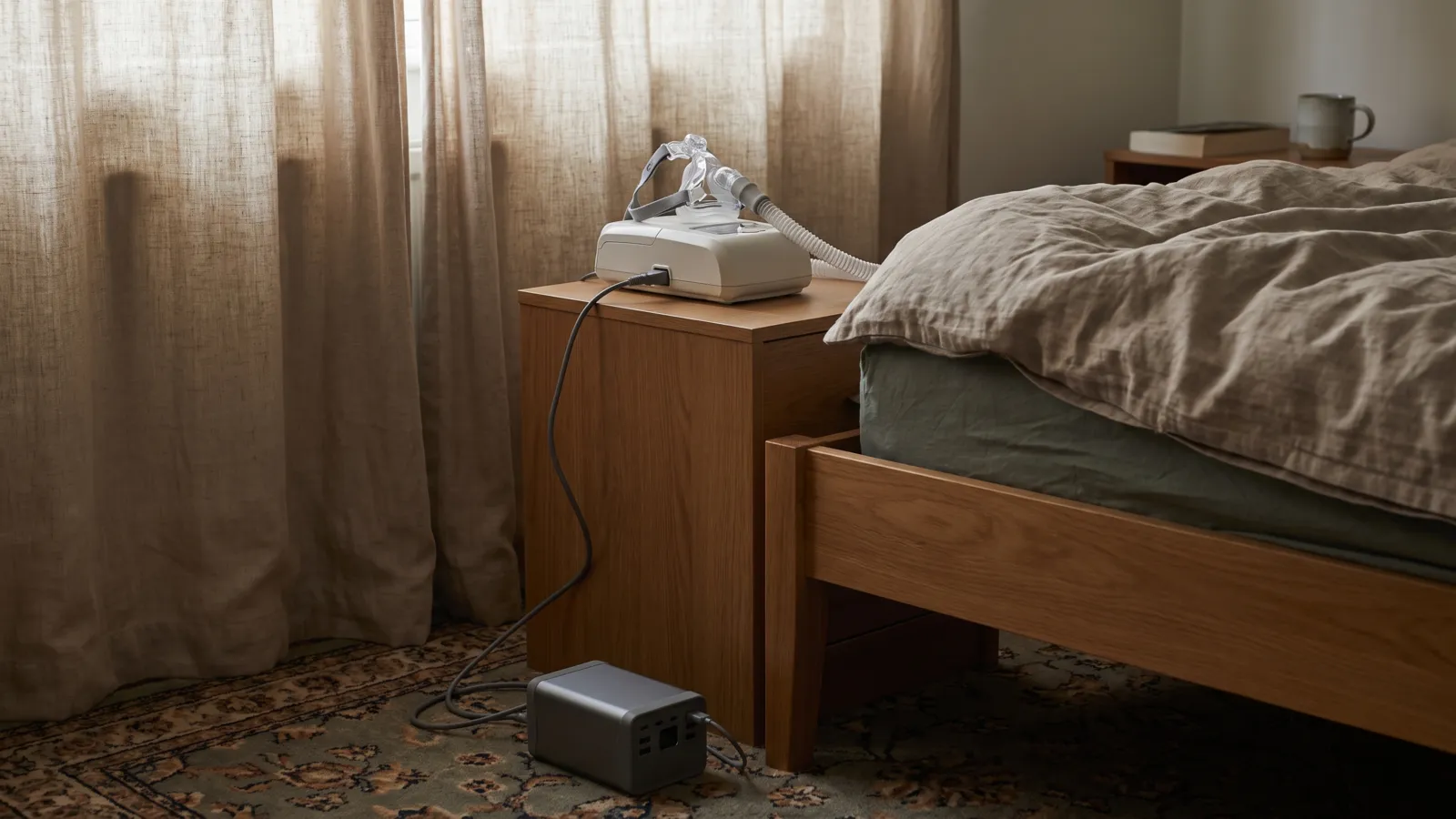
CPAP, blower only: ResMed’s battery guide lists the AirMini at about 4.4–9.1W and the AirSense 10 at about 8.4–19.9W, depending on pressure, measured at 12V DC through ResMed’s own DC/DC converter. ResMed strongly recommends running its machines from a battery through that converter rather than an inverter, and warns that, apart from three older humidifier models, its heated humidifiers must not be used with an inverter because damage to the unit or serious injury may result. On the DELTA 3 Plus or the Elite 100 V2, that means the 12V socket with the ResMed converter for your model; for the newer AirSense 11, which the guide predates, ResMed sells an AirSense 11 DC/DC Converter that plugs into a cigarette-lighter-style socket, so ask ResMed or your sleep service what it draws. On the Elite 100 V2, switch ECO mode off first: BLUETTI says to disable it for devices under 60W, and it can shut the DC output off at light loads. As a rough guide on BLUETTI’s published method, whose efficiency figure is for the inverter, that is about 1,024Wh × 0.9 × 0.9 ÷ (20W + 10W) ≈ 28 hours to 1,024Wh × 0.9 × 0.9 ÷ (4.4W + 10W) ≈ 58 hours. The Classic has no 12V socket, so a CPAP on it would run through the mains inverter, which ResMed’s guide does not cover for these machines: ask your sleep service before relying on it, and never run a heated humidifier that way. With a heated tube, the humidifier or both switched on, ResMed’s figures for the AirSense 10 rise to about 13–67W; ask your sleep service whether you can do without them on battery. EcoFlow’s manuals say its power stations are not intended for life-sustaining medical equipment and to consult the equipment’s maker before using one for any other medical device. If anyone in your home depends on a CPAP or other powered medical equipment, join the Priority Services Register, always follow the device maker and your prescribing service, and read running medical equipment in a power cut.
Home oxygen is a different case: NHS guidance says oxygen concentrators switch off in a power cut and that patients have a large backup cylinder, so follow your oxygen supplier’s plan rather than relying on any of these; the medical equipment guide covers it.
Router: BT’s Smart Hub 2 draws 14.1W in operation and 8.5W in network standby. On BLUETTI’s method that is 1,024Wh × 0.9 × 0.9 ÷ (14.1W + 10W) ≈ 34 hours to 1,024Wh × 0.9 × 0.9 ÷ (8.5W + 10W) ≈ 45 hours from the mains socket. A 12V lead can save the inverter loss, but only if the label on the router’s own adapter says 12V DC and the plug and polarity match; if in doubt, use the adapter. On a digital landline, Ofcom’s guidance requires your provider to have at least one solution, such as a battery backup unit, that gives landline-dependent customers at least one hour of access to the emergency services in a power cut; ask them what yours is.
Who should pick which
Pick the EcoFlow DELTA 3 Plus if there is any chance you will add a second battery, if you want four mains sockets and two full-power USB‑C ports, or if the fastest mains recharge matters. You pay for headroom you may not use on day one, but it is the only one that can grow beyond 1kWh.
Pick the BLUETTI Elite 100 V2 if you want the lightest and most compact of the three, are sure you will not need more capacity, and like a ready-made Silent charging mode (switched on in BLUETTI’s app; EcoFlow’s app can also slow the DELTA 3 units’ mains charging, but without a named mode). It keeps the 12V socket and the second high-power USB‑C that the Classic drops.
Pick the EcoFlow DELTA 3 Classic if you want the same battery and the same 1,800W for the lowest outlay of the three when we checked, and can live with five ports, no 12V socket (so not the one for a CPAP), 500W of solar and a capacity fixed forever. For a household covering the fridge, router and lights through a typical short cut, that is not a compromise. EcoFlow was taking pre-orders for it in September 2026, so check stock on the card below. If cuts where you live are rare and short, check the power cuts tracker and power cuts this winter before buying any of them; the kit builder shows what a basic household kit needs, power bank included.
Common questions
Will the EcoFlow DELTA 3 Plus or BLUETTI Elite 100 V2 run a fridge-freezer?
Yes, for broadly similar times, because both hold 1,024Wh. On BLUETTI’s own formula, which counts about 10W that the unit draws itself, a class A fridge-freezer averaging about 12W runs for around a day and a half, the average one sold in the EU in 2020 (about 21W) for about a day, and the 1990 average (about 54W) for around 13 hours. EcoFlow publishes no equivalent figure, so expect similar, not identical, hours from the DELTA 3 Plus. First switch ECO mode off on the BLUETTI, or set the AC timeout to ‘never’ on the EcoFlow, or the unit may shut down when the compressor cycles.
Which is better for a CPAP machine?
The DELTA 3 Plus or the Elite 100 V2, because both have a 12V socket for ResMed’s DC/DC converter, which ResMed strongly recommends over running a CPAP through an inverter. The DELTA 3 Classic has no 12V socket, so a CPAP on it would run through the mains inverter, which ResMed’s battery guide does not cover for the AirSense 10 or AirMini: ask your sleep service first, and do not use a heated humidifier that way. EcoFlow says its power stations are not for life-sustaining medical equipment. Confirm with your device maker and sleep service before relying on any battery.
Is X‑Boost or Power Lifting real extra power?
No. Both let a heating appliance rated above 1,800W but no higher than 2,400W (EcoFlow) or 2,700W (BLUETTI), such as a lower-rated kettle, run at reduced power rather than trip the unit. BLUETTI’s manual says actual output stays at 1,800W. Neither mode is for a fridge or anything else with a compressor, X‑Boost is off while an EcoFlow unit is charging or passing mains through, and the 2,700W versus 2,400W figures are not a meaningful difference.
Can I add an extra battery to the BLUETTI Elite 100 V2 or the DELTA 3 Classic?
Not as a true extra battery. The Elite 100 V2 has no extra-battery port; BLUETTI says a B80 in Power Bank Mode can be connected to its DC input with an Aviation-to-XT60 cable, which tops it up rather than expanding it. The DELTA 3 Classic has no expansion port at all. Only the DELTA 3 Plus takes EcoFlow’s DELTA 3 Smart Extra Battery, which takes it to about 2kWh.
Which charges fastest?
From the mains, the DELTA 3 Plus: 1,500W input and full in 56 minutes. The Classic is full in 60 minutes at 1,400W. The Elite 100 V2 in Turbo mode reaches 80 per cent in 45 minutes and full in around 70, and has a named Silent 600W mode, switched on in its app. From solar, the Plus accepts up to 1,000W and the Elite 100 V2 up to 1,000W in Turbo mode (600W otherwise); the Classic is capped at 500W.
How long does the switchover take if the power goes off?
About 10 milliseconds on all three (EcoFlow’s UK DELTA 3 Plus spec says under 10ms): quick enough for most routers, but test yours first. BLUETTI’s manual says its UPS is not for data servers or workstations that need a high-performance UPS, so check with your CPAP’s maker or sleep service before relying on pass-through.
Sources: EcoFlow UK — DELTA 3 Series (DELTA 3 Plus) product page and specs (1,024Wh; 4 AC outlets, 1,800W, surge 3,600W; 2,400W X‑Boost maximum; kettles 1,200–3,000W; 1,500W AC, 56 min; 2 × 500W solar, 11–60V; car 800W; <10ms UPS; 2 × 140W USB‑C, 2 × 36W USB‑A, car socket 126W, 2 × DC5521; ≤12.5kg, 398 × 200 × 284mm; 4,000 cycles to 80%; 5-year warranty; 2kWh with the DELTA 3 Extra Battery (1kWh) and 5kWh with the DELTA Pro 3 Extra Battery) · EcoFlow UK — DELTA 3 Classic product page (2 AC outlets, 1 × 18W USB‑A, 100W and 30W USB‑C, no 12V DC output; 2,400W X‑Boost; 1,400W AC, 80% in 45 min, 100% in 60 min; 500W solar; 500W Alternator Charger; 10ms UPS; pure sine wave; 12.1kg; 10-year lifespan; no extra-battery port, not expandable; 3+2-year warranty; pre-order shipping from 12 October 2026) · EcoFlow — DELTA 3 Plus user manual, EU edition (pure sine wave; standby UPS with 10ms transfer; X‑Boost 2,400W at 230V, disabled by default, suited to heating devices and unavailable while charging or in bypass; AC timeout ‘never’ for fridges; medical equipment limit; charging speed settable in the app; car input 12V 8A, car cable sold separately; XT60i solar inputs 500W per port, Solar to XT60i cable sold separately; 12V DC outputs 126W total; 5-year warranty) · EcoFlow — DELTA 3 Classic user manual, EU edition (pure sine wave; 10ms standby UPS; X‑Boost 2,400W at 230V, active by default and unavailable while charging or in bypass; AC timeout ‘never’ for fridges; medical equipment limit; charging speed settable in the app; car input 12V 8A 96W, car cable sold separately; solar 500W max) · EcoFlow UK — Warranty policy table (DELTA 3 Classic and DELTA 3 Plus: 5 years) · EcoFlow — X‑Boost explainer, US page (X‑Boost reduces the voltage so a higher-rated appliance runs on a lower-rated inverter) · BLUETTI UK — Elite 100 V2 product page (2 AC outlets, 9 ports; 1,800W, 2,700W Power Lifting, 3,600W surge; 80% in 45 min and 100% in about 70 min at 1,200W AC; over 4,000 cycles, 10-year battery life, 5-year warranty; in-the-box list; 10ms UPS marketed for CPAPs; FAQ A17 runtime = capacity × 90% DoD × η ÷ (load + about 10W self-consumption); FAQ A18 B80 in Power Bank Mode via Aviation-to-XT60 cable; Charger 1 560W alternator charger) · BLUETTI — Elite 100 V2 user manual, EU edition (box contents and optional accessories incl. car and MC4-to-XT60 solar cables; solar 1,000W in Turbo, 600W in Standard and Silent; Silent set in the app; Power Lifting 1,800–2,700W pure resistive only, off by default, actual output still 1,800W; ECO modes on by default, disable for devices under 60W and fridges; UPS ≤10ms, not for high-performance UPS needs; 12V or 24V car charging with the engine running; FAQ Q1 compressors 2–4× rated power; FAQ Q5 runtime formula with 90% DoD, η over 90%, about 10W self-consumption; 11.5kg, 320 × 215 × 250mm) · ResMed — Battery guide 198103 (DC/DC converters strongly recommended over inverters; AirMini and AirSense 10 current draw at 12V DC by pressure, with and without heated tube and humidifier; heated humidifier inverter warning; inverter guidance limited to S9, VPAP III, AutoSet CS2, VPAP Adapt and Stellar) · ResMed UK — AirSense 11 DC/DC Converter (12V/24V; plugs into a vehicle’s accessory power outlet) · BT — Smart Hub 2 power consumption (14.10W in operation, 8.48W network standby) · Bosch — KGN392LAF specification sheet (class A, 104 kWh/annum, 203 × 60cm) · European Commission — Fridges and freezers: average refrigerator-freezer sold used 477 kWh/a in 1990 and 181 kWh/a in 2020 · EcoFlow — How to test power station runtime (0.80–0.90 AC efficiency as a first pass; very small loads lower efficiency; use DC ports for routers and phones) · Android Authority — Anker SOLIX OptiSave: Anker’s own, not independently verified, tests of the EcoFlow DELTA 2 Max and DELTA 3 Max at 10W (about 36% and 32% efficiency) · GOV.UK / Food Standards Agency — Food safety in a power cut (fridge cold for up to 4 hours; full freezer frozen for up to 48 hours, 24 if half full; England, Wales and Northern Ireland) · GOV.UK — Public health advice from the UK Chief Medical Officers during a national power outage (no generators indoors; place outdoors at least 6 metres away, exhaust facing away from windows or doors) · NHS — Carbon monoxide poisoning (vehicle engines in an enclosed space such as a garage cause a build-up of carbon monoxide) · NHS Highland — Contingency planning for power outages: home oxygen (concentrators switch off in a power cut; patients have a large backup cylinder) · Ofcom — Letter on the PSTN switch-off: providers must have at least one solution giving landline-dependent customers a minimum of one hour of emergency access in a power cut. PreparedBritain is independent and not affiliated with HM Government.
Keep reading
All power cuts & energy guides →EcoFlow vs BLUETTI: which power station brand for a UK home?
EcoFlow or BLUETTI for a UK home? The three matched pairs compared on capacity, output, cycles, charging,…
Will a power station run a fridge freezer, and for how long?
What a fridge freezer really draws, why a power station’s output rating decides whether the compressor starts, 1kWh…
Which power station will run a CPAP machine through a power cut?
The blower alone is a small load; the humidifier and heated tube decide the size. What an NHS sleep service says…