BLUETTI Elite 30 V2 vs EcoFlow RIVER 3 Plus: which small power station for a router, phones and lights?
Two near-identical 288Wh and 286Wh power stations compared on what differs: sockets, USB-C, weight, charging, expansion and the auto-off settings that can cut a router or CPAP mid-night.
Pick the EcoFlow RIVER 3 Plus if you want three mains sockets, a built-in light, or any chance of adding an extra battery later (EcoFlow’s EB300 or EB600 take it to 572Wh or 858Wh). Pick the BLUETTI Elite 30 V2 if you will charge mostly over USB-C (140W and 100W ports against EcoFlow’s single 100W), want the lighter, slimmer unit, or value a published standby figure and a Silent charging mode. Both hold 286 to 288Wh and deliver 600W, so a router runs for a similar 10 to 14 hours on BLUETTI’s published method and a blower-only CPAP for a night on the 12V socket. Neither runs a fridge-freezer; for phones, a torch and a radio alone, a power bank is enough. Whichever you buy, turn off ECO mode or the AC timeout first.
By Tom Calder · Updated 12 October 2026 · Sourced to BLUETTI, EcoFlow, ResMed, BT, Bosch, the NHS, Ofcom and the Food Standards Agency
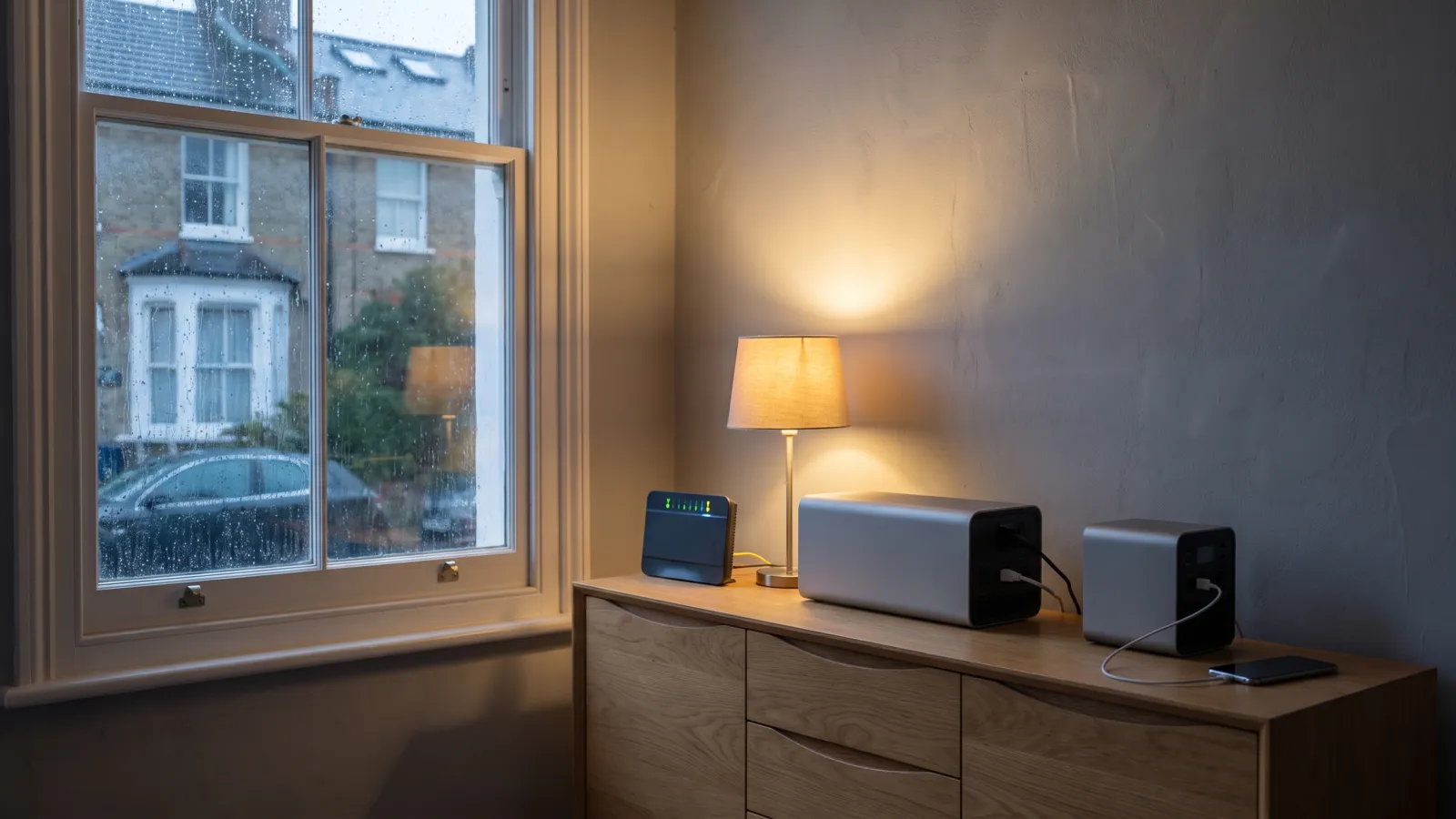
Same size, same output, so what actually differs?
On paper these two are the same product. BLUETTI’s manual gives the Elite 30 V2 a 288Wh lithium iron phosphate (LFP) battery behind a 600W inverter; EcoFlow’s UK page gives the RIVER 3 Plus 286Wh and 600W. Two watt-hours is nothing. BLUETTI quotes over 3,000 cycles and a ten-year lifespan; EcoFlow quotes 3,000 cycles, or around ten years of everyday use, before capacity drops to 80 per cent. Both advertise five-year warranties. Both are the size a household buys to keep a router, a few phones and some lights going through a cut of several hours, not to run a fridge-freezer.
What differs is the detail around the battery: how many mains sockets, how much USB-C power, which is lighter, how each charges, whether you can add a second battery later, and the power-saving settings that can silently switch off a small load. Choose on those. If you have not settled on this size, read what size power station do I need first, and compare the wider ranges on power stations and BLUETTI power stations. For the brands’ 1kWh units, see EcoFlow DELTA 3 Plus vs BLUETTI Elite 100 V2.
Sockets and ports: three mains outlets against one, but more USB-C
The clearest everyday difference is the number of three-pin sockets. EcoFlow’s UK page lists three AC outlets on the RIVER 3 Plus, sharing the 600W; BLUETTI’s manual lists exactly one on the Elite 30 V2. If you want the router, a lamp and a laptop charger all on mains at once, the RIVER 3 Plus does it from the unit, while the Elite 30 V2 needs a short mains extension lead. The Solar Lab notes that two of EcoFlow’s three sockets are on the back, so cables leave both ends of the unit, which matters on a tight shelf.
BLUETTI answers with USB-C. Its manual lists one 140W USB-C port (up to 28V at 5A) and a second at 100W, two 15W USB-A ports, a 12V cigarette-lighter socket at 10A and two DC5521 barrel outputs, with the three 12V outputs sharing a 10A total of about 120W. EcoFlow’s UK page gives the RIVER 3 Plus one 100W USB-C, two 12W USB-A (24W together) and one 12.6V, 10A car-style socket rated 126W. A modern laptop that charges over USB-C runs from either unit without touching a mains socket, and the Elite 30 V2 can charge two at once, one at up to 140W and the other at up to 100W.
Both have a 12V socket, which matters for a CPAP on ResMed’s DC lead (below) and for a 12V router or lamp. BLUETTI’s UK page markets the Elite 30 V2 as having eight outlets; our product card lists the main ones. In the box, BLUETTI’s manual lists a car charging cable with the Elite 30 V2 but not a solar cable, which First Quadcopter’s review confirms; EcoFlow’s manual says the RIVER 3 Plus comes with neither, both sold separately.
Power Lifting and X-Boost: 600W is still the ceiling
Both advertise a figure above 600W. BLUETTI’s UK page says “600W rated power, 1,500W lifting power”; EcoFlow’s says X-Boost lets the RIVER 3 Plus run devices up to 1,200W. Neither is extra power. BLUETTI’s manual limits Power Lifting to pure resistive loads rated 600 to 1,500W, says it is off by default, and states that the actual output power is still 600W. EcoFlow’s manual says X-Boost is on by default, suits heating and motor devices, is not for devices with voltage protection or precision instruments, and is unavailable in bypass mode, so it does nothing while the unit sits on mains as a UPS.
In practice, treat both as 600W units. BLUETTI pitches Power Lifting at kettles and hairdryers, but they run at reduced power, and at 600W either battery lasts well under an hour, so keep heaters, kettles and toasters for the mains. BLUETTI’s manual warns that motors and compressors can start at two to four times their rated power. It lists no surge figure for the Elite 30 V2, so do not read its 1,500W against EcoFlow’s 1,200W surge rating as a difference. The Solar Lab’s view is that X-Boost is not a true 1,200W and works by lowering the voltage, which can harm sensitive electronics such as laptops.
Alex Reviews Tech found a small fan heater tripped the Elite 30 V2 on any heat setting until Power Lifting was switched on, and even then only the lowest setting ran. On waveform, EcoFlow’s manual gives the RIVER 3 Plus a pure sine wave output. BLUETTI’s spec table does not state one for the Elite 30 V2, though First Quadcopter measured a clean sine wave on an oscilloscope.
NewSee this for your own homeHome Alerts: your postcode's power cuts, warnings and floods, on one screen. Free for your own home. Opening in October; the first 100 on the list get in first.Join the list →Switchover and the auto-off trap: using either as a router or CPAP UPS
The most useful way to own one of these is plugged into the wall with the router plugged into it. Both makers describe a standby UPS with a 10-millisecond switchover: BLUETTI’s manual gives 10ms or less for the Elite 30 V2, EcoFlow’s gives 10ms for the RIVER 3 Plus, and StorageReview measured 9ms on its RIVER 3 Plus with a power analyser. That is quick enough for most routers and small electronics, but it is not a promise. BLUETTI’s manual says the UPS is not for data servers or workstations that need a high-performance UPS. Test yours by switching off the wall socket while the router is running from it.
Reviewers back this up in a small way. Alex Reviews Tech reports a NAS and a printer carrying on each time wall power to an Elite 30 V2 was switched off, though it could not stage a real blackout; The Gadgeteer’s reviewer did not test it and makes the fair point that a UPS is for saving work and shutting down safely. EcoFlow supplies a USB-B data cable with the RIVER 3 Plus, and its manual points to EcoFlow’s own Power Manager software for monitoring the unit and setting its UPS options from a computer or NAS; BLUETTI’s manual lists no data port.
One setting matters more than switchover speed: both units can switch off a light load, and a router or CPAP is a light load. BLUETTI’s manual says the Elite 30 V2’s AC and DC ECO modes are on by default; disable them for devices under 10W and critical appliances such as lights. AC-ECO does not run while the unit charges from the mains, so it bites once the cut starts; the manual gives DC-ECO, which covers the 12V socket, no such exception. EcoFlow’s manual says the RIVER 3 Plus’s AC outlets switch off after an idle period; for critical use, set the AC timeout to ‘Never’. Change these first.
On a digital landline, Ofcom requires your provider to have at least one solution giving landline-dependent customers a minimum of one hour of emergency access in a power cut; ask what yours is, and read the PSTN switchover if you still have a home phone.
Charging: mains, solar and car
From the mains, both are quick. EcoFlow’s UK page quotes 360W input and 0 to 100 per cent in 60 minutes for the RIVER 3 Plus. BLUETTI’s manual gives the Elite 30 V2 three modes: Standard at up to 200W in about two hours, Turbo at up to 380W for 80 per cent in 45 minutes (BLUETTI’s Irish page quotes about 70 minutes to full), and Silent at 200W over about three hours. The Gadgeteer’s reviewer found those times accurate in use. BLUETTI’s 980W ‘AC input with bypass’ figure is the mains pass-through rating while plugged in, not a charging speed.
Solar is close to a tie. BLUETTI’s manual accepts up to 200W at 12 to 28V and 10A; EcoFlow’s UK page accepts up to 220W at 11 to 55V and quotes a full charge in as little as 1.5 hours. EcoFlow’s wider voltage window gives more freedom in which panel you pair; BLUETTI’s manual says third-party panels with an open-circuit voltage of 12 to 28V and MC4 connectors are fine, through its solar cable. Either takes one typical folding panel from our portable solar panels page; see solar backup for a power cut for how far that gets you in a British winter.
From a car, EcoFlow’s UK page lists an 8A car input, which from a 12V socket is roughly 100W, full in about 3.3 hours; BLUETTI’s manual takes a 12V or 24V socket within its 10A, 200W DC limit, so about 120W from 12V. EcoFlow sells its car cable separately; BLUETTI includes one. Charge on a journey you need to make, not by idling, and never run a car engine in a garage or any enclosed space: the NHS says that causes a build-up of carbon monoxide (see carbon monoxide poisoning symptoms). A generator goes outdoors only; read how to use a generator safely.
Expandability and weight: the two real dividing lines
Only the RIVER 3 Plus can grow. EcoFlow’s UK page describes two extra batteries that clip wirelessly underneath: the EB300 at 286Wh, which doubles capacity to 572Wh, and the EB600 at 572Wh, which takes the pair to 858Wh. EcoFlow calls the combinations RIVER 3 Max and RIVER 3 Max Plus. The Elite 30 V2 has no expansion port: BLUETTI’s manual lists a lead-acid battery charging cable as an optional extra, which tops it up through the DC input rather than adding capacity. If there is any chance you will want a second night of router and lights later, the EcoFlow is the one that lets you buy it.
Weight goes the other way. BLUETTI’s manual gives the Elite 30 V2 as about 4.3kg at 250 × 178 × 168mm; EcoFlow’s UK page gives the RIVER 3 Plus as 4.7kg at 234 × 232 × 146mm. Four hundred grams is a small gap; the shapes differ more: the BLUETTI longer and narrower, the EcoFlow squarer and lower. EcoFlow claims IP54 battery protection and a shell that survives a one-metre drop; BLUETTI rates the Elite 30 V2 IP20, so keep it dry. Both have a handle, an on-unit display and Bluetooth and Wi-Fi apps; The Solar Lab notes the RIVER 3 Plus also has a built-in light bar.
Reviewers’ complaints are minor on both. Alex Reviews Tech found the BLUETTI app pushed other products, that firmware downloaded over Wi-Fi but installed only over Bluetooth, and that the wattage display sometimes read zero under load. The Solar Lab’s complaints about the RIVER 3 Plus were the rear sockets, X-Boost, and that adding an extra battery is poor value against a bigger unit. BLUETTI claims under 30dB at light loads, EcoFlow under 30dB at half a metre; reviewers call both quiet enough for a bedroom. Nothing in the reviews we read amounts to a reliability verdict, and long-term data on both is thin.
What they will actually run: router, phones and lights, CPAP
Capacity is the same, so runtimes are close, though not identical, because each unit uses some power of its own and only BLUETTI publishes that figure. BLUETTI’s manual method for the Elite 30 V2 is 288Wh × 95 per cent depth of discharge × 90 per cent inverter efficiency ÷ (the appliance’s watts + about 9W the unit draws itself); its Irish product page quotes 4.5W standby with only AC on, 5W with only DC, 9W with both. EcoFlow publishes no self-consumption figure for the RIVER 3 Plus, so treat the hours below as a guide for both, and run small loads from the USB or 12V outputs.
Router: BT’s Smart Hub 2 draws 14.1W in operation and 8.5W in network standby. On BLUETTI’s method, 288 × 0.95 × 0.9 ÷ (14.1 + 9) ≈ 10.7 hours, and ÷ (8.5 + 9) ≈ 14 hours. Add a full-fibre ONT at a few watts and you lose an hour or two. That is an evening and a night of Wi-Fi; the power cuts tracker shows how long cuts near you tend to last. Phones and USB lights barely register against a battery this size, so charge them from the USB ports alongside the router rather than through the inverter.
CPAP, blower only: ResMed’s battery guide lists the AirMini at about 4.4 to 9.1W and the AirSense 10 at about 8.4 to 19.9W by pressure, measured at 12V through ResMed’s own DC/DC converter, which ResMed strongly recommends over an inverter. On BLUETTI’s method that is 288 × 0.95 × 0.9 ÷ (19.9 + 9) ≈ 8.5 hours at the top of the AirSense 10 range and ≈ 18 hours at the AirMini’s lowest draw: one night with margin, two at low pressure. Our CPAP guide’s two-to-eight-night range is before the unit’s own draw, which is what pulls these figures down.
A heated tube, the humidifier or both lift the AirSense 10 to about 13 to 67W, roughly 11 hours down to under 4 here, and ResMed warns that, apart from three older humidifier models, its heated humidifiers must not be used with an inverter. Before relying on either unit for a CPAP, switch ECO or the AC timeout off, use the 12V socket with the ResMed converter for your model (ResMed sells one for the AirSense 11), and ask your sleep service. Our CPAP power station guide has the full working across sizes.
EcoFlow’s manual says the RIVER 3 Plus is not designed to power life-support equipment, naming ventilators and hospital-grade CPAP, and to consult the equipment maker before using it with any other medical device; it also warns that power stations’ electromagnetic fields can affect implants such as pacemakers. BLUETTI’s Elite 30 V2 manual says nothing either way about medical use beyond its UPS note. If anyone at home depends on powered medical equipment, join the Priority Services Register and read running medical equipment in a power cut.
Fridge-freezer: no. A class A model such as Bosch’s KGN392LAF is rated at 104kWh a year, about 285Wh a day, which is the whole of either battery before inverter losses and the unit’s own draw. For a cut of a few hours the Food Standards Agency says a shut fridge stays cold for up to four hours and a full freezer keeps food frozen for up to 48 hours (24 if half full); see power cut food safety. If a fridge through a long cut is the goal, you need the 1kWh class in which power station runs a fridge-freezer.
Who should pick which
Pick the EcoFlow RIVER 3 Plus if you want three mains sockets so the router, a lamp and a charger plug straight in, if there is any chance you will add an extra battery later, or if you want a built-in light bar. It is the only one of the two that can grow, and EcoFlow’s 60-minute full recharge is the simplest charging story.
Pick the BLUETTI Elite 30 V2 if you will mostly charge over USB-C, where its 140W and 100W ports beat EcoFlow’s single 100W, if the lighter, slimmer shape matters, or if you want a published standby figure and a named Silent charging mode for a bedroom. Accept the single mains socket and that 288Wh is all it will ever hold. Both sit in our BLUETTI power stations and power stations pages with live prices.
Whichever you buy, do three things on day one: turn off ECO mode (BLUETTI) or set the AC timeout to ‘Never’ (EcoFlow), plug the router through it and switch off the wall socket to prove the switchover, and give it a full charge and discharge every three months, which both manuals ask for. Read preparing for a power cut for the rest of the household plan, and lithium battery fire safety for where to charge and store it.
Common questions
Is the BLUETTI Elite 30 V2 or the EcoFlow RIVER 3 Plus better for a router?
Either, for about the same time. BT’s Smart Hub 2 draws 14.1W in use, which on BLUETTI’s published method gives the Elite 30 V2 around 10 to 11 hours; EcoFlow publishes no self-consumption figure, so expect similar hours from the RIVER 3 Plus. The EcoFlow’s three mains sockets make it easier to add a lamp and a charger without an extension lead. On both, switch off the power-saving mode first: BLUETTI’s ECO mode and EcoFlow’s AC timeout can cut a light load.
Can either run a CPAP machine through the night?
Blower only, yes, on the 12V socket with ResMed’s DC/DC converter, which ResMed strongly recommends over an inverter. ResMed’s figures give the AirSense 10 about 8.4 to 19.9W, which on BLUETTI’s method is roughly 8.5 to 14 hours from the Elite 30 V2; the RIVER 3 Plus should be similar. A heated humidifier or tube can cut that to under four hours. Switch off BLUETTI’s DC-ECO or EcoFlow’s timeout first. EcoFlow says its unit is not for life-support equipment including hospital-grade CPAP. Ask your sleep service first.
Which has more sockets?
The RIVER 3 Plus has three mains sockets sharing 600W, one 100W USB-C, two 12W USB-A and a 12.6V car socket, per EcoFlow’s UK page. The Elite 30 V2 has one mains socket, but a 140W and a 100W USB-C, two 15W USB-A, a 12V car socket and two DC5521 outputs, per BLUETTI’s manual. More mains outlets on the EcoFlow; more and faster USB-C on the BLUETTI.
Can I add an extra battery?
Only to the RIVER 3 Plus. EcoFlow’s EB300 (286Wh) or EB600 (572Wh) clips underneath wirelessly, taking it to 572Wh or 858Wh. The Elite 30 V2 has no expansion port; BLUETTI sells a lead-acid battery charging cable as an optional extra, which tops it up through the DC input rather than adding capacity.
Is Power Lifting or X-Boost real extra power?
No. BLUETTI’s manual limits the Elite 30 V2’s 1,500W Power Lifting to pure resistive loads and says actual output stays at 600W; it is off by default. EcoFlow’s 1,200W X-Boost is on by default, is unavailable while the unit passes mains through, and EcoFlow says it is not for voltage-protected devices; The Solar Lab says it works by lowering the voltage. At 600W either battery lasts well under an hour, so keep heaters, kettles and toasters for the mains.
Which charges faster?
From the mains they are close: EcoFlow quotes 360W and 0 to 100 per cent in 60 minutes for the RIVER 3 Plus; BLUETTI quotes 380W in Turbo mode for 80 per cent in 45 minutes and about 70 minutes to full for the Elite 30 V2, with slower Standard and Silent modes. Solar is 220W against 200W, a negligible gap, though EcoFlow’s wider 11 to 55V input window accepts more panels.
Sources (20)
- BLUETTI UK — Elite 30 V2 product page288Wh; 600W rated, 1,500W lifting power; eight outlets; ≤10ms UPS; 140W PD USB-C; 4.5W standby; under 30dB under light loads
- BLUETTI — Elite 30 V2 user manual V1.0, 230Vspec table: 288Wh LFP, 1 AC outlet 600W, 140W and 100W USB-C, 2 × 15W USB-A, 12V/10A car socket and 2 × DC5521 sharing 10A; AC charging 380W max, 80% in 45 min; Standard 200W about 2 hrs, Silent 200W about 3 hrs; 980W bypass; DC input 200W max, 12–28V, 10A; third-party panels 12–28V open-circuit with MC4 connectors; 12V/24V car input; car charging cable in the box, solar and lead-acid battery cables optional; LCD display; UPS ≤10ms, not for high-performance UPS needs; Power Lifting 600–1,500W resistive only, off by default, actual output still 600W; AC-ECO and DC-ECO on by default, disable under 10W and for critical appliances, AC-ECO not available while charging from AC; FAQ Q1 motors 2–4× start-up; FAQ Q5 runtime = capacity × 95% DoD × over 90% efficiency ÷ (load + about 9W); fully cycle every 3 months; about 4.3kg, 250 × 178 × 167.5mm, IP20
- BLUETTI Ireland — Elite 30 V2 product page FAQAC max 380W, about 70 min to full; standby 4.5W AC-only, 5W DC-only, 9W both; third-party panels 12–28V VOC, 200W max, XT60; app over Bluetooth and Wi-Fi; no touchscreen; over 3,000 cycles and 10-year lifespan; 5-year warranty
- BLUETTI EU — Elite 30 V2 product page (over 3,000 cycles; 10-year lifespan)
- EcoFlow UK — RIVER 3 Plus product page286Wh LFP; 3 AC outlets, 600W, surge 1,200W, X-Boost 1,200W; 2 × 12W USB-A, 1 × 100W USB-C, 12.6V/10A 126W car socket; AC 200–240V 360W, 0–100% in 60 min; solar 11–55V 13A 220W; car 11–55V 8A 220W, 3.3 hr; 10ms UPS; 4.7kg, 234 × 232 × 146mm; IP54 battery protection; 1m drop; under 30dB at 0.5m; 3,000 cycles to 80%, about 10 years; EB300 and EB600 extra batteries to 572Wh and 858Wh
- EcoFlow — RIVER 3 Plus user manual, global editionSpanish-language copy hosted by a retailer; pure sine wave; standby UPS 10ms; X-Boost on by default, for heating and motor devices, not for voltage-protected devices, unavailable in bypass; AC timeout ‘Never’ for critical use; box contents: AC cable and USB-B to USB-A UPS data cable, solar and car cables sold separately; Power Manager software for a computer or NAS; charge and discharge every 3 months in storage; medical equipment limit: not for life-support including ventilators and hospital-grade CPAP, consult the maker for other devices; electromagnetic-field warning for implants; combined output 760W alone, 990W with an extra battery
- EcoFlow UK — Warranty policy tableRIVER 3 Plus, RIVER 3 Max and RIVER 3 Max Plus: 5 years; the plain RIVER 3 is 24 months
- StorageReview — EcoFlow RIVER 3 Plus review9ms line-to-inverter switchover measured with a Quarch analyser; pogo-pin extra batteries to 572Wh and 858Wh; on-unit display; USB-B UPS data port
- The Solar Lab — EcoFlow RIVER 3 Plus reviewtwo of three AC sockets on the back; built-in light bar; X-Boost not a true 1,200W and lowers voltage; poor value when expanded; quiet enough beside a bed
- Alex Reviews Tech — BLUETTI Elite 30 V2 reviewreview unit provided by BLUETTI; NAS and printer kept running when wall power was switched off; app promotes other BLUETTI products; firmware installs only over Bluetooth; power display sometimes read 0W; small fan heater tripped the unit without Power Lifting, lowest setting only with it; about 400g lighter than the RIVER 3 Plus
- First Quadcopter — BLUETTI Elite 30 V2 reviewpure sine wave on an oscilloscope; AC cord and car charging cable in the box, no solar cable; quiet enough to sleep beside; 650W hairdryer ran for 20 minutes
- The Gadgeteer — BLUETTI Elite 30 V2 reviewsample provided free; charge times in Turbo, Standard and Silent accurate in use; UPS switchover not tested; a UPS is for saving work and shutting down safely
- BT — Smart Hub 2 power consumption (14.10W in operation, 8.48W network standby)
- ResMed — Battery guide 198103DC/DC converters strongly recommended over inverters; AirMini and AirSense 10 current draw at 12V DC by pressure, with and without heated tube and humidifier; heated humidifier inverter warning
- ResMed UK — AirSense 11 DC/DC Converter12V/24V; plugs into a vehicle-style accessory socket
- Bosch — KGN392LAF specification sheet (class A, 104 kWh/annum)
- GOV.UK / Food Standards Agency — Food safety in a power cutfridge cold for up to 4 hours; full freezer frozen for up to 48 hours, 24 if half full
- NHS — Carbon monoxide poisoningvehicle engines in an enclosed space such as a garage cause a build-up of carbon monoxide
- GOV.UK — Public health advice from the UK Chief Medical Officers during a national power outageno generators indoors; outdoors at least 6 metres away, exhaust facing away from windows or doors
- Ofcom — Letter on the PSTN switch-off: providers must have at least one solution giving landline-dependent customers a minimum of one hour of emergency access in a power cut
PreparedBritain is independent and not affiliated with HM Government.
The Power Cut Action Card
One page for the kitchen drawer: what to do first, what to have ready, how long food keeps, and how to stay warm without risking carbon monoxide. Free, no catch.
Download it straight away. We'll also send the occasional briefing when something genuinely matters — severe weather, live incidents, real price drops. Nothing else.
Latest from our live data
All stories → News · 21 OctOnly 4 in 100 adults have three days of bottled water at home, the government's survey shows
 News · 21 OctFood inflation held at 1.3%. Wholesale cabbage and cauliflower are up a third. Both are true
 News · 21 OctAldi recall: shoppers warned of hairdryer electric shock or fire risk. How to check yours
Keep reading
All power cuts & energy guides →Anker SOLIX C1000 Gen 2 vs EcoFlow DELTA 3 Classic: which 1kWh power station should you buy?
Two 1,024Wh power stations compared on what differs: 2,000W against 1,800W, a 12V socket against none, 49-minute…
Is Britain ‘one shock away’ from an energy crisis? What the experts said, and what it means for your home
GB News says Britain is ‘one shock away’ from an energy crisis. The experts it quotes are talking about prices and…
EcoFlow DELTA 3 Plus vs BLUETTI Elite 100 V2: which 1kWh power station should you buy?
Two popular 1kWh power stations, plus EcoFlow’s cheaper DELTA 3 Classic, compared on the things that actually…
