Are candles safe in a power cut?
Candles started 844 accidental house fires in England last year. The honest answer, the fire-service rules if you use them, and the better light for the money.
By Tom Calder · Updated 26 August 2026 · Sourced to MHCLG fire statistics, LFB, the Scottish Fire and Rescue Service & the NHS
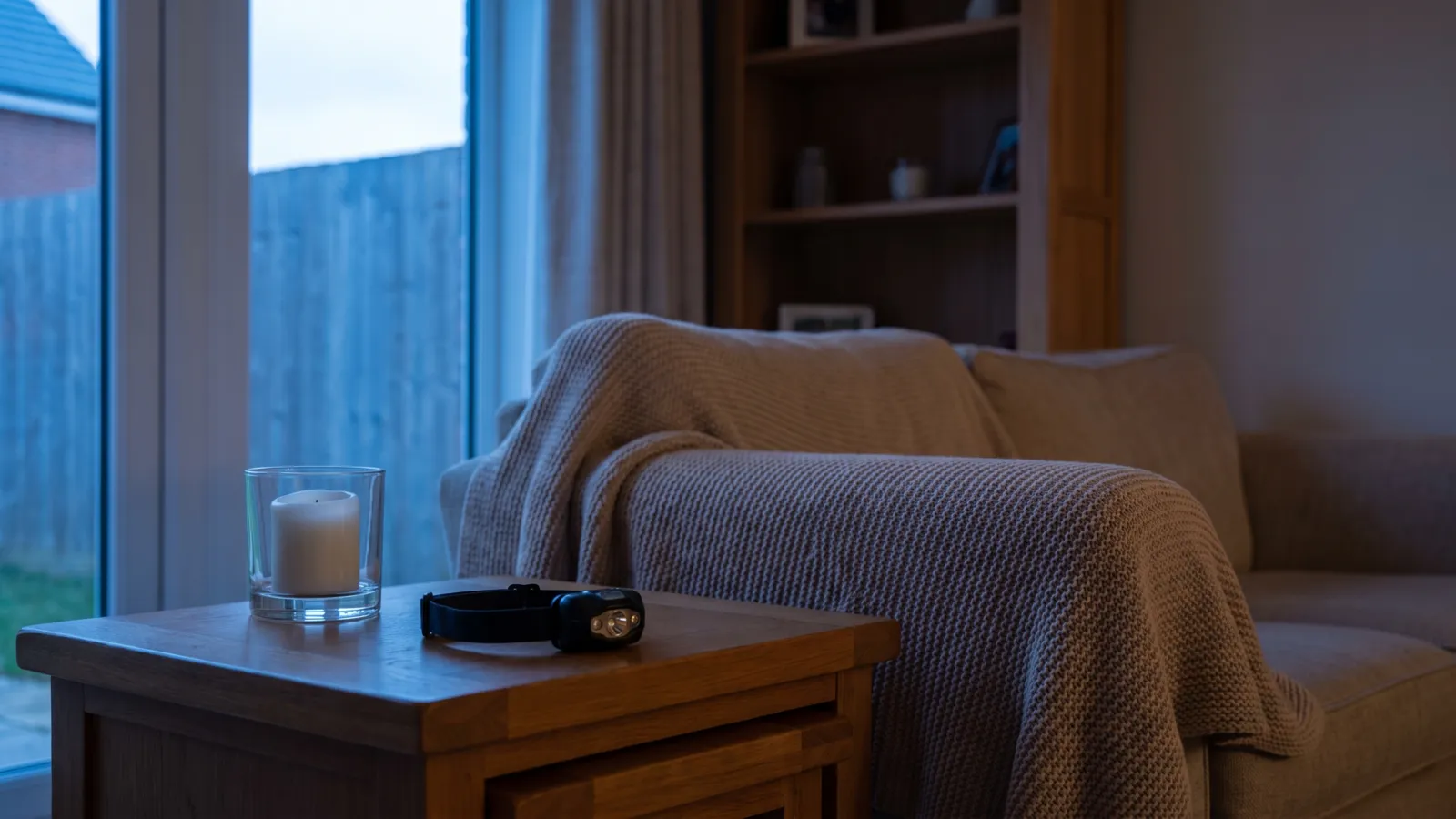
The honest answer: fire services would rather you didn't
When the power goes off, candles are the instinctive answer — most homes have a few, and they cost nothing to use. Fire services don't share the enthusiasm. London Fire Brigade describes candles as one of the most common causes of fires in the home, and both LFB and the Scottish Fire and Rescue Service steer you towards battery-powered light instead.
The reason is in the government's own data. MHCLG's fire statistics for England — data table FIRE0602, updated 19 August 2026 — record 844 accidental dwelling fires started by candles in the year to March 2026. That is roughly 16 a week, and more than matches (111) and cigarette lighters (156) put together. It makes candles the fifth most common specified source of ignition for accidental house fires, behind cooking appliances, electrical distribution, other electrical appliances and smokers' materials — and ahead of space heating appliances. Those fires accounted for 10 of the 161 deaths in accidental dwelling fires that year, and 241 non-fatal casualties (a count that includes people sent to hospital for a precautionary check).
It isn't a fluke year. The candle figure has sat between roughly 800 and 950 every year since 2010/11, while accidental dwelling fires overall fell by a quarter — from 31,723 to 23,795. So candles account for a slightly larger share of England's accidental house fires now (3.5%) than they did fifteen years ago (2.9%), not a smaller one. London Fire Brigade issued a festive warning in December 2025 after four candle fires in four days across the capital.
None of that means a candle in a proper holder, on a stable heat-resistant surface, is about to burn your house down. It means the base rate is worse than most people assume — and a power cut is exactly the situation where a candle gets lit carelessly: in the dark, in a hurry, with people moving between rooms.
If you do use one, the rules that actually matter
Where London Fire Brigade and the Scottish Fire and Rescue Service agree, the rules are short. Put every lit candle in a proper holder, on a stable, heat-resistant surface — not a saucer balanced on a sofa arm, not a windowsill beside the curtains. Keep them well away from anything that can catch fire; LFB names curtains, papers, furniture and clothes.
Never leave a lit candle alone. SFRS puts it plainly: only light candles in a room you are using, and if you are going out or going to sleep, make sure they are all extinguished. LFB's advice is the same — candles out before bed.
One rule gets broken almost exclusively during power cuts, so it is worth stating on its own: do not carry a lit candle around the house. SFRS advises specifically against using candles as a light source when moving from room to room. If you need to leave the room, put the candle out and move with a torch.
Tea lights need their own warning. LFB warns that they get very hot and, without proper holders, can melt through plastic surfaces such as a TV or a bath. A tea light sitting directly on plastic is not a minor risk.
Keep candles, matches and lighters out of reach of children, and mind pets — a naked flame at tail height is knocked over easily.
Better light, for very little money
A head torch is the single best upgrade for a power cut, because it points where you look and leaves both hands free — which matters more than it sounds when you are finding the fuse box, carrying a child or making a hot drink in the dark. It also can't fall over onto the curtains.
For lighting a whole room rather than your immediate view, a lantern gives even, ambient light with no naked flame, and a wind-up torch-radio keeps working when the batteries you meant to replace have gone flat. Between them they cover the two jobs people actually light candles for.
And if what you really want is to see your phone — check for updates, ring someone, look something up — a power bank does that job, which no candle was ever going to.
None of this needs to be expensive, and unlike a candle, none of it is still a fire risk after you've forgotten about it.
The one absolute never: nothing that burns fuel, indoors
Everything above is about light. Heat is a different question, and the line here is not negotiable: never bring a barbecue, camping stove, patio heater or gas or gel-fuel burner indoors during a power cut. Not briefly, not in a well-ventilated room, not to take the chill off. A generator is the same rule — it runs outdoors, well away from doors, windows and air bricks.
These all burn fuel, and burning fuel in an enclosed space produces carbon monoxide. The HSE describes it as a colourless, odourless, tasteless gas, so there is no smell to warn you. The NHS lists the symptoms as headache, dizziness, feeling sick or being sick, feeling weak, tiredness and confusion, chest and muscle pain and shortness of breath — a cluster that reads like flu, with one useful difference: carbon monoxide poisoning does not cause a high temperature.
A barbecue that looks like it has gone out can still give off carbon monoxide for hours. If you suspect CO, get everyone and any pets outside into fresh air; call 999 if anyone has collapsed, lost consciousness or is struggling to breathe, and for milder symptoms ring NHS 111 and say you think it may be carbon monoxide. An audible alarm meeting BS EN 50291 is the only thing that will reliably warn you in the first place.
Common questions
Are candles actually dangerous, or is this overcautious advice?
The risk is real but proportionate. Candles started 844 of the 23,795 accidental house fires in England in the year to March 2026 — about 3.5% of them. The point isn't that candles are exceptionally dangerous; it's that a head torch removes the risk entirely for very little money, so there's no real trade-off to make.
Are tea lights more dangerous than normal candles?
For melting and scorching surfaces, yes. London Fire Brigade warns that tea lights get very hot and, without proper holders, can melt through plastic surfaces such as a TV or a bath. Always use a heat-resistant holder, and never stand one directly on plastic or fabric.
Is it OK to use a candle if I stay in the room with it?
Staying in the room is the right instinct, but it isn't the whole rule. The Scottish Fire and Rescue Service says to light candles only in a room you're using, to put them all out if you go out or go to sleep, and not to use them as a light source when moving from room to room. In a power cut, that last one is the rule people break.
Can I use a gas camping stove indoors just to see by, without cooking on it?
No. Any gas, gel-fuel or charcoal-burning appliance produces carbon monoxide while it burns, whether or not you're cooking on it, and it builds up fast in an enclosed room. Barbecues, camping stoves and gel-fuel burners stay outdoors, full stop — and a barbecue that appears to have gone out can still give off carbon monoxide for hours.
Are LED or flameless candles a reasonable substitute?
Yes — London Fire Brigade recommends battery-powered LED candles precisely because they can be left unattended without risk. They won't light a room the way a lantern will, but if what you want is the look of a candle, they're the version that can't start a fire.
What's the single best replacement for candles in a power cut?
A head torch, for most households. It's hands-free, runs for hours, and can't be knocked over onto the curtains. Pair it with a lantern for whole-room light and a power bank to keep your phone alive.
Sources: MHCLG: Fire statistics data tables — FIRE0602, Primary fires, fatalities and non-fatal casualties by source of ignition, England (updated 19 August 2026) · MHCLG: Fire and rescue incident statistics, England, year ending March 2026 · London Fire Brigade: Candles — fire safety at home · London Fire Brigade: Warning after spate of candle fires over festive period (December 2025) · Scottish Fire and Rescue Service: Power cuts · NHS: Carbon monoxide poisoning. PreparedBritain is independent and not affiliated with HM Government.
The Power Cut Action Card
One page for the kitchen drawer: what to do first, what to have ready, how long food keeps, and how to stay warm without risking carbon monoxide. Free, no catch.
Download it straight away. We'll also send the occasional briefing when something genuinely matters — severe weather, live incidents, real price drops. Nothing else.
Keep reading
All power cuts & energy guides →How to run a generator safely: carbon monoxide, positioning, refuelling and fuel storage
UK generator safety, fully sourced: carbon monoxide rules, 6-metre positioning, refuelling, legal petrol storage…
Power cut with a baby: feeding, sterilising and keeping them warm safely
How to feed, sterilise and keep a baby safely warm in a power cut — NHS formula rules, cold-water sterilising and…
Insulin and fridge medicines in a power cut or heatwave: what's safe and what to do
NHS-sourced temperature windows for insulin and fridge medicines in a power cut or heatwave, correct cool-bag…