Power cut with a baby: feeding, sterilising and keeping them warm safely
How to feed, sterilise and keep a baby safely warm in a power cut — NHS formula rules, cold-water sterilising and safer-sleep warmth, step by step.
By Tom Calder · Updated 12 August 2026 · Sourced to the NHS, the Lullaby Trust & the FSA
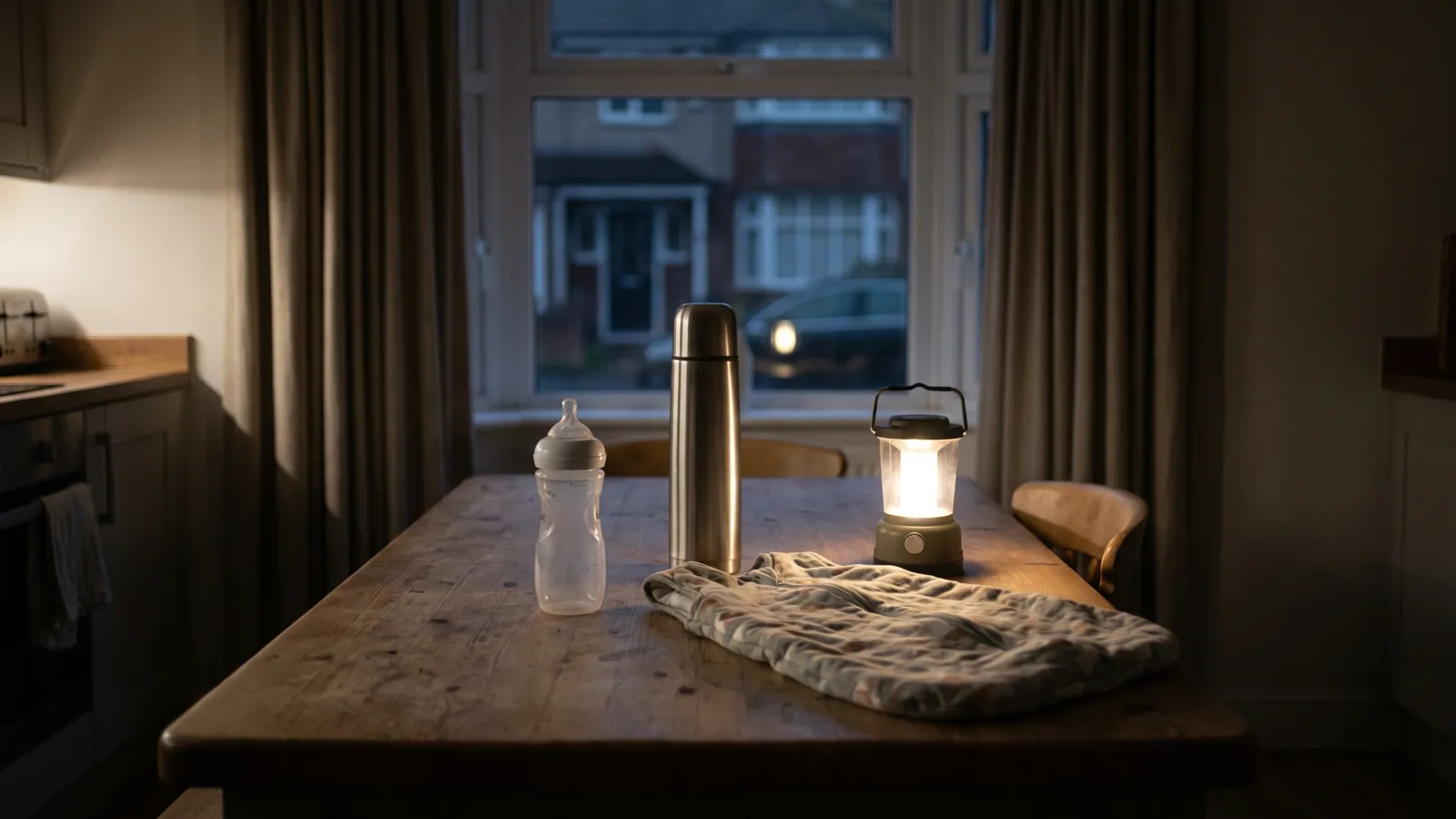
It's 9pm, the power's off and a feed is due
A power cut with a baby in the house comes down to two jobs: the next feed, and keeping them warm overnight. Everything else — the fridge, the Wi-Fi, your own phone battery — can wait. Call 105 (free, from any phone) to report the cut and get a restoration estimate, and use a torch rather than candles, especially anywhere near a cot or changing table.
Neither job needs special equipment beyond what a normal kitchen holds. But two cheap additions — a few ready-to-feed cartons and a tub of cold-water sterilising tablets — turn a stressful evening into a routine one, which is why they earn a place in any baby emergency kit.
Ready-to-feed cartons: the calm answer
Ready-made liquid formula is the calm answer, and it helps to understand why. Unlike powder, the liquid in an unopened carton is sterile — it needs no water, no boiling and no cooling. Pour it into a sterilised bottle and feed. The NHS's 70°C rule exists to kill bacteria in non-sterile powder; ready-to-feed simply doesn't have that problem, and it's safe served at room temperature — warming a bottle is about your baby's preference, not safety.
Keep two or three cartons in the cupboard, rotated by their use-by dates. They cost more per feed than powder, which is exactly why they're the emergency option rather than the everyday one: a few pounds covers several power-cut feeds with zero equipment. While the fridge is off, open a fresh carton for each feed and throw away whatever your baby doesn't finish rather than saving it.
Powdered formula: the vacuum-flask method
If powder is all you have, the NHS method still works without mains electricity — it just needs hot water. Formula powder is not sterile, so it must be mixed with water at 70°C or above to kill any bacteria in the powder itself. A vacuum flask filled to the top with freshly boiled water and sealed will keep it above 70°C for several hours — the NHS's own suggestion for feeds away from home, and it works just as well for feeds away from electricity. If a cut is forecast, fill the flask while you still can; otherwise boil water on a match-lit gas hob or outdoors.
Make one feed at a time: hot water into a sterilised bottle first, then the exact number of scoops, mix, and cool it quickly by standing the bottle in cold water. Test it on the inside of your wrist — body temperature, not hot — and use the feed within two hours.
What never changes, power or not: never mix powder with cooled or cold water — cleanliness is not sterility. Don't stockpile made-up bottles in the fridge, because the NHS's 24-hour storage allowance assumes a fridge that's actually cold — 5°C or below — which a fridge without power soon isn't. Never add extra scoops, and avoid bottled water — it isn't sterile and can contain too much sodium or sulphate for a baby; if it's genuinely all you have, it still needs boiling first.
Sterilising with no electricity
A steam steriliser is a paperweight without mains power, but cold-water sterilising needs no electricity at all: sterilising tablets or fluid, a clean container with a lid, and cold tap water. Wash bottles and teats in hot soapy water, rinse, then submerge them completely in the solution — no trapped air bubbles — for at least 30 minutes. The same batch of solution stays effective for 24 hours, and equipment can be left in it until needed.
The alternative is boiling everything for at least 10 minutes, fully submerged — fine if you have a safe heat source, though teats wear out faster this way. A tub of tablets costs about the price of a coffee and belongs in the baby kit permanently. And wash your hands and clean the work surface before assembling bottles: sterilising is undone by dirty hands.
Expressed milk and the fridge
Expressed breast milk follows the NHS storage rules: up to 8 days in a fridge running at 4°C or lower — and if you're not sure of the temperature, or it's higher than 4°C, use it within 3 days. Keep it where the fridge stays coldest, at the back rather than in the door. In a power cut a closed fridge warms slowly — food-safety guidance is that chilled contents are fine while they stay under 8°C, and once the fridge has warmed past that, anything perishable should be used within four hours. So keep the door shut, use the milk you have in date order, and resist the urge to keep checking. Once your baby has drunk from a bottle, anything left over should be used within an hour or thrown away.
The freezer buys far more time — around 48 hours if it's full, 24 if half-full, door shut. Frozen milk that has fully thawed should be used straight away and never refrozen. And the last-resort rule applies to milk exactly as it does to food: if in doubt, throw it out.
Keeping them warm — and the free register to join tomorrow
Cold houses worry parents, but the Lullaby Trust's advice cuts both ways: overheating is the bigger safer-sleep risk, and the answer to a cool room is layers, not improvisation. The ideal room temperature is 16–20°C; if the house drops below that, add one extra layer of clothing, or use a sleep bag of the right tog or blankets firmly tucked no higher than the shoulders. Never put a hot water bottle or electric blanket in a baby's sleep space, never use loose or doubled-over bedding, and no hats indoors for sleep. Check the chest or the back of the neck — it should feel warm, not hot or sweaty; cool hands and feet are normal.
Over a long winter cut, close curtains and internal doors and gather in one room so everyone shares the warmth, with the cot or Moses basket alongside you — the safest place for a baby to sleep is in your room anyway. What you must not do is fall asleep with the baby on a sofa or armchair, however cold the night: that risk far outweighs any warmth gained.
Finally, the ten-minute job for tomorrow: households with a child under five qualify for the free Priority Services Register, which brings advance notice of planned power cuts and priority support and updates during unplanned ones. Register with both your electricity network operator and your supplier — it's the cheapest resilience a family with a baby can buy, because it's free.
Common questions
Can my baby drink formula at room temperature?
Ready-to-feed liquid formula, yes — it's sterile until opened and safe served at room temperature; warming is about preference, not safety. Powdered formula is different: it must be made up with water at 70°C or above to kill bacteria in the powder, then cooled before feeding. The heat rule is about making the feed, not serving it.
A power cut is forecast — can I make bottles up in advance?
No. The NHS advice is to make powdered feeds fresh, one at a time. The exception that allows storage — the back of a working fridge, for up to 24 hours — assumes a fridge that's actually cold (5°C or below), which one without power soon isn't. For a planned outage, buy ready-to-feed cartons and fill a vacuum flask with just-boiled water before the power goes off.
How do I warm a bottle without electricity?
Stand the bottle in a jug of warm water for a few minutes, then shake it and test on the inside of your wrist. (The NHS advises against microwaving feeds even in normal times, because a microwave can heat the milk unevenly and scald a baby's mouth.) A ready-to-feed carton can simply be served at room temperature — no warming needed.
Can I boil water indoors on a camping stove for a feed?
No — take it outside. Camping stoves, barbecues and patio heaters must never be used indoors because of the carbon monoxide risk. A mains-gas hob usually still works in a power cut: most can be lit with a match if the electronic ignition is dead (check your model's manual). Otherwise boil outdoors, or rely on the flask and cartons.
Should my baby wear a hat or have extra blankets if the house is cold?
Not a hat — babies release excess heat through their heads, and the Lullaby Trust advises no hats indoors for sleep. Add an extra layer of clothing, or use blankets firmly tucked no higher than the shoulders, then check the chest or back of the neck: it should feel warm, not hot or sweaty. Cool hands and feet are normal and not a sign your baby is cold.
The baby monitor is dead — what do I do?
Nothing clever: keep the baby where you can see and hear them. NHS and Lullaby Trust advice is that babies sleep in the same room as you for their first six months anyway, so a power cut is simply a night to follow that advice to the letter — cot or Moses basket in the room where you are.
Sources: NHS — Making up baby formula · NHS — Formula milk: common questions (flask method, ready-to-feed, storage times) · NHS — Sterilising baby bottles · NHS — Expressing and storing breast milk · The Lullaby Trust — Room temperature for a sleeping baby · Food Standards Agency — Food safety in a power cut (GOV.UK). PreparedBritain is independent and not affiliated with HM Government.
The Power Cut Action Card
One page for the kitchen drawer: what to do first, what to have ready, how long food keeps, and how to stay warm without risking carbon monoxide. Free, no catch.
Download it straight away. We'll also send the occasional briefing when something genuinely matters — severe weather, live incidents, real price drops. Nothing else.
Keep reading
All power cuts & energy guides →Insulin and fridge medicines in a power cut or heatwave: what's safe and what to do
NHS-sourced temperature windows for insulin and fridge medicines in a power cut or heatwave, correct cool-bag…
What size portable power station do you actually need? A UK sizing guide
Plain watt-hour arithmetic for UK homes — fridge-freezer, combi boiler, CPAP, router — three sizing tiers, and when…
How to cook without power: safe hot food in a power cut
Safe ways to get hot food in a power cut: the one rule (never burn fuel indoors), a what-to-use decision guide, real…