Jackery vs EcoFlow: which power station brand for a UK home?
Jackery or EcoFlow for UK power cuts? The Explorer 1000 v2 and 2000 v2 against the DELTA 3 Plus and DELTA 3 Max Plus on output, charging, solar, switchover, expansion, warranty and UK support.
Neither brand is better for every UK home. On like-for-like units, EcoFlow’s DELTA 3 Plus and DELTA 3 Max Plus have the higher continuous output (1,800W and 3,000W against Jackery’s 1,500W and 2,200W), four UK sockets to two, faster mains recharging (56 and 68 minutes against about 1.7 hours), 1,000W of solar input against 400W, and take extra batteries to 5kWh and 10kWh. Jackery’s Explorer 1000 v2 and 2000 v2 are lighter (10.8kg and 17.5kg against 12.5kg and 22.1kg), publish a 4,000-cycle rating on both where EcoFlow gives none for the Max Plus, and have fewer settings to get wrong, but are fixed-capacity and quote 20ms switchover against EcoFlow’s 10ms on the DELTA 3 Plus. Jackery’s expandable Plus v2 units are not covered here. Whichever you buy, set it up before a cut and register the warranty.
By Tom Calder · Updated 12 October 2026 · Sourced to Jackery UK, EcoFlow UK, ResMed, the FSA and GOV.UK
How the two ranges line up
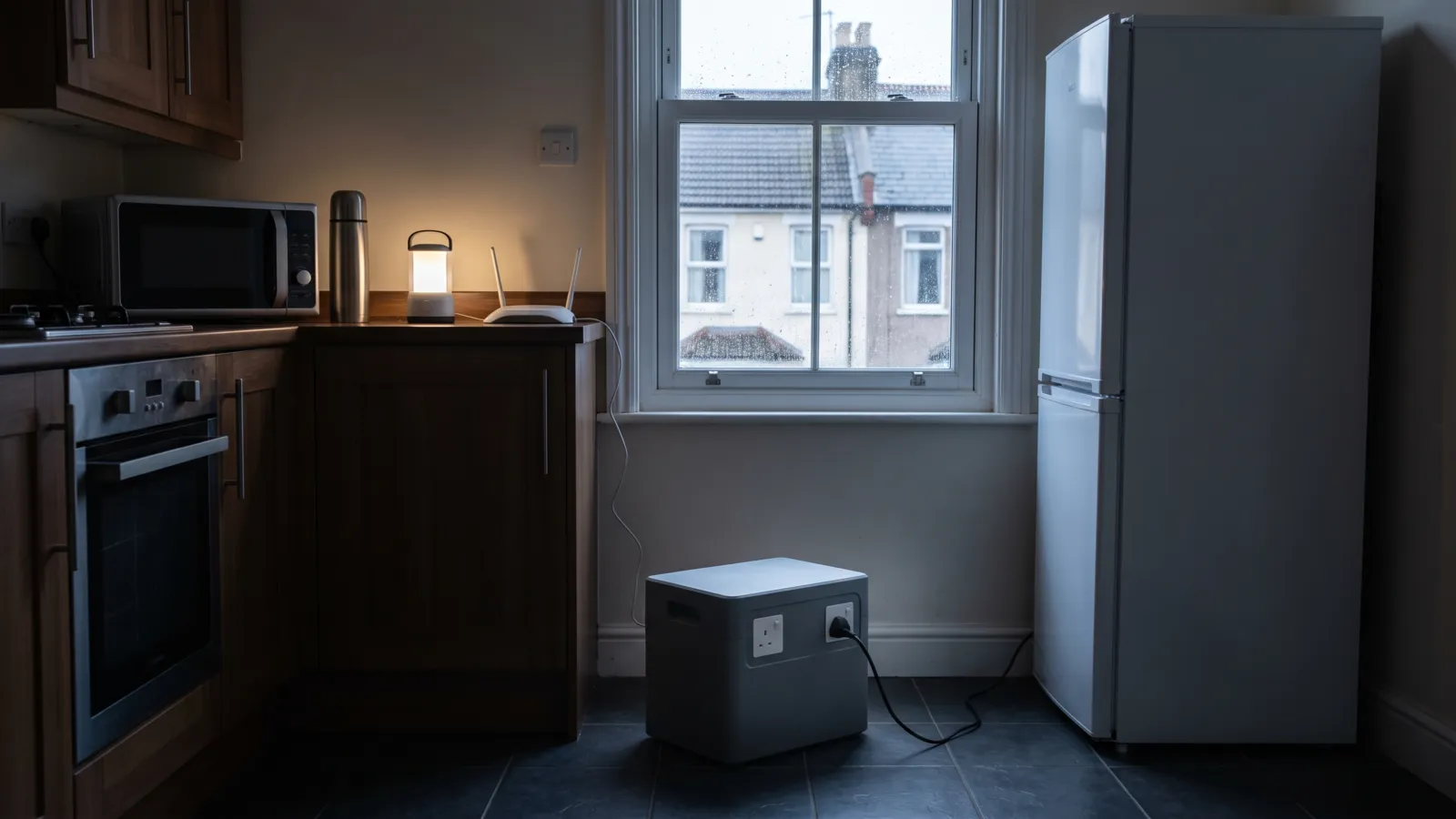
Jackery and EcoFlow both sell units at the two sizes that matter most in a power cut. At about 1kWh, Jackery’s Explorer 1000 v2 (1,070Wh, 1,500W) sits against EcoFlow’s DELTA 3 Plus (1,024Wh, 1,800W). At about 2kWh, the Explorer 2000 v2 (2,042Wh, 2,200W) sits against the DELTA 3 Max Plus (2,048Wh, 3,000W). All four use lithium iron phosphate cells and have a 12V car socket, by their makers’ spec tables, and three of the four quote a UPS switchover time for running a router or fridge through the unit.
One naming point matters before anything else. Jackery’s plain “v2” units are fixed-capacity: its own comparison pages list the 1000 v2 as “non-expandable” and the 2000 v2 as “not supported” for extra batteries. Jackery also sells an Explorer 1000 Plus v2 and 2000 Plus v2 that do take extra batteries and are closer rivals to EcoFlow’s “Plus” units; they are not in our catalogue, so this guide compares the units we track and says where the Plus v2 siblings change the answer.
If you haven’t settled on a size, start with what size power station do I need, and if you are weighing a battery against a petrol generator, read power station vs generator first. Store stock changes often; the cards on this page show live prices and availability.
About 1kWh: Explorer 1000 v2 vs DELTA 3 Plus
The capacities are near enough equal, 1,070Wh against 1,024Wh, and both makers rate the pack at 4,000 cycles, though to different end points: Jackery to 70% or more of original capacity, EcoFlow to 80%. The headline differences are output and sockets. EcoFlow’s spec table gives the DELTA 3 Plus 1,800W continuous and 3,600W surge through four UK mains sockets; Jackery’s gives the 1000 v2 1,500W continuous and 3,000W surge through two. EcoFlow adds X-Boost to 2,400W for heaters and kettles, which its manual says is off by default on the Plus and unavailable while the unit is charging.
Jackery’s unit is the lighter and smaller box: 10.8kg and roughly 33 × 22 × 25cm on Jackery’s spec table, against about 12.5kg and 40 × 20 × 28cm for the DELTA 3 Plus on EcoFlow’s. For USB, Jackery lists one 100W and one 30W USB-C plus an 18W USB-A; EcoFlow lists two USB-C at up to 140W each and two USB-A at up to 36W. The DELTA 3 Plus is rated IP65 against dust and water on EcoFlow’s page; Jackery’s UK page gives no rating for the 1000 v2, so we don’t either.
This is the size for a fridge-freezer. Its compressor cycles, so its average draw is far below its running draw: our sizing guide plans on 40–80W, and dividing the kWh/annum on the energy label by 8.76 gives your own model’s average. Jackery’s comparison page works out runtimes as capacity × 0.85 ÷ load; on that sum, 40–80W gives roughly 11–22 hours on either unit, an estimate only. Check the compressor’s start-up demand against the surge rating, as Jackery’s tables advise. Read power cut food safety before powering a fridge at all, and power station for a fridge freezer for the settings.
Choose the DELTA 3 Plus for more sockets, more output headroom, 1,000W of solar input and the option of adding a battery. Choose the Explorer 1000 v2 if weight matters more than headroom and you want a fixed, simpler unit; if you want Jackery and expansion, Jackery’s 1000 Plus v2 is the one to compare, not the 1000 v2.
About 2kWh: Explorer 2000 v2 vs DELTA 3 Max Plus
Here the brands part company on output. EcoFlow’s spec table gives the DELTA 3 Max Plus 3,000W continuous, 6,000W surge and 3,900W with X-Boost, through four sockets rated at 13A each. Jackery’s table gives the Explorer 2000 v2 2,200W continuous and 4,400W surge through two sockets, 10A maximum. Kettles run up to 3kW, so the Max Plus is the only one of the four rated to run a 3kW kettle within its continuous rating, at the limit, with nothing else on; on the 2000 v2 a 3kW kettle exceeds the rating. Check the plate on your own kettle.
Jackery’s answer is weight and a published cycle figure. The Explorer 2000 v2 is 17.5kg on Jackery’s UK spec table against about 22.1kg for the Max Plus on EcoFlow’s, and Jackery describes it as the lightest and smallest 2kWh lithium iron phosphate unit, a maker’s claim. Jackery rates it for 4,000 cycles to 70% or more; EcoFlow’s UK page says the Max Plus delivers power “for over 10 years” but prints no cycle count, so the two can’t be compared on that. Noise is quoted at different points, under 30dB for the Jackery and 25dB or less at 600W for the EcoFlow, so neither figure shows which is quieter.
The Max Plus takes DELTA Pro 3 and other EcoFlow extra batteries to 10kWh, per its spec table; the 2000 v2 takes none. Jackery’s own comparison page makes a point that holds for both brands: extra batteries add cost, weight and the energy needed to recharge, and do not raise continuous output. For home oxygen, EcoFlow’s manuals say its power stations are not intended for life-sustaining medical equipment; the Jackery pages we read say nothing either way. Plan on the back-up cylinder your oxygen supplier provides, and read running medical equipment in a power cut.
Choose the DELTA 3 Max Plus to run several appliances at once, boil a 3kW kettle or add storage later. Choose the Explorer 2000 v2 if it has to be carried upstairs or to a car, you want a quoted cycle rating, and 2,200W covers what you’d actually plug in.
NewSee this for your own homeHome Alerts: your postcode's power cuts, warnings and floods, on one screen. Free for your own home. Opening in October; the first 100 on the list get in first.Join the list →Charging and solar
Mains recharging is EcoFlow’s clearest win. EcoFlow’s spec tables give the DELTA 3 Plus 0–100% in 56 minutes from a 1,500W input and the DELTA 3 Max Plus 0–80% in 47 minutes and full in 68 from 2,300W. Jackery’s tables give both the 1000 v2 and 2000 v2 about 1.7 hours as standard, with a faster “Emergency” charge set in the app: about an hour on the 1000 v2 and 1.33 hours on the 2000 v2. Jackery’s own buying guide says frequent use of that mode can stress the battery and is best saved for last-minute needs, so plan on the 1.7-hour figure for everyday use.
Solar is a wider gap. Jackery lists a maximum solar input of 400W on both units; EcoFlow lists 1,000W (two 500W inputs) on both of its, which its tables turn into 70 minutes to full on the DELTA 3 Plus. Jackery quotes roughly 3.8 hours for the 1000 v2 from two of its 200W panels, though its pages give different figures for the 2000 v2, so take any solar time as a fair-weather estimate. Jackery’s 2000 v2 FAQ says some of its own panel models need their adaptor removed and others need it kept, so check which connector your panel needs. See solar backup for a power cut.
From a car, Jackery quotes about 12 hours for the 1000 v2 and about 24 for the 2000 v2 from a 12V socket; the 1000 v2’s car cable is sold separately. EcoFlow quotes far faster figures, 1.3 hours to full on the DELTA 3 Plus and 0–80% in 95 minutes on the Max Plus, but only through its separately sold alternator chargers; its plain 12V car input is 8A. For a home that will mostly recharge from the mains between cuts, none of this decides it.
Switchover, apps and settings before a cut
These units can sit between the wall and a router or fridge as a UPS: mains passes through until it fails, then the battery takes over. EcoFlow quotes under 10 milliseconds on the DELTA 3 Plus; the DELTA 3 Max Plus spec table we read gives no switchover figure, so ask EcoFlow if UPS use matters. Jackery quotes 20 milliseconds or under on both the 1000 v2 and 2000 v2, and lists the 2000 v2 as UL1778 certificated. Either quoted time is quick enough for most routers, but it is not a guarantee: test your own router on the unit, both while it charges and once it is full.
The settings matter more than the brand. EcoFlow’s manuals say the AC output switches off after a set idle time, which can catch a fridge between compressor cycles, so set the AC timeout to “never” in the EcoFlow app; X-Boost also lives there. Jackery’s UK pages document fewer such settings for the v2 units, with Emergency and quiet charging set in its app and charging schedules and a battery reserve documented only on the 1000 Plus v2. Fewer documented settings is not proof there is no auto-off, so read the manual and run a trial night.
For a CPAP, ResMed’s battery guide puts its AirMini and AirSense 10 at roughly 4–20W from 12V with the humidifier off and strongly recommends its DC converter from the car socket over an inverter; it says most of its heated humidifiers must not be used with an inverter. All four units have a 12V socket at 10A. Agree it with your sleep service first, and read power station for a CPAP. Update either brand’s firmware while the power is on, never during a cut.
Neither brand puts carbon monoxide in your home: these are batteries, not engines. The CO warning belongs to petrol and diesel generators, which GOV.UK says must never run indoors and should sit at least 6 metres from the house with the exhaust facing away from windows and doors. Join the Priority Services Register if anyone at home depends on powered equipment.
The Power Cut Action Card
One page for the kitchen drawer: what to do first, what to have ready, how long food keeps, and how to stay warm without risking carbon monoxide. Free, no catch.
Download it straight away. We'll also send the occasional briefing when something genuinely matters — severe weather, live incidents, real price drops. Nothing else.
Where Jackery is the better choice
Weight. On the makers’ UK spec tables, the Explorer 1000 v2 is 10.8kg to the DELTA 3 Plus’s 12.5kg, and the Explorer 2000 v2 is 17.5kg to the Max Plus’s 22.1kg. If the unit lives in a cupboard and comes out for the fridge, the lighter box gets used.
A quoted cycle rating at 2kWh. Jackery rates the 2000 v2 for 4,000 cycles to 70% or more; EcoFlow says “over 10 years” for the Max Plus but gives no cycle figure. For a few cuts a year neither will wear out, but if you’ll cycle daily with solar, Jackery is the one that publishes a number.
Simplicity. Two sockets, no boost mode, fewer app settings documented: less to get wrong at 2am. Jackery’s pages also list a quiet charging mode, under 22dB on one page and under 30dB on another, for a bedroom. If you want Jackery with expansion, its 1000 Plus v2 and 2000 Plus v2 take extra batteries and are rated by Jackery for 6,000 cycles, so the choice is not “EcoFlow expands, Jackery doesn’t”. Where EcoFlow is plainly ahead on these units: output, sockets, mains and solar charging speed, a faster switchover claim on the DELTA 3 Plus, integrated expansion, and a flat five-year warranty and IP65 on the DELTA 3 Plus.
UK warranty and support: what each brand publishes
EcoFlow UK’s warranty table gives the DELTA 3 Plus five years and the DELTA 3 Max Plus three years plus two more on registration in the EcoFlow app. Jackery’s UK product pages for both the 1000 v2 and 2000 v2 carry a “3+2 years” line, and the 2000 v2 page says to register for the extended warranty through Jackery’s online form; its extension page adds that channel-partner orders with several packages need a separate request for each product. The pages we read don’t say whether a direct purchase needs the form, so submit it wherever you buy, Amazon or Jackery’s own store.
Both publish UK company details. Jackery’s UK terms give a company number and a London address; EcoFlow’s contact page gives a company number, a London address, an email and a UK freephone support line on weekdays, 08:00 to 16:00. Jackery’s user-guides page lists a UK freephone line seven days a week, 07:00 to 19:00, while its policy page gives weekday hours for a phone line, so check which applies before you rely on it. A UK address and phone line are not evidence of service quality either way.
Owner reviews of both brands praise the build and performance, and both brands also attract complaints about slow replies and drawn-out warranty claims, so register your purchase on day one and keep the receipt. Owners of both also mention paid add-ons at checkout, such as delivery protection or extra cover; decide on those before you reach the basket. Waiting for a sale? Black Friday power stations tracks the genuine drops.
Common questions
Is Jackery or EcoFlow better for a UK home power cut?
Neither for every home. On like-for-like units, EcoFlow’s DELTA 3 Plus and DELTA 3 Max Plus have the higher continuous output (1,800W and 3,000W against 1,500W and 2,200W), four UK sockets to Jackery’s two, faster mains recharging, 1,000W of solar input against 400W, and take extra batteries. Jackery’s Explorer 1000 v2 and 2000 v2 are lighter, publish a 4,000-cycle rating on both, and have fewer settings to get wrong. All four use lithium iron phosphate cells. Pick on what you will plug in and how often you will lift it.
Which is better for a fridge-freezer, Jackery or EcoFlow?
Either 1kWh unit is sized for one. A fridge-freezer averages well below its running draw because the compressor cycles; our sizing guide plans on 40–80W, which on Jackery’s own runtime sum (capacity × 0.85 ÷ load) is roughly 11–22 hours on either unit, an estimate only. Check the compressor’s start-up demand against the surge rating. On the DELTA 3 Plus, set the AC timeout to “never” in the EcoFlow app, as EcoFlow’s manual says. On the Jackery, read the manual for any auto-off and run a trial night.
Which switches over faster when the power goes?
EcoFlow quotes under 10 milliseconds on the DELTA 3 Plus and Jackery 20 milliseconds or under on the Explorer 1000 v2 and 2000 v2; the DELTA 3 Max Plus spec table we read gives no figure. Either quoted time is quick enough for most routers, but it is not a guarantee, so test yours on the unit first. For a CPAP, ResMed strongly recommends its DC converter from the 12V socket rather than an inverter, and says most heated humidifiers must not be used with an inverter.
Can I add a battery later?
On the EcoFlow DELTA 3 Plus (to 5kWh) and DELTA 3 Max Plus (to 10kWh with DELTA Pro 3 extra batteries), yes, per EcoFlow’s spec tables. On the Jackery Explorer 1000 v2 and 2000 v2, no: Jackery’s own comparison pages list them as non-expandable. Jackery’s Explorer 1000 Plus v2 and 2000 Plus v2 do take extra batteries, to roughly 11kWh and 12kWh by Jackery’s figures. Jackery also notes that extra batteries add cost, weight and the energy needed to recharge without raising continuous output, which holds for both brands.
Which has the better UK warranty, Jackery or EcoFlow?
EcoFlow UK’s warranty table gives the DELTA 3 Plus a flat five years and the DELTA 3 Max Plus three years plus two on app registration. Jackery’s UK product pages show “3+2 years” on the Explorer 1000 v2 and 2000 v2, and the 2000 v2 page says the extended warranty is registered through Jackery’s online form. Its pages don’t say whether a direct purchase needs the form, so submit it wherever you buy, Amazon included, and keep the receipt.
Do Jackery and EcoFlow power stations need an app?
Set them up before you need them, because some power-cut settings live in the apps. EcoFlow’s app is where the AC timeout is set to “never” for a fridge, where X-Boost is switched, where firmware updates run, and where the DELTA 3 Max Plus earns its extra two years of warranty. Jackery’s app controls the faster Emergency charge and quiet charging on the v2 units; Jackery documents charging schedules and a battery reserve on the 1000 Plus v2 but not the 1000 v2.
Sources (25)
- Jackery UK — Explorer 1000 v2 product page1,070Wh; 3+2 years warranty banner; quiet charging mode
- Jackery UK — Explorer 1000 v2 review and spec table1,500W/3,000W surge, 10.8kg, dimensions, ports, 12V 10A, UPS ≤20ms, 1.7h standard / 1h Emergency charge, 4,000 cycles
- Jackery UK — Explorer 1000 v2 vs 1000 Plus v2non-expandable; 400W solar max; runtime = capacity × 0.85 ÷ load; Plus v2 expansion, 6,000 cycles, ≤10ms UPS; app function table; expansion adds cost, weight and recharge energy, not output
- Jackery UK — Explorer 1000 v2 or 1000 PlusEmergency mode caution; 12h car charging; solar times; 22dB quiet charging
- Jackery UK — Explorer 2000 v2 product page2,042Wh; 3+2 years warranty line; extended-warranty registration form; lightest 2kWh LiFePO4 claim; panel adaptor FAQ
- Jackery UK — Explorer 2000 v2 spec table2,200W/4,400W surge, 17.5kg, 2 × AC 10A, 12V 10A, UPS 20ms UL1778, 1.7h / 1.33h charge, 400W solar, 24h car charging, <30dB, 4,000 cycles, temperatures
- Jackery UK — Explorer 2000 v2 vs 2000 Plus v22000 v2 expansion ‘not supported’; Plus v2 to 12kWh, 2,400W, 800W solar, 6,000 cycles
- Jackery — Extend warrantychannel-partner orders with several packages need a separate request per product
- Jackery UK — Terms of service (UK company number and London address)
- Jackery UK — User guides (UK freephone support line, seven days)
- Jackery UK — Policy (weekday phone hours; heavy-item delivery)
- EcoFlow UK — DELTA 3 Series pageDELTA 3 Plus: 1,024Wh, 1,800W/3,600W surge, 2,400W X-Boost, 4 × AC, 2 × 140W USB-C, 2 × 36W USB-A, 12.6V 10A, 56 min charge, 2 × 500W solar in 70 min, 800W car charge in 1.3h, <10ms UPS, 1–5kWh expansion, 4,000 cycles to 80%, IP65, <30dB at 600W, 5-year warranty
- EcoFlow UK — DELTA 3 Max series page‘over 10 years’; 0–80% in 95 min with the Alternator Charger Plus 1000; 3+2 warranty; temperatures
- EcoFlow UK — DELTA 3 Max Plus specifications2,048Wh, 22.1kg, 3,000W total 13A per port × 4, 6,000W surge, 3,900W X-Boost, USB, 12V and Anderson outputs, 2,300W input, 47/68 min charge, 1,000W solar, 12V/24V 8A car input, up to 10kWh with 2 × DELTA Pro 3, 3+2 years, ≤25dB at 600W
- EcoFlow UK — DELTA 3 Max Plus product page (expansion tiers)
- EcoFlow UK — Warranty policyDELTA 3 Plus 5 years; DELTA 3 Max Plus 3+2 on app registration
- EcoFlow UK — Contact usUK company number, London address, UK support line and hours, email
- EcoFlow — DELTA 3 Plus user manualAC timeout ‘never’; X-Boost off by default and unavailable while charging; not for life-sustaining medical equipment; 12V car input 8A
- EcoFlow — DELTA 3 Max Plus user manualX-Boost on by default; AC timeout; medical equipment limit
- ResMed — Battery guideCPAP draw at 12V DC; DC converter recommended; heated humidifiers not to be used with inverters
- Food Standards Agency — Food safety in a power cut
- GOV.UK — UK CMOs’ public health advice during a national power outagegenerators never indoors; 6 metres from the house; exhaust away from windows and doors
- NHS — Carbon monoxide poisoning
- Trustpilot — Jackery UK reviews (owner themes read 12 Oct 2026; scores not compared)
- Trustpilot — EcoFlow reviews (owner themes read 12 Oct 2026; scores not compared)
PreparedBritain is independent and not affiliated with HM Government.
Latest from our live data
All stories → News · 21 OctOnly 4 in 100 adults have three days of bottled water at home, the government's survey shows
 News · 21 OctFood inflation held at 1.3%. Wholesale cabbage and cauliflower are up a third. Both are true
 News · 21 OctAldi recall: shoppers warned of hairdryer electric shock or fire risk. How to check yours
Keep reading
All power cuts & energy guides →BLUETTI vs Jackery: which power station brand for a UK home?
BLUETTI or Jackery for a UK home? The Elite 100 V2 and 200 V2 against the Explorer 1000 v2 and 2000 v2 on output,…
BLUETTI Elite 200 V2 vs EcoFlow DELTA 3 Max: which 2kWh power station should you buy?
Three 2kWh power stations compared on what actually differs: output, solar, charging, expansion, cycle rating,…
Boiler not working after a power cut? What to check, safely
Power is back but the boiler is not. The safe checks in order: wait, clock and timer, pressure gauge, one reset, a…
