Philips TAR1609 review
Philips TAR1609 FM/AM Radio with Torch (crank, solar, AAA)
By Tom Calder
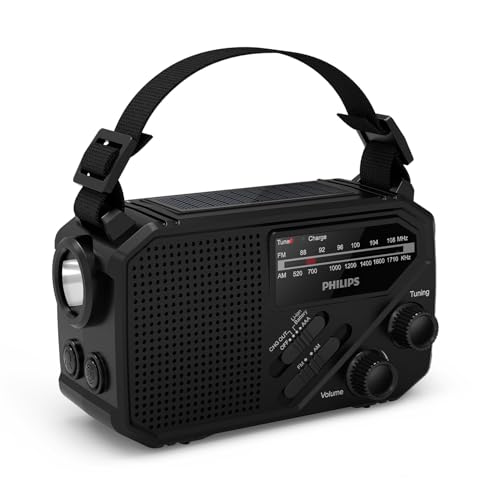
The radio we'd put in a household kit first. Philips quotes up to 32 hours of listening from the built-in battery, it charges from the same USB-C lead as most modern phones, and it also runs on three ordinary AAA cells, so a flat internal battery doesn't leave you relying on the handle or the sun. There's no DAB, no headphone socket and no water-resistance rating, and Philips publishes no torch brightness or crank figure, but it does the one job GOV.UK asks of a radio, from a brand that publishes its specs, without an American weather band you can't use.
- Best for
- Most UK households: a mainstream-brand FM/AM set with its own rechargeable battery, three AAA cells as a fallback, and a crank and solar panel behind those.
- Skip it if
- You want DAB, or a radio that will properly charge a phone
as of 2 Nov 2026, 13:07 GMT · Details
Product prices and availability are accurate as of the date/time indicated and are subject to change. Any price and availability information displayed on Amazon.co.uk at the time of purchase will apply to the purchase of this product.We earn a commission if you buy through the retailer links on this page. It doesn't change our verdict. How we make money →
Researched, not used. We haven't used this product. This review is built from the maker's specifications, owner reports and our own sizing.
What we like
- Takes 3 x AAA as well as its built-in battery, and a packet of alkalines keeps for years in a drawer
- Philips states up to 32 hours of listening from a full charge at a reasonable volume; one owner reports 35 hours non-stop on FM
- Published specs from a known brand: 1W speaker, 390g, USB-C charging, a torch and an SOS alarm with a flashing light
Worth knowing
- FM/AM only, with analogue tuning: no DAB+, no presets and no headphone socket
- No water-resistance rating (one owner says it isn't splash-proof), no published torch or crank figures, and an owner of the identical TAR1659 finds the crank handle very stiff
ⓘ As an Amazon Associate, PreparedBritain earns from qualifying purchases. We may earn a commission when you buy, or a fee when you request a quote, through our links. When two products are close, commission can decide which one we pick. A clearly better product always wins. Amazon prices come from Amazon's own product data and show the date and time they were retrieved. Prices at other retailers are checked by us, less often. Prices and stock can change at any time, so always check the retailer's price before you buy.
Our review
A 390g FM/AM radio with an 18650 lithium cell, a slot for three AAA cells, a hand crank, a solar panel and a torch, and unusually for this type, Philips publishes figures for all of them. The numbers show what to rely on: the cell and the AAA cells. The crank and the sun are the last resort.
The figures, source by source
Philips' manual gives the built-in cell as an 18650 at 3.7V and 2,000mAh, good for up to 32 hours at half volume, with a full USB-C charge taking 3.5 hours. Three AAA (LR3) cells, not supplied, give up to 12 hours at the same volume. Cranking at 120 turns a minute for 25 minutes gives around an hour of radio, and an hour of sun brighter than 60,000 lux gives up to 30 minutes. Those last two are honest numbers, and they show why the crank is for when everything else has run out: 25 minutes of steady winding is hard work. In practice, keep the lithium cell charged from a phone charger, leave three fresh AAA cells in a bag beside it, and you have well over a day of listening before the handle is needed.
What else it does
Tuning is analogue on FM (87.5 to 108MHz) and AM, with no RDS, presets or Bluetooth. The speaker is a 57mm, 1W mono unit. There is a side-button torch and an SOS mode that strobes the torch and sounds a siren. A function switch has four positions: off, charge out, lithium and AAA. In charge-out mode the USB-A socket supplies 5V 0.5A, enough to keep a phone alive but slow to fill it. The box holds the radio, a USB-C cable, a hand strap and the paperwork.
Limits to know
Neither the datasheet nor the manual lists a headphone socket or a water rating, so keep it dry and expect to listen through the speaker. Philips gives no torch brightness. The manual asks you to top the cell up to about half charge every six months if the radio is stored unused, which is worth adding to the same reminder the government's Be Ready campaign suggests for checking kit dates. Its operating range is 0 to 45°C, so a frozen shed is not the place to store it.
How it compares
On our emergency radio comparison its bigger sibling, the Philips TAR3500, adds IP55, a 3W speaker, presets, a headphone socket and a 1A USB port for 670g. The Sangean MMR-99 cranks more efficiently by its maker's figures but weighs 900g and has no disposable-cell fallback. For DAB+ in a similar format, the Nedis RDDBCR2000GN weighs 288g but has no AAA option.
Our verdict
Buy it if you want one compact radio for the household kit that runs for days on its own cell and keeps going on a packet of AAA cells you can buy anywhere. Skip it if you need DAB, a headphone socket for quiet listening at night, or a real phone charger. The government's checklist asks for an FM radio, battery or wind-up, and this meets it with room to spare; see our emergency kit list for the rest.
A researched review, built from the maker's specs, manual and UK listings; facts checked 2 Nov 2026. Sources: Philips: TAR1609 user manual (English, V1.0); Philips: TAR1609 datasheet; Philips UK: TAR1609 product page; UK Government Be Ready: emergency kit checklist.
Who shouldn't buy this
Don't buy it if you want DAB, or a radio that will properly charge a phone. Its USB-A port is an emergency top-up only, so keep a separate power bank.
Key specs
| Power sources | Built-in Li-ion (USB-C charging), 3 x AAA (not included), solar panel and hand crank |
| Bands | FM/AM, analogue tuning (no DAB, no RDS) |
| Phone charging | Emergency top-up only, via USB-A (Philips gives no rating; an owner of the identical TAR1659 says it gives 0.5A at 5V) |
| Built-in torch | Yes - torch, plus an SOS alarm with siren and flashing light (brightness not stated) |
This is a Researched review: we haven't used this product. We check every specification against at least two independent sources, re-check the UK price on a schedule where we can track it automatically, and say plainly who it isn't for. Commissions never change a rating.
If this isn’t the one

Best for A rugged home or shed radio: IP55, a user-replaceable battery Philips rates for up to 60 hours, a phone-charging port and four AAA cells as a fallback.
as of 2 Nov 2026, 13:07 GMT · Details
Product prices and availability are accurate as of the date/time indicated and are subject to change. Any price and availability information displayed on Amazon.co.uk at the time of purchase will apply to the purchase of this product.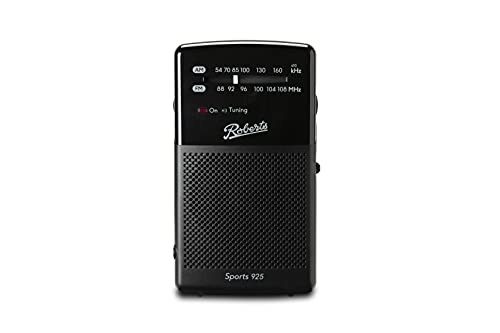
Best for The plain 'battery radio' answer to the GOV.UK kit list: a pocket FM/AM set from a UK radio brand that runs for days on two AA cells and has little to go wrong.
as of 2 Nov 2026, 13:07 GMT · Details
Product prices and availability are accurate as of the date/time indicated and are subject to change. Any price and availability information displayed on Amazon.co.uk at the time of purchase will apply to the purchase of this product.
Best for A tough household radio that can top up a phone from its own cell and keep going from the crank or the sun, if FM and AM are enough.
as of 2 Nov 2026, 13:07 GMT · Details
Product prices and availability are accurate as of the date/time indicated and are subject to change. Any price and availability information displayed on Amazon.co.uk at the time of purchase will apply to the purchase of this product.Questions
How long does the Philips TAR1609 run?
Up to 32 hours at half volume from its 2,000mAh lithium cell, and up to 12 hours from three AAA cells, by Philips' manual. A full USB-C charge of the cell takes 3.5 hours.
How much radio do you get from cranking the Philips TAR1609?
Philips says around 60 minutes of radio after 25 minutes of cranking at 120 turns a minute. An hour of strong sun, above 60,000 lux, gives up to 30 minutes.
Can the Philips TAR1609 charge a phone?
Only slowly. With the function switch on charge out, its USB-A socket gives 5V 0.5A, enough for an emergency top-up. Keep a separate power bank for proper charging.
Does the Philips TAR1609 have a headphone socket?
None is listed in Philips' datasheet or manual. It has a 1W speaker, analogue FM and AM tuning, a torch and an SOS siren.
Free alerts for your home
Home Alerts emails you when a power cut, a Met Office warning or a flood warning covers your postcode. Free for your own home. Sign up in a minute.
Start free →