Can a power cut damage your appliances?
What really happens electrically when the power comes back on, which appliances are genuinely at risk, and how to protect them without overspending.
By Tom Calder · Updated 26 August 2026 · Sourced to the Institution of Engineering and Technology (IET), National Grid Electricity Distribution, SSEN, Electricity North West, Northern Powergrid, Electrical Safety First, UK Power Networks, Citizens Advice, Sollatek and Worcester Bosch.
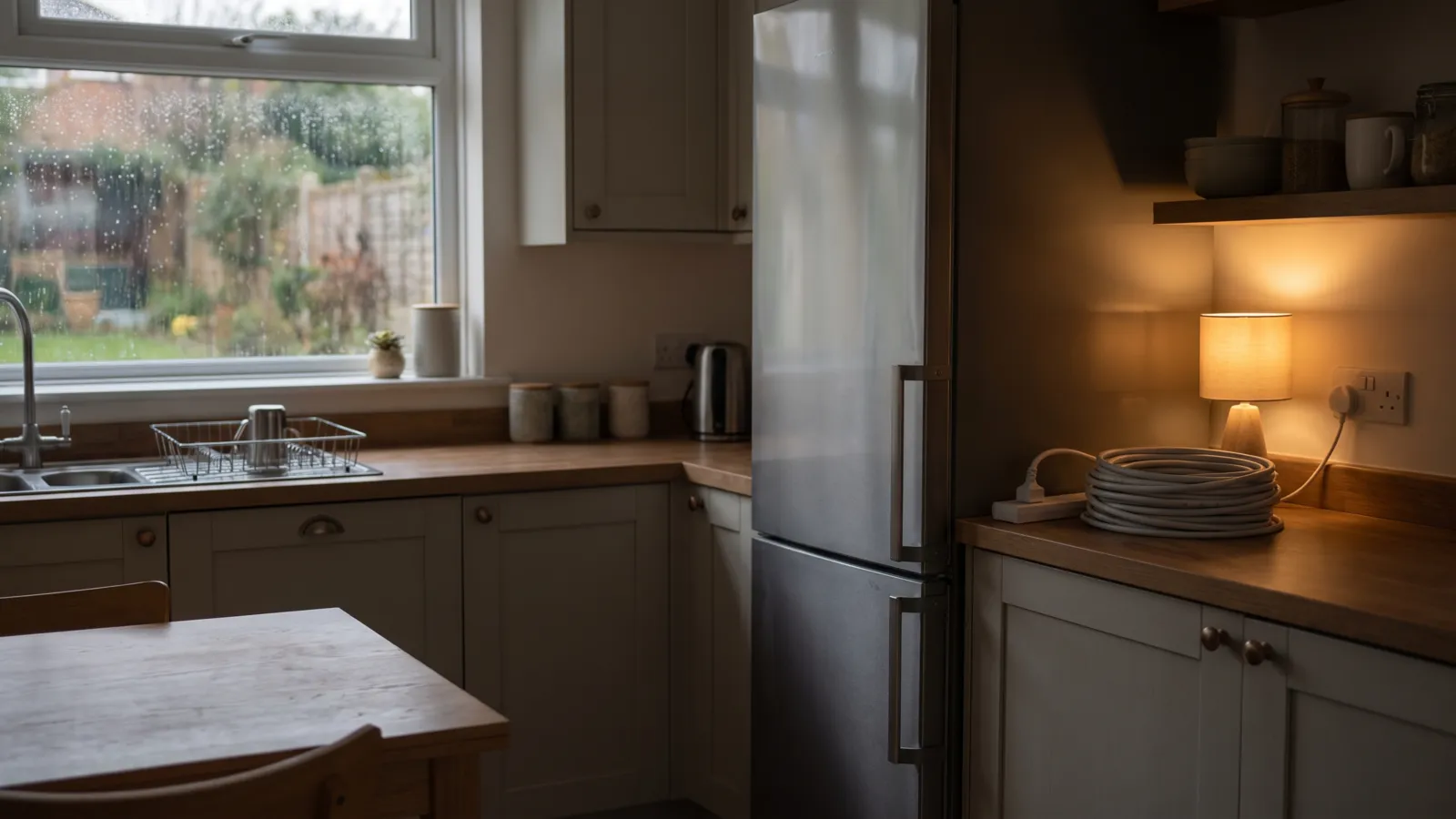
What actually happens when the power comes back
While the power is off, nothing is happening to your appliances electrically. No current is flowing, so there is nothing for a surge to damage. The electrical event, if there is one, is the moment supply is restored — which is why National Grid Electricity Distribution's power cut advice is to turn off or unplug sensitive and expensive electrical equipment while you are waiting, on the basis that electrical surges during power cuts can damage digital devices.
The IET, which publishes the UK wiring regulations, describes two families of cause for these short bursts of higher voltage, known as transients. Natural ones: indirect lightning strikes, most often a strike on a nearby overhead power or telephone line rather than on your house. And man-made ones: the switching of motors and transformers, and some types of lighting — plus newer household loads the IET names specifically, including electric vehicle charging, air and ground source heat pumps, and speed-controlled washing machines. Some of that originates out on the network; some of it originates inside your own home.
None of this means every power cut ends in a surge, or that a surge always causes damage. The overwhelming majority of power cuts end with everything coming back on exactly as it was. What it does mean is that the restoration moment is where what risk there is sits — and that tells you when to act, and what to act on.
What's genuinely at risk — and what isn't
The IET's own description of what surge protection is for maps the risk category well: sensitive electronic equipment such as computers, televisions and washing machines, plus safety circuits such as fire detection systems and emergency lighting. The common thread is control electronics designed to work within a narrow voltage range. That is why a router, a games console, a smart TV, a washing machine's control board and a modern boiler's circuit board all belong on the same list, and why the list is shorter than most people assume.
By the same logic, an appliance that is essentially a heating element and a thermostat has very little for a transient to find — a kettle, a toaster, an iron, an immersion heater, a plug-in convector heater. We would treat that as a reasonable inference from where the standards place the risk rather than a cast-iron guarantee, and plenty of modern kettles now carry electronic controls of their own. But it is the reason 'unplug everything in the house' is over-cautious advice. It is the electronics that want attention, not the whole kitchen.
Fridges and freezers are a separate case, and not really a surge story at all. A compressor builds up internal gas pressure while running and needs that pressure to settle before it restarts. Sollatek, which manufactures voltage-protection equipment, explains that if those gases do not neutralise first it 'can be very damaging to the compressor and can cause total appliance failure' — which is why protection devices impose a delay of around three minutes before allowing a restart, and why many modern fridges have a similar delay built in. Sollatek also notes that voltages can fluctuate after a power cut, and that the delay stops appliances switching on and off unnecessarily while supply stabilises.
So the scenario that actually threatens a compressor is not one clean cut. It is repeated short cycling on an unstable supply — power flickering on and off, as it can during storm restoration. If that is what you are seeing rather than a clean cut, switching the fridge off at the socket until the supply settles is the one sensible exception to leaving it alone. Keep the door shut, and switch it straight back on once power is steady.
The unplug ritual — what to switch off, and what to leave alone
National Grid Electricity Distribution advises turning off or unplugging sensitive and expensive electrical equipment, naming phones, TVs, laptops and tablets. We would add the rest of the same category: your router, your computer and your games console. SSEN's advice is broader and simpler — switch off all electrical appliances, and always leave one light on so you know the moment electricity has returned.
Electricity North West's guidance covers a second and quite separate reason to switch things off, one that has nothing to do with surges: switch off anything not designed to run unattended, and it names cookers, grills, chip pans, hair straighteners and electric fires. The point is that these could come back on with nobody watching, having been forgotten about when the cut struck. Same action, different reason, both worth doing.
What should not be unplugged is your fridge and freezer. Network operators treat them as the exception — leave them running and keep the doors shut, because what actually costs you food is the door being opened to check, not the cut itself. Keep your phone charged instead, so you can follow updates or call for help; a power bank is cheap insurance for exactly that.
When power's back: fridge, freezer and boiler
Your fridge and freezer need nothing from you, and the food inside stays safe for a set window provided the doors have stayed shut. Be aware that the network operators' own published figures for that window vary quite widely — Electricity North West gives at least four hours for a fridge and 24 to 48 hours for a freezer, while National Grid Electricity Distribution says up to 12 hours for a freezer. We set out the Food Standards Agency position, which is the one to work to, in our dedicated guide.
Boilers are the appliance that most reliably needs your attention afterwards. Northern Powergrid's advice, if you use gas heating, is to check whether it will function without electricity — for most modern boilers it will not, because the pump, controls and ignition all run on mains power. What happens next depends on the controls. Worcester Bosch's guidance for its EasyControl thermostat is a good example of the modern case: the unit loses power and the appliance switches off, but it 'remembers last set settings', and as soon as power returns the thermostat reboots, retrieves the time from the internet and restarts to its existing clock programme — which does assume your router is back too. Older or non-smart programmers will not do this, and Electricity North West's advice is to reset the timer and thermostat as soon as your electricity comes back on, checking the settings are right before you do.
If your boiler will not fire up even after a proper reset — not just a blank clock, but no ignition at all — that is a job for a Gas Safe registered engineer, not a DIY fix. It is uncommon, but a control board sits squarely in the category of electronics a bad transient can take out, and there is no safe way to check or repair one yourself.
Surge-protected extension leads: what to actually buy
Start with Electrical Safety First's baseline for any extension lead, surge protection or not. The plug should meet BS 1363, marked on the back, and carry a correctly rated fuse meeting BS 1362, marked on the fuse body. Never plug one extension lead into another — Electrical Safety First is explicit that this should never be done, because it risks overloading the wall socket. Never exceed the lead's maximum current rating with the appliances you plug into it, and register the product so you can be contacted in the event of a recall.
For the surge protection itself, the marking worth looking for is BS EN 61643-11, the British and European standard for surge protective devices connected to low-voltage power systems. A plug-in or socket-outlet device is a Type 3 under that standard — supplementary protection, fitted close to the equipment it protects. Many leads also advertise a joule rating, and higher is broadly better, but treat it as a rough indicator rather than a like-for-like comparison: it is a manufacturer-declared figure, not a standardised test result, so the standard marking is the more reliable signal.
It is also worth knowing that a surge protector is consumable. The protective components degrade as they absorb surges, and a lead that has taken a significant hit can carry on passing power normally while no longer protecting anything. Many have a status indicator light for exactly this reason — if it has gone out, replace the lead rather than trusting it a second time.
You do not need to protect the whole house this way. One 4- to 6-way surge-protected lead behind the desk or the media unit, covering the router, the TV and the computer, covers the actual risk category. It is worth keeping year-round rather than digging it out for storms, since the switching transients the IET describes are generated by ordinary equipment as well as by weather.
Whole-house surge protection: worth it?
For new electrical work this is now closer to standard than optional. BS 7671:2018+A2:2022, the current version of the UK wiring standard, came into full effect on 28 September 2022 and rewrote the surge protection rules. It scrapped the old risk-assessment method that many ordinary homes used to fall outside, and now requires protection against transient overvoltages where the consequences could cause serious injury or loss of life, or significant financial or data loss. In all other cases protection must still be provided unless the owner of the installation declares it is not required, on the basis that any loss or damage would be tolerable and they accept the risk. Note the direction of that: the default is now that it goes in, and it is the homeowner who opts out, not the electrician who signs it off as unnecessary.
A whole-house device is fitted by a qualified electrician in or beside your consumer unit, and protects everything on the installation rather than only what happens to be plugged into one lead — including things a plug-in protector cannot reach, such as your boiler, hard-wired smoke alarms or an electric shower.
BS 7671 is a standard rather than a statute, and it applies to new and altered work, not retrospectively. If nothing in your older property has been touched since 2022, you are not required to retrofit anything. The sensible play is to raise it at your next rewire, consumer unit upgrade, boiler replacement or EV charger installation, when the electrician is already at the board and the marginal cost is far lower than a standalone visit — rather than treating it as an emergency purchase after a bad night.
If something does get damaged: compensation, and what to protect properly
Do not expect your network operator to pay out. UK Power Networks states plainly that it is 'not liable for any damage to electrical appliances such as TVs, computers' as a result of a power cut, and points customers to their home insurer. Citizens Advice confirms the general position: your electricity network operator does not have to give you compensation for damage to electronic devices after a power cut. It is still worth asking — operators may make a discretionary goodwill payment covering some or all of the cost, and Citizens Advice suggests supporting the request with photographs and receipts. That is a separate question from the Guaranteed Standards payment you may be owed simply for being off supply beyond a set number of hours, which we cover separately.
For anything you genuinely cannot afford to lose power to even briefly — a router that carries your only phone line, for instance — a surge-protected lead is the wrong tool, because the device still goes dark during the cut itself. A battery-backed power station keeps it running through both the cut and the restoration, which sidesteps the problem rather than mitigating it.
If anyone in your household relies on powered medical equipment, treat this as a planning question rather than a shopping one, and start with the Priority Services Register. Around 120,000 people on UK Power Networks' register alone — covering London, the South East and the East of England — rely daily on equipment such as ventilators, feeding pumps, nebulisers and oxygen saturation monitors, and UK Power Networks loans portable battery packs free of charge to those customers for cuts lasting more than four hours. Register well before you need it. And never assume a consumer power station is a suitable backup for life-supporting equipment without checking the run time, connection and safe use with the equipment supplier or clinical team first. We set out the full picture in our medical equipment guide.
Common questions
Can a power cut really damage my appliances?
Selectively, yes, though the great majority of power cuts end with everything working normally. The risk sits with control electronics — computers, TVs, routers, games consoles, and appliances with circuit boards such as modern boilers and washing machines. Appliances that are essentially a heating element and a thermostat, like kettles and toasters, have very little for a transient to damage. The moment of electrical risk is when supply is restored rather than while it is off, which is why National Grid Electricity Distribution advises unplugging sensitive equipment during the cut itself.
Do I need to unplug everything during a power cut?
No. Network operator advice is to switch off or unplug sensitive electronics such as the TV, computer and router, and anything not designed to run unattended — Electricity North West names cookers, grills, chip pans, hair straighteners and electric fires. Your fridge and freezer should be left running with the doors shut. Unplugging them protects them from nothing and risks losing food to an opened door.
What should I look for in a surge-protected extension lead?
First the basics Electrical Safety First sets for any lead: a plug meeting BS 1363, a correctly rated BS 1362 fuse, never daisy-chained into another lead, and never loaded beyond its current rating. For the surge protection itself, look for BS EN 61643-11 — the standard for surge protective devices on low-voltage power systems — with a plug-in unit classed as Type 3. Joule ratings are a rough guide only, as they are manufacturer-declared rather than a standardised test result. Check the status indicator too: protection degrades with each surge absorbed, and a lead can still pass power after its protection is spent.
Will my electricity network pay if a power surge damages my TV or computer?
Usually not. UK Power Networks says it is not liable for appliance damage caused by a power cut, and Citizens Advice confirms network operators are not obliged to compensate for damaged electronic devices. They may make a discretionary goodwill payment, so it is worth asking with photographs and receipts to hand, but home contents insurance is the realistic route. That is separate from the Guaranteed Standards payment you may be owed for being without power beyond a set number of hours.
Is whole-house surge protection a legal requirement in the UK?
BS 7671 is a standard rather than a law, but for new and rewired domestic installations it now amounts to a default requirement. BS 7671:2018+A2:2022 took full effect on 28 September 2022 and removed the old route by which ordinary homes fell outside the rules. Surge protection must be provided unless the owner of the installation declares it is not required and accepts the risk of damage — so the omission is the homeowner's decision, not a technical exemption. Existing older installations are not required to retrofit one.
Sources: IET — Surge Protective Devices: consumer guidance · IET Wiring Matters — Surge Protective Devices (SPDs) · National Grid Electricity Distribution — What to do in a power cut · SSEN — What to do during a power cut · Electricity North West — Tips to help you during a power cut · Northern Powergrid — What to do in a power cut · Electrical Safety First — Plugs and fuses · Electrical Safety First — Extensions and leads · UK Power Networks — Compensation: a power cut damaged something in my home · Citizens Advice — Get compensation if you have a power cut · UK Power Networks — Extra support for people reliant on electricity for medical reasons · Sollatek — Why is there a time delay before switching on my fridge? · Worcester Bosch — We've had a power cut. Does that affect EasyControl?. PreparedBritain is independent and not affiliated with HM Government.
The Power Cut Action Card
One page for the kitchen drawer: what to do first, what to have ready, how long food keeps, and how to stay warm without risking carbon monoxide. Free, no catch.
Download it straight away. We'll also send the occasional briefing when something genuinely matters — severe weather, live incidents, real price drops. Nothing else.
Keep reading
All power cuts & energy guides →Are candles safe in a power cut?
Candles started 844 accidental house fires in England last year. The honest answer, the fire-service rules if you…
How to run a generator safely: carbon monoxide, positioning, refuelling and fuel storage
UK generator safety, fully sourced: carbon monoxide rules, 6-metre positioning, refuelling, legal petrol storage…
Power cut with a baby: feeding, sterilising and keeping them warm safely
How to feed, sterilise and keep a baby safely warm in a power cut — NHS formula rules, cold-water sterilising and…