Solar storms, the aurora and the grid: a calm UK guide
What a geomagnetic storm actually does, the G1–G5 scale, the record May 2024 aurora, and why a severe solar storm is a managed national risk in the UK — not the blackout apocalypse it's sold as online.
By Tom Calder · Updated 20 July 2026 · Sourced to the Met Office, NOAA & the National Risk Register
What a solar storm actually is
A solar storm starts with a coronal mass ejection — a CME — an eruption of roughly a billion tonnes of magnetised plasma from the Sun's outer atmosphere. When that cloud reaches Earth, typically after a few days but as fast as around 18 hours for the most intense events, it can drive a geomagnetic storm: a major disturbance of Earth's magnetic environment caused by energy transferring efficiently from the solar wind. The largest storms are associated with CMEs.
That disturbance is what produces the aurora, nudges compass needles, and — in a severe event — can induce unwanted currents in long conductors like power lines. It is a real natural hazard, which is exactly why it's worth understanding calmly rather than through the lens of the more excitable corners of the internet.
How strength is measured: the G-scale
Forecasters rate geomagnetic storms on NOAA's scale from G1 (Minor) to G5 (Extreme). It's tied to the planetary K-index, or Kp — Kp 5 is a G1, rising to Kp 9 for a G5. The Kp index runs from 0 to 9 and is worked out from magnetic-field fluctuations measured over three-hour intervals at observatories around the world; a value of 5 or more means storm conditions.
So when you see "G4 watch" or "Kp 7 forecast", it's simply telling you how disturbed Earth's magnetic field is expected to get — and, for most of us, how far south the aurora might be visible.
The May 2024 storm — the one you saw
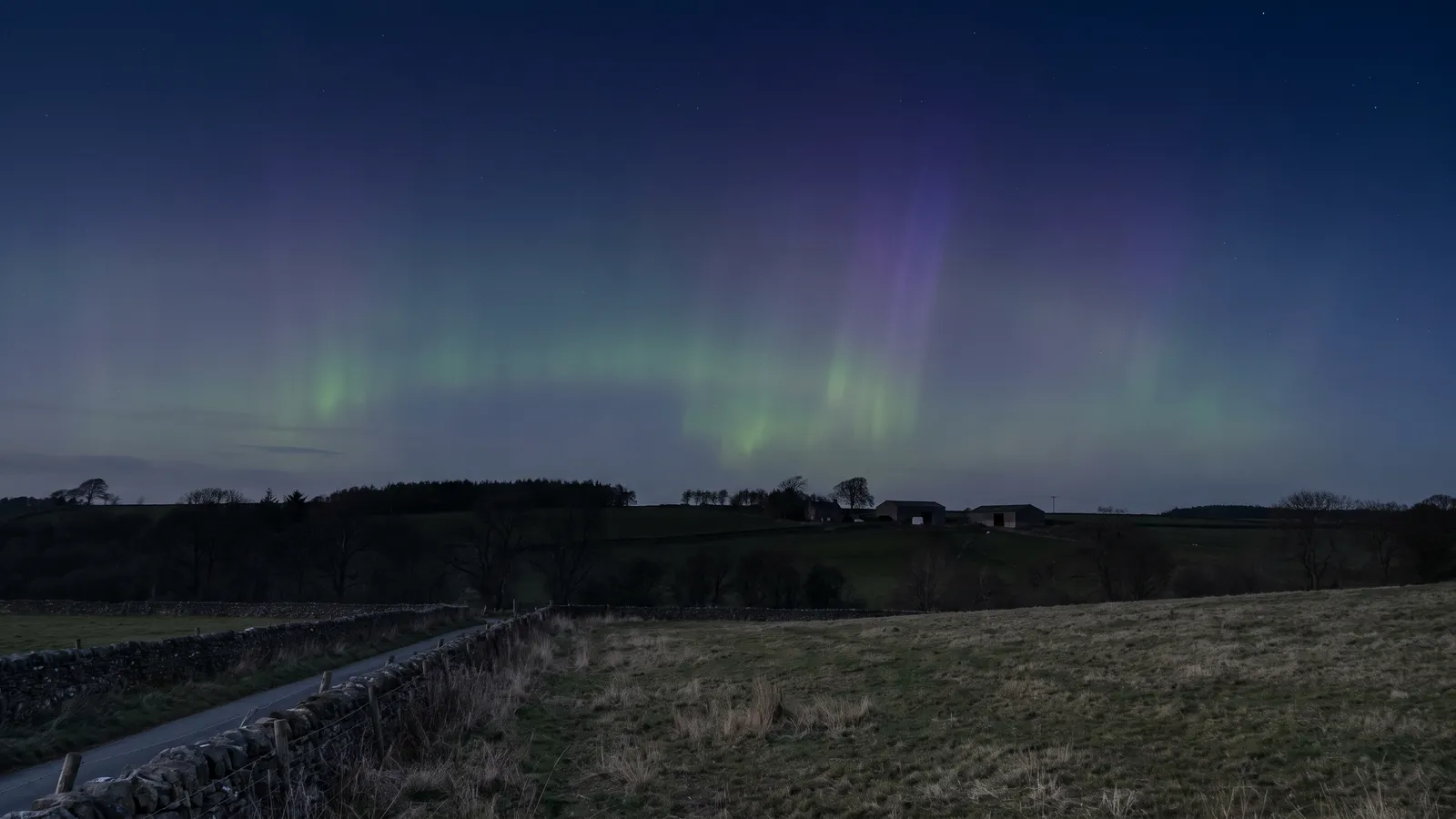
On 10–11 May 2024 the "Gannon" storm reached G5 and peaked at Kp 9 — the first G5-level storm since the Halloween storms of October 2003 and the strongest in over twenty years. It was driven by five successive Earth-directed CMEs arriving in quick succession, and it pushed the aurora across the whole of the UK, visible over central and southern England for several hours.
And here's the part that matters for preparedness: despite being the strongest storm in a generation, the observed impacts were relatively minor. There was temporary degradation of GPS accuracy — positioning errors of tens of metres, enough to disrupt precision-farming equipment — along with some minor power-grid effects and high-frequency radio disruption. There was no major or lasting blackout. UK grid operators managed the event.
Who watches the Sun for the UK
Britain has its own space-weather forecasters. The Met Office Space Weather Operations Centre (MOSWOC) opened in 2014 as one of only a handful of 24/7 space-weather forecast centres in the world. It was set up after solar storms were added to the UK National Risk Register in 2011, and it works in partnership with NOAA's Space Weather Prediction Center, issuing warnings to government, emergency responders, critical-infrastructure operators and the public.
In other words, there is a professional early-warning system for this, the same as there is for storms and floods — you don't need to monitor the Sun yourself.
Could a big one take down the grid?
The benchmark severe scenario is the Carrington Event of 1859, when a storm induced currents strong enough to spark and even ignite telegraph equipment, and produced aurora seen close to the equator. Reasonable-worst-case scenarios developed for the UK National Risk Assessment estimate local peak geoelectric fields of around 20–25 volts per kilometre for a Carrington-scale event.
The National Risk Register treats severe space weather as a significant national risk and acknowledges a severe event could disrupt the electricity network. But grid operators such as National Grid plan and engineer for it, so the more likely consequences of even a severe storm are localised and manageable — individual transformer stress, temporary radio blackouts, GPS degradation — rather than a guaranteed national blackout.
The sensible preparation is therefore identical to preparing for any power cut: torches, a power bank, warm layers. There is no special "solar storm kit" worth buying.
Why the aurora reaches southern England in a big storm
The Northern Lights appear when charged particles from the solar wind are funnelled down Earth's magnetic field lines into the upper atmosphere, where they excite oxygen and nitrogen atoms that then glow. During a stronger geomagnetic storm the ring of aurora around the magnetic pole — the "auroral oval" — expands towards the equator, which is why a large storm can bring the lights to southern England rather than only to Scotland and the far north.
If you want to catch it: get away from streetlights, look north, and use your phone camera — its long exposure picks up colour that's often too faint for the naked eye, and it's the easiest way to confirm the glow on the horizon really is the aurora.
Common questions
What is a geomagnetic (solar) storm?
A disturbance of Earth's magnetic environment, usually driven by a coronal mass ejection — about a billion tonnes of magnetised plasma erupting from the Sun. When it reaches Earth it can produce aurora and, in severe cases, induce currents in power lines.
What was the May 2024 storm?
The "Gannon" storm of 10–11 May 2024 reached G5 (Extreme) — the strongest in over 20 years — driven by five successive CMEs. It brought aurora across the whole UK but caused only minor impacts: temporary GPS and radio disruption, no lasting blackout.
Could a solar storm cause a UK blackout?
A severe, Carrington-scale event is a genuine risk on the National Risk Register and could disrupt the grid. But operators plan and engineer for it, so localised, managed effects are far more likely than a guaranteed national blackout.
Who forecasts space weather in the UK?
The Met Office Space Weather Operations Centre (MOSWOC), running 24/7 since 2014 in partnership with NOAA. It issues warnings to government, responders, infrastructure operators and the public — so you don't need to track the Sun yourself.
How do I see the Northern Lights in England?
You need a strong storm to push the aurora that far south. Get away from streetlights, look north, and use your phone camera — its longer exposure reveals colour the eye can miss and confirms a faint glow really is the aurora.
Do I need a special kit for solar storms?
No. The realistic preparation is identical to any power cut — a torch, a power bank and warm layers. Anything sold specifically as "solar storm" or "EMP" survival gear is playing on fear, not need.
Sources: Met Office — Space weather · NOAA Space Weather Prediction Center · UK Government — National Risk Register · Royal Society Open Science — The May 2024 geomagnetic storm: UK experience. PreparedBritain is independent and not affiliated with HM Government.
The Emergency Kit Checklist
The GOV.UK Prepare essentials on one printable page — tick them off as you go and keep it with the kit. Free, no catch.
Download it straight away. We'll also send the occasional briefing when something genuinely matters — severe weather, live incidents, real price drops. Nothing else.
Keep reading
All planning & the national picture guides →Your landline is going digital: the PSTN switch-off explained
The UK's old copper phone network is being switched off by January 2027. What the digital switchover means, why your…
The National Risk Register 2026, explained for households
What the UK government's 2026 risk assessment says — and the calm, practical steps every household can take.
The UK Emergency Kit List, explained item by item
The Government's recommended kit — with the best products for each item at every budget.