Sandbags and flood barriers: where to get them, how to use them, and what works better
Where to get sandbags in the UK, how to fill and stack them correctly, and why the Environment Agency says flood barriers and air-brick covers usually work better.
By Tom Calder · Updated 21 July 2026 · Sourced to the Environment Agency, GOV.UK and the National Flood Forum
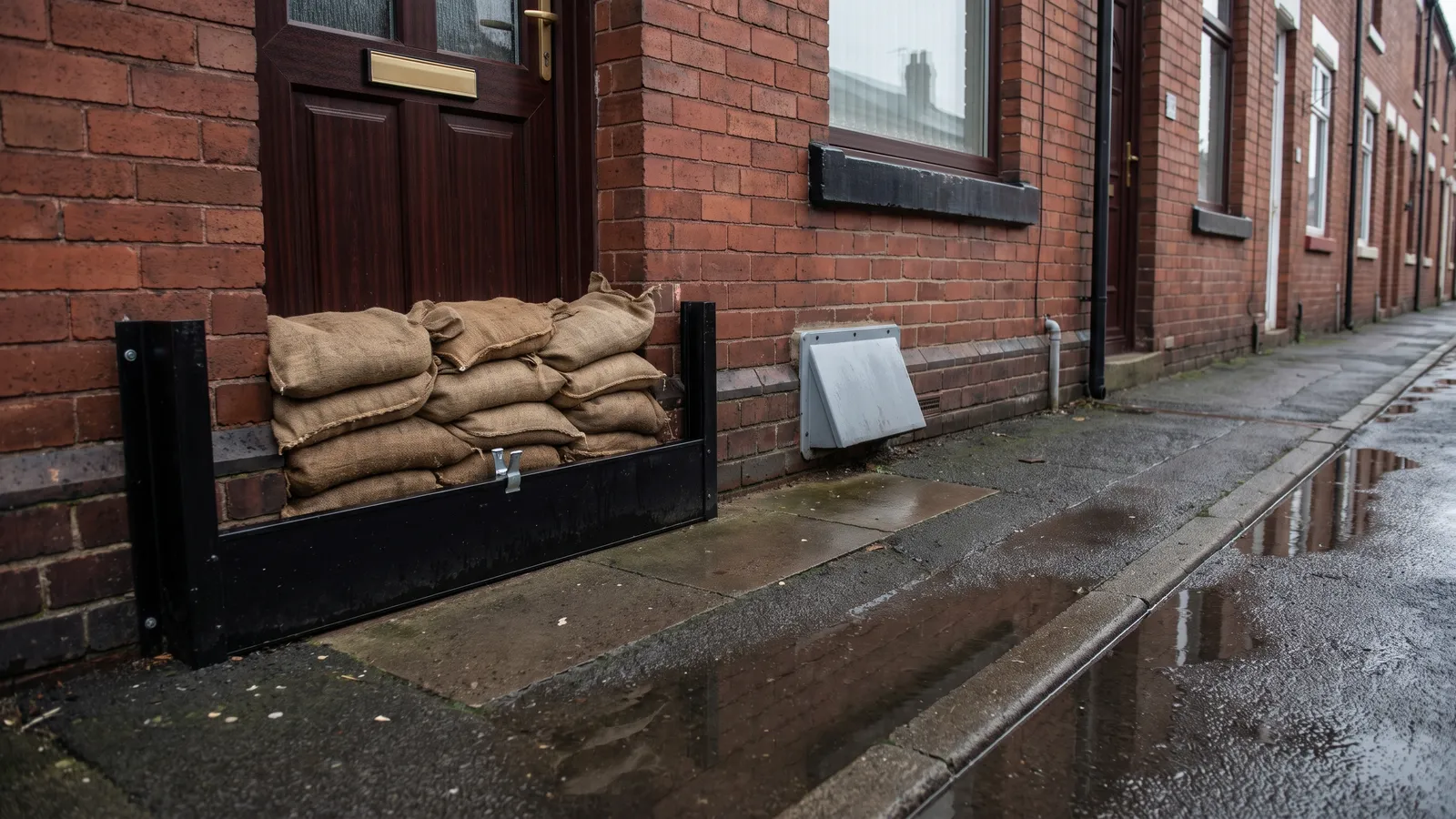
Where sandbags come from — and who has to supply them
The first thing to know is that no one is obliged to hand you sandbags. The Environment Agency is explicit: don't assume the authorities will provide them in a flood emergency, because protecting your property is the owner's responsibility. Councils have no statutory duty to supply them. Some hold a limited stock to protect the public highway or vulnerable residents, but their priority is the public at large, supplies run out fast, and there may be a charge. Check your own council's sandbag policy now, in dry weather — not when the river is already rising.
For your own supply, buy empty sandbags and a bag of building sand from a builders' merchant or DIY store before you need them. Once a flood warning is issued, demand routinely outstrips supply as everyone buys at once. In a genuine emergency the Environment Agency suggests pillowcases or refuse sacks filled with garden soil as a stopgap. But storing a few reusable flood products costs little more and works better — which is where the rest of this guide goes.
How to fill and stack sandbags the right way
If sandbags are your option, method matters more than quantity. Fill each bag no more than half full — overfilled bags won't mould together and they leave gaps — and you don't need to tie the neck. It is a two-person job (one holds, one fills) and slow: the Environment Agency reckons about an hour to fill 12 bags, at roughly 15kg of sand each. You'll need at least six bags to hold back 20cm of water across a standard doorway.
Clear debris from the ground first. Where you can, lay a sheet of heavy-duty plastic between the bags and the wall of the house — the plastic is the real water barrier, and the sand behind it provides the weight and shape to hold it in place. Place bags lengthways, tuck the open end under the filled half, and point them into the flow. Build up in overlapping layers like brickwork, each bag covering the joint below by half, and stamp every one down to close gaps. Wear gloves and sturdy, ideally steel-toe, footwear. A wall 60cm high by a metre long needs around 80 bags — and above three layers it must be built pyramid-style, three times as wide as it is tall.
The honest problem: sandbags seep
Here is the part product adverts skip and the Environment Agency states plainly: sandbags seep water even when well-stacked and trodden into place, and are relatively ineffective compared with purpose-designed flood protection products. They slow and divert water rather than seal a doorway; a saturated wall leaks steadily, and the sacking rots if it is left out for long. They also do nothing about the routes water actually uses — airbricks, cable and pipe entry points, gaps under doors — unless you seal those separately with covers or silicone.
The agency's own recommendation is to use purpose-made products such as flood boards, non-return valves for plumbing and air-brick covers. Sandbags are also of no use once water is already inside: at that point, protect yourself and move valuables upstairs rather than keep laying bags.
What usually works better: property flood resilience
Flood professionals split protection into two ideas. Resistance keeps water out; resilience limits the damage if it gets in. For resistance, the mainstays are demountable flood barriers or boards that clip across doorways in seconds, air-brick covers (either automatic self-closing units or clip-on covers over your existing vents), non-return valves on drains and toilets so sewage can't back up, and pumps. Compact gel-based 'flood socks' that swell on contact with water are a store-in-a-cupboard alternative to a pallet of sand.
The trade-off is honest: barriers and covers cost more up front, but they deploy in minutes, seal far better than sacks, and are reusable year after year. Many resilience products also need occasional cleaning and maintenance to keep working, and not every building suits every measure — an old solid-wall cottage behaves differently from a modern cavity-wall house.
How to choose: standards, the Blue Pages and buying time
Before you buy, check the product is properly tested. Look for the BSI Kitemark for flood protection products, tested to PAS 1188 (now being updated as BS 851188) — independent testing that puts barriers and covers through simulated static water, waves and currents. The National Flood Forum runs the Blue Pages, a free independent directory of flood products and services; it doesn't endorse specific brands, but it lets you compare categories and the standards each should meet. Its helpline (01299 403 055) can point you to a property-protection survey if your home floods repeatedly.
Keep expectations realistic. Even good barriers keep water out only up to a certain depth and for a limited time — their real job is to buy you hours to move belongings and, if a flood is deep or prolonged, to reduce rather than eliminate damage. Match the products to how your home actually floods, not to a generic kit.
Before the water rises: check your risk and sign up for warnings
Most of the value is in the quiet weeks beforehand. Use GOV.UK to check your property's long-term flood risk, then sign up for the Environment Agency's free flood warnings by text, phone or email — it is the difference between deploying barriers in daylight and doing it in the dark. Floodline is staffed 24 hours a day on 0345 988 1188.
Pair that with a simple household plan: know where your stop taps and consumer unit are, agree where the barriers and covers live, and keep insurance documents somewhere they won't be soaked. Our flood-preparation checklist and live weather-warning tracker turn this into a routine you can run each autumn and winter.
Common questions
Do councils have to provide sandbags when it floods?
No. Councils have no statutory duty to supply sandbags, and the Environment Agency says not to assume the authorities will provide them — protecting your property is the owner's responsibility. Some councils keep a small stock for the public highway or vulnerable residents, and there may be a charge, so check your council's policy in advance and buy your own to be safe.
How many sandbags do I need for a doorway?
The Environment Agency's rule of thumb is at least six sandbags to hold back about 20cm of water across a standard door opening, using roughly 15kg of sand per bag. Filling is slow — around an hour for 12 bags with two people. For a wall 60cm high and a metre long you'd need about 80 filled bags.
Are sandbags or flood barriers better?
The Environment Agency describes sandbags as relatively ineffective compared with purpose-designed products and strongly encourages flood boards, air-brick covers and non-return valves instead. Barriers and covers seal far better, deploy in minutes and are reusable, whereas sandbags seep even when well-stacked and are usually a one-time job. Sandbags remain a reasonable cheap stopgap if you can't get anything else in time.
What can I use if I can't get sandbags in time?
In an emergency the Environment Agency suggests filling pillowcases or refuse sacks with garden soil as a temporary substitute. Self-inflating gel 'flood socks' and clip-on door barriers, kept in advance, are a tidier alternative you can deploy in seconds. Whatever you use, also seal airbricks and low service entry points, as these are common water routes.
How do I dispose of sandbags after a flood?
If sandbags have been in contact with flood water they may be contaminated, so don't reuse the sand and seek advice from your local authority's environmental health department on safe disposal. Clean, dry sacks can be emptied, dried and refilled, but hessian sacking is biodegradable and will rot if left damp.
How do I know a flood product is any good?
Look for the BSI Kitemark for flood protection products, tested to PAS 1188 (now being updated as BS 851188), which covers independent testing against water pressure, waves and leakage. The National Flood Forum's free Blue Pages directory lets you compare products and the standards each category should meet, without endorsing specific brands.
Sources: Environment Agency — Sandbags: how to use them properly for flood protection (LIT 3833, 2009; withdrawn June 2020, but still the basis of most councils' sandbag guidance) (PDF) · GOV.UK — Prepare for flooding · GOV.UK — Get flood warnings by text, phone or email · National Flood Forum · Blue Pages — independent flood products directory. PreparedBritain is independent and not affiliated with HM Government.
The Emergency Kit Checklist
The GOV.UK Prepare essentials on one printable page — tick them off as you go and keep it with the kit. Free, no catch.
Download it straight away. We'll also send the occasional briefing when something genuinely matters — severe weather, live incidents, real price drops. Nothing else.
Keep reading
All weather, storms & flooding guides →Are portable air conditioners worth it in a UK home?
A calm, honest look at portable air con for UK homes: when a fan and night-purge is enough, the BTU sizing rule, and…
Heat-health alerts explained: what yellow, amber and red mean
What the UKHSA Heat-Health Alert colours mean, how they differ from Met Office heat warnings, and the calm,…
Frozen and burst pipes: prevent, thaw, and act fast
How to stop pipes freezing, thaw a frozen pipe safely, and act fast if one bursts — one of the most preventable and…