Are portable air conditioners worth it in a UK home?
A calm, honest look at portable air con for UK homes: when a fan and night-purge is enough, the BTU sizing rule, and what one really costs to run at the Ofgem cap.
By Tom Calder · Updated 10 September 2026 · Sourced to Ofgem, the NHS, UKHSA & the Met Office
The honest answer: for most homes, mostly no
The UK gets genuinely hot for a short stretch each summer, not for months. A location only meets the Met Office's heatwave definition after at least three consecutive days at or above a temperature threshold that varies by region — roughly 25–28°C depending on where you are — and even a hot year delivers only a week or two of truly uncomfortable weather. For that many days, the cheap, quiet, boring combination of a good fan, daytime shading and a night-time draught does most of what a portable air conditioner does.
So a portable AC is worth it in specific situations rather than as a default. It earns its place when one room simply won't cool — a top-floor bedroom, a poorly shaded home office, a flat under the roof — or where someone is older, has a heart or breathing condition, or otherwise can't tolerate heat well. If that's you, read on for how to buy and run one sensibly. If it isn't, spend the money on a fan and better curtains and you'll barely notice the difference.
Single-hose vs twin-hose: why the cheap ones fight themselves
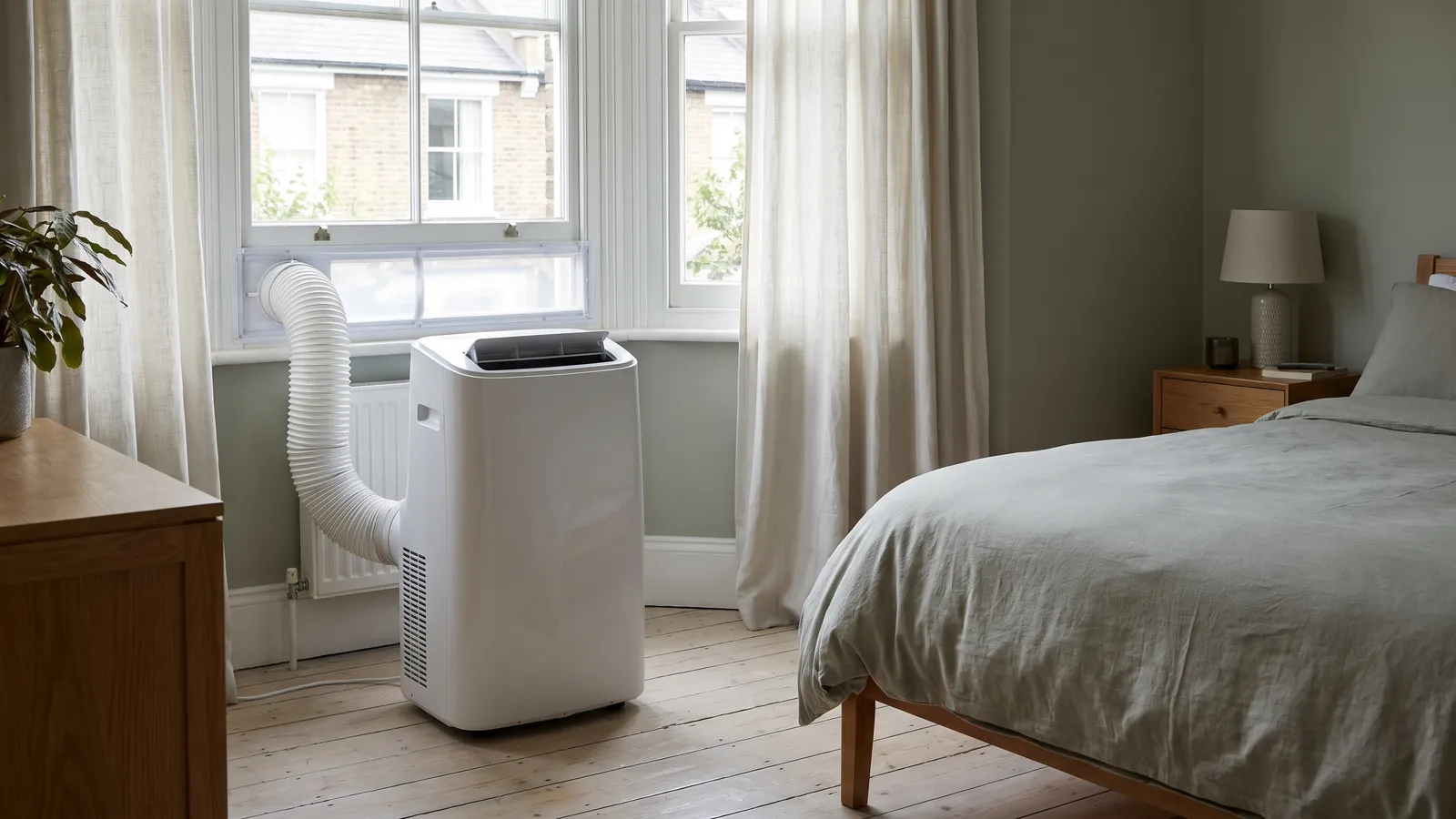
Almost every budget portable unit is single-hose: it draws air from the room, uses it to cool the coil, then blows the warm exhaust outside through one pipe in the window. The catch is physics. Pushing that air out lowers the pressure indoors slightly, so warm, unconditioned air gets pulled back in through gaps around doors, floors and the window kit itself. The unit ends up partly cooling air it just helped bring in, which is why real-world performance always trails the headline BTU figure.
Twin-hose units take their exhaust air from outside instead of from the room, so they don't create that suction — they cool a given room noticeably faster and more efficiently. They cost more and there's less choice, but for a room you'll cool often, they're the better buy. Whichever you choose, the window seal matters as much as the machine: an unsealed hose lolling out of an open sash lets the heat you just paid to remove pour straight back in.
Sizing: the BTU rule so you don't over- or under-buy
Cooling capacity is measured in BTU. A workable rule of thumb for a standard UK room with 2.4-metre ceilings is around 500 BTU per square metre of floor area. Add roughly 10–20% for a sun-facing or top-floor room, poor insulation, or several people and a couple of PCs generating heat — and, because portable units are less efficient than fixed ones, nudge the figure up rather than down.
In practice that means a small box room of 8–10 m² is served by a 5,000–7,000 BTU unit, while a typical double bedroom of 14–18 m² wants around 9,000 BTU. Resist the temptation to just buy the biggest. An oversized unit short-cycles — it cools the air fast, hits the thermostat and switches off before it has pulled enough moisture out, leaving the room cold but clammy. Right-sized beats oversized.
What it actually costs to run
This is where the honest maths helps. Under the Ofgem price cap for 1 July to 30 September 2026, a typical direct-debit customer pays about 26.11p per kilowatt-hour for electricity. A common 9,000–12,000 BTU portable unit draws roughly 1 to 1.3 kilowatts when its compressor is running.
So a 1kW unit costs about 26p an hour. Run it for eight hours overnight and that's around £2.09 a night; a 1.3kW unit about £2.72. Across a two-week hot spell, budget around £30 for a 1kW unit, or nearer £38 for a 1.3kW one. That's not ruinous — but it's real money for a job a fan does adequately on the milder nights for pennies, which is exactly why the fan-first approach makes sense for occasional heat. Check your own tariff and meter, as unit rates vary by region and payment method.
Safety and the practical catches
A portable AC only works if its hot exhaust genuinely goes outside. Venting the hose into a hallway, cupboard or another room just moves heat around the house and makes things worse — the pipe must reach a window or door with a proper seal. That seal also matters for security and insects, since a gaping window undoes the point of the machine and, on the ground floor, is an easy way in.
Run it on its own wall socket, not daisy-chained through a thin travel extension lead or a multi-way adaptor shared with other appliances — a compressor pulling a kilowatt or more can overheat an underrated lead. Empty or drain the condensate as the instructions say, keep the air filter clean so it doesn't lose performance, and expect noise: most portables run at 45–55 decibels, enough to disturb light sleepers.
One useful advantage over a fan: the NHS says electric fans can help when the air is below about 35°C. Above that they stop doing much good — the air they push around is hotter than your skin, so it warms you rather than cooling you — whereas a working air conditioner still lowers the temperature in extreme heat. During amber or red heat-health alerts, the priority remains checking on older or unwell neighbours and relatives — a cool room helps, but a daily phone call helps more.
The alternatives worth trying first
Before buying, exhaust the free wins, because they genuinely work: close curtains and blinds on the sunny side through the day, keep windows shut while it's hotter outside than in, then open everything for a through-draught once the evening cools. External shade — an awning, shutter or even a pale sheet outside the glass — stops heat before it enters and beats anything you do indoors.
Evaporative 'air coolers' are cheaper than a real AC but only cool well in dry heat; UK heatwaves are often humid, where they mostly add moisture without dropping the temperature much. If you need reliable cooling every summer and don't want a portable's hoses and noise every year, a fixed air-to-air heat pump — an air conditioner that also heats in winter — is the more efficient long-term answer for the right home.
Common questions
Do portable air conditioners actually work in a UK house?
Yes — they lower the temperature of the room they're in, provided the hot exhaust is properly vented outside through a sealed window kit. The main limitation is that most budget units are single-hose, which pulls some warm air back into the room and means real-world cooling lags the advertised BTU rating. Seal the window well and size the unit correctly and one will make a hot bedroom usable.
How much does a portable air conditioner cost to run per night?
At the Ofgem price cap for July–September 2026 of about 26.11p per kWh, a 1kW unit costs roughly 26p an hour. Run overnight for eight hours that's around £2.09 a night, or about £2.72 for a more powerful 1.3kW model. Over a two-week hot spell, budget around £30 for a 1kW unit, or nearer £38 for a 1.3kW one. Your own cost depends on your tariff, region and how hard the compressor works.
What size (BTU) portable air conditioner do I need for a bedroom?
As a rule of thumb, allow about 500 BTU per square metre for a standard room, adding 10–20% for a sun-facing or top-floor room. That puts a small box room at 5,000–7,000 BTU and a typical double bedroom of 14–18 m² at around 9,000 BTU. Avoid buying oversized — too much capacity short-cycles and leaves the room cold but humid.
Are portable air conditioners better than a fan?
For the handful of genuinely hot days most UK summers deliver, a fan plus daytime shading and a night-time draught does most of the job far more cheaply and quietly. An air conditioner is worth the extra cost and noise when a specific room won't cool, or in extreme heat above about 35°C — the NHS says fans only help below that temperature, above which the air they move is hotter than your skin and no longer cools you.
Can you use a portable air conditioner without a window to vent it?
No — not usefully. The unit produces a stream of hot exhaust air that must go outside. Venting it into another room, a hallway or a cupboard simply relocates the heat and can make the home hotter overall. You need a window or door with a proper seal around the hose; an open, unsealed window lets warm air flood back in.
Sources: Ofgem — Energy price cap: unit rates and standing charges · NHS — Heatwave: how to cope in hot weather · GOV.UK (UKHSA) — Beat the heat: staying safe in hot weather · Met Office — What is a heatwave? (UK thresholds and definition). PreparedBritain is independent and not affiliated with HM Government.
The Emergency Kit Checklist
The GOV.UK Prepare essentials on one printable page — tick them off as you go and keep it with the kit. Free, no catch.
Download it straight away. We'll also send the occasional briefing when something genuinely matters — severe weather, live incidents, real price drops. Nothing else.
Keep reading
All weather, storms & flooding guides →Heat-health alerts explained: what yellow, amber and red mean
What the UKHSA Heat-Health Alert colours mean, how they differ from Met Office heat warnings, and the calm,…
Frozen and burst pipes: prevent, thaw, and act fast
How to stop pipes freezing, thaw a frozen pipe safely, and act fast if one bursts — one of the most preventable and…
Cold-Health Alerts and staying safe in cold weather
What the UKHSA Cold-Health Alert colours mean, who's most at risk in cold weather, and the practical, sourced steps…