Boiler stopped in the cold? Thawing a frozen condensate pipe safely
How to tell a frozen condensate pipe from a real boiler fault, thaw it safely with warm water, reset the boiler, and stop it freezing again.
By Tom Calder · Updated 12 August 2026 · Sourced to the HSE, NHS & Met Office
Why a cold snap stops a condensing boiler
Since 2005, building regulations have required new gas boilers in England and Wales to be condensing models. They squeeze extra heat out of the flue gases, and the by-product is a steady trickle of slightly acidic water — condensate — which drains away through a narrow plastic pipe from the bottom of the boiler. In many homes that pipe runs to an internal waste pipe. In many others it exits through the wall and runs down to an outside drain.
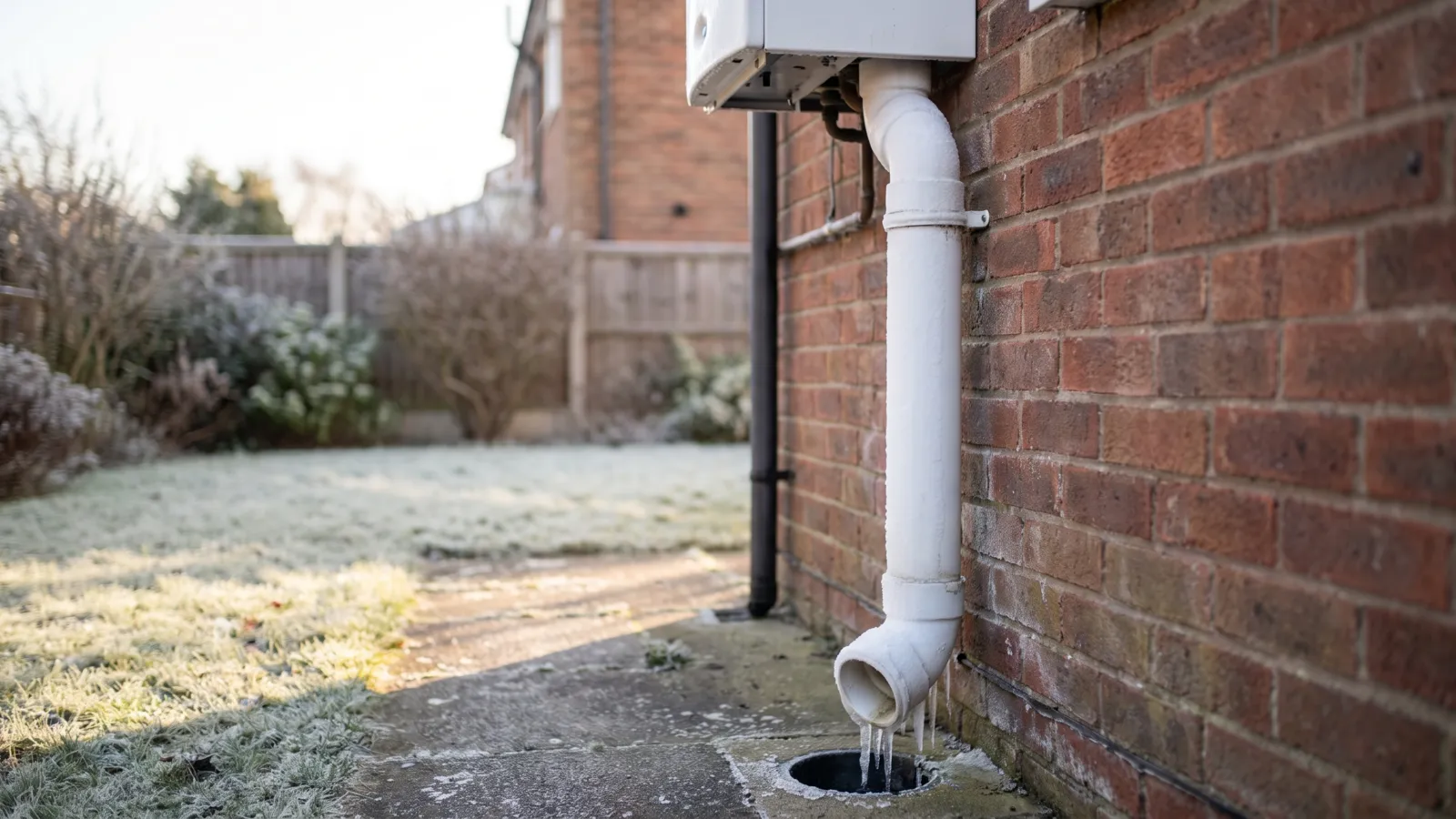
On a sub-zero night, that exposed external run can freeze solid. The condensate backs up, the boiler detects it can't drain, and it shuts itself down. This is a protective lockout, not damage — and it is one of the most common causes of 'boiler breakdown' calls during a cold snap. If a spell of freezing weather is in force — an amber Cold Health Alert from the UKHSA, or a Met Office warning for snow and ice — assume this before assuming a genuine fault; you can check current alerts on our weather warnings tracker.
Condensate pipe or genuine fault? Three quick checks
First, timing and sound. A frozen condensate pipe almost always announces itself on a freezing morning, after the boiler ran fine the day before. The classic tell is a gurgling or bubbling noise from the boiler or the pipe as it tries to fire — that's condensate sloshing against the ice blockage.
Second, the fault code. Blocked condensate usually surfaces as an ignition or flame-loss code: Worcester Bosch shows EA (often EA 229); Vaillant shows F28 or F29; Ideal shows L2 (F2 on older models); Baxi shows E133. Be honest with yourself about what these mean: they are generic 'failed to light' codes, and in mild weather the same code points to a real fault. It's the combination — freezing weather, gurgle, ignition code — that makes the condensate pipe the prime suspect.
Third, the pipe itself. Find the plastic pipe (usually white or grey) leaving the wall below the boiler and trace it to the drain. Frost on the pipe, or ice at the open end and at elbows, confirms it. If your condensate pipe never leaves the house, freezing is very unlikely to be your problem. And if your taps have stopped running too, you're dealing with frozen water supply pipes — a different job with different risks, covered in our frozen and burst pipes guide.
Thawing it safely: warm water, never boiling
Fill a jug or watering can with warm tap water — comfortably warm to the touch, never boiling. Boiling water can crack or deform the plastic pipe and is a scald risk to you. Pour it slowly along the frozen section, starting at the open end and working back up the pipe. The blockage is usually at the most exposed point: the outlet, an elbow, or a sagging horizontal run. Repeat until you hear the backed-up condensate release. A hot water bottle or microwavable heat pack held against the pipe works too, and is the gentler option if you have time.
Two ground rules. Work only at ground level, within comfortable reach — never climb a ladder on an icy path for this. If the frozen run is up at first-floor height, leave it for an engineer. And watch your footing: the water you pour will refreeze on the ground around you, so stand to one side and grit the path afterwards.
The reset — and when to stop resetting
Once the pipe is clear, reset the boiler following the instructions in its manual — typically pressing and holding the reset button for a few seconds. It should attempt ignition and fire within a few minutes; occasionally it takes a second reset. The house will take a while to warm back up, so if you've been without heat for hours, our guide to keeping warm without heating covers the interim sensibly.
If the boiler will not reset, or fires briefly and locks out again even though the pipe is demonstrably clear, stop. Repeated resetting of a boiler that keeps locking out is a signal to hand over to a professional, not a technique.
The hard boundary: gas smells and repeated lockouts
If you smell gas at any point: do not operate light switches or anything with a flame, open doors and windows, turn the gas off at the meter control valve if it's safe to reach, leave the property, and call the free 24-hour National Gas Emergency line on 0800 111 999. Those steps come from the Health and Safety Executive and the Gas Safe Register, and they are not negotiable.
Never open the boiler's case. By law, anyone working on a gas appliance in a domestic property must be a Gas Safe registered engineer — thawing an external plastic drain pipe is fine for you to do, but anything behind the case, on the gas valve or on the flue is not. Repeated lockouts, error codes in mild weather, or any doubt at all: book a registered engineer and check their ID card against the Gas Safe Register. While you're at it, make sure you have a working carbon monoxide alarm near the boiler.
Stop it happening again
A condensate pipe that froze once will freeze again, so fix the cause before the next cold spell. The cheapest fix is waterproof foam lagging (Class O pipe insulation) over the whole external run, including elbows, leaving only the outlet clear. The better fix is upgrading the external section to 32mm pipe with a short run and a good continuous fall — narrow 21.5mm overflow pipe freezes fastest. The best fix, where the layout allows, is rerouting the condensate to an internal waste pipe so nothing runs outside at all; raise it at your annual service, as it's a job for a heating engineer. For stubborn exposed runs, thermostatic trace-heating kits are a proven last resort.
During a severe cold spell, running the heating continuously on a low setting also helps: a steady trickle of warm condensate is much harder to freeze than intermittent bursts left sitting in the pipe overnight.
Common questions
Can I pour boiling water on a frozen condensate pipe?
No. Boiling water can crack or deform the plastic pipe and can scald you. Use warm tap water, a hot water bottle, or a microwavable heat pack instead. If you do scald yourself, the NHS advice is to hold the area under cool running water for 15 to 30 minutes, or until the pain eases, and never to put creams, oils or butter on it.
Will a frozen condensate pipe damage my boiler?
No. The lockout is a protective shutdown, not a fault — the boiler stops precisely so that backed-up condensate can't cause harm. Once the pipe is thawed and the boiler reset, it should run normally. Repeated freezing every winter is a reason to insulate, upsize or reroute the pipe, not a sign the boiler is failing.
Do I need a Gas Safe engineer to thaw the pipe?
No — the external condensate pipe is a plastic drain, not a gas component, so thawing it yourself is legal and safe. Anything beyond that is different: by law, work on the gas appliance itself — behind the case, on the gas valve or the flue — must be done by a Gas Safe registered engineer. If the boiler keeps locking out after a thaw, book one and check their ID card.
Why does my condensate pipe freeze every winter?
Usually because the external run is too long, too thin (21.5mm overflow pipe rather than 32mm), poorly insulated, or laid with sags where condensate pools. The fixes, in rising order of effectiveness: waterproof foam lagging, upgrading to 32mm with a short steep run, a thermostatic trace-heating kit, or rerouting to an internal drain. Ask your engineer at the annual service.
What does the gurgling noise from my boiler mean?
Gurgling or bubbling is condensate backing up against a blockage — in freezing weather, almost always ice in the external pipe. It's the single strongest clue that separates a frozen condensate pipe from a genuine ignition fault, because the same fault codes can mean either.
Sources: HSE — Domestic gas safety FAQs (gas emergencies and Gas Safe registration) · Gas Safe Register — the official register of gas engineers · NHS — Burns and scalds · Met Office — UK weather warnings · UKHSA — Adverse Weather and Health Plan (Weather-Health Alerting System). PreparedBritain is independent and not affiliated with HM Government.
The Emergency Kit Checklist
The GOV.UK Prepare essentials on one printable page — tick them off as you go and keep it with the kit. Free, no catch.
Download it straight away. We'll also send the occasional briefing when something genuinely matters — severe weather, live incidents, real price drops. Nothing else.
Keep reading
All weather, storms & flooding guides →Flood alerts vs flood warnings: what each level means and what to do
What flood alerts, flood warnings and severe flood warnings mean, how much time each typically gives you, and the…
How to drive through flood water — and when you must not
How to drive through flood water safely if you have no choice — the real depth limits (30cm of moving water can…
How to stay warm without turning the heating on
How to stay warm at home without turning the heating on — warm the person, then the zone, then the room, with the…