Best car battery chargers and maintainers for winter UK (2026)
A flat battery is one of the commonest reasons a car won't start on a cold morning, and a vehicle that sits for weeks over winter is the one most likely to suffer it. A smart charger, often called a maintainer or conditioner, plugs into the mains, brings the battery back to full and then holds it there without overcharging. This page compares chargers sold in the UK on what separates them: current, the battery sizes and chemistries they state they handle, and whether they cover 6V as well as 12V. We have not tested any of them; every figure is credited to the maker or a UK retailer's listing.
By Tom Calder · Updated 21 October 2026 · 8 products, all price-tracked
Our picks by type
 Photo: Amazon
NOCO GENIUS5
The all-round winter charger for a family car, and for owners who also have a lithium or 6V battery.
as of 21 Oct 2026, 10:37 BST · Details
Product prices and availability are accurate as of the date/time indicated and are subject to change. Any price and availability information displayed on Amazon.co.uk at the time of purchase will apply to the purchase of this product. Photo: Amazon
CTEK MXS 7.0
Vans, motorhomes, caravans and big car batteries up to 150Ah.
as of 21 Oct 2026, 10:37 BST · Details
Product prices and availability are accurate as of the date/time indicated and are subject to change. Any price and availability information displayed on Amazon.co.uk at the time of purchase will apply to the purchase of this product. Photo: Amazon
CTEK MXS 3.8
A small to mid-size car or motorcycle battery that needs charging and then months on maintenance.
as of 21 Oct 2026, 10:37 BST · Details
Product prices and availability are accurate as of the date/time indicated and are subject to change. Any price and availability information displayed on Amazon.co.uk at the time of purchase will apply to the purchase of this product.All 8 compared
| Charger | Charge current | Batteries | Battery types | Modes | Price |
|---|---|---|---|---|---|
5 A · 6V and 12V · Lead-acid and lithium (LiFePO4) · Auto charge and maintain, plus Force Mode The all-round winter charger for a family car, and for owners who also have a lithium or 6V battery. | 5 A | 6V and 12V | Lead-acid and lithium (LiFePO4) | Auto charge and maintain, plus Force Mode | £73.99 at Amazon as of 21 Oct 2026, 10:37 BST · DetailsProduct prices and availability are accurate as of the date/time indicated and are subject to change. Any price and availability information displayed on Amazon.co.uk at the time of purchase will apply to the purchase of this product.In stockCheck price → |
Our verdictOur verdictResearched NOCO rates the GENIUS5 for batteries up to 120Ah, with lead-acid and lithium support at 6V and 12V. It is the closest rival to CTEK's MXS 5.0, which is already on another page. For one charger across a car, a classic 6V bike and a lithium battery, it is the most flexible of the mid-size chargers here. Best for The all-round winter charger for a family car, and for owners who also have a lithium or 6V battery. Good
Worth knowing
Who shouldn't buy it: You want a single-button charger with no mode choice: CTEK's range is simpler. | |||||
3.8 A · 12V · Lead-acid: wet, MF, Ca/Ca, AGM, GEL · Selectable programs incl. desulphation A small to mid-size car or motorcycle battery that needs charging and then months on maintenance. | 3.8 A | 12V | Lead-acid: wet, MF, Ca/Ca, AGM, GEL | Selectable programs incl. desulphation | £61.31 at Amazon as of 21 Oct 2026, 10:37 BST · DetailsProduct prices and availability are accurate as of the date/time indicated and are subject to change. Any price and availability information displayed on Amazon.co.uk at the time of purchase will apply to the purchase of this product.In stockCheck price → |
Our verdictOur verdictResearched CTEK describes the MXS 3.8 as an entry-level charger for small batteries, rated 1.2Ah to 80Ah, with selectable programs for different battery sizes and a desulphation program. It suits a hatchback or motorbike stored over winter. One UK retailer now lists the MXS 5.0 as its recommended replacement, so check the newer model is not close in price before choosing this one. Best for A small to mid-size car or motorcycle battery that needs charging and then months on maintenance. Good
Worth knowing
Who shouldn't buy it: Your car has a big diesel battery or you own a lithium battery: the NOCO GENIUS5 or GENIUS10 cover bigger batteries and lithium. | |||||
 2 A · 6V and 12V · Lead-acid and lithium (LiFePO4) · Auto charge and maintain, plus Force Mode Motorbikes, small cars and mowers that need charging as well as maintenance, at a modest price. | 2 A | 6V and 12V | Lead-acid and lithium (LiFePO4) | Auto charge and maintain, plus Force Mode | £53.34 at Amazon as of 21 Oct 2026, 10:37 BST · DetailsProduct prices and availability are accurate as of the date/time indicated and are subject to change. Any price and availability information displayed on Amazon.co.uk at the time of purchase will apply to the purchase of this product.In stockCheck price → |
Our verdictOur verdictResearched NOCO's listing and Tayna rate the GENIUS2 for 6V and 12V batteries up to 40Ah, lead-acid and lithium (LiFePO4), with Force Mode for very flat batteries. It sits between the slow GENIUS1 and the 5A unit. For a small petrol car stored over winter it will keep the battery full; it is not for a big diesel battery. Best for Motorbikes, small cars and mowers that need charging as well as maintenance, at a modest price. Good
Worth knowing
Who shouldn't buy it: Your battery is bigger than 40Ah: the GENIUS5 or CTEK MXS 3.8 is a better match. | |||||
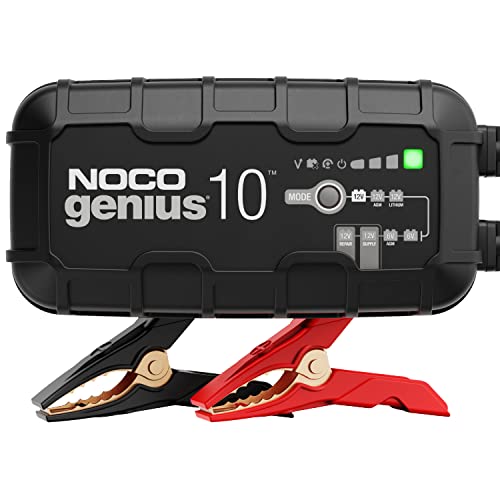 10 A · 6V and 12V · Lead-acid and lithium (LiFePO4) · Auto charge and maintain, plus Force Mode Large diesel car, van and leisure batteries up to 230Ah that need a quicker charge. | 10 A | 6V and 12V | Lead-acid and lithium (LiFePO4) | Auto charge and maintain, plus Force Mode | £117.89 at Amazon as of 21 Oct 2026, 10:37 BST · DetailsProduct prices and availability are accurate as of the date/time indicated and are subject to change. Any price and availability information displayed on Amazon.co.uk at the time of purchase will apply to the purchase of this product.In stockCheck price → |
Our verdictOur verdictResearched At 10A and a stated 230Ah ceiling, the GENIUS10 is the high-output choice on this page, for 6V and 12V lead-acid and lithium (LiFePO4). It is overkill for a motorbike, and the 7.2A CTEK MXS 7.0 is its direct rival in lead-acid-only use. Best for Large diesel car, van and leisure batteries up to 230Ah that need a quicker charge. Good
Worth knowing
Who shouldn't buy it: You only have a small or mid-size car, or a motorbike: the GENIUS5 or smaller will do. | |||||
7.2 A · 12V · Lead-acid: wet, MF, Ca/Ca, AGM, GEL · Multi-voltage lead-acid charge, 12V supply Vans, motorhomes, caravans and big car batteries up to 150Ah. | 7.2 A | 12V | Lead-acid: wet, MF, Ca/Ca, AGM, GEL | Multi-voltage lead-acid charge, 12V supply | £119.95 at Amazon as of 21 Oct 2026, 10:37 BST · DetailsProduct prices and availability are accurate as of the date/time indicated and are subject to change. Any price and availability information displayed on Amazon.co.uk at the time of purchase will apply to the purchase of this product.In stockCheck price → |
Our verdictOur verdictResearched The MXS 7.0 is CTEK's answer for larger lead-acid batteries: 7.2A maximum, 14Ah to 150Ah to charge and a stated 225Ah on maintenance. Halfords also lists it as a power supply for 12V equipment up to 7A. It is the pick on this page for a leisure or van battery, while the MXS 3.8 is more sensible for a small car. Best for Vans, motorhomes, caravans and big car batteries up to 150Ah. Good
Worth knowing
Who shouldn't buy it: You only have a small car or motorbike battery, where the MXS 3.8 or XS 0.8 is better matched, or you run lithium. | |||||
 0.8 A · 12V · Lead-acid: wet, MF, Ca/Ca, AGM, GEL · Automatic charge, then maintain Motorbikes, scooters and ride-on mowers that sit unused all winter. | 0.8 A | 12V | Lead-acid: wet, MF, Ca/Ca, AGM, GEL | Automatic charge, then maintain | £48.99 at Amazon as of 21 Oct 2026, 10:37 BST · DetailsProduct prices and availability are accurate as of the date/time indicated and are subject to change. Any price and availability information displayed on Amazon.co.uk at the time of purchase will apply to the purchase of this product.In stockCheck price → |
Our verdictOur verdictResearched CTEK's smallest 12V charger is built for batteries from 1.2Ah to 32Ah, and can hold larger car batteries topped up over a long layup. At 0.8A it is slow by design, so it suits a battery that only needs keeping full rather than recovering. It is the gentle option on this page; step up to the MXS 3.8 or the NOCO GENIUS2 if you want to charge a flat battery in a sensible time. Best for Motorbikes, scooters and ride-on mowers that sit unused all winter. Good
Worth knowing
Who shouldn't buy it: You have a lithium (LiFePO4) battery or a flat car battery to bring back quickly: look at the NOCO GENIUS units or the CTEK MXS 3.8 instead. | |||||
 1 A · 6V and 12V · Lead-acid and lithium (LiFePO4) · Auto charge and maintain, plus Force Mode Keeping a small motorbike, scooter or garden-machinery battery topped up, including lithium. | 1 A | 6V and 12V | Lead-acid and lithium (LiFePO4) | Auto charge and maintain, plus Force Mode | £38.80 at Amazon as of 21 Oct 2026, 10:37 BST · DetailsProduct prices and availability are accurate as of the date/time indicated and are subject to change. Any price and availability information displayed on Amazon.co.uk at the time of purchase will apply to the purchase of this product.In stockCheck price → |
Our verdictOur verdictResearched NOCO rates the GENIUS1 for batteries up to 30Ah and lists lead-acid and lithium support at 6V and 12V. Unlike the CTEK XS 0.8, it also handles 6V classic-bike batteries and lithium. It is a maintainer first; for a car battery use one of the larger units. Best for Keeping a small motorbike, scooter or garden-machinery battery topped up, including lithium. Good
Worth knowing
Who shouldn't buy it: You have a car or van battery: step up to the GENIUS5 or GENIUS10. | |||||
 4 A · 6V and 12V · Lead-acid, gel, AGM, EFB, LiFePO4 A low-cost UK-brand charger for a car, bike or caravan, including lithium and stop-start batteries. | 4 A | 6V and 12V | Lead-acid, gel, AGM, EFB, LiFePO4 | — | £25.79 at Amazon as of 21 Oct 2026, 10:37 BST · DetailsProduct prices and availability are accurate as of the date/time indicated and are subject to change. Any price and availability information displayed on Amazon.co.uk at the time of purchase will apply to the purchase of this product.In stockCheck price → |
Our verdictOur verdictResearched Ring's 900-series SMARTCHARGE 4 covers 6V and 12V lead-acid (including EFB and AGM) and LiFePO4 at up to 4A, rated by Ring to charge batteries to 90Ah and maintain them to 140Ah. Halfords lists it as stop-start compatible. It is a straightforward budget option from a long-established UK brand, but Ring's product page does not state a warranty period, where CTEK states five years and NOCO three. Best for A low-cost UK-brand charger for a car, bike or caravan, including lithium and stop-start batteries. Good
Worth knowing
Who shouldn't buy it: You want a stated long warranty or need to charge a battery over 90Ah: the NOCO GENIUS5 or CTEK MXS 7.0 suits better. | |||||
ⓘ As an Amazon Associate, PreparedBritain earns from qualifying purchases. We may earn a commission when you buy, or a fee when you request a quote, through our links — it never affects what we recommend. Amazon prices come from Amazon's own product data and show the date and time they were retrieved. Prices at other retailers are checked by us, less often. Prices and stock can change at any time, so always check the retailer's price before you buy.
Before you buy
Start with the battery, not the charger.
The label on top states its capacity in amp-hours (Ah) and its type: a plain flooded lead-acid battery, or an EFB or AGM unit, which most cars with stop-start use. Every charger here states the capacities it charges and the chemistries it covers, and those two lines decide the shortlist. For a stop-start car, pick a charger whose maker or UK listing names AGM and EFB or stop-start batteries; if neither names your battery type, assume it is not covered. A battery coded to the car's electronics still charges in the usual way, but a replacement may need registering by a garage.
Amps set the speed, and more is not always better.
A motorbike or garden-machinery battery of a few Ah suits a 0.8A to 2A unit, which is gentle and small enough to leave connected all winter. A hatchback or family car is comfortable on 3.8A to 5A, which recovers a flat battery in a day rather than a week. Vans, motorhomes and large diesel cars with batteries past 100Ah want 7A to 10A, and the makers' stated ceilings on this page run to 230Ah. For pure maintenance any of them will do, because once the battery is full the charger drops to a trickle.
Smart chargers differ from the old transformer trickle chargers in one way that matters
They monitor the battery and switch to a float or pulse maintenance stage when it is full. A traditional trickle charger with no control can keep pushing current into a full battery, which boils off the electrolyte over weeks. Every charger on this page is the controlled kind. Some add a desulphation or recovery stage for a battery that has sat flat, and NOCO's units have a forced mode for a battery too flat to be detected; both help, but neither reliably rescues a battery that has been flat for months.
Lithium (LiFePO4) batteries, common on newer motorbikes and some leisure setups, need a charger with a dedicated lithium mode, because the lead-acid desulphation and recovery stages can damage them. The NOCO GENIUS range and Ring's SMARTCHARGE 4 state lithium support; the CTEK units on this page are lead-acid only. Classic bikes and older vehicles on 6V need a charger that states 6V, which again rules CTEK's 12V-only models out. Check the battery maker's lowest charging temperature too: many lithium batteries should not be charged below freezing, which matters for a bike in an unheated shed.
Charge somewhere with air moving.
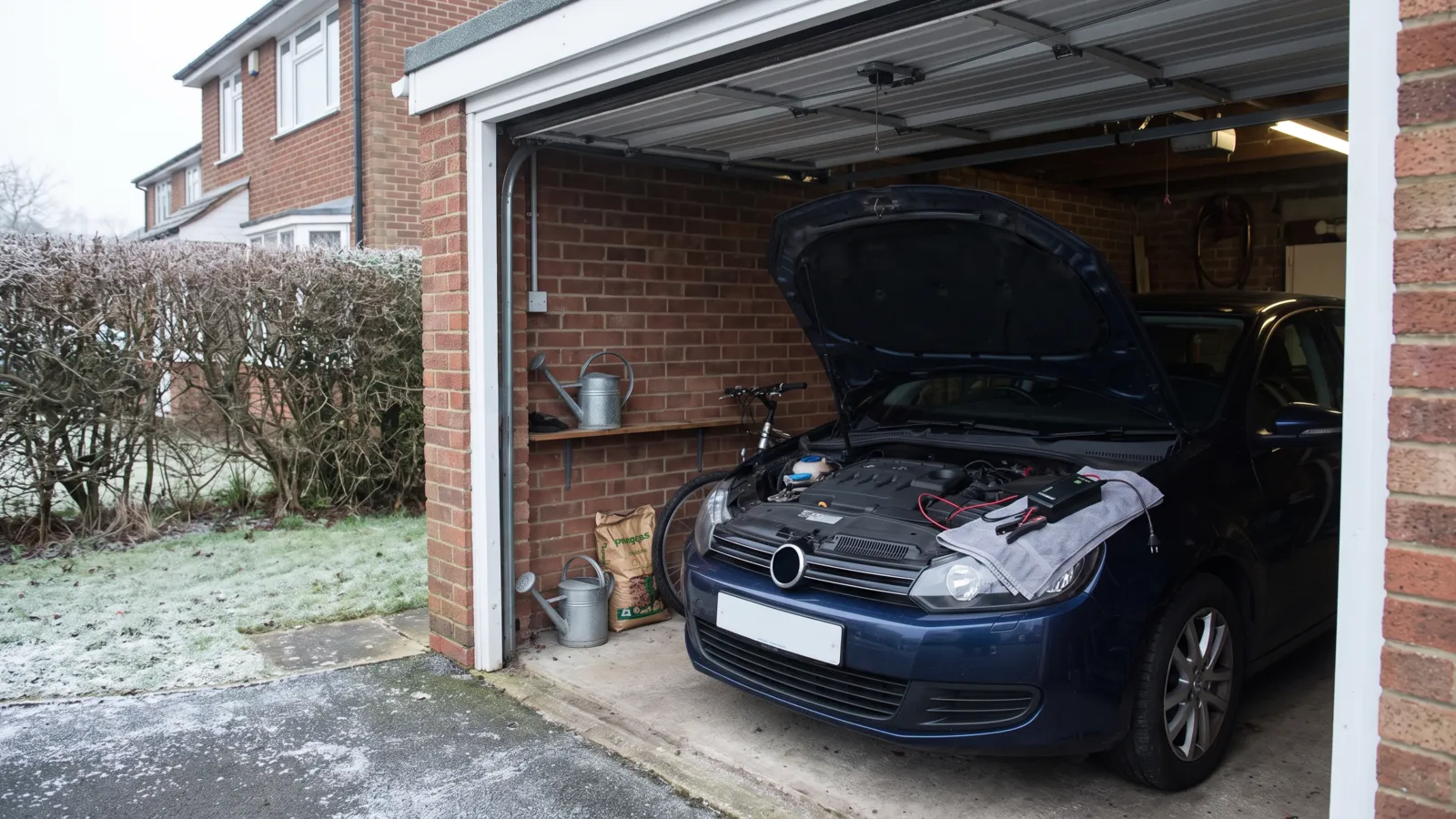
The Health and Safety Executive's guidance is that lead-acid batteries give off hydrogen as they charge, so use a ventilated space, never a sealed cupboard or under a cover, and keep flames and sparks away. Connect and disconnect the clamps in the order the charger's instructions give, with the charger unplugged. Never charge a battery that is frozen, cracked or leaking: a frozen one must thaw first and may need replacing. Use an RCD-protected socket, unwind any extension reel fully and never run a lead across a pavement. The IP65 rating CTEK and Ring state covers the charger body, not the plug or socket.
We verify every product's specifications against at least two independent sources, re-check its UK price and stock on a schedule where we can track it automatically, and cross-check safety-relevant claims against official guidance. Every review is labelled Researched or Used and reviewed by us: where we've bought a product, or been sent it free, and used it ourselves, its review says which; where we haven't, our verdict is a considered spec-and-evidence comparison, not a hands-on test — and commissions never change a ranking either way. Read our full methodology →
Related kit comparisons
Guides that go with this
The correct connection order for jump leads and jump packs, the stop-start and EV caveats most guides skip, an…
Highway Code rules 228–231 explained: clearing snow and ice legally, tyres, gentle-input technique, black ice,…
What the Highway Code and the regulations say about running the engine to defrost your car, idling fines, insu…
How UK storm warnings work, what Arwen and Éowyn taught households, and the short pre-storm checklist that mat…
Why lithium batteries fail, the charging rules that prevent fires, warning signs of a failing pack, and how to…
Common questions
Can I leave a battery charger connected all winter?
With a smart charger or maintainer, yes: that is what the maintenance stage is for, provided the battery is within the charger's stated maintenance range. The conditions are a controlled charger, a ventilated spot, a battery in sound condition and a lead that is not a trip hazard. Check on it every few weeks. An old uncontrolled trickle charger is a different matter and should not be left on unattended.
What size battery charger do I need for my car?
Read the amp-hour figure on the battery and pick a charger whose maker states it charges that capacity. As a rough guide, a motorbike or small garden battery suits 1A to 2A, a petrol hatchback or family car 3.8A to 5A, and a large diesel, van or leisure battery 7A or more. A smaller charger can maintain a bigger battery within its stated maintenance range, but charging a flat one may take days.
Do I need a special charger for a stop-start car with an AGM or EFB battery?
Pick one whose maker or UK listing names AGM and EFB or stop-start batteries. NOCO and Ring name both; CTEK lists AGM, and Halfords lists the XS 0.8 and MXS 3.8 as stop-start compatible. AGM batteries in particular can need a slightly higher charge voltage than a plain flooded battery, which is why some chargers have a separate mode. The battery type is printed on its label. If you replace the battery, fit the same type; some cars need the new one registering to the car's electronics.
Can I charge the battery without disconnecting it from the car?
Usually, and the charger makers design for it: connecting to the terminals, or the positive terminal and an earth point the handbook names, with the charger unplugged, then plugging in. Some cars with a battery sensor on the negative terminal ask you to clamp to a chassis earth rather than the terminal itself, so check the handbook. If you prefer to remove the battery, note that some cars lose settings and may need a reset afterwards.
Is it safe to charge a car battery in a garage or indoors?
In a ventilated garage or outbuilding, yes, with care. HSE guidance says lead-acid batteries release hydrogen while charging, which a spark can ignite, so leave a door or window open, keep flames and smoking away and don't charge under a sheet. Avoid living rooms, bedrooms and cupboards; if you take the battery out, charge it in a garage or outbuilding on a hard, stable surface. Never charge a frozen battery. Never run a vehicle's engine in a garage to charge it: the exhaust carries carbon monoxide.
Will a charger fix a battery that keeps going flat?
Only if the cause is the car sitting unused. If a battery goes flat during normal driving the likely causes are a worn-out battery, a charging fault or something drawing current when the car is off, and a charger will hide the symptom for a while rather than cure it. Have the battery and charging system tested; many garages and motor factors do this cheaply or free. A charger with a recovery stage can help a sulphated battery, but a battery past its life needs replacing.
