How to jump start a car: leads, jump packs and when not to try
The correct connection order for jump leads and jump packs, the stop-start and EV caveats most guides skip, and when a flat battery is a recovery job.
By Tom Calder · Updated 26 August 2026 · Sourced to gov.uk, the HSE & National Highways
First, check a jump start is the right fix
A flat 12V battery has a signature: you turn the key and get a click or a slow, laboured crank, the dashboard lights dim, and the car usually has a reason — it sat unused for a fortnight, did nothing but short trips through a cold week, or an interior light was left on. A jump start fixes exactly one problem: not enough charge to turn the engine over. If the engine cranks briskly but will not fire, or the car cut out while you were driving, the battery is not the fault and jumping it wastes your morning.
Set up properly before any clamp touches metal. Both vehicles switched off with handbrakes applied, in neutral (or park for automatics), and not touching each other. Confirm both are 12V — almost every car is, but some commercial vehicles run 24V, and the HSE's battery-safety guidance says plainly: if you are not sure the voltages match, do not proceed. Use colour-coded, insulated jump leads, empty your pockets of anything metal that could bridge the terminals, and keep flames, cigarettes and mobile phones away from the battery — the HSE treats all of them as ignition sources around a battery.
Jump leads: the order matters, and so does the reason
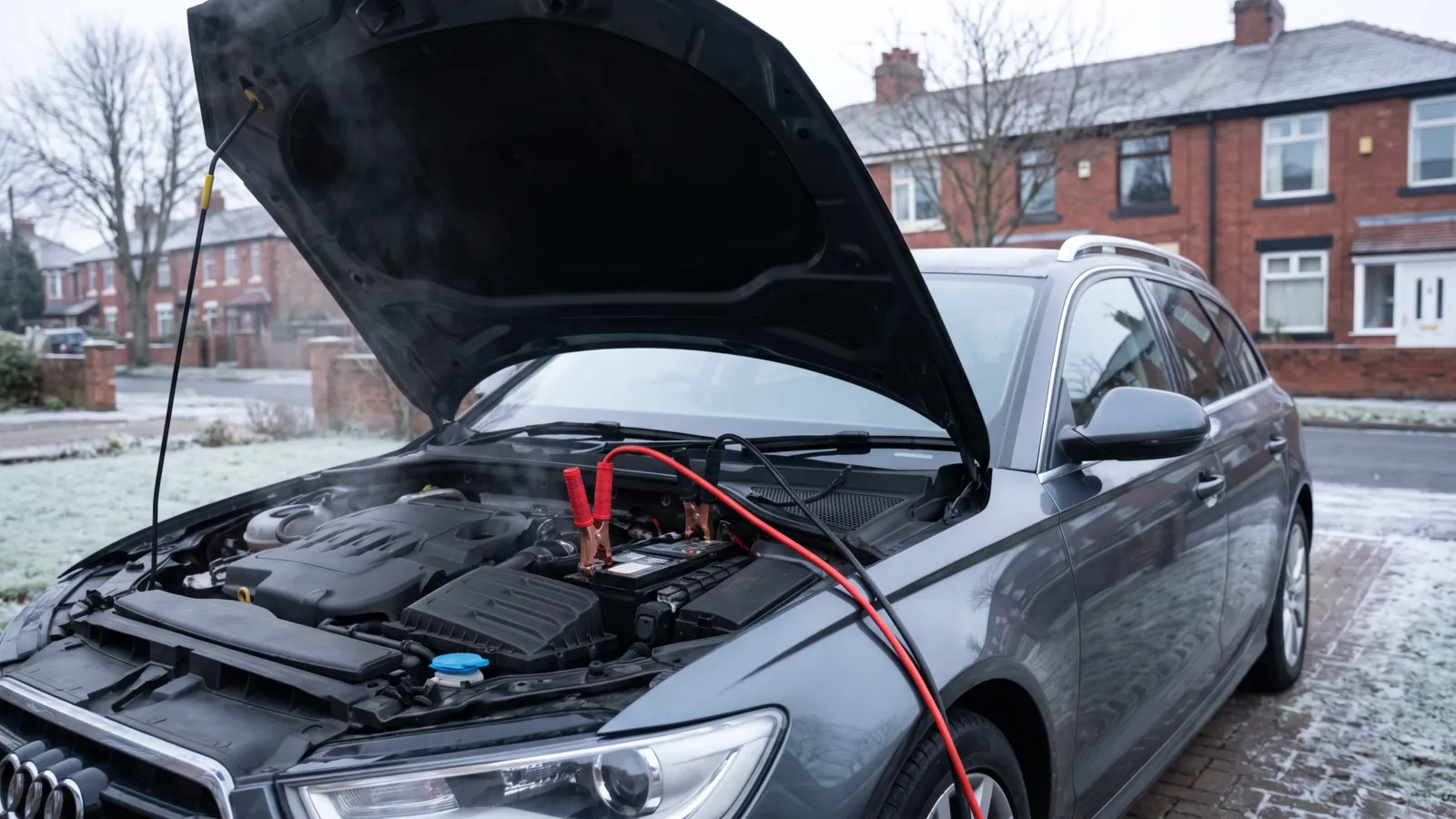
With both cars off, connect in this order: red clamp to the positive (+) terminal of the flat battery; red clamp to the positive terminal of the donor battery; black clamp to the negative (−) terminal of the donor battery; black clamp to a solid, unpainted metal point on the flat car's engine block or chassis — not the flat battery's negative terminal. The HSE specifies that this final earth point should be at least 15cm from the battery and away from fuel and brake lines. All of this assumes both cars are negative-earth, which every modern car is; if one of them is a pre-1970s classic, check its earth polarity before you start, because the HSE reserves mixed-polarity jump starts for people with suitable experience.
The reasoning behind that last step is the part most guides skip. The final connection is the one that completes the circuit, so it is the one that can spark — and a lead-acid battery gives off an explosive hydrogen–oxygen mixture while it is being charged, a risk that lingers after charging stops (in a jump start, the donor battery is exactly that: recently charged). The HSE notes that many battery explosions happen at the moment connections are made or broken. Clamping the last lead to bare metal well away from the battery puts the inevitable spark where the gas is not.
Start the donor car and hold it at a fast idle for a minute or so, then start the flat car. Disconnect in exactly the reverse order — the earth clamp on the engine block comes off first, the red clamp on the once-flat battery comes off last — after switching the donor's engine and ignition off. Leave the jumped car running, never let the clamps touch each other or the bodywork while any lead is still connected, and if the clamps are hot after a long crank, let them cool before you handle them.
Jump packs: the same logic, no donor car
A lithium jump pack replaces the donor car entirely: red clamp to the flat battery's positive terminal, black clamp to an earth point away from the battery — the same final-earth logic — then switch the pack on and start the engine. One important exception: follow your pack's own instructions over the generic rule. Many modern packs have spark-detection circuitry and tell you to clamp directly to the negative terminal; the manufacturer's sequence wins. Once the engine is running, switch the pack off and remove black, then red.
The practical case for a pack is simple: leads need a second car with a healthy battery, parked nose-to-nose, driven by someone with time to spare. A pack needs nothing but itself, which is why it works on a dark driveway at 7am, in a multi-storey, or anywhere you are on your own. If you carry one thing for winter motoring, this is the strongest candidate — our jump starter comparison covers sizing against engine capacity and which packs hold their charge in a cold boot, and it earns a permanent place in a car emergency kit.
When not to jump start at all
Some flat batteries should not be jumped, full stop. Do not connect anything if the battery case is cracked, leaking, swollen or smells of rotten eggs — the electrolyte is sulphuric acid, and if it reaches skin or eyes the NHS advice is to call 999 and rinse with cool or lukewarm running water, for about an hour rather than a quick splash. Do not jump a battery that may have frozen: a deeply discharged battery's electrolyte is mostly water, and after days of hard frost forcing current into it risks cracking the case. Do not use damaged leads or clamp onto heavily corroded terminals, and do not proceed at all if you cannot confirm both vehicles are the same voltage.
Then there is the pattern that matters more than any single flat: repetition. One flat battery after the kids left a door ajar is an event. A second inside a month is a symptom — a battery at the end of its life, a charging-system fault, or something draining the car while it is parked. Jump starting a failing battery every week is not thrift; it is a breakdown on deferred terms, and it will eventually happen somewhere far less convenient than your drive. A garage can test the battery and charging system in minutes.
Afterwards: recharge properly, then find the cause
A jump start gets the engine running; it does not refill the battery. The HSE's guidance makes the point directly: immediately after a jump the battery is still flat, and you will need to drive several miles before it holds enough energy to restart the engine on its own. A steady run at normal speeds is the minimum — a winter crawl through town with the heated screen, lights and blower running may barely break even. The proper fix is a mains smart charger overnight.
Close the loop before you forget about it. If there was an obvious cause — lights, dashcam, a month at the airport — charge it and move on. If there was not, get it tested rather than waiting for the next cold snap to find out for you: low temperatures cut a battery's output at exactly the moment the engine demands more, which is why the first hard frost of the year is peak flat-battery season. If your winter kit thinking stops at a scraper, it is worth ten minutes on what else belongs in the boot.
Common questions
Can I jump start an automatic car?
Yes. Jump starting works on any car regardless of gearbox — put an automatic in park with the handbrake on before connecting anything. It is bump starting (rolling the car and releasing the clutch) that needs a manual gearbox, and that technique is not recommended for modern cars anyway.
Can I use an electric or hybrid car to jump start another car?
Generally no. The 12V systems in hybrids and EVs are typically not designed to supply the heavy current needed to crank a petrol or diesel engine, and most manufacturers advise against it — check the handbook before assuming. The EV's own 12V battery can usually be jump started, following the handbook's procedure exactly and never touching the orange high-voltage cabling.
Is it safe to jump start a car in the rain?
Yes, with normal care. A car's 12V system is low voltage, so rain does not create a meaningful shock risk. The hazards are the same as in dry weather — sparks near the battery and short circuits — so follow the connection order, keep the clamps from touching each other, and stop if the battery itself is damaged.
How long should I drive after a jump start?
The HSE notes the battery is still flat immediately after a jump — you need several miles of driving before it can restart the engine unaided. Treat a 20 to 30 minute run at normal speeds as the minimum, and remember short urban trips may not recharge it at all. An overnight mains smart charger is the proper fix.
Why does my car battery keep going flat?
Repeated flats are a symptom, not bad luck. The usual causes are a battery at the end of its life, a charging-system fault such as a failing alternator, a parasitic drain from an accessory like a dashcam, or a pattern of journeys too short to replace the charge used starting. Get the battery and charging system tested rather than jumping it again.
My battery is in the boot — where do I connect the leads?
Use the dedicated jump points under the bonnet: a positive post, usually under a red flip-up cover, and an earth stud. Your handbook shows exactly where they are. They exist so you never have to clamp onto the battery itself, and they keep the final connection — the one that sparks — well away from it.
Sources: HSE — Using electric storage batteries safely (INDG139) · The Highway Code — Breakdowns and incidents (Rules 274 to 287), GOV.UK · National Highways — What to do if you break down · HSE — Electric and hybrid vehicles · NHS — Acid and chemical burns. PreparedBritain is independent and not affiliated with HM Government.
The Emergency Kit Checklist
The GOV.UK Prepare essentials on one printable page — tick them off as you go and keep it with the kit. Free, no catch.
Download it straight away. We'll also send the occasional briefing when something genuinely matters — severe weather, live incidents, real price drops. Nothing else.
Keep reading
All planning & the national picture guides →Condensation, damp and mould: the winter guide (and when it's your landlord's job)
How to tell condensation from penetrating and rising damp, fix each properly, when a dehumidifier helps — and…
Will solar panels keep the lights on in a power cut?
The surprising answer is usually no — standard grid-tied solar shuts down in a blackout. Here's why, what battery…
The Boiler Upgrade Scheme: the £7,500 heat-pump grant explained
A plain-English guide to the £7,500 Boiler Upgrade Scheme grant (£9,000 for off-gas-grid homes from 21 July 2026) —…