Condensation, damp and mould: the winter guide (and when it's your landlord's job)
How to tell condensation from penetrating and rising damp, fix each properly, when a dehumidifier helps — and renters' rights under Awaab's Law.
By Tom Calder · Updated 12 August 2026 · Sourced to GOV.UK & UKHSA
Work out which damp you have before you spend anything
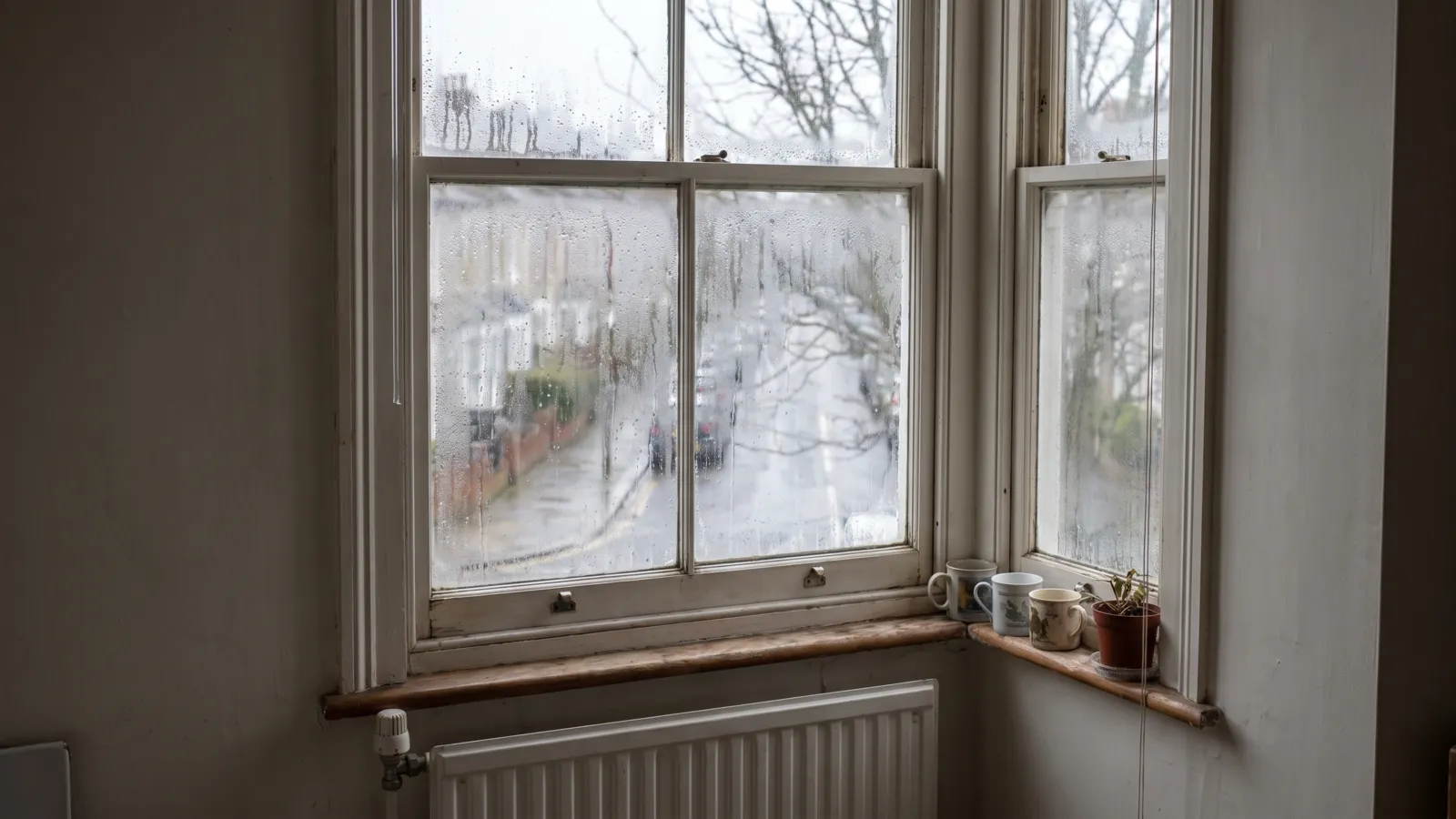
Damp is three different problems wearing the same name, and the fixes have almost nothing in common. Condensation is by far the most common in UK homes: it appears in winter on cold surfaces — window glass and frames, corners of external walls, behind wardrobes, inside cupboards on outside walls — and its mould is spotty and black. It is a moisture-in-the-air problem, and it responds to the ventilation and heating changes in this guide.
Penetrating damp is water getting in through the fabric of the building: a leaking gutter, cracked render, failed pointing, a roof or plumbing fault. The giveaway is a defined patch, at any height, that darkens or spreads during and after rain. Rising damp is ground moisture wicking up a wall where the damp-proof course has failed — ground floors only, typically a "tide mark" with white salt deposits up to about a metre, often with damaged skirting. It is rarer than the damp-proofing industry suggests and frequently misdiagnosed.
Everything below — moisture habits, ventilation, warmth, dehumidifiers — treats condensation. If your symptoms match the other two, skip to the callout and the landlord section: those need repairs, not routines.
The triangle: moisture, ventilation, warmth
Ordinary life puts litres of water vapour into your home every day — cooking, kettles, showers, breathing, and roughly two litres per load of washing dried indoors. Warm air carries that moisture invisibly; where it meets a surface cold enough, it condenses back into liquid water, and mould follows wherever a surface stays damp. Winter is worst because walls are colder, windows stay shut and washing moves indoors.
That gives you three levers, and they work together: produce less moisture, ventilate what you do produce to the outside, and keep surfaces warm enough that vapour doesn't condense on them. Homes that only get mould in a cold snap usually need the warmth lever; homes with streaming windows every morning usually need the first two. If affording warmth is the underlying problem, start with our guide to keeping warm on a budget.
One caution when sealing up for winter: draught-proof doors, letterboxes and floors by all means, but never block trickle vents, extractor fans, air bricks or chimney vents — they are the ventilation the triangle depends on.
Room-by-room habits that cost nothing
Kitchen: lids on pans, the extractor running while you cook and for ten minutes after, and the door closed so steam doesn't migrate to colder rooms. Bathroom: extractor fan or open window during and for a good fifteen minutes after showers, door closed, and a thirty-second squeegee of tiles and shower screen — removing water by hand is the cheapest extraction there is.
Washing: dry it outside when you can, or in one room with the door closed and either a window cracked or a dehumidifier running — not draped over radiators around the house, which pushes the vapour into every cold corner. Bedrooms: leave a gap of a few centimetres between furniture and external walls so air can circulate, and air each room daily — ten minutes with the window wide open swaps humid air for drier outdoor air without chilling the building itself.
Dehumidifiers: genuine help, or an expensive mask?
For condensation, a dehumidifier is a legitimate tool, not a gimmick: it does mechanically what ventilation does passively, and it earns its keep where the triangle is hard to balance — flats with no outdoor drying space, single-aspect rooms, tenancies where you can't add an extractor fan. A good rule of thumb is to hold indoor relative humidity roughly in the 40–60% range; a cheap hygrometer or an air quality monitor tells you whether you're winning and which rooms need attention.
What a dehumidifier cannot do is fix a building. If it runs constantly and the wall stays wet, or the damp tracks rainfall or sits at skirting level, the machine is masking a fault — your electricity is drying the symptom, not solving the cause.
The health picture, and removing mould safely
Joint government guidance, written with the UK Health Security Agency, is clear that damp and mould are a health issue, not a cosmetic one: living with them raises the risk of respiratory infections, allergic reactions and asthma flare-ups, and for people with weakened immune systems it carries a risk of more serious infection. The risk is highest for babies and children, older people, pregnant women and those who have recently given birth, and anyone with asthma, allergies or a weakened immune system — which is why mould should be dealt with promptly rather than lived with.
A very small patch caused by condensation — a scatter of spots around a window or in a corner, not a spreading wall — can be removed yourself: use a fungicidal mould and mildew cleaner, wear rubber gloves, goggles and a mask covering your nose and mouth, keep the window open while you work, and wipe rather than dry-brush, which releases spores. Larger, recurring or extensive growth means fixing the cause first, and often professional removal. If someone in a higher-risk group has symptoms, speak to your GP or NHS 111.
Renting? When it's the landlord's job — and how fast
Landlords are legally responsible for the structure, exterior and installations of the home — which covers penetrating damp, rising damp and leaks — and government guidance to housing providers is explicit that damp and mould must not be dismissed as tenant "lifestyle": the landlord must investigate the underlying cause, which can include building defects or inadequate ventilation. Report problems in writing with photos and dates, and keep copies.
Social tenants in England have hard deadlines under Awaab's Law, in force since 27 October 2025: the landlord must investigate a reported damp and mould hazard within 10 working days, give you a written summary within 3 working days of the investigation concluding, and — where a significant hazard is confirmed — complete the safety work needed to make the home safe within 5 working days, with any longer-term works started as soon as practicable and within 12 weeks. Emergency hazards must be investigated and made safe within 24 hours, and if the home can't be made safe in time the landlord must offer suitable alternative accommodation. If they don't act, complain formally, then escalate to the Housing Ombudsman.
Private tenants: the Renters' Rights Act 2025 gives the government the power to extend Awaab's Law to private tenancies, but that extension is not yet in force and no date has been set — for now, report in writing, and if the landlord doesn't act, ask your council's environmental health team to inspect (they can order repairs under the housing health and safety rating system) or use the Homes (Fitness for Human Habitation) Act 2018. Scotland and Wales have their own repairing and fitness standards, but the report-in-writing-then-escalate route is the same.
Common questions
What should indoor humidity be in winter?
Roughly 40–60% relative humidity is the band commonly recommended for healthy homes. Mould becomes likely where humidity stays persistently high at cold surfaces, so the room average matters less than the cold corners — a £10 hygrometer moved around the house, or an air quality monitor, will show you exactly which rooms and walls are the problem.
Does leaving the heating on low stop condensation?
Steady background warmth keeps wall and window surfaces above the temperature at which vapour condenses, so it genuinely helps — but it's the most expensive of the three levers. Cut moisture at source and ventilate first; use extra heat to finish the job, not start it. If affording heat is the issue, check what support you're entitled to before running the boiler harder.
Can I just paint over mould with anti-mould paint?
No. Paint applied over live mould fails within months, because the moisture that grew the mould is still there. Kill and remove the growth, fix the moisture problem, let the wall dry, and only then use an anti-mould paint as insurance — in that order.
Is drying washing indoors really causing my mould?
It's often the single biggest contributor: a typical load releases around two litres of water into the air. Drying indoors is fine if you contain it — one room, door closed, window cracked or dehumidifier running. The worst habit is washing spread over radiators through the house with every window shut.
Do disposable moisture-absorber pots work?
Only at very small scale. Crystal pots absorb a few hundred millilitres over weeks — useful inside a wardrobe, a car or a caravan cupboard. A household produces litres of vapour a day, so at room scale they are no substitute for ventilation or a dehumidifier extracting litres daily.
My landlord says the mould is caused by my lifestyle — can they do that?
Government guidance to housing providers is explicit that blaming damp and mould on tenants' "lifestyle choices" is not an acceptable response: the landlord must investigate and tackle the underlying cause, which can include building defects or inadequate ventilation. Put the report in writing; social tenants in England then have Awaab's Law deadlines behind them, and private tenants can ask the council's environmental health team to inspect.
Sources: Understanding and addressing the health risks of damp and mould in the home — GOV.UK (MHCLG, DHSC & UKHSA) · Awaab's Law Phase 1: guidance for social landlords — GOV.UK · Awaab's Law: guidance for tenants in social housing — GOV.UK · Repairs in private rented homes — GOV.UK. PreparedBritain is independent and not affiliated with HM Government.
The Emergency Kit Checklist
The GOV.UK Prepare essentials on one printable page — tick them off as you go and keep it with the kit. Free, no catch.
Download it straight away. We'll also send the occasional briefing when something genuinely matters — severe weather, live incidents, real price drops. Nothing else.
Keep reading
All planning & the national picture guides →Will solar panels keep the lights on in a power cut?
The surprising answer is usually no — standard grid-tied solar shuts down in a blackout. Here's why, what battery…
The Boiler Upgrade Scheme: the £7,500 heat-pump grant explained
A plain-English guide to the £7,500 Boiler Upgrade Scheme grant (£9,000 for off-gas-grid homes from 21 July 2026) —…
The Priority Services Register: free extra help in an emergency
What the free Priority Services Register is, who's eligible, the help it gives in a power, gas or water emergency,…