Best damp meters for UK homes (2026): pin, pinless and what the readings mean
A damp meter is a small handheld tester that puts a number, or a colour, on a patch of wall, floor or skirting that looks or smells wet. It is useful for one job: comparing a suspect spot with a known dry one, and watching whether a patch is drying out after a leak, a flood or a winter of condensation. This page compares the meters sold in the UK on how they measure, how plainly their makers state the limits, and what comes in the box. We have not tested any of them ourselves; every figure is credited to the maker, a retailer's spec sheet or published guidance.
By Tom Calder · Updated 21 October 2026 · 9 products, all price-tracked
Our picks by type
 Photo: Amazon
Dryzone Moisture Meter
A first look at a damp patch, with a maker that spells out what the masonry numbers mean.
as of 21 Oct 2026, 10:37 BST · Details
Product prices and availability are accurate as of the date/time indicated and are subject to change. Any price and availability information displayed on Amazon.co.uk at the time of purchase will apply to the purchase of this product. Photo: Amazon
Protimeter Digital Mini
Someone who wants a number on a screen as well as the traffic-light bar, from a surveyor-grade maker.
as of 21 Oct 2026, 10:37 BST · Details
Product prices and availability are accurate as of the date/time indicated and are subject to change. Any price and availability information displayed on Amazon.co.uk at the time of purchase will apply to the purchase of this product. Photo: Amazon
Protimeter Aquant
Scanning finished walls and floors for damp patterns without marking them.
as of 21 Oct 2026, 10:37 BST · Details
Product prices and availability are accurate as of the date/time indicated and are subject to change. Any price and availability information displayed on Amazon.co.uk at the time of purchase will apply to the purchase of this product. Photo: Amazon
Protimeter SurveyMaster
A landlord or serial renovator who wants both a pinless scan and a pin check from one professional tool.
as of 21 Oct 2026, 10:37 BST · Details
Product prices and availability are accurate as of the date/time indicated and are subject to change. Any price and availability information displayed on Amazon.co.uk at the time of purchase will apply to the purchase of this product.All 9 compared
| Meter | Type | Material scales | Range | Extras | Price |
|---|---|---|---|---|---|
Pin and pinless (dual) · Pin: WME; pinless: relative · Pin 6-99% WME; pinless to 19mm · Backlit LCD, LED arc, 2-year warranty A landlord or serial renovator who wants both a pinless scan and a pin check from one professional tool. | Pin and pinless (dual) | Pin: WME; pinless: relative | Pin 6-99% WME; pinless to 19mm | Backlit LCD, LED arc, 2-year warranty | £559.95 at Amazon as of 21 Oct 2026, 10:37 BST · DetailsProduct prices and availability are accurate as of the date/time indicated and are subject to change. Any price and availability information displayed on Amazon.co.uk at the time of purchase will apply to the purchase of this product.In stockCheck price → |
Our verdictOur verdictResearched The SurveyMaster is Protimeter's dual-function meter: scan with the non-invasive mode to find where the patterns are, then switch to pins to check a spot. Protimeter lists a 6% to 99% pin range on its WME scale and a 19mm non-invasive depth, plus deep-wall probes and hammer electrodes as options. It is the most complete meter on this page and by far the dearest. Even so, it carries the same limits as all of them on masonry, so it informs a surveyor's visit rather than replacing it. Best for A landlord or serial renovator who wants both a pinless scan and a pin check from one professional tool. Good
Worth knowing
Who shouldn't buy it: You will use it a handful of times: the Dryzone or Brennenstuhl, or a call to a surveyor, is better value. | |||||
Pin · Wood chart; other materials as WME · 7.9-99% WME · Backlit LCD plus LED bar, 2 x AA Someone who wants a number on a screen as well as the traffic-light bar, from a surveyor-grade maker. | Pin | Wood chart; other materials as WME | 7.9-99% WME | Backlit LCD plus LED bar, 2 x AA | £289 at Amazon as of 21 Oct 2026, 10:37 BST · DetailsProduct prices and availability are accurate as of the date/time indicated and are subject to change. Any price and availability information displayed on Amazon.co.uk at the time of purchase will apply to the purchase of this product.In stockCheck price → |
Our verdictOur verdictResearched The Digital Mini adds a backlit digital display to the colour bar of the plain Mini, and Protimeter lists optional hammer and deep-wall probes for it. Pins reach up to 12.7mm, according to Protimeter. It is a sensible step up from the Mini if you want to log readings, and it uses the same wood-based scale, so the usual caveat applies: in plaster or brick, the numbers compare spots, they do not give a true moisture content. Best for Someone who wants a number on a screen as well as the traffic-light bar, from a surveyor-grade maker. Good
Worth knowing
Who shouldn't buy it: A one-off check is all you need, or you want to scan walls without pin marks: the Aquant is pinless, and a budget meter covers a single look. | |||||
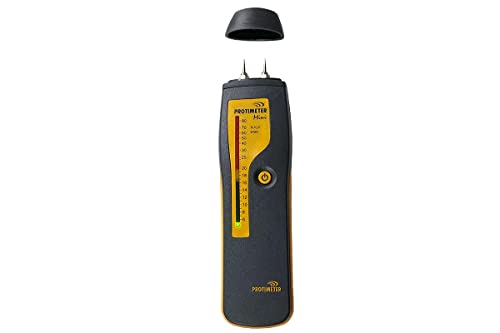 Pin (analogue LED scale) · Wood chart for 150 species · 6-90% (WME) · Check device, spare pin probe, pouch A homeowner who wants a damp meter from an established professional maker, with a way to confirm it still works. | Pin (analogue LED scale) | Wood chart for 150 species | 6-90% (WME) | Check device, spare pin probe, pouch | £194.89 at Amazon as of 21 Oct 2026, 10:37 BST · DetailsProduct prices and availability are accurate as of the date/time indicated and are subject to change. Any price and availability information displayed on Amazon.co.uk at the time of purchase will apply to the purchase of this product.In stockCheck price → |
Our verdictOur verdictResearched Protimeter calls this a low-cost analogue pin meter. A row of 60 LEDs runs green, amber and red instead of a number screen, with a wood chart for 150 species, a check device, an extension pin probe and a pouch in the box. The traffic-light display suits the homeowner question, is this spot worse than that one, better than the LCD budget meters, and it is simpler than the Digital Mini. It costs several times as much as the Dryzone or Brennenstuhl. Best for A homeowner who wants a damp meter from an established professional maker, with a way to confirm it still works. Good
Worth knowing
Who shouldn't buy it: You only need to compare a couple of patches once: a budget meter does that job, and a surveyor is the right call if the reading worries you. | |||||
Pinless (radio frequency) · Relative scale only · 60-1000 relative, to 19mm deep · Backlit LCD, LED arc, 2 x AA Scanning finished walls and floors for damp patterns without marking them. | Pinless (radio frequency) | Relative scale only | 60-1000 relative, to 19mm deep | Backlit LCD, LED arc, 2 x AA | £385.50 at Amazon as of 21 Oct 2026, 10:37 BST · DetailsProduct prices and availability are accurate as of the date/time indicated and are subject to change. Any price and availability information displayed on Amazon.co.uk at the time of purchase will apply to the purchase of this product.In stockCheck price → |
Our verdictOur verdictResearched The Aquant reads through the surface to about 19mm using radio frequency, so you can sweep a papered wall and map where the readings climb. Its scale is relative, 60 to 1000, with colour bands for dry, at risk and wet, rather than a moisture percentage, which is honest for a wall but means nothing is comparable to a wood reading. Protimeter describes it as the SurveyMaster's sister without pins. It is the pricey way to map; it cannot confirm what is causing damp. Best for Scanning finished walls and floors for damp patterns without marking them. Good
Worth knowing
Who shouldn't buy it: You want to read timber percentages or poke a spot: choose a pin meter, or the SurveyMaster that does both. | |||||
Pinless · 37 wood types, 10 building materials · Not stated; reads up to 30 mm deep · IP65 rubber housing, pouch, 2 x AA A tradesperson or keen DIYer who wants a rugged pinless meter with a setting for the material being checked. | Pinless | 37 wood types, 10 building materials | Not stated; reads up to 30 mm deep | IP65 rubber housing, pouch, 2 x AA | |
Our verdictOur verdictResearched Bosch's GMM 1-15 is a non-invasive meter with preset settings for 37 wood types and 10 building materials, a threshold scale, a reference mode for comparing areas and a rubber-armoured IP65 case. It costs several times as much as the pin meters here, and the material presets do not turn a wall reading into a diagnosis: Bosch's reference mode is there to compare areas, which is how any damp meter is best used. Against the Trotec BM31 you pay for material selection and a tougher build; against the Protimeter SurveyMaster you get Bosch's service network rather than a damp-industry name. Best for A tradesperson or keen DIYer who wants a rugged pinless meter with a setting for the material being checked. Good
Worth knowing
Who shouldn't buy it: You need one check on one wall: a budget pin meter or the Trotec BM31 does that job for far less. | |||||
Pin · Wood and building modes · Wood 6-60%; masonry indicative only · LCD, 126g, masonry profile guide A first look at a damp patch, with a maker that spells out what the masonry numbers mean. | Pin | Wood and building modes | Wood 6-60%; masonry indicative only | LCD, 126g, masonry profile guide | £24.99 at Amazon as of 21 Oct 2026, 10:37 BST · DetailsProduct prices and availability are accurate as of the date/time indicated and are subject to change. Any price and availability information displayed on Amazon.co.uk at the time of purchase will apply to the purchase of this product.In stockCheck price → |
Our verdictOur verdictResearched This is the plain entry point from a UK damp-treatment firm: pins, a wood mode and a building mode, and a wood accuracy of plus or minus 2% on Safeguard's own technical table. Safeguard is also unusually frank that masonry readings are indicative only, which is the honest way to read any meter on a wall. Next to the Brennenstuhl it costs about the same, states a tighter wood accuracy and comes with a guide to masonry moisture profiles; next to the Protimeter Mini it lacks the check device and the brand's field track record. Best for A first look at a damp patch, with a maker that spells out what the masonry numbers mean. Good
Worth knowing
Who shouldn't buy it: You want a quantified wall reading or a way to check calibration: no meter in this price band gives either, and a surveyor's sampling does. | |||||
 Pinless · One digit scale, no material modes · 0-100 digits; reads 5-40 mm deep · LCD, 180 g, 9V battery Scanning a wall for patches that read higher than the rest without making holes. | Pinless | One digit scale, no material modes | 0-100 digits; reads 5-40 mm deep | LCD, 180 g, 9V battery | £74.99 at Amazon as of 21 Oct 2026, 10:37 BST · DetailsProduct prices and availability are accurate as of the date/time indicated and are subject to change. Any price and availability information displayed on Amazon.co.uk at the time of purchase will apply to the purchase of this product.In stockCheck price → |
Our verdictOur verdictResearched The BM31 is a pinless indicator from a German climate-equipment maker: you press it flat against a surface and it senses moisture by a dielectric method to a stated depth of 5 to 40 mm. Trotec gives its range as 0 to 100 digits rather than a percentage, so it is a comparison tool for finding the wettest spot, not a meter that tells you how wet a wall is. Next to the pin meters on this page it leaves no marks, but Trotec lists no wood mode and no calibration check device; the Bosch GMM 1-15 is the pinless step up for those who want material settings. Best for Scanning a wall for patches that read higher than the rest without making holes. Good
Worth knowing
Who shouldn't buy it: You want a percentage scale for timber or separate wood and masonry settings: look at the Stanley for a wood percentage scale or the Bosch GMM 1-15 for material modes. | |||||
 Pin · Wood; building materials · Wood 5-50%; building 1.5-33% · LCD to 0.1%, hold, 9V not included A known German tool brand's basic pin meter for a quick wood and wall check. | Pin | Wood; building materials | Wood 5-50%; building 1.5-33% | LCD to 0.1%, hold, 9V not included | £22.38 at Amazon as of 21 Oct 2026, 10:37 BST · DetailsProduct prices and availability are accurate as of the date/time indicated and are subject to change. Any price and availability information displayed on Amazon.co.uk at the time of purchase will apply to the purchase of this product.In stockCheck price → |
Our verdictOur verdictResearched Brennenstuhl lists two measuring ranges, 5-50% for wood and 1.5-33% for building materials, a hold button and an audible signal that can be switched off. It is a straightforward, no-app pin meter. Against the Dryzone it puts a percentage range on building materials where Safeguard calls masonry figures indicative, but those numbers are no more meaningful on a wall, so the same caution applies: treat wall readings as a comparison between spots. Best for A known German tool brand's basic pin meter for a quick wood and wall check. Good
Worth knowing
Who shouldn't buy it: You want a tighter stated accuracy or a calibration check: the Dryzone states plus or minus 2% for wood, and the Protimeter Mini ships a check device. | |||||
 Pin · Wood and masonry scales · Wood 6-44%; masonry 0.2-2.0% · Bar-graph LCD, 8 mm pins, +/-2% A well-known tool brand's basic pin meter for spot checks on skirting, window frames and walls. | Pin | Wood and masonry scales | Wood 6-44%; masonry 0.2-2.0% | Bar-graph LCD, 8 mm pins, +/-2% | £24 at Amazon as of 21 Oct 2026, 10:37 BST · DetailsProduct prices and availability are accurate as of the date/time indicated and are subject to change. Any price and availability information displayed on Amazon.co.uk at the time of purchase will apply to the purchase of this product.In stockCheck price → |
Our verdictOur verdictResearched Stanley's two-pin meter reads by electrical resistance and offers a wood scale of 6 to 44% and a separate masonry scale of 0.2 to 2.0%, with a bar-graph display. The masonry scale is a small relative range, so on plaster or brick it is best used to compare one spot with another rather than to give a verdict. It sits in the same price tier as the Dryzone and the Brennenstuhl, with a household-name brand. Stanley quotes plus or minus 2% without saying which scale, and on a masonry scale that only runs from 0.2 to 2.0% that figure cannot be taken at face value. Best for A well-known tool brand's basic pin meter for spot checks on skirting, window frames and walls. Good
Worth knowing
Who shouldn't buy it: You want a pinless scan that leaves no marks on decorated walls, or a calibration check beyond the cap contacts: the Trotec BM31 scans without pins. | |||||
ⓘ As an Amazon Associate, PreparedBritain earns from qualifying purchases. We may earn a commission when you buy, or a fee when you request a quote, through our links — it never affects what we recommend. Amazon prices come from Amazon's own product data and show the date and time they were retrieved. Prices at other retailers are checked by us, less often. Prices and stock can change at any time, so always check the retailer's price before you buy.
Before you buy
Start with how the meter measures, because that decides what it can tell you.
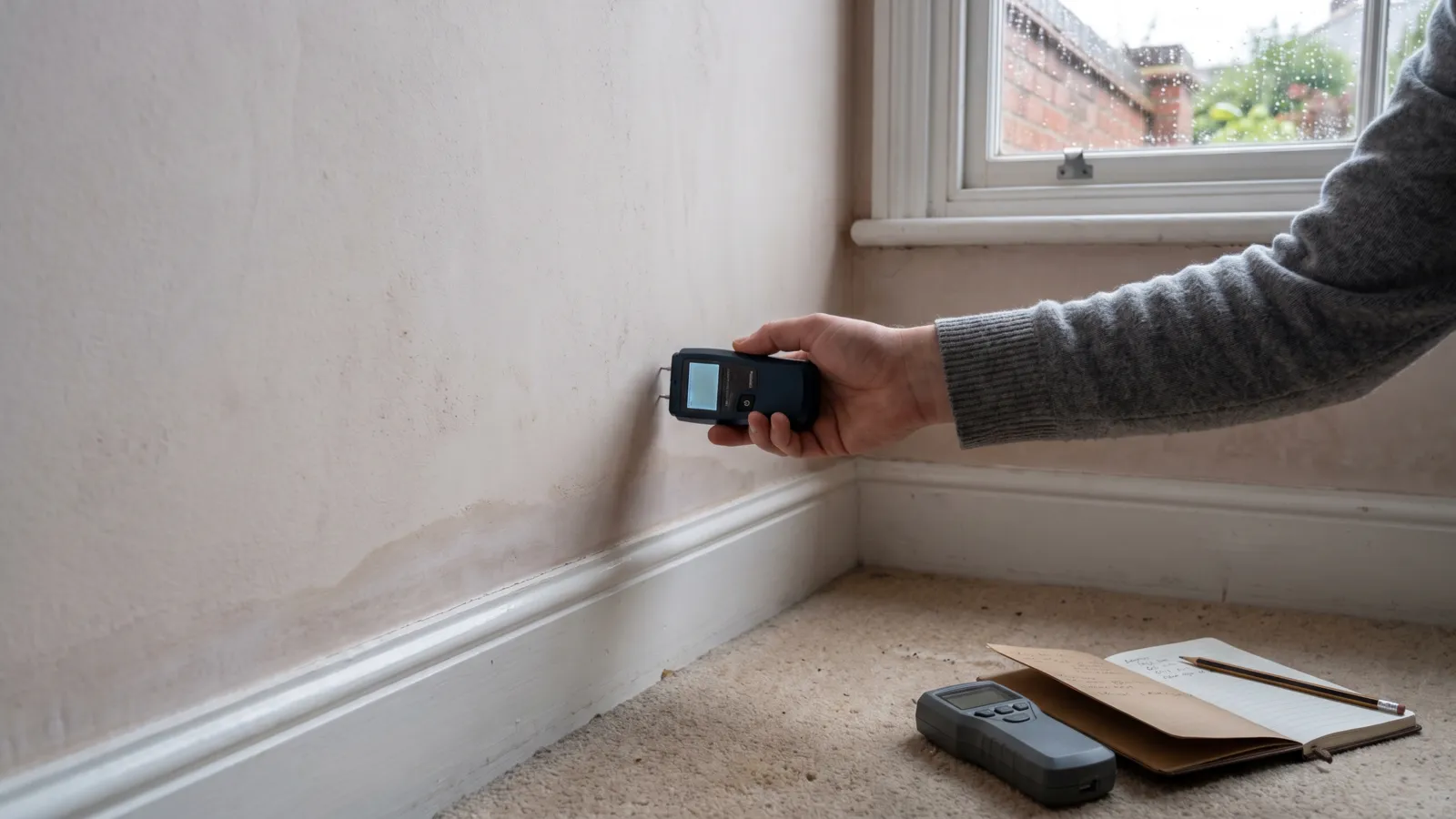
Pin meters push two electrodes into the surface and read the electrical resistance between them, a sound method in timber and the reason wood percentages are the only ones that mean much. Pinless meters hold a flat sensor against the surface and read into it by radio frequency, so you can sweep a papered or painted wall without marks and map where readings climb. Protimeter states a 19mm depth for the Aquant, and the SurveyMaster's pinless mode is listed to the same depth. A dual meter does both: scan for the pattern, then pin a spot.
Read the scale, not just the number.
Pin meters report wood moisture equivalent, or WME: Protimeter lists 6% to 90% for the Mini and 7.9% to 99% for the Digital Mini; the SurveyMaster's pins are listed at 6% to 99%. Brennenstuhl prints separate ranges for wood and building materials; Safeguard says plainly that the Dryzone masonry values are indicative only. Pinless meters such as the Aquant use a relative scale, 60 to 1000, with dry, at-risk and wet colour bands. None is a true moisture content for brick or plaster. On masonry the honest use is comparison: same meter, same wall, dry spot against suspect spot.
Decide how much meter you need.
For a homeowner checking a patch after a leak, or watching a wall dry after a flood, a budget pin meter from a maker that publishes its ranges and accuracy, as Safeguard and Brennenstuhl do, does the job. Protimeter states a two-year warranty on all four of its meters here, and the Mini comes with a check device, to confirm it still reads correctly. The pinless meters suit scanning finished walls without pin marks; the SurveyMaster is the landlord or renovator tool, pins and scan in one case. Most households use a meter a handful of times, so simpler usually wins.
Know the traps before you take a reading.
The Property Care Association guidance notes that salts carried into plaster by past damp raise conductivity, and so raise readings long after the wall has dried, which is why a treated wall can still read wet. RICS makes the same point about conductive substances in materials other than timber. Foil-backed plasterboard, metal lath, cables and pipes behind the surface, and condensation on a cold wall on a winter morning can all do the same. Take readings in a grid at several heights rather than one spot, note whether the wall was recently wetted, and compare against an area you know is dry.
Then decide who should look.
A meter helps you describe a problem to a landlord, insurer or surveyor: where it is, how far it spreads and whether it is getting better or worse. It does not tell you the cause, and the cause decides the fix. Condensation is managed with heat, ventilation and a dehumidifier; a leak needs a plumber or roofer; a flooded wall needs monitored drying before redecorating. Where rising damp is suggested, RICS and the Property Care Association both point towards a proper diagnosis before any damp-proof course is sold: an independent surveyor with damp experience, not a free survey from the firm selling it.
We verify every product's specifications against at least two independent sources, re-check its UK price and stock on a schedule where we can track it automatically, and cross-check safety-relevant claims against official guidance. Every review is labelled Researched or Used and reviewed by us: where we've bought a product, or been sent it free, and used it ourselves, its review says which; where we haven't, our verdict is a considered spec-and-evidence comparison, not a hands-on test — and commissions never change a ranking either way. Read our full methodology →
Related kit comparisons
Guides that go with this
How to tell condensation from penetrating and rising damp, fix each properly, when a dehumidifier helps — and …
What to do after a flood in the UK: safety checks before re-entry, contaminated-water hygiene, drying out prop…
How to stop pipes freezing, thaw a frozen pipe safely, and act fast if one bursts — one of the most preventabl…
Know your risk, get warnings, and what to do before, during and after a flood — the practical checklist, sourc…
What counts as a storm for home insurance, how the ombudsman settles disputes, who pays for fallen trees, fenc…
Common questions
What is a normal damp meter reading for a wall?
There is no single normal figure, because the meters are calibrated for wood. Protimeter's own guide shows that the same percentage represents different real moisture levels in wood, mortar, brick and plaster, and Safeguard calls its masonry readings indicative only. The useful comparison is between spots on the same wall with the same meter: find an area you are confident is dry, read it, then read the suspect patch. A clear and consistent difference is worth investigating; a single number on its own is not.
Can a damp meter tell me if I have rising damp?
No. A meter can show a band of higher readings near the base of a wall, but condensation, a leaking pipe, bridged render, high ground levels and old hygroscopic salts can all produce a similar band. The Property Care Association's guidance treats meter readings in masonry as comparative, and RICS warns against relying on a meter alone. Diagnosing rising damp properly takes a surveyor who looks at the whole picture, and sometimes drilled samples. Get that opinion before anyone sells you a damp-proof course.
Pin or pinless damp meter: which should I buy?
Pin meters are the straightforward choice for timber, skirting, joists and a quick check on a patch. Pinless meters read through a surface to a stated depth, 19mm on Protimeter's Aquant, so they suit scanning a finished wall or floor for a pattern without leaving pin holes, but on walls they give only relative readings. If you want both, the SurveyMaster combines them. For most homes checking a single damp patch, a pin meter from a maker that publishes its accuracy is enough.
Why does my damp meter read high on a wall that feels dry?
Several things raise a reading without the wall being wet. Salts left behind by past damp conduct electricity and keep readings high after the wall has dried, which the Property Care Association's guidance explains. Foil-backed plasterboard, metal lath, a cable or a pipe behind the surface, and a film of condensation on a cold wall do the same. RICS makes the same point about conductive substances in materials other than timber. Take readings in a grid, compare with a known dry area, and treat a lone high reading with caution.
Can I use a damp meter to check a house before buying it?
You can take comparative readings on a viewing, and they may prompt questions, but they are no substitute for a survey. RICS notes that meters are reliable in timber yet can read high in other materials, and that not every surveyor is experienced in damp. A RICS Home Survey Level 2 or 3 includes damp checks, and if the surveyor flags a concern, ask for an independent damp specialist rather than a free survey from a treatment company. Keep your own readings as a record to compare against later.
Is a damp meter the same as a humidity meter?
No. A damp meter reads moisture in a material: wood, plaster, brick or a floor. A humidity meter, or hygrometer, reads the moisture in the air of a room as relative humidity. For condensation problems, which are the most common winter damp in UK homes, the hygrometer is often the more useful tool: it shows whether a room sits in the range where mould grows and whether ventilation or a dehumidifier is helping. Many dehumidifiers display humidity, and a basic hygrometer is a simple add-on.
