Best mould removers for bathrooms, walls and ceilings UK (2026)
A mould remover is a spray, foam or liquid that clears the black and grey marks that grow on grout, sealant, window reveals and cold corners of a room when damp air meets a cold surface. Most are a weak bleach; a few use a different biocide so they can go on painted walls and ceilings. This page compares the products sold in the UK on what the makers and their safety data sheets state: the active ingredient, the surfaces each is meant for, the contact time and the hazard wording. We have not tried any of them ourselves; every figure is credited to its source.
By Tom Calder · Updated 21 October 2026 · 6 products, all price-tracked
Our picks by type
 Photo: Amazon
HG Foam Spray
Black mould on vertical bathroom grout and sealant, where foam stays put.
as of 21 Oct 2026, 10:37 BST · Details
Product prices and availability are accurate as of the date/time indicated and are subject to change. Any price and availability information displayed on Amazon.co.uk at the time of purchase will apply to the purchase of this product. Photo: Amazon
Polycell Mould Remover
Treating mould on walls and ceilings before repainting, without bleach.
as of 21 Oct 2026, 10:37 BST · Details
Product prices and availability are accurate as of the date/time indicated and are subject to change. Any price and availability information displayed on Amazon.co.uk at the time of purchase will apply to the purchase of this product.All 6 compared
| Mould remover | Active ingredient | Format | For | Contact time (maker) | Price |
|---|---|---|---|---|---|
Sodium hypochlorite (2-5%, per SDS) · Foam spray, 500ml · Tiles, grout, sealant, plaster; not wood · 30 minutes Black mould on vertical bathroom grout and sealant, where foam stays put. | Sodium hypochlorite (2-5%, per SDS) | Foam spray, 500ml | Tiles, grout, sealant, plaster; not wood | 30 minutes | £5.60 at Amazon as of 21 Oct 2026, 10:37 BST · DetailsProduct prices and availability are accurate as of the date/time indicated and are subject to change. Any price and availability information displayed on Amazon.co.uk at the time of purchase will apply to the purchase of this product.In stockCheck price → |
Our verdictOur verdictResearched A bleach-based foam from a Dutch cleaning specialist. HG says to spray from 3-5cm, leave it for 30 minutes and wipe off with a wet sponge, and says the foam stays on the surface longer than a spray and cuts splashing, which suits walls and sealant lines. It sits at the strong end of this page: the safety data sheet classes it as corrosive, so it is for people happy to wear gloves and eye protection. Of the sprays here it has the clearest maker instructions. Best for Black mould on vertical bathroom grout and sealant, where foam stays put. Good
Worth knowing
Who shouldn't buy it: You want something gentler around children or pets, or the mould is on wood or soft furnishings; ask a professional or fix the damp first if it covers a large area. | |||||
 Bleaching action (active not named on page) · Trigger spray, 500ml · Tiles, grout, sealant, plaster; not wood · 30 minutes Tiled walls, grout and silicone seals in a bathroom, kitchen or cellar. | Bleaching action (active not named on page) | Trigger spray, 500ml | Tiles, grout, sealant, plaster; not wood | 30 minutes | £4.50 at Amazon as of 21 Oct 2026, 10:37 BST · DetailsProduct prices and availability are accurate as of the date/time indicated and are subject to change. Any price and availability information displayed on Amazon.co.uk at the time of purchase will apply to the purchase of this product.In stockCheck price → |
Our verdictOur verdictResearched The non-foam sibling of HG's foam spray, with the same 3-5cm spray distance and 30-minute wait on HG's page. It suits flat tile and grout where a foam is not needed. HG says the spray has a bleaching effect and to test first in a hidden spot, but its page does not name the active ingredient, so check the bottle label. Choose the foam version if you are treating walls and ceilings. Best for Tiled walls, grout and silicone seals in a bathroom, kitchen or cellar. Good
Worth knowing
Who shouldn't buy it: You are working on ceilings or walls where runs are a nuisance, in which case the foam version is a better fit. | |||||
 Sodium hypochlorite (2.19g per 100g, per SDS) · Trigger spray, 750ml · Bath, shower, tiles, damp surfaces A large bottle for regular bathroom and shower mould. | Sodium hypochlorite (2.19g per 100g, per SDS) | Trigger spray, 750ml | Bath, shower, tiles, damp surfaces | — | £6.99 at Amazon as of 21 Oct 2026, 10:37 BST · DetailsProduct prices and availability are accurate as of the date/time indicated and are subject to change. Any price and availability information displayed on Amazon.co.uk at the time of purchase will apply to the purchase of this product.In stockCheck price → |
Our verdictOur verdictResearched A big 750ml bleach spray from Reckitt. The safety data sheet puts sodium hypochlorite at 2.19g per 100g, declares under 5% chlorine-based bleaching agents, and warns that it must not be used with other products because it can release chlorine. Retailers repeat the maker's wording that it works without scrubbing and removes visible black mould, but online listings give differing contact times, so follow the bottle. A sensible everyday choice next to the stronger HG range. Best for A large bottle for regular bathroom and shower mould. Good
Worth knowing
Who shouldn't buy it: The mould is on wood, marble, carpets or soft furnishings, or you want a bleach-free product. | |||||
 Sodium hypochlorite (2.59% w/w, Dettol) · Trigger spray, 3 x 750ml pack · Tiles, grout, plastics, basins, acrylic baths · Up to 5 minutes (maximum) Hard, sealed bathroom surfaces where you want a short contact time. | Sodium hypochlorite (2.59% w/w, Dettol) | Trigger spray, 3 x 750ml pack | Tiles, grout, plastics, basins, acrylic baths | Up to 5 minutes (maximum) | £11.99 at Amazon as of 21 Oct 2026, 10:37 BST · DetailsProduct prices and availability are accurate as of the date/time indicated and are subject to change. Any price and availability information displayed on Amazon.co.uk at the time of purchase will apply to the purchase of this product.In stockCheck price → |
Our verdictOur verdictResearched Dettol's bleach spray has the shortest contact time here: its page says leave for up to 5 minutes at most, then wipe. It lists tiles, grout, plastics, basins and acrylic baths, and says not to use it on coloured grout, rubber, unglazed tiles or painted surfaces. Dettol states the sodium hypochlorite content at 2.59%. This Amazon listing is a pack of three 750ml bottles, which is worth it only if you will use them all. Best for Hard, sealed bathroom surfaces where you want a short contact time. Good
Worth knowing
Who shouldn't buy it: You have painted walls, coloured grout or ceilings to treat, or you do not want to buy three bottles. | |||||
Quaternary ammonium (DDAC under 1%, per SDS) · Trigger spray, 500ml · Walls and ceilings before painting Treating mould on walls and ceilings before repainting, without bleach. | Quaternary ammonium (DDAC under 1%, per SDS) | Trigger spray, 500ml | Walls and ceilings before painting | — | £6.49 at Amazon as of 21 Oct 2026, 10:37 BST · DetailsProduct prices and availability are accurate as of the date/time indicated and are subject to change. Any price and availability information displayed on Amazon.co.uk at the time of purchase will apply to the purchase of this product.In stockCheck price → |
Our verdictOur verdictResearched Polycell's remover is bleach-free: the safety data sheet lists a quaternary ammonium compound at under 1% and classes it only as an eye irritant. Polycell positions it for preparing surfaces before painting, with a 2 to 4 hour drying time and coverage of 2.5 square metres per bottle at 200ml per square metre. That makes it the one to pick for painted walls, where bleach sprays can mark. It is a decorator's product more than a bathroom grout cleaner, and Polycell's page gives no contact time. Best for Treating mould on walls and ceilings before repainting, without bleach. Good
Worth knowing
Who shouldn't buy it: You want a quick bathroom grout and sealant cleaner, where the HG or Dettol sprays are a closer fit. | |||||
 Quaternary ammonium (chlorinated salt) · Liquid in a screw-cap bottle, 500ml · Bare or painted walls and ceilings Mould on bare or painted walls and ceilings when you want to avoid bleach. | Quaternary ammonium (chlorinated salt) | Liquid in a screw-cap bottle, 500ml | Bare or painted walls and ceilings | — | £9.98 at Amazon as of 21 Oct 2026, 10:37 BST · DetailsProduct prices and availability are accurate as of the date/time indicated and are subject to change. Any price and availability information displayed on Amazon.co.uk at the time of purchase will apply to the purchase of this product.In stockCheck price → |
Our verdictOur verdictResearched Ronseal's 3 in 1 lists an ethoxylated alcohol and a chlorinated quaternary ammonium salt as its hazardous ingredients, with no bleach among them. Ronseal says it is for bare or previously painted walls and ceilings and that it kills mould and prevents it returning, but gives no contact time on its page. This listing is the liquid in a bottle rather than the trigger spray. The maker's hazard statements include serious eye damage, so eye protection matters. It sits alongside Polycell as the wall-and-ceiling option on this page. Best for Mould on bare or painted walls and ceilings when you want to avoid bleach. Good
Worth knowing
Who shouldn't buy it: You are cleaning tiles, grout or sealant in a shower, where a dedicated bathroom spray is a better match. | |||||
ⓘ As an Amazon Associate, PreparedBritain earns from qualifying purchases. We may earn a commission when you buy, or a fee when you request a quote, through our links — it never affects what we recommend. Amazon prices come from Amazon's own product data and show the date and time they were retrieved. Prices at other retailers are checked by us, less often. Prices and stock can change at any time, so always check the retailer's price before you buy.
Before you buy
Start with the surface, because that decides the chemistry.
HG's foam, Dettol and Cillit Bang state sodium hypochlorite, the same active as thin bleach, and HG's plain spray says it has a bleaching effect. The makers list them for hard bathroom surfaces such as glazed tiles, grout and sealant, and each sets its own exclusions: Dettol rules out coloured grout, rubber, unglazed tiles and painted or varnished surfaces, while HG rules out coloured surfaces, wood, plastic shower trays and aluminium or stainless steel trim. For a painted wall or ceiling, Polycell and Ronseal use a quaternary ammonium biocide instead of bleach and are sold for preparing a surface before repainting.
Read the contact time and follow the bottle rather than a retailer listing.
The makers' figures run from a few minutes to half an hour: Dettol says leave its spray for up to five minutes at most, HG says thirty minutes for both its spray and its foam, and Cillit Bang's online listings disagree with each other, so the directions on the pack win. Polycell and Ronseal give no contact time for their wall treatments, only a drying time before you paint. Longer is not better; it is more time for bleach to mark grout or sealant, and HG and Dettol both say to test a hidden patch first.
Foam, spray or liquid is a question of where the mould is.
A trigger spray is fine on a flat run of tiles. On a vertical sealant line, a window reveal or a ceiling, a thin spray runs off before it has worked and drips where you do not want it; HG says its foam version stays on the surface longer and splashes less, which is the reason to pick it over the plain spray. The Ronseal liquid comes in a screw-cap bottle rather than a trigger, so it goes on by hand rather than as a spray and suits a wall you are about to decorate.
Treat these as the hazardous chemicals their labels say they are.
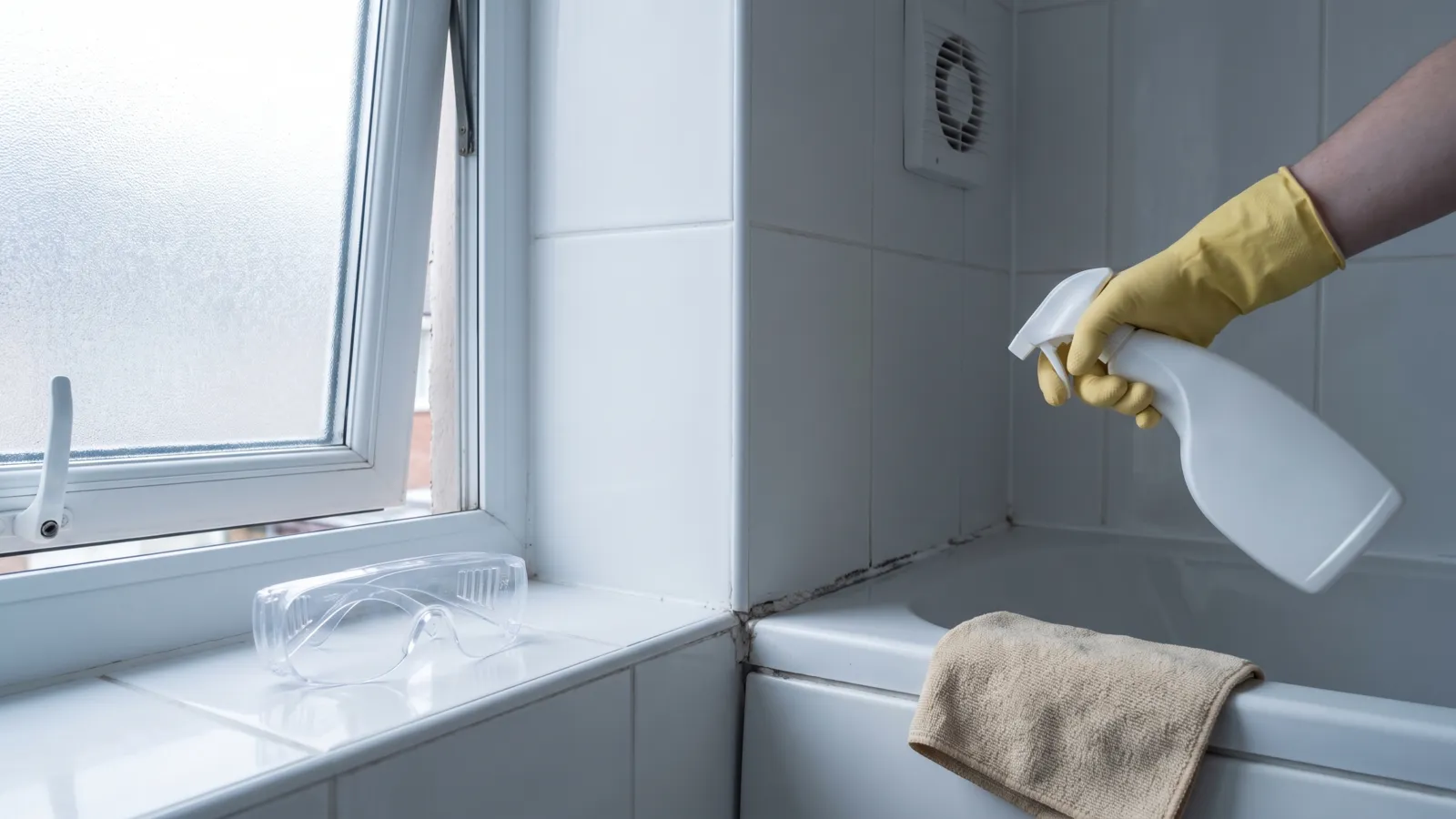
Government guidance on damp and mould says whoever removes mould should wear a mask, gloves and goggles, that doors should be kept shut so spores do not spread, and that mould and mildew products are preferred over plain bleach. Open a window, run the extractor, keep children and pets out until surfaces are dry, and never mix a bleach spray with any other cleaner, descaler or vinegar: HG's foam and Cillit Bang both warn that mixing can release chlorine gas. The bleach-free products are not harmless either; Polycell and Ronseal both warn about eye irritation or damage.
Plan the week after, not just the hour.
Once the patch is clean and dry, work out why it grew: cold outside walls, washing dried indoors, a bathroom without a working fan, a leaking seal or a blocked airbrick. Government guidance expects the cause to be found and fixed and advises checking the area again at least six weeks after any work. Our condensation, damp and mould guide walks through the free checks; a dehumidifier or a damp meter helps in the rooms where ventilation alone is not enough. If the mould came back after a flood or a leak, dry the structure out first, or it will simply return.
We verify every product's specifications against at least two independent sources, re-check its UK price and stock on a schedule where we can track it automatically, and cross-check safety-relevant claims against official guidance. Every review is labelled Researched or Used and reviewed by us: where we've bought a product, or been sent it free, and used it ourselves, its review says which; where we haven't, our verdict is a considered spec-and-evidence comparison, not a hands-on test — and commissions never change a ranking either way. Read our full methodology →
Related kit comparisons
Guides that go with this
How to tell condensation from penetrating and rising damp, fix each properly, when a dehumidifier helps — and …
What to do after a flood in the UK: safety checks before re-entry, contaminated-water hygiene, drying out prop…
How to stay warm at home without turning the heating on — warm the person, then the zone, then the room, with …
Common questions
What is the best mould remover for bathroom sealant and grout?
A bleach-based spray or foam is what the makers sell for glazed tiles, grout and silicone, and a foam suits vertical sealant lines because HG says it stays in place longer than a spray. Check the exclusions first: Dettol rules out coloured grout, rubber and painted surfaces, and HG rules out coloured surfaces, wood and metal trim. If the sealant is black right through rather than on the surface, no spray will bring it back and it needs cutting out and replacing.
Can I use a mould remover on painted walls and ceilings?
Not a bleach one, unless the maker says so: Dettol's page lists painted and varnished surfaces among the ones to avoid, and HG warns against coloured surfaces. Polycell and Ronseal sell bleach-free, quaternary ammonium treatments for walls and ceilings, Ronseal for bare or previously painted ones and Polycell as preparation before painting. Whatever you use, ventilate, wear eye protection, and remember a ceiling patch usually means a cold surface or damp air that still needs sorting.
Is it safe to use bleach mould spray around children and pets?
Only with care, never while they are in the room. HG's foam is classed as corrosive on its safety data sheet, so government guidance on removing mould applies: gloves, goggles and a mask for whoever does it, a window open and the extractor on. Keep children and pets out until surfaces are dry, store bottles out of reach, and never mix a bleach spray with another product. If anyone is splashed in the eyes, rinse with water for several minutes and call NHS 111; if swallowed or serious, call 999.
Does a mould remover kill mould or just bleach it white?
It depends on the surface. Sodium hypochlorite breaks down the pigment and the growth on a hard, non-porous surface such as a glazed tile, which is why it works well there. On porous plaster, grout or sealant the growth can sit below the surface, so the mark fades and returns. That is why Polycell and Ronseal sell wall treatments for use before painting rather than cleaners, and why government guidance says removing surface mould will not stop it returning unless the damp is dealt with.
My landlord will not deal with the mould. What can I do?
Report it in writing, with photos and dates, and keep copies. If you rent from a council or housing association in England, Awaab's Law has applied since 27 October 2025: GOV.UK says the landlord must investigate significant damp and mould within 10 working days, make the home safe within 5 working days of the investigation concluding, and act on emergencies within 24 hours. If they miss those deadlines you can go to the Housing Ombudsman. Private tenants can report disrepair to the council's environmental health team.
Should I use a mould remover after a flood or a leak?
Not as the first step. Mould after water damage means the wall, floor or plaster is still wet, and no spray will keep it clean until the building has dried out, which can take weeks with heaters and dehumidifiers. Deal with the water source, strip out anything soaked that cannot be dried, dry the structure, then clean what remains. A large area, or anything involving sewage or contaminated floodwater, is a job for a professional and usually for your insurer. Our after-a-flood guide covers the order to do things in.
