Bug-out bag vs grab bag: what the UK actually recommends
The UK’s version of a bug-out bag is a grab bag for leaving home quickly. What GOV.UK and the Environment Agency say to pack, what fire services say to do, and what UK law rules out.
The UK’s official version is a grab bag: a spare bag of essentials you can pick up if you are asked to leave home quickly, for example because of flooding. GOV.UK Prepare suggests medication, a first aid kit, important documents, a torch, bottled water, warm waterproof clothing and baby care items, and the Environment Agency’s flood kit adds contact details and a phone charger or spare batteries. It isn’t a kit for fending for yourself: UK evacuation planning points people to rest centres, hotels, friends or family. Leave out anything sold for self-defence: pepper and CS sprays are prohibited weapons, and any knife except a non-locking folding pocketknife with a cutting edge of 3 inches or less needs a good reason to be carried in public. In a house fire, take nothing: get out, stay out, call 999.
By Tom Calder · Updated 24 September 2026 · Sourced to GOV.UK, the Environment Agency, the Cabinet Office, London Fire Brigade, the Home Office, the CPS, the British Red Cross & legislation.gov.uk
Two names for one bag, almost
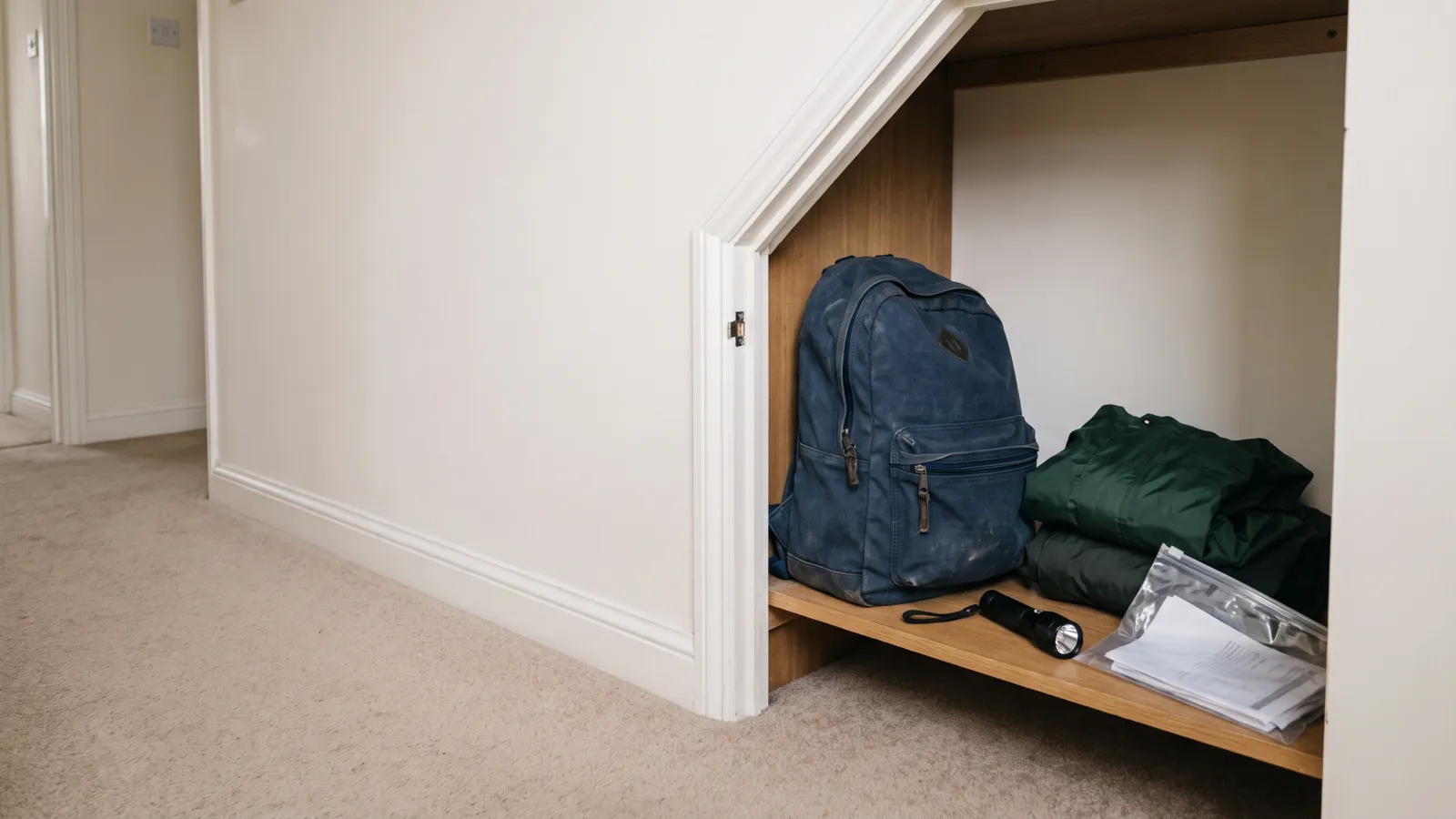
GOV.UK Prepare, the government’s preparedness campaign, doesn’t call it a bug-out bag. It suggests keeping the items you might need if you are asked to leave your home quickly in a spare bag, adding that you might hear some people call this a ‘grab bag’, and its flooding page uses the term itself. The Environment Agency’s name for the same thing is a flood kit.
The dictionary meanings overlap: Cambridge defines a bug-out bag as a bag of necessary supplies “such as food to last for a few days”, for use in an emergency, and lists grab bag as a synonym. Where the two part company is the job. The UK grab bag is for leaving home quickly, for example in a flood, with the council and the emergency services telling you when to go and helping with where to stay. A list that assumes you will be fending for yourself for days, with a tent, a stove and a knife, is answering a different question.
Where UK evacuations actually go
UK emergency planning doesn’t expect you to live out of your bag. The Cabinet Office’s evacuation and shelter guidance asks local responders to identify buildings such as schools, leisure centres and community halls to use as rest centres, and plans for short-term shelter of up to 72 hours, until people can go home or medium-term arrangements are made. Where only a few people need shelter, it says hotels may be more cost-effective, and it notes that friends or family may be able to put people up. If your home is flood damaged and you can’t live there, GOV.UK Prepare says to contact your local council for help getting emergency accommodation.
When you are told to go, go. GOV.UK Prepare says to always follow advice from your council or the emergency services if you are asked to evacuate, because not evacuating or delaying can put your life at risk, and the Environment Agency says to take your flood kit with you if you are directed to an evacuation centre. Many centres will let you bring a pet, it says; put cats and small animals in a carrier or small box.
What goes in a UK grab bag
The official lists are short. GOV.UK Prepare’s flooding advice suggests packing a grab bag of essentials in advance: any medication you need, a first aid kit and important documents, plus items such as a torch, bottled water, warm waterproof clothing and baby care items, stored somewhere you can easily get to. The Environment Agency’s flood kit adds contact information, footwear, toys for children and a mobile phone charger or spare batteries.
Around those, GOV.UK Prepare asks for enough medication to keep you going for several days, important phone numbers written down on paper, and documents in resealable water-tight plastic bags. The British Red Cross’s kit for when you are on the move adds cash and bank cards and spare glasses or contact lenses, and Ready Scotland suggests keeping some of your kit in a waterproof bag in case you have to leave without notice. If someone relies on a medical device, GOV.UK Prepare asks for a paper copy of its instructions and charged back-up batteries, and its advice for disabled people and carers suggests keeping medication in a waterproof container, such as a plastic food container.
None of these lists includes a knife, and none of the lists for leaving home includes a tent, a stove or a water filter. Our grab bag builder turns them into one checklist sized to your household, and says where each line comes from.
In a fire, the bag stays behind
A grab bag is for leaving with a few minutes to spare, never for a fire. GOV.UK Prepare says that if you are escaping your home because of a fire you should not take anything with you at all, and not to waste time investigating what has happened or rescuing valuables: get out, stay out, call 999. London Fire Brigade adds that you should shut the doors behind you and never go back into the building once you are safely outside.
Flats can differ. London Fire Brigade says your landlord, housing provider or managing agent needs to tell you your building’s evacuation plan, which may be to stay put or to leave; if you leave, it says, don’t stop to pick up valuables. GOV.UK Prepare’s fire advice is to keep exit routes clear and door and window keys where everyone can find them, so keep the grab bag out of your escape route.
What UK law rules out
Some bug-out lists tell you to pack a gun, a self-defence spray or a large knife. UK law prohibits the spray, tightly controls guns and limits carrying knives, so none of them belongs in a grab bag. The Home Office’s guide to firearms law says the Firearms Act 1968’s ban on weapons designed to discharge a noxious liquid, gas or other thing includes personal protection sprays using CS, Mace or OC pepper, and that the courts have held stun guns are prohibited too; Northern Ireland’s firearms law prohibits weapons that discharge electricity or a noxious substance. In Great Britain the Act also prohibits small firearms, which in general terms means handguns, and makes it an offence to have a loaded shotgun, an air weapon, or any other firearm with its ammunition in a public place without lawful authority or reasonable excuse.
Knives need the most care. GOV.UK says it is illegal to carry most knives in public without a good reason; the exception is a folding pocketknife with a cutting edge of 3 inches or less that isn’t a lock knife. The law is section 139 of the Criminal Justice Act 1988 in England, Wales and Northern Ireland, and section 49 of the Criminal Law (Consolidation) (Scotland) Act 1995 in Scotland, with the same 3-inch rule; the defence is a good reason or lawful authority under section 139, and a reasonable excuse or lawful authority in Scotland. The examples the law gives of a defence are having it for work, for religious reasons or as part of national costume, and a court decides. GOV.UK puts the maximum penalty for an adult at 4 years in prison, an unlimited fine or both; in Scotland it is 5 years.
Three points matter for anything you pack. The Crown Prosecution Service’s guidance for England and Wales says a lock knife is not a folding pocketknife, because it is not immediately foldable at all times; that the offence needs no intent to harm; and that having a knife with you covers one that is nearby, under your control or immediately accessible, for example under a car seat or in a bag next to you. Carrying a weapon merely because of a constant or enduring threat, even a genuine one, does not amount to self-defence or a reasonable excuse, it adds.
So if you want a blade in a grab bag at all, the simple choice is a non-locking folding pocketknife with a cutting edge of 3 inches or less, and the same test applies to the blade on a multi-tool: check whether it locks. Anything bigger or locking can be kept at home, but not taken out in a bag without a good reason. Some knives are banned outright, even at home, and GOV.UK’s list includes zombie-style knives and machetes, defined by their length, a pointed end and features such as serrations or spikes, so check any large knife against it. Our multi-tools comparison covers the tools themselves.
A get home bag, the calm version
The other term you may meet is a ‘get home bag’: a small kit for being caught away from home, on a commute for example. The official advice for that is modest. GOV.UK Prepare’s guidance on transport disruption suggests packing essential medication, a fully charged phone and charger, a portable power bank, water and food, and warm or waterproof clothing, and telling someone your destination and when you expect to arrive. The British Red Cross’s on-the-move kit is similar, adding a flask for hot drinks, spare glasses or contact lenses, cash and bank cards, and a paper list of emergency numbers in case your phone loses power.
It isn’t a plan to set off on foot at the first sign of trouble. GOV.UK Prepare’s advice for public transport is that if you are delayed or stranded, it is usually safer to stay where you are and wait for assistance, and to follow instructions from transport staff and the emergency services. The bag makes a long wait or a slow journey more comfortable. The planning matters more than the kit: GOV.UK Prepare suggests agreeing a meeting point for times you can’t get home, checking whether your workplace has a plan for what to do if you can’t contact it in an emergency, and making sure your children’s school has the right numbers for you. Store an emergency contact in your phone’s ICE or Medical ID feature, or keep a written copy in your wallet or purse.
If you drive, the car is the natural place for it. GOV.UK Prepare suggests keeping a torch, in-car phone chargers or a power bank, warm clothes and blankets, high-visibility clothing, jump leads, food and drink, a first aid kit and a shovel in the vehicle, and our car kit builder sizes a kit for whoever usually travels with you. Keep any blade in it within the pocketknife rule above: the CPS gives a knife under a car seat as an example of one you have with you.
Build yours without buying a special bag
GOV.UK Prepare’s own words are ‘a spare bag’, and any rucksack you already own will do; it leaves both hands free. Store it somewhere you can easily get to, as GOV.UK Prepare advises, and where everyone at home knows to find it. Check it when the clocks change: charge the power bank, swap food and water before their dates, and update the medicines and phone numbers.
If you would rather buy one ready-made, our grab bag comparison covers which are worth it; you will still need to add the personal layer of medicines, documents, glasses and chargers, and to check any multi-tool in it against the knife rule above. The quicker route is the grab bag builder: set who lives with you and it sizes the list.
Common questions
Is a grab bag the same as a bug-out bag?
Close, but not quite. Cambridge Dictionary defines a bug-out bag as a bag of supplies, such as food to last a few days, for use in an emergency, and lists grab bag as a synonym. GOV.UK Prepare doesn’t use the phrase: it talks about a spare bag of items you might need if you are asked to leave home quickly, which some people call a grab bag, and the Environment Agency calls it a flood kit. The UK version assumes you are heading to a rest centre, a hotel, friends or family, not fending for yourself.
What does the government say to put in a grab bag?
GOV.UK Prepare’s flooding advice suggests any medication you need, a first aid kit and important documents, plus items such as a torch, bottled water, warm waterproof clothing and baby care items. The Environment Agency’s flood kit adds contact information, footwear, toys for children and a phone charger or spare batteries. GOV.UK Prepare also asks for enough medication for several days and important phone numbers written on paper, and the British Red Cross adds cash, bank cards and spare glasses or contact lenses.
How many days should a grab bag cover?
No official list gives a number for the bag itself. GOV.UK Prepare asks for enough medication to keep you going for several days, and the Cabinet Office’s guidance for local responders plans rest-centre shelter for up to 72 hours. Water is the heavy part: GOV.UK Prepare quotes a minimum of 2.5 to 3 litres of drinking water per person per day, so pack what you can carry and plan to refill where you are going.
Can I pack a knife, multi-tool or pepper spray?
Not pepper spray: the Home Office’s guide to firearms law says sprays using CS, Mace or OC pepper are prohibited weapons in Great Britain, which it is an offence to have without official authority, and Northern Ireland’s law prohibits them too. A knife or multi-tool is only straightforward if it is small: GOV.UK says the exception to the good-reason rule is a folding pocketknife with a cutting edge of 3 inches or less that is not a lock knife, and the Crown Prosecution Service says a knife in a bag next to you counts as one you have with you. Anything bigger or locking can stay at home, unless it is a banned type, but shouldn’t go out in a bag without a good reason.
Should I take my grab bag if there is a fire?
No. GOV.UK Prepare says that if you are escaping your home because of a fire you should not take anything with you at all, and not to waste time rescuing valuables: get out, stay out, call 999. In a block of flats, follow your building’s evacuation plan, which London Fire Brigade says your landlord, housing provider or managing agent needs to tell you, and which may be to stay put or to leave. The grab bag is for floods and other evacuations where you have a few minutes to spare.
What is a get home bag, and do I need one?
It is a small kit for being caught away from home, for example on a commute. GOV.UK Prepare’s transport advice suggests carrying essential medication, a charged phone and charger, a power bank, water and food, and warm or waterproof clothing, and telling someone where you are going and when you expect to arrive. If you are delayed or stranded on public transport, it says, it is usually safer to stay where you are and wait for assistance, so the kit is for a long wait rather than a long walk.
Sources (20)
- GOV.UK Prepare — Get prepared for emergenciesa spare ‘grab bag’, take nothing in a fire, medication for several days, phone numbers on paper, meeting point, workplace and school plans
- GOV.UK Prepare — Floodingwhat a grab bag could include, documents in water-tight bags, evacuation, emergency accommodation
- GOV.UK Prepare — Fires in the home (get out, stay out, call 999; exit routes; keys)
- GOV.UK Prepare — Transport disruption and delayswhat to pack, staying where you are if stranded, car kit, ICE contacts
- GOV.UK Prepare — Advice for disabled persons and carers (medication in a waterproof container)
- Environment Agency — Personal flood plan (flood kit, pets, evacuation centres), GOV.UK
- Cabinet Office — Evacuation and shelter guidance, last updated 27 January 2014 (rest centres, short-term shelter up to 72 hours, hotels, friends or family), GOV.UK
- London Fire Brigade — Escape plan: houses and converted flats
- London Fire Brigade — Escape plan: blocks of flatsstay put or leave; your building’s evacuation plan
- British Red Cross — Prepare an emergency kit (home, on-the-move and car kits)
- Ready Scotland — Make an emergency kitwaterproof bag if you may leave without notice; updated 24 March 2026
- Cambridge Dictionary — bug-out bag
- GOV.UK — Selling, buying and carrying knives and weaponsgood reason, folding pocketknife exception, banned knives, penalties
- Criminal Justice Act 1988, section 139 (England and Wales; Northern Ireland version), legislation.gov.uk
- Criminal Law (Consolidation) (Scotland) Act 1995, section 49, legislation.gov.uk
- Crown Prosecution Service — Knife and other weapons offences, prosecution guidancelock knives, ‘has with him’, self-defence; updated 28 May 2026
- Home Office — Guide on firearms licensing law (section 5 prohibited weapons, including CS, Mace and OC pepper sprays, stun guns and handguns; updated 18 September 2026), GOV.UK
- Firearms Act 1968, section 5 (weapons subject to general prohibition), legislation.gov.uk
- Firearms Act 1968, section 19 (carrying a firearm in a public place), legislation.gov.uk
- Firearms (Northern Ireland) Order 2004, article 45 (weapons subject to general prohibition), legislation.gov.uk
PreparedBritain is independent and not affiliated with HM Government.
The Emergency Kit Checklist
The GOV.UK Prepare essentials on one printable page — tick them off as you go and keep it with the kit. Free, no catch.
Download it straight away. We'll also send the occasional briefing when something genuinely matters — severe weather, live incidents, real price drops. Nothing else.
Keep reading
All planning & the national picture guides →Is Britain in a wildfire crisis, and is 2026 the worst year on record?
The Liberal Democrats have called it “Britain’s Wildfire Crisis”, with 1.8 million homes exposed and the most…
When is the government’s emergency preparedness campaign launching?
The government told Parliament on 14 July 2026 that a national resilience campaign would launch “later this year”,…
Is the UK bringing back conscription? What has actually been said, dated
Every war headline brings a wave of ‘conscription is coming’ posts. The record says otherwise: a minister ruled it…