Storm Austen named: first storm of the season, 70mph gusts possible late Thursday into Friday
The Met Office named Storm Austen at 10:45 on Tuesday 20 October, the first named storm of the 2026/27 season. It expects disruptive wind and rain from late Thursday into Friday, with gusts above 70mph possible on exposed coasts and 20 to 30mm of rain in many places. On 21 October it issued an amber wind warning for Devon and Cornwall from 3am to 10am on Friday and extended the yellow warning.
The Met Office named Storm Austen at 10:45 on Tuesday 20 October 2026, seven weeks into the storm season and the first name used from the 2026/27 list. It says an Atlantic low will deepen quickly as it approaches and bring disruptive wind and rain to the south-west from late Thursday, moving west to east through Friday: gusts of 50 to 60mph are likely within the warning area, above 70mph possible on the most exposed coasts, with 20 to 30mm of rain in many places and higher totals possible over high ground in the west and north. On Wednesday 21 October the Met Office issued an amber wind warning for Cornwall, Devon, the Isles of Scilly and Plymouth, from 3am to 10am on Friday, and extended the yellow wind warning to run from midnight to 2pm on Friday 23 October, across 23 council areas in England, Kent now included, and 16 in Wales. The Met Office says the storm's exact track is still being determined and its warnings are under constant review. Before Thursday night: secure loose items outside, charge phones and power banks, and put a torch and a battery or wind-up radio where you can find them.
By Tom Calder · Updated 21 October 2026 · Sourced to the Met Office's naming statement of 10:45 on 20 October 2026, its live warnings feed read the same afternoon, its amber and updated yellow warnings of 21 October, its storm centre season tables, Ofgem's payment standards and our own live power-cut trackers
Earlier changes
21 Oct Updated: the Met Office issued an amber wind warning for Cornwall, Devon, the Isles of Scilly and Plymouth, extended the yellow warning to 2pm Friday and to Kent, and issued a yellow rain warning for Scotland.
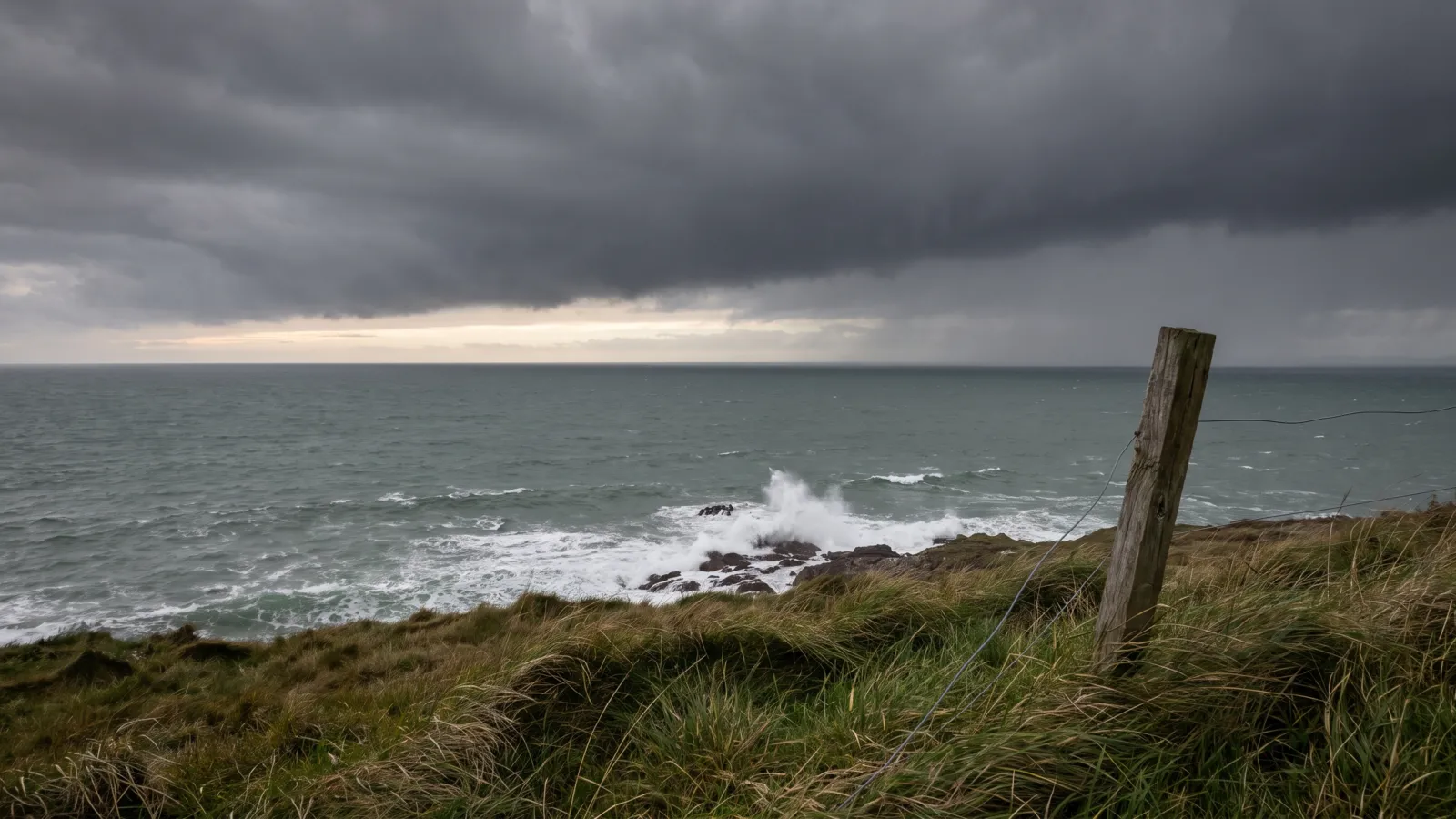
Update, Wednesday 16:30: amber wind warning for Devon and Cornwall
The Met Office issued an amber warning for wind for Storm Austen at 09:41 on Wednesday 21 October, covering Cornwall, Devon, the Isles of Scilly and Plymouth from 3am to 10am on Friday 23 October, UK time. It says there is a good chance of gusts of 60 to 70mph widely for a time, perhaps around 80mph on exposed headlands, that road closures are likely, damage to buildings probable and power cuts a good chance. It also extended the yellow wind warning to 2pm on Friday and to Kent. Our report on the warning has the full list and what to do.
What the Met Office said at 10:45
The Met Office named Storm Austen at 10:45 on Tuesday 20 October. Its statement says the storm will bring "disruptive wind and rain for some from late Thursday and into Friday". Tuesday and Wednesday bring spells of rain and showers for many; the focus shifts to the south-west of the UK late on Thursday as an area of low pressure forming in the Atlantic deepens rapidly, invigorated by the jet stream.
Its deputy chief forecaster, Tom Crabtree, said the exact track and position of the storm were still being determined, but that there was "an impactful period of weather on the way and the potential for disruption in places", which is why it was named. He said peak gusts of more than 70mph were possible on the most exposed coasts, with 50 to 60mph likely more widely within the warning area, and that the warnings were under constant review and could be updated as confidence increases.
The storm moves from west to east through Friday, with winds generally easing later in the day. Rain is the second hazard: 20 to 30mm in many places, with higher totals possible over high ground in the west and further north on Friday. Austen's influence wanes late on Friday as it moves into the North Sea, but the Met Office expects further spells of wind and rain through the weekend and into the start of next week, with the heaviest rain more likely in western areas.
The warning as it stands
On Wednesday 21 October the warning changed. At 09:41 the Met Office issued an amber warning for wind for Cornwall, Devon, the Isles of Scilly and Plymouth, from 3am to 10am on Friday, UK time, with a good chance of gusts of 60 to 70mph widely for a time and perhaps around 80mph on exposed headlands. It extended the yellow wind warning to run from midnight on Thursday night to 2pm on Friday 23 October, added Kent, and raised the likelihood of significant impacts to medium, 25 to 50%: 23 council areas in England and 16 in Wales. London and north Wales are not included. The full list of council areas is in our report on the warning. A yellow rain warning also covers southern, central and north-east Scotland from 6am on Friday to 3am on Saturday.
The yellow warning is now rated medium, 25 to 50%, with a significant impact: road, rail, air and ferry services may be affected, some roads and bridges may close, power cuts may occur, some damage to buildings could happen, and injuries from flying debris are possible. The amber warning, rated high, 50 to 75%, says most of these are likely, with a good chance of power cuts. On the coast, the Met Office warns of large waves and beach material thrown onto sea fronts, coastal roads and properties.
Any further change, a red warning, a shift in the areas or times, shows on the live weather warnings tracker as soon as the Met Office publishes it, and on our Storm Austen page, which carries the live warnings, power cuts and flood alerts for the storm.
Home Alerts members
The full picture, for your home
Each week, what's happening across Britain set against your own address: your water company, your power network, fuel for your car and the gaps in your kit. Free for your own home. Opening in October; the first 100 on the list get in first.
Join the list →Britain's figures from our live trackers, 21 October.
Why it was named before any amber warning
The Met Office names a storm when it has the potential to cause disruption or damage that could lead to an amber or red warning: medium or high impacts, not the colour of the warning in force today. That is the test Austen met on Tuesday morning. The statement is careful about the uncertainty: the track is still being determined, and the warnings may change. A name tells you a stronger warning is possible; it does not make one certain, and it says nothing about how bad the wind will be at your address. On Wednesday it did: an amber warning for Devon and Cornwall.
Local papers have been using the name since before it was given, and some are now quoting gust figures for individual towns. Those are their forecasts, not the Met Office warning, which gives a range for the whole area. The figures to act on are the ones in the warning: gusts of 50 to 60mph likely across the yellow area and 70mph or more possible on some coasts; in the amber area, a good chance of 60 to 70mph widely, perhaps around 80mph on exposed headlands.
Seven weeks in: an ordinary date for a first name
The 2026/27 names were announced on 1 September by the Met Office, Met Éireann and KNMI, with Austen first on the list, put forward by Met Éireann for its 90th anniversary. Seven weeks without a name felt slow after last season, when Amy was named on 1 October and the season went on to seven named storms that affected the UK. The storm centre's own season tables say today's date is unremarkable: in five of the last eleven seasons (2015/16, 2016/17, 2019/20, 2021/22 and 2022/23) no storm had been named by 20 October, and the midpoint of their first-naming dates, counting names from any service, is 18 October. The latest first storm in those eleven seasons was Otto, named by Denmark's DMI on 16 February 2023.
A first name on 20 October is not a forecast of the winter, and we make none. The Met Office's three-month outlook for October to December, issued on 28 September, gives double the normal chance of a wet period overall; the next is due on 26 October. It does not forecast storms, and it does not name them.
Power cuts: the live checks, and what the rules say
The yellow warning says power cuts may occur on Friday; the amber warning for Devon and Cornwall gives them a good chance. If yours goes off, call 105, free from any phone: it reaches your network operator, not your energy supplier. In the warning area that is National Grid Electricity Distribution across south Wales, most of the south-west and Herefordshire, Scottish and Southern Electricity Networks in Hampshire, Dorset, Wiltshire and the Isle of Wight, and UK Power Networks in Sussex and Kent.
We read every network's live feed for each town in the warning area, with a postcode check on each page: Cardiff, Swansea, Bristol, Plymouth, Exeter, Bournemouth, Southampton and Brighton and Hove, among others, and the Storm Austen page brings them together.
In a storm, compensation follows separate rules. Networks group storms into categories by how many faults the weather causes. For a Category 1 storm the payment is £90 if your supply is not restored within 24 hours, then £45 for each further six hours, capped at £2,235; for a Category 2 storm the £90 starts at 48 hours. In Great Britain these payments are made automatically. Our compensation guide explains the rules and the calculator works out what a given cut is likely to be worth; who pays for storm damage covers fallen trees and roof tiles.
Before Thursday night
The Met Office's own advice starts outside: check for loose items and plan how to secure them. It names bins, garden furniture, trampolines, tents, sheds and fences. Do it on Thursday afternoon, in daylight. For a power cut, it suggests gathering torches and batteries, a mobile phone power pack and other essentials in advance.
GOV.UK Prepare's power cut advice is to keep a battery or wind-up radio and spare batteries, because updates may be broadcast by radio and mobiles can stop if the local mast loses power. On Thursday evening, charge phones and power banks and put a torch where you can find it in the dark. Our power cut preparation guide has the full list, radios included.
If you are driving on Friday morning, check road conditions and train timetables first, and allow for fallen branches and spray on exposed roads. On the coast, the Met Office warns that large breaking waves can sweep people off their feet even from the shore: keep back from sea fronts and take care near cliffs. In an emergency on the coast, call 999 and ask for the Coastguard.
What happens next
The Met Office says its warnings are under constant review and could be updated as confidence increases. This page is updated when the warning changes or the Met Office adds to its forecast, and the time at the top changes with it. Our tracker reads the Met Office's warnings feed every refresh and its storm centre and news pages for namings, so the Storm Austen page and the weather warnings tracker move before this page does.
Common questions
When was Storm Austen named?
At 10:45 on Tuesday 20 October 2026, by the Met Office. It is the first named storm of the 2026/27 season and the first name on the list announced on 1 September.
When will Storm Austen hit?
The Met Office expects disruptive wind and rain from late Thursday 22 October into Friday 23 October, moving from west to east through Friday and easing later in the day. The yellow wind warning runs from midnight on Thursday night to 2pm on Friday, UK time, and the amber warning for Devon and Cornwall from 3am to 10am on Friday.
Which areas are in the warning?
Much of Wales (16 council areas, not north Wales), south-west England from Cornwall to Gloucestershire and Wiltshire, the south coast from Hampshire and the Isle of Wight to Kent, and Herefordshire: 23 council areas in England. Cornwall, Devon, the Isles of Scilly and Plymouth are also under an amber warning. London is not included. Our report on the warning lists every council area.
How strong will the winds be?
The Met Office says gusts of 50 to 60mph are likely within the warning area, and more than 70mph is possible on the most exposed coasts. It says there is still uncertainty about where the strongest winds will be. In the amber area (Devon and Cornwall), the Met Office gives a good chance of 60 to 70mph widely for a time, perhaps around 80mph on exposed headlands.
Has the warning been upgraded to amber?
Yes, in part. On 21 October the Met Office issued an amber wind warning for Cornwall, Devon, the Isles of Scilly and Plymouth, from 3am to 10am on Friday 23 October. The rest of the warning area stays yellow.
Sources (7)
- Met Office — Storm Austen named (10:45, 20 October 2026)
- Met Office — UK weather warningsthe amber and yellow wind warnings, Friday 23 October 2026, and the yellow rain warning for Scotland, updated 21 October
- Met Office — UK Storm Centrehow storms are named; the 2026/27 list and the season tables
- Met Office — 2026/27 storm names announced (1 September 2026)
- GOV.UK Prepare — Power cuts (radio, phones, 105)
- Ofgem — Adjustments to the Guaranteed Standards of Performance: 2026 (payment amounts from 1 April 2026)
- PreparedBritain — storm names tracker and the Storm Austen page
PreparedBritain is independent and not affiliated with HM Government.
See our checks first on Google. Add PreparedBritain as a preferred source and Google will show our stories to you more often in Top Stories.

The Emergency Kit Checklist
The GOV.UK Prepare essentials on one printable page — tick them off as you go and keep it with the kit. Free, no catch.
Download it straight away. We'll also send the occasional briefing when something genuinely matters — severe weather, live incidents, real price drops. Nothing else.
Latest from our live data
All stories → News · 21 OctOnly 4 in 100 adults have three days of bottled water at home, the government's survey shows
 News · 21 OctFood inflation held at 1.3%. Wholesale cabbage and cauliflower are up a third. Both are true
 News · 21 OctAldi recall: shoppers warned of hairdryer electric shock or fire risk. How to check yours
Keep reading
All planning & the national picture guides →65% of Shell-branded forecourts charge £2 for diesel. Almost no supermarket forecourt does
UK average diesel has been under £2 a litre on Fuel Finder since 8 October, and the share of forecourts charging £2…
Union claims strike by offshore workers could disrupt fuel supplies: what Unite, Apache and our forecourt data say
The 24-hour strike by more than 160 Apache offshore workers went ahead from 6am on Wednesday 21 October. The…
UK drivers warned of fines for car heater mistake in winter: what you can actually be fined for
Regional papers are warning drivers of fines for a car heater mistake this winter. There is no offence of using the…