No planning permission needed for cross-pavement EV chargers: what changes in England
From 21 October 2026, a cable channel under the pavement for charging a car parked on the street no longer needs planning permission in England, as long as the council installs or authorises it. What changed, what still needs the council, and where it doesn't apply.
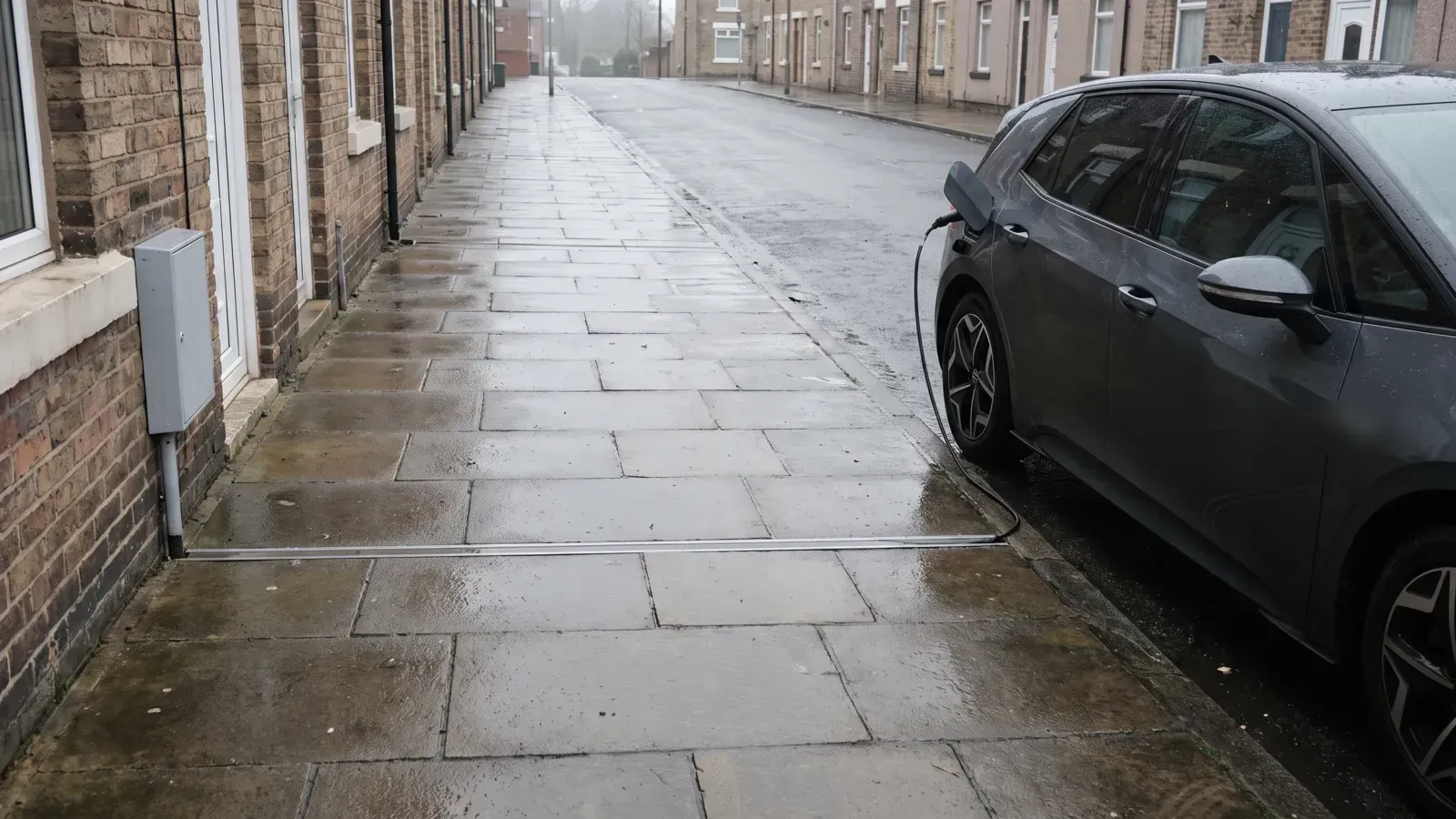
From today, Wednesday 21 October 2026, a cross-pavement channel, a covered gully set into the pavement so a charging cable can run from a house to a car parked on the street, no longer needs planning permission in England. The change comes from a planning order made on 25 September and laid before Parliament on 30 September. The channel must still be installed by the council as highway authority, on its behalf or with its authorisation, and the new right does not apply in conservation areas, within the curtilage of a listed building or on a scheduled monument. One charger on the front wall is covered too, within limits on height, how far it sticks out and the pavement width left, with the cable crossing through an authorised channel. The Department for Transport says the change saves drivers up to £300 on installation. It does not make councils allow channels, it does not reserve the parking space, and it covers England only.
By Tom Calder · Updated 21 October 2026 · Sourced to the Department for Transport's announcement of 21 October 2026, the planning order itself on legislation.gov.uk, and the government's chargepoint grant pages
What changed today
The Department for Transport announced on 21 October 2026 that people no longer need planning permission to install cross-pavement chargers, the set-ups that run a cable from a home, under the pavement, to a car parked on the street. The law behind it is the Town and Country Planning (General Permitted Development) (England) (Amendment) (No. 2) Order 2026: made on 25 September, laid before Parliament on 30 September, and in force from today.
The order defines a cross-pavement solution as a pavement-embedded cable channel that lets a charging cable cross the pavement safely from a home to a parked car. Installing, altering or replacing one is now permitted development, which means no planning application, when it is done by the highway authority, on its behalf or with its authorisation. In two-tier areas that is usually the county council; elsewhere it is the single council for the area.
The government's own figure for what this saves is up to £300 on installation. It ties the saving to no longer needing planning permission and does not say how it reached the figure; the order does not change the price of the channel or the charger.
What a channel still needs
The council is still the gate. A channel counts as permitted development only if the highway authority installs it, has it installed or authorises it, so whether you can have one at all is still the council's decision, and not every council allows them. Street-works permission can still apply when the pavement is dug up.
The new right does not apply if the channel would be within a conservation area, within the curtilage of a listed building or within a scheduled monument. In those places the new right does not apply, so planning permission is needed, on top of the council's consent, unless the council has a local development order.
The order also sets a condition for the end of a channel's life: when it is no longer needed, it has to be removed as soon as reasonably practicable and the pavement put back as it was.
The charger on your wall
The same order widens the existing permitted development right for wall-mounted chargers (and, on similar terms, chargers on a post). Until today it covered a charger within an area lawfully used for off-street parking. It now also covers one elsewhere within the curtilage of a house or block of flats, which is what a home without a driveway needs.
There are limits. No wall charger under this right can sit more than 1.6 metres above the ground, and, as before, none can go within the curtilage of a listed building or on a scheduled monument. On the new no-driveway route, there can be only one charger at the house or block, and none in a conservation area. Where the wall meets the pavement directly, the charger can stick out no more than 20 centimetres and must leave at least 1.5 metres of pavement to the kerb. And whenever there is a pavement between the charger and the car, the cable has to cross it through an authorised channel: a cable trailed across the pavement does not meet the condition. The 1.6-metre and pavement-edge limits also apply to chargers by a driveway; work the old rules allowed can still go ahead until the end of 20 October 2027.
The order's definition of a charger excludes an ordinary three-pin plug and socket, so the right covers a dedicated charge point, not an outdoor socket.
Home Alerts members
The full picture, for your home
Each week, what's happening across Britain set against your own address: your water company, your power network, fuel for your car and the gaps in your kit. Free for your own home. Opening in October; the first 100 on the list get in first.
Join the list →Britain's figures from our live trackers, 21 October.
What it saves, in the government's figures
The Department for Transport's announcement gives three figures, all its own: up to £300 saved on installation, home charging for as little as 2p a mile, and, in the words of the minister Simon Lightwood, savings of up to £1,750 on running costs for residents without off-street parking. The department does not publish how it worked out the 2p or the £1,750 in the announcement, and neither is a figure we have checked.
The grant has not changed today. The government's chargepoint grant for households with on-street parking pays 75 per cent of the cost of buying and installing the charger, up to £500, through an installer authorised by the Office for Zero Emission Vehicles, and is open until 31 March 2027. It needs a permanent channel with the highway authority's consent; temporary cable covers or mats do not count. Our home EV charger guide sets out who qualifies and what a charger costs, and EV or diesel works through the running costs.
What hasn't changed
A channel does not reserve the space outside your house. If someone else is parked there, the cable cannot reach your car.
The change applies in England only. Planning is devolved, so the rules in Scotland, Wales and Northern Ireland are set separately and this change does not apply there.
Renters and leaseholders still need the landlord's or freeholder's agreement to fit a charger to the building, as before today.
Two consultations, open until 16 December
Alongside the order, the government has opened two consultations, both closing on 16 December 2026. One asks about a clearer route for tenants and leaseholders to get a charge point installed, including guidance for landlords and whether to make it harder for landlords and freeholders to refuse. The other asks about changing building regulations so that charge points go into new and refurbished covered car parks.
The department also says the same planning changes make it quicker and cheaper for operators to put in larger public charging hubs.
Common questions
Do I still need planning permission for a cross-pavement EV charger?
Not in England from 21 October 2026, if the channel is installed by the council as highway authority, on its behalf or with its authorisation, and is not in a conservation area, within the curtilage of a listed building or on a scheduled monument. In those places the new right does not apply, so planning permission is needed unless the council has a local development order.
Do I still need the council's permission?
Yes. The new right only covers a channel the highway authority installs or authorises, so the council still decides whether you can have one, and not every council allows them. Street-works permission can also apply.
Can I fit a charger on my front wall without planning permission?
In England, if you have no driveway: one dedicated charger at the house or block of flats, no higher than 1.6 metres, not in a conservation area, and not within the curtilage of a listed building or on a scheduled monument. Where the wall meets the pavement it can stick out no more than 20 centimetres and must leave at least 1.5 metres of pavement, and the cable must cross the pavement through an authorised channel. A wall charger beside a driveway was already covered and has no one-charger or conservation-area limit.
Is there a grant for on-street home charging?
Yes, and it did not change today. The chargepoint grant for households with on-street parking pays 75 per cent of the cost up to £500, through an installer authorised by the Office for Zero Emission Vehicles, until 31 March 2027, and needs a permanent channel with the highway authority's consent.
Does this apply in Scotland, Wales or Northern Ireland?
No. The change applies in England only; the other nations set their own planning rules. The £500 on-street grant itself is open across the UK.
Sources (6)
- Department for Transport — Drivers to save up to £300 when installing EV chargers at home, as government slashes unnecessary red tape (21 October 2026)
- The Town and Country Planning (General Permitted Development) (England) (Amendment) (No. 2) Order 2026, SI 2026/1056 (in force 21 October 2026)
- Department for Transport — Changes to various permitted development rights for EV charging: government response (11 September 2026)
- GOV.UK — Electric vehicle chargepoint grant for households with on-street parking
- GOV.UK — Cross-pavement solutions for charging electric vehicles: guidance for local authorities24 December 2024, written before this change; still the reference on highway and street-works permissions
- PreparedBritain — Home EV chargers: what one costs, the grant, and when it's not worth it
PreparedBritain is independent and not affiliated with HM Government.
See our checks first on Google. Add PreparedBritain as a preferred source and Google will show our stories to you more often in Top Stories.

The Emergency Kit Checklist
The GOV.UK Prepare essentials on one printable page — tick them off as you go and keep it with the kit. Free, no catch.
Download it straight away. We'll also send the occasional briefing when something genuinely matters — severe weather, live incidents, real price drops. Nothing else.
Latest from our live data
All stories → News · 21 OctOnly 4 in 100 adults have three days of bottled water at home, the government's survey shows
 News · 21 OctFood inflation held at 1.3%. Wholesale cabbage and cauliflower are up a third. Both are true
 News · 21 OctAldi recall: shoppers warned of hairdryer electric shock or fire risk. How to check yours
Keep reading
All planning & the national picture guides →Massive Google outage crashes banking apps: the cash and numbers to keep offline at home
A power fault in one London zone of Google Cloud ran from 07:08 to about 15:00 on Tuesday 20 October and took…
Storm Austen named: first storm of the season, 70mph gusts possible late Thursday into Friday
The Met Office named Storm Austen at 10:45 on Tuesday 20 October, the first named storm of the 2026/27 season. It…
65% of Shell-branded forecourts charge £2 for diesel. Almost no supermarket forecourt does
UK average diesel has been under £2 a litre on Fuel Finder since 8 October, and the share of forecourts charging £2…