Home EV chargers: what one costs, the grant, and when it's not worth it
What a 7kW home charger costs installed, what makes a quote grow after the survey, exactly who can claim the £500 OZEV grant before it ends in March 2027, the overnight tariffs that do the real saving, what to do without a driveway, what happens in a power cut, and who should not buy one.
Which? puts a typical 7kW home charger at around £900 installed; Pod, the national installer we use as a benchmark, charges £999 for its Solo 3S or £1,049 with a cable attached, standard installation included. Owner-occupiers of houses with a driveway get no grant. Renters and flat owners with their own off-street space, and households without off-street parking that fit a council-approved pavement channel, can claim 75 per cent of the cost up to £500 from OZEV until 31 March 2027, which OZEV calls a final year. The bigger saving is the overnight tariff: at about 8p a kWh against the 26.32p cap rate, the car’s electricity costs about £540 a year less at the average electric-car mileage, before any higher day rate on the rest of your use. In a six-hour cheap window a 7kW charger adds about 134 miles where a 3-pin socket adds about 44, but Electrical Safety First advises against regular charging from standard sockets. In a power cut it stops. Skip it if you drive little, rent without written permission, or are moving soon.
By Tom Calder · Updated 29 September 2026 · Sourced to OZEV and GOV.UK, Ofgem, HMRC, the Department for Transport, Electrical Safety First, the IET, the network operators, Zapmap, Which?, the RAC and the suppliers named
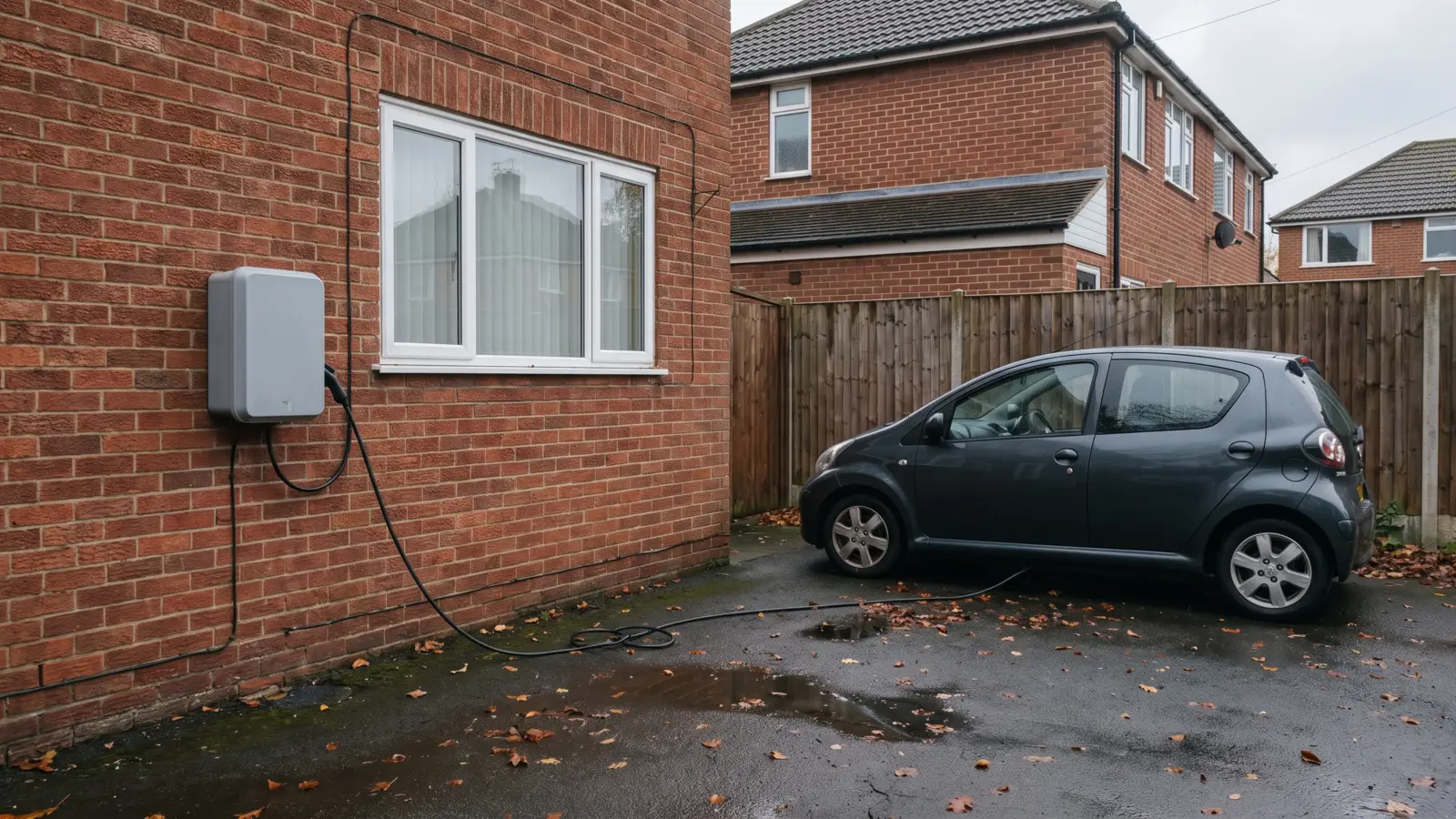
What a home charger does that a 3-pin socket doesn't
Every electric car can charge from an ordinary 13-amp socket using the cable that comes with it. The catch is speed. A 3-pin socket delivers about 2.3 to 2.4kW (Zapmap says about 2.3kW, Which? uses 2.4kW). A dedicated charger on its own circuit delivers about 7kW; Pod’s Solo 3S is rated up to 7.4kW. Which?’s charging-time table gives a 2022 Tesla Model Y 38.5 hours on a 2.4kW 3-pin plug and 12 hours on a 7kW home charger. Pod’s own example is a 60kWh battery taking over 24 hours from a 2.4kW domestic socket.
Speed decides how much of the car you can refill in a cheap overnight window. The off-peak windows on the tariffs below last five to seven hours. In six hours a 3-pin socket adds about 13.8kWh, roughly 44 miles at the 3.18 miles per kWh that Which? measures as the average across every electric car it has tested; a 7kW charger adds about 42kWh, roughly 134 miles. The Department for Transport records the average battery-electric car in England at 9,400 miles a year, about 26 miles a day, which a socket can put back in about three and a half hours. So for average mileage the case for a charger is less about speed than about longer days, big top-ups after a long trip, and safety.
Safety is the other difference. Electrical Safety First says to avoid standard sockets for car charging, because the extended load and duration are likely to exceed what a standard socket and its wiring are designed for; sockets built for car charging are marked BS 1363/EV and should be supplied by a dedicated circuit, and a home charge point must be installed by a registered, competent electrician. Never charge through a domestic multi-socket extension lead and never daisy-chain leads: that is Electrical Safety First’s long-standing advice, and Polestar’s 2026 owner’s manual says the same more bluntly, banning extension cords, multi-way sockets and adaptors outright. MG UK warns that frequent charging from standard plugs can cause overheating.
A proper charger is wired on its own circuit, which Pod’s installation guide says is 40 amps for most 7kW installations, with its own protection in the fuse box, and it cannot be plugged into a 3-pin socket. Since 30 June 2022 every home charger sold has also had to be smart: able to send and receive information and to shift when it charges. That matters for the tariffs below.
What it costs
Which? puts the cost of buying and installing a home charger at typically £500 to £1,200, with a 7kW charger, the right choice for most people, around £900 (February 2026). The spread between a simple and a difficult job is mostly the installation, not the box.
Pod, the national installer we use as a benchmark, prices its Solo 3S at £999 untethered (you plug in your own cable) or £1,049 tethered, with a 6.5-metre cable permanently attached, and both prices include a standard installation. Pod says about 90 per cent of its customers qualify for the standard package. It covers up to 15 metres of cable clipped to the wall from your supply to the charger, up to 3 metres of trunking from the meter to the outside wall, an additional consumer unit if one is needed, with a Type B or C MCB and a Type A RCD (or an equivalent RCBO), and it assumes a fuse box on the ground floor with straightforward access. Pod says a standard installation usually takes about two hours. If Pod cannot fit the charger, or you decline the extra work its survey quotes for, it says you get a full refund. Pod has been a wholly owned subsidiary of EDF since August 2025, which is worth knowing when EDF tariffs appear below.
The grant, if you qualify, comes off that bill: 75 per cent of the cost, capped at £500. On a £999 job, 75 per cent is £749.25, so the cap applies and you would pay £499; on £1,049 you would pay £549. That assumes the charger model is on OZEV’s eligible list and the installer is OZEV-authorised, so check both before you apply. Owner-occupiers of houses with a driveway do not qualify, which the grant section explains.
Watch the subscription framing. Pod’s alternative is £34 a month for 36 months with nothing upfront, an offer it says ends on 1 November. That is 36 × £34 = £1,224 over the term, £225 more than paying £999 outright, and it is a different product with its own service terms, so it is not a like-for-like saving. The same goes for charger-and-tariff bundles: EDF’s Pod Point Plug & Power offers the Solo 3S from £499 upfront tied to a two-year fixed tariff, with exit fees if you leave within two years. Always ask what the charger costs on its own and what the tariff’s day rate, standing charge and exit fee are, then compare.
What pushes the price up after the survey
A quote is a standard-installation price until someone has looked at your house. Five things commonly move it.
Cable runs. Pod’s standard package covers 15 metres. Octopus prices its installs by cable length, with the first 10 metres included, then £125 for up to 20 metres, £250 for up to 30 and £350 beyond that. A meter cupboard at the front and a parking space round the back is the classic long run.
Groundwork. If the cable has to cross a garden or path underground, that is trenching, which Pod’s terms exclude from the standard package; if it is only discovered on the day, the job may pause for a quote. We found no primary source that publishes a fixed price for it, because it depends on the ground.
The consumer unit. A charger needs its own protected circuit. Pod fits an additional consumer unit as part of its standard installation if one is needed; with other installers it can be an extra, so ask whether the quote includes it.
Earthing. A charger used outdoors needs protection against a fault in the street cable, called an open-PEN fault, that can put dangerous voltages on metalwork such as the car’s body. The IET says current regulations require the charging equipment to stop charging and completely isolate the car when it detects one. Pod says its Solo 3 and Solo 3S have this protection built in, so no dedicated earth rod is normally needed, with exceptions such as homes on a TT earthing system, which already need a rod. A charger without built-in protection may need extra work, so ask.
A looped supply. Some homes share their incoming electricity supply with a neighbour, known as a looped supply. Pod’s installation guide has its installers check for a looped supply before fitting, and Electricity North West says that to connect a charger to a looped supply it would need to install a new, separate supply first. Ask the installer to check the meter cupboard at the survey rather than on the day.
Whatever the outcome, your distribution network operator (DNO), the company that owns the local cables, must be told that a charger has been connected. Electrical Safety First says this is required by law, and UK Power Networks says the installer does it on your behalf, within 28 days of the install. Where your supply can carry the load, UK Power Networks and Electricity North West both say there is no charge from them. What does cost money is asking for more supply than you have: Electricity North West puts the average cost of upgrading to three-phase power, rated at 80 amps per phase, at £5,370, and Which? says a 22kW home charger needs a three-phase connection, which most homes do not have. For almost every household, 7kW on the single-phase supply you already have is the right answer.
NewSee this for your own homeHome Alerts: your postcode's power cuts, warnings, floods and more, on one screen. Free for your own home, opening in October.Join the list →The OZEV grant: who gets £500 and how
The Office for Zero Emission Vehicles (OZEV) runs the home chargepoint grant in two household versions. Since 1 April 2026 each pays 75 per cent of the cost of buying and installing one socket, up to £500; it was £350 before that date, and some installer pages still say so. The government says the higher figure covers almost half the cost of a typical installation. Funding is confirmed to 31 March 2027, and OZEV says the grants have been extended for a final year; it reserves the right to end or change the schemes and aims to give four weeks’ notice.
Version one is for flats and rented homes. You qualify if you own and live in a flat (shared ownership counts) or you rent a residential property, you have your own private off-street parking space, and you own or use an eligible vehicle. OZEV’s grant page says it covers plug-in battery electric and hybrid vehicles, and a car on order that you will receive within three months counts. You do not qualify if you own and live in a house (unless it has been converted into flats and you live in one of them), if you are a lodger in a home where the landlord lives, if you are moving house or planning to, if you have already claimed this grant or its predecessors (the Electric Vehicle Homecharge Scheme or the Domestic Recharge Scheme), or if a charger is required by law anyway, as in a new build.
Version two is for households with no private off-street parking, owners and renters alike, that fit a permanent cross-pavement channel to charge a car parked on the street. You must not have private and exclusive access to a driveway, garage or residential car park. Same money, same 31 March 2027 deadline, but you need your highways authority’s consent for the channel, and temporary cable covers or mats do not count. OZEV describes the grant as 75 per cent off the cost to buy and install the socket, so budget for the channel separately, and it gives you no right to the parking space outside your house. More on channels below.
Landlords have a separate version: 75 per cent up to £500 per socket, up to 200 sockets a year, for landlords registered at Companies House or for VAT. If you rent and your landlord will not sign the permission for your own application, this is the page to send them.
How it works. Get a dated quote from an OZEV-authorised installer for a charger on OZEV’s eligible model list (last updated on 22 September 2026); gather written permission from your landlord, freeholder or property manager, a utility bill in your name and, if renting, your tenancy agreement; then apply online. Do not have the charger fitted until OZEV confirms you are eligible. OZEV’s initial estimate for its new application platform, which opened on 1 April 2026, is up to 10 working days to assess applications. After the install the installer claims the grant and OZEV pays it to them, so it comes off your invoice rather than back to you.
Smart charging rules and cheap overnight tariffs
Since 30 June 2022 a home charger cannot legally be sold unless it is smart. The regulations require it to be able to send and receive information and change when or how fast it charges, to come pre-set to charge outside peak hours, defined as 8am to 11am and 4pm to 10pm on weekdays with no peak at weekends, and to start each charge with a random delay of up to 10 minutes so that thousands of cars do not switch on in the same second. You are offered the choice to accept, remove or change the default hours the first time you use it, you can override them at any time, and you can cancel the delay. Smart by default is not compulsory off-peak charging; it is a setting you control.
The saving is in the tariff, and a smart charger makes it easier to use fully. Ofgem’s price cap for 1 October to 31 December 2026 puts the average electricity unit rate at 26.32p a kWh, and from 1 October domestic electricity in Great Britain carries no VAT until 31 March 2027. Against that, the electric-car tariffs on sale in late September 2026 charge, in their off-peak hours: Octopus’s Intelligent Octopus Go 8p a kWh from 1 October (8.4p before the VAT change), 11.30pm to 5.30am plus up to six hours a day of smart charging, needing a smart meter and a compatible car or charger, on a 12-month fix with a £50 exit fee; EDF GoElectric 6.66p at 0 per cent VAT by EDF’s own footnote (the headline still reads 6.99p), 11pm to 6am, £75 exit fee; E.ON Next Drive Smart 8.5p, midnight to 6am, needing a compatible car and charger, no exit fee; British Gas EV Power 9.5p, midnight to 5am, paid by Direct Debit. E.ON and British Gas do not say whether their figures include VAT.
All of them need a smart meter, and the rate outside the cheap hours is the number to check before you switch. Octopus’s public tariff data for Intelligent Octopus Go in London shows a day rate of 35.481p a kWh before VAT, which is the rate from 1 October (37.255p with 5 per cent VAT until then), against the 26.32p cap. E.ON charges 32.363p a kWh for boost charging or for charging outside its smart schedule at peak times. EDF and British Gas show their day rates in a quote. Our guide to time-varying electricity prices explains who these tariffs suit and who should stay on a flat rate.
Here is what the difference is worth for the car. Which?’s average is 3.18 miles per kWh, and Which? says its lab figures include charging losses. At 8p a kWh that is 8 ÷ 3.18 = 2.5p a mile; at the 26.32p cap rate it is 8.3p a mile. The Department for Transport’s National Travel Survey puts the average battery-electric car in England at 9,400 miles a year (2025, as estimated by owners), which is 9,400 ÷ 3.18 = 2,956kWh. On the cap rate that costs 2,956 × 26.32p = £778 a year; at 8p it costs £236; the gap is about £540. That is the car’s share only: the rest of your household use moves to the tariff’s day rate, so the net difference depends on how much else you use and when. For comparison, a diesel Volkswagen Tiguan 2.0 TDI at its official 52.2mpg and the RAC’s 28 September UK average of 199.18p a litre costs 199.18 × 4.546 ÷ 52.2 = 17.3p a mile, about £1,630 over the same miles. Our fuel price tracker follows the pump price.
Two caveats. The zero rate of VAT is temporary and runs to 31 March 2027; if the 5 per cent rate that applied before then returns, home rates rise by about 5 per cent. And the government has announced a mileage charge for electric cars of 3p a mile from 1 April 2028, uprated with inflation from 2029; draft legislation was published for technical consultation in July 2026, so it is not yet law.
No driveway: channels, council permission and public charging
If you park on the street, the tidy answer is a cross-pavement channel: a narrow covered gully set into the pavement so your cable can run from the house to the kerb without a trip hazard. Whether you may install one is your local authority’s decision, and not all councils allow them. Under current rules in England you can need three permissions: from the council as highway authority for the channel itself, planning permission for the channel and charger unless the council has a local development order, and street-works permission. The government confirmed on 11 September 2026 that it will create a permitted development right for channels in England, removing the planning application, subject to conditions, but the legislation had not been laid at the time of writing and the Highways Act permissions stay either way.
Cost varies by council. Kerbo Charge, one of the main suppliers, advertises a fully installed channel from £999 including VAT and the council permissions, says the exact price is set by your local authority and may be higher, and says it is live or trialling with 55 councils; those are the company’s own claims. A £25 million fund that helped English councils pay for channels in 2025-26 is now closed, so what your council charges, and whether it has a scheme at all, is a question for its highways department. In Scotland, Transport Scotland announced a pilot in August 2025 offering up to £3,500 per household in East Lothian, Renfrewshire and Perth and Kinross, delivered by Energy Saving Trust; check with Energy Saving Trust whether it is still open. With a channel in place you can claim the on-street version of the £500 grant for the charger.
Two things a channel does not do: it does not reserve the space outside your house, and it does not help on a day someone else is parked in it.
Without home charging you pay public prices, which HMRC treats as standard-rated for VAT at 20 per cent, with no domestic overnight rate. Zapmap’s price index for August 2026 puts the average pay-as-you-go rate at 54p a kWh on chargers from 3kW up to 49kW and 77p on rapid and ultra-rapid units; Zapmap notes many drivers pay less through memberships and offers. At 3.18 miles per kWh that is 54 ÷ 3.18 = 17p a mile on a slower public charger, just under the diesel Tiguan above at 17.3p, and 77 ÷ 3.18 = 24.2p a mile on a rapid, which is dearer than diesel. Zapmap says around 85 per cent of all charging happens at home. An electric car without home or workplace charging still works, but most of the running-cost case for it disappears, which is a reason to settle the charger question before the car, not after.
What happens in a power cut
The charger stops. It is mains-powered with no battery of its own; Pod’s user guide says a charger showing no light can be a sign there is no power to it, and a flashing white light means it is powering on. Whether it picks up the charge where it left off or waits for you to start it again depends on the charger and the car’s own settings, so check both manuals rather than assume: nothing in Pod’s documentation promises a restart. If a cable will not come out, Pod’s advice is to unlock the car, release the plug at the car end first, then the charger end, and never to force it.
Can the car power the house? Mostly not, and be wary of anyone selling a charger on that basis. Some electric cars offer vehicle-to-load (V2L): a socket, or an adaptor for the charge port, that runs appliances. Nissan’s new Leaf gives up to 3.6kW that way through an accessory adaptor; Kia says its UK cars support only V2L, not vehicle-to-home, and that V2L cannot be used while the car is charging. Powering the house itself needs vehicle-to-home or vehicle-to-grid hardware, and Octopus, which sells a V2G tariff, calls it early-stage technology and says the vast majority of EVs cannot discharge back into a home; its Power Pack works with one pairing, a V2G-enabled BYD Dolphin and a Zaptec Pro charger. Even then, Indra, a UK maker of vehicle-to-home chargers, says its charger disconnects in a power cut in line with technical regulations and cannot supply the house, and that its units are trial-only. Backup during a grid cut needs an installation designed for island mode, which the IET’s Code of Practice covers as specialist guidance, and Electricity North West says chargers using G99 type-tested equipment must apply for a network connection rather than simply notify.
For a household that wants the lights, the heating controls and the phones to stay on, a portable power station charged from the wall, or from the car’s V2L socket, is the practical answer in 2026. Our power cut tracker shows live faults by area and what you are owed when one runs long.
How to buy
The free route first. GOV.UK has a postcode search of OZEV-approved installers; if you want the grant you must use an OZEV-authorised installer and fit a charger on OZEV’s eligible model list. Electrical Safety First says a home charge point must be installed by a registered, competent electrician, and Pod’s installer guide requires installers registered with a Competent Persons Scheme. Ask two or three for a quote and put the same four questions to each: what exactly the standard installation includes (cable length, trunking, consumer unit), what would make yours non-standard, whether they check for a looped supply and the earthing at the survey rather than on the day, and who notifies the DNO.
Then use a national installer as a benchmark. Pod’s £999 with installation included, and its published list of what standard covers, is a useful yardstick to hold a local quote against. Which? gave Pod’s installation service its Trusted Trader endorsement in September 2023; Trusted Trader is a scheme traders pay to join, so treat it as a check rather than a recommendation, and judge on the price and the survey. PreparedBritain is in Pod’s affiliate programme, so we may earn a fee if you order through a link on this site; that does not change the benchmark, and the free GOV.UK route comes first.
Tethered or untethered: the tethered version has a 6.5-metre cable permanently attached, the untethered version means you plug in your own cable each time. At Pod the difference is £50.
Timing: the grant, for those who qualify, runs to 31 March 2027 and can be ended or changed, with OZEV aiming to give four weeks’ notice. Do not book the install before OZEV approves you.
Common questions
How much does a home EV charger cost to install in the UK?
Which? puts a typical home charger at £500 to £1,200 to buy and install, with a 7kW unit around £900. Pod charges £999 untethered or £1,049 tethered, standard installation included, and says about 90 per cent of its customers qualify for its standard package. Long cable runs, trenching, a fuse box that is not on the ground floor, a looped supply or a three-phase upgrade add to it.
Can I get a grant for a home EV charger in 2026?
Only if you rent or own the flat you live in and have your own off-street parking, or you have no off-street parking and fit a council-approved pavement channel. The OZEV chargepoint grant pays 75 per cent of the cost up to £500 (raised from £350 on 1 April 2026), needs an OZEV-authorised installer and an eligible charger, and is open until 31 March 2027, which OZEV calls a final year. Owner-occupiers of houses with a driveway get nothing. Apply before the charger is installed and wait for OZEV to confirm you are eligible.
Do I need a home charger or can I use a 3-pin plug?
You can charge from a 13-amp socket at about 2.3 to 2.4kW, roughly a third of a 7kW charger’s speed: Which?’s table gives a Tesla Model Y 38.5 hours against 12. Electrical Safety First advises against standard sockets for charging because of the sustained load, and says sockets for car charging should be BS 1363/EV types on a dedicated circuit; never use a multi-socket extension lead. The average electric car’s 26 or so miles a day fits in a socket’s overnight window, so for low or average mileage a properly installed EV socket can be enough. A 7kW charger adds about 134 miles in a six-hour cheap window against about 44, which matters for long days and big top-ups.
What can push the price up after the survey?
Cable beyond the standard allowance (Pod includes 15 metres; Octopus charges £125, £250 or £350 for runs to 20, 30 or over 30 metres), trenching across a garden or path, a new consumer unit if your installer does not include one, extra earthing work for a charger without built-in open-PEN protection, and a looped supply shared with a neighbour, which the network operator may need to replace with a separate supply before the charger goes in. A 22kW charger needing a three-phase supply is the expensive case: Electricity North West puts the average upgrade at £5,370.
Does a home EV charger work in a power cut?
No. It has no battery of its own and stops when the supply drops; whether it restarts by itself when power returns depends on the charger and the car, so check both manuals. Most electric cars cannot power the house either. Vehicle-to-load sockets, such as the new Nissan Leaf’s 3.6kW, can run a few appliances; whole-home backup needs specialist vehicle-to-home equipment designed for island mode, which Octopus describes as early-stage technology.
Can I have a home charger without a driveway?
Sometimes. A cross-pavement channel lets a cable run under the pavement to a car parked outside, but it needs your council’s permission and not all councils allow them; the government has said it will make channels permitted development in England, but the Highways Act permissions remain. Kerbo Charge advertises from £999 including permissions, with the final price set by the council. With a channel you can claim the on-street version of the £500 grant, whether you own or rent. It does not reserve the parking space.
Is a charger subscription or bundle cheaper than buying one?
Usually not over the term. Pod’s £34 a month for 36 months is £1,224 against £999 or £1,049 upfront, and it is a different product with its own terms. Charger-and-tariff bundles, such as EDF’s Plug & Power with a Solo 3S from £499 upfront, tie you to a fixed tariff for two years, with exit fees if you leave early. Price the charger and the tariff separately: ask for the day rate, the standing charge and the exit fee, then compare.
Sources (63)
- OZEV / GOV.UK — Changes to electric vehicle chargepoint grant schemes from 1 April 2026published 25 February 2026, updated 7 July 2026
- OZEV via GOV.UK Find a grant — Electric vehicle chargepoint grant for renters and flat ownersread 29 September 2026; closes 31 March 2027
- OZEV / GOV.UK — Electric vehicle chargepoint grant: eligibility (read 29 September 2026)
- OZEV / GOV.UK — Electric vehicle chargepoint grant: how to apply (read 29 September 2026)
- OZEV via GOV.UK Find a grant — Electric vehicle chargepoint grant for households with on-street parking (read 29 September 2026)
- OZEV via GOV.UK Find a grant — Electric vehicle chargepoint and infrastructure grants for landlords (read 29 September 2026)
- OZEV / GOV.UK — Find an approved electric vehicle chargepoint installer (read 29 September 2026)
- OZEV / GOV.UK — Eligible EV chargepoint model list (updated 22 September 2026)
- OZEV / GOV.UK — Residential chargepoints: eligible vehicles (updated 29 September 2026)
- DfT / OZEV, GOV.UK — Grant boost to cover almost half the cost of installing EV chargers (25 February 2026)
- legislation.gov.uk — The Electric Vehicles (Smart Charge Points) Regulations 2021, SI 2021/1467 (in force 30 June 2022)
- DfT / OZEV, GOV.UK — Cross-pavement solutions for charging electric vehicles: guidance for local authorities (24 December 2024)
- Department for Transport, GOV.UK — Electric vehicle charging: changes to permitted development rights, consultation outcome (11 September 2026)
- Department for Transport — Changes to various permitted development rights for EV charging: government response (11 September 2026)
- OZEV / GOV.UK — EV pavement channels grant: local authority allocations (scheme closed; updated 30 April 2026)
- Transport Scotland — Cross-pavement charging pilot (28 August 2025)
- Kerbo Charge — Pricing (company's own figures, read 29 September 2026)
- Kerbo Charge — homepage: councils live or triallingcompany's own claim, read 29 September 2026
- Ofgem — Changes to the energy price cap between 1 October and 31 December 2026 (26 August 2026)
- HMRC, GOV.UK — Revenue and Customs Brief 10 (2026): temporary zero rate of VAT for domestic electricity in Great Britain (8 September 2026)
- HMRC, GOV.UK — Revenue and Customs Brief 4 (2026): VAT on electricity from public EV charge points (12 May 2026)
- HMRC, GOV.UK — Electric Vehicle Excise Duty (eVED) policy paper (13 July 2026)
- HM Treasury, GOV.UK — The introduction of Electric Vehicle Excise Duty (eVED): consultation response, with draft legislation for technical consultation (13 July 2026)
- Octopus Energy — Intelligent Octopus Go tariff page (read 29 September 2026)
- Octopus Energy public tariff API — Intelligent Octopus Go 12M Fixed, region C (London), rates active 28 September 2026
- EDF — GoElectric EV tariff (read 29 September 2026)
- EDF — Pod Point Plug & Power charger and tariff bundle (read 29 September 2026)
- E.ON Next — Next Drive Smart tariff (information correct 23 September 2026)
- British Gas — EV Power tariff (correct as of 24 September 2026)
- Zapmap — Charging Price Index, August 2026 data (published 4 September 2026)
- Zapmap — Electric car charging costs: all you need to know (4 September 2026)
- Zapmap — EV connector types (updated 20 May 2026)
- Which? — Electric car charging at home (25 February 2026)
- Which? — How much does it cost to charge an electric car? (26 August 2026)
- Which? — Looking to install a home charger for your electric car? Find a trader you can trust (5 September 2023)
- Which? Trusted Traders — Joining fees for traders (read 29 September 2026)
- Pod (Pod Point Limited) — Solo 3S home EV charger: prices and specification (read 29 September 2026)
- Pod (Pod Point Limited) — Installation: what standard installation covers (read 29 September 2026)
- Pod (Pod Point Limited) — Home charger terms of sale (updated 18 June 2026)
- Pod Point Limited — Solo 3S UK domestic installation guide, PP-2300436-6 (read 29 September 2026)
- Pod Point Limited — Earthing systems information sheet, PP-D-200317-5 (read 29 September 2026)
- Pod Point Limited — Solo 3S user guide, PP-D-MK0054-3 (read 29 September 2026)
- Pod (Pod Point Limited) — What to do if my EV charging cable is stuck (updated 19 June 2026)
- Pod (Pod Point Limited) — Should you charge an electric car with an extension cable? (updated 19 June 2026)
- EDF — EDF completes acquisition of EV charging solutions provider Pod (4 August 2025)
- Octopus Energy — EV charger sales: installation extras by cable length (read 29 September 2026)
- Electrical Safety First — Electric vehicles: charging safely at home (read 29 September 2026)
- Electrical Safety First — Driven to danger: EV drivers charging dangerously (2019)
- Polestar UK — Polestar 2 owner's manual 2026: charging with the Mode 2 cable
- MG Motor UK — How to charge an electric car at home (read 29 September 2026)
- Institution of Engineering and Technology — New standard to ensure safety for electric vehicle charging equipment, open-PEN protection (1 October 2024)
- IET Wiring Matters — Fifth edition of the IET Code of Practice for EV charging equipment installation (September 2023)
- UK Power Networks — Electric vehicles: cost, time and what's involved (read 29 September 2026)
- Electricity North West — Connecting a single EV charger (read 29 September 2026)
- Kia UK — Vehicle-to-load (read 29 September 2026)
- Kia UK — What is bi-directional charging? (read 29 September 2026)
- Nissan UK — The Nissan LEAF returns: press release (17 June 2025)
- Octopus Energy — Power Pack vehicle-to-grid tariff (read 29 September 2026)
- Indra Renewable Technologies — Vehicle-to-home (read 29 September 2026)
- Department for Transport — National Travel Survey table NTS0901: annual mileage of cars by fuel type, England (10 September 2026)
- Vehicle Certification Agency — Fuel cost calculation, litres to imperial gallons (31 March 2026)
- Volkswagen UK — Tiguan technical data, WLTP combined consumption (read 29 September 2026)
- RAC Fuel Watch — UK average pump prices and the 2022 records28 September 2026 averages from the RAC's Fuel Watch chart
PreparedBritain is independent and not affiliated with HM Government.
The Blackout Briefing
One calm email when something genuinely matters — severe weather, live incidents, real price drops. No noise.
Keep reading
All money & bills guides →Is diesel rationing coming to the UK, and is there a 50mph plan?
Headlines say diesel rationing and a 50mph speed limit could return. The rationing tools are real but not new: part…
Is the US about to ban diesel exports, and what would it mean for UK pump prices?
Headlines say European diesel is surging because Trump is weighing a ban on US exports. The price move is real:…
Do you need to take a meter reading before 1 October?
The energy price cap rises to £1,723 on 1 October 2026. If you have a working smart meter you need do nothing. If…