No water coming out of your taps? What to do, your rights and compensation
No water from your taps? How to check if it's your pipe or the mains, fill up fast, find bottled water stations, and check the 2025 GSS compensation rates.
By Tom Calder · Updated 12 August 2026 · Sourced to gov.uk, Ofwat & the Drinking Water Inspectorate
Is it your pipe or the mains? The two-minute check
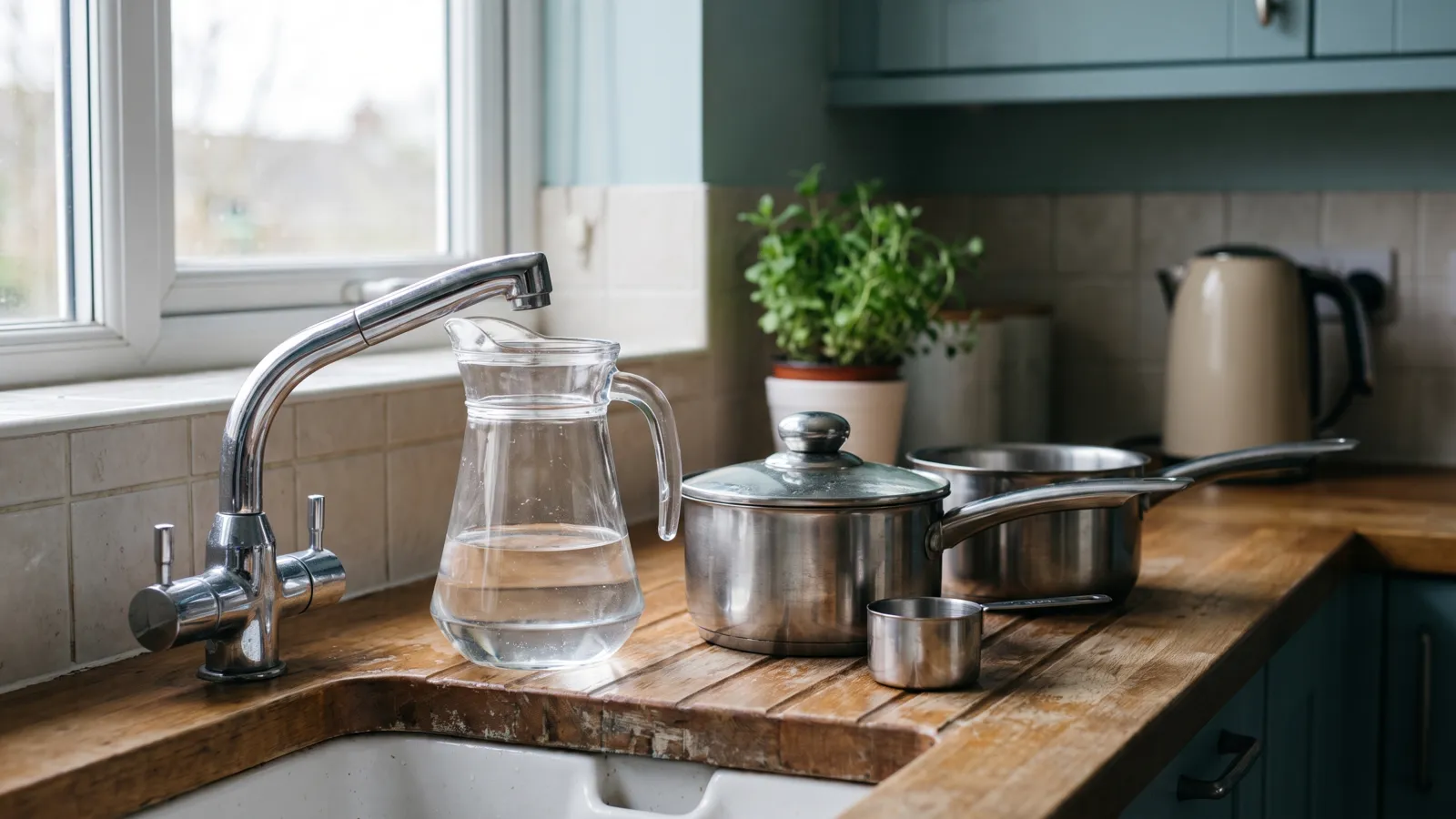
Start at the cold tap in the kitchen — in most homes it is fed directly from the mains, so it is the truest test of whether supply has failed. If nothing comes out, check your internal stop tap first: it is usually under the kitchen sink, and it is surprisingly common for one to be knocked or part-closed during cleaning or plumbing work. Turn it fully anticlockwise, then try the tap again.
Next, ask a neighbour whether their water is off, and check your water company's website — the major companies all run live incident maps (usually linked from the homepage as 'in your area' or similar) showing affected postcodes and an estimated restoration time. If your neighbours have water and your stop tap is open, the fault is probably on your side of the boundary: the company is responsible for the mains and the communication pipe up to the outside stop valve, but the supply pipe from there into your home is yours. In freezing weather, the usual culprit is a frozen pipe.
The first hour: fill containers while pressure lasts
Mains pressure often fades gradually rather than cutting out at once, so the first hour matters. Fill the kettle, jugs, saucepans and any clean bottles with drinking water straight away, then fill the bath or buckets with water for flushing and washing — keep the two jobs separate and don't drink bath-stored water. Ten litres per person comfortably covers a day's drinking, cooking and hand-washing.
Switch off the washing machine or dishwasher if it is mid-cycle, and remember the reserves you already have: the kettle, the toilet cisterns, and a hot water cylinder if you have one (a typical cylinder holds well over 100 litres). Treat cistern and cylinder water as a washing and flushing reserve, not drinking water. If you keep a small stock of stored water as part of your emergency kit, this is exactly the moment it pays for itself.
Toilets, washing and hot water during the outage
You can flush a toilet with no mains supply: pour around eight litres of water briskly into the pan (not the cistern) and it will flush itself. Bath water, water-butt water and washing-up water are all fine for this — flushing water doesn't need to be clean. Wash hands with stored water poured from a jug, or use hand sanitiser between proper washes.
Central heating is a sealed loop, so radiators keep working without mains water. A combi boiler, however, cannot produce hot tap water without mains pressure, and if a cylinder or immersion heater runs empty, switch it off until supply returns so the element doesn't heat a dry tank.
Bottled water stations and doorstep delivery
Water companies are required to plan for supply failures, not just react to them. Under the government's Security and Emergency Measures Direction, companies must plan to provide alternative supplies of at least 10 litres per person per day within 24 hours of a piped supply failing, rising to 20 litres per person per day in a prolonged incident. In practice that means bottled water stations — locations are posted on the company's incident page and social feeds. Take a bag; there is no charge.
If you can't get to a station, the Priority Services Register is the mechanism that brings water to you. It is free to join and covers people who depend on water for medical reasons (dialysis, for example), people with disabilities or serious illness, those of pensionable age, and households with very young children. Registered customers get bottled water delivered to the door during an incident. Since 1 October 2025, English water companies also owe a £100 payment under the Guaranteed Standards Scheme if they fail to provide a priority service they have promised during an incident — a genuine incentive to get the deliveries right. If you qualify, register before you need it.
Compensation: the GSS ladder at the 2025 rates
The Guaranteed Standards Scheme (GSS) sets legally binding restoration deadlines, and the payment rates in England were uprated substantially from 2 July 2025 — many articles still quote the old figures. For an unplanned interruption, your company must restore supply within 12 hours of becoming aware of it, or within 48 hours if the cause is a burst on a strategic main (a large trunk main serving a whole area). Miss that deadline and a household is owed £50, plus a further £50 for each additional full 12 hours without supply. Before July 2025 those figures were £20, then £10 per further 24 hours — so the initial payment has more than doubled, and the ongoing rate for a continuing outage is ten times what it was.
Payments should arrive automatically, normally as a credit on your bill; if the company fails to pay on time it owes you a further £40, and if it couldn't identify your property as affected you can claim in writing within three months. Planned works have their own standard: at least 48 hours' written notice for any planned shut-off longer than four hours, and restoration by the time promised. Persistent low pressure pays £50 per occurrence, capped at £250 per financial year (up from a £25 one-off). Boil water and do-not-drink notices attract their own payments from 1 October 2025: £40 if the notice runs beyond 48 hours, then £20 for each further 24 hours.
One catch worth knowing: the uprated rates apply to customers of English water companies. In Wales — Dŵr Cymru Welsh Water and Hafren Dyfrdwy — the older scheme amounts still apply: £20 for a missed restoration deadline and £10 per further 24 hours.
When the water comes back on
Open the cold kitchen tap slowly and let it run gently. Spluttering is trapped air working its way out; milky-white water is air bubbles and clears from the bottom of a glass upwards; brown or orange water is sediment disturbed by the repressurised main and normally clears with gentle running. If it is still discoloured after about 20 minutes, stop, give the network time to settle, and contact your company. Hold off using the washing machine until the water runs clear.
If the company has issued a boil water notice for your area, follow its advice and keep using stored or bottled water for drinking in the meantime. Then take five minutes to note what you were short of — that's your restock list.
Common questions
How long can a water company legally leave me without water?
There's no absolute limit, but the Guaranteed Standards Scheme sets deadlines with automatic payments attached: unplanned interruptions must be restored within 12 hours (48 hours for a strategic main burst), and planned shut-offs by the time given in the notice. Beyond that, under the Security and Emergency Measures Direction companies must plan to provide alternative supplies — at least 10 litres per person per day within 24 hours of a piped supply failing — which in practice means bottled water stations and priority deliveries.
How much compensation do I get for no water in 2025–26?
In England, households are owed £50 if supply isn't restored within the deadline, plus £50 for each further full 12 hours without water, paid automatically as a bill credit. If the company pays late, it owes an extra £40. In Wales the older rates still apply: £20 initially, then £10 per further 24 hours.
Can I flush the toilet when the water is off?
Yes. Pour around eight litres of water quickly into the pan (not the cistern) and the toilet will flush. Bath water, water-butt water or washing-up water all work — flushing water doesn't need to be drinkable. Each cistern also holds one normal flush when the outage starts.
Will the water company deliver bottled water to my home?
If you're on the Priority Services Register — which covers medical dependency on water, disability or serious illness, pensionable age and households with very young children — yes, delivery to your door is standard during incidents. Everyone else collects from bottled water stations, listed on the company's incident page. Registration is free; do it before you need it.
Why is my water brown or cloudy after the supply comes back?
Cloudy or milky water is trapped air and clears from the bottom of a glass upwards. Brown or orange water is sediment disturbed when the main was repressurised — run the cold kitchen tap gently and it normally clears. If it's still discoloured after about 20 minutes, or a boil water notice is in place, follow your company's advice and contact them.
Who has to fix the pipe — me or the water company?
The company is responsible for the water main and the communication pipe up to the outside stop valve at your property boundary. The supply pipe from the boundary into your home is the property owner's responsibility, though many companies offer free or subsidised repairs for leaks on it — check yours before paying a plumber.
Sources: The Water Supply and Sewerage Services (Customer Service Standards) (Amendment) Regulations 2025 (SI 2025/662) — legislation.gov.uk · Defra: Customers to receive up to £2,000 for water service failures — gov.uk · Ofwat: The guaranteed standards scheme — summary guidance · Drinking Water Inspectorate: Security and Emergency Measures Direction (SEMD) · The Water Supply and Sewerage Services (Customer Service Standards) Regulations 2008 (SI 2008/594, as amended) — legislation.gov.uk. PreparedBritain is independent and not affiliated with HM Government.
The Emergency Water Checklist
One page: how much to store per person, the cheapest ways to store it properly, how to make uncertain water safe, and what changes in a hosepipe ban. Free, no catch.
Download it straight away. We'll also send the occasional briefing when something genuinely matters — severe weather, live incidents, real price drops. Nothing else.
Keep reading
All water guides →How to purify water in an emergency: safe UK methods
The ways to make water safe in an emergency — boiling, tablets and filters — what each actually removes, what none…
Is UK tap water safe to drink?
A calm, sourced answer: UK mains tap water is among the safest in the world. What the regulation says, why taste…
Boil water notices: exactly what to do
What a boil water notice means, precisely how to make tap water safe, what you can and can't use the tap for, and…