Igenix air conditioner not cooling: the fixes that actually work
The hose, seal, filter, drainage and settings checks from Igenix's own manuals — including three built-in behaviours regularly mistaken for faults — and the one failure that is never a DIY fix.
By Tom Calder · Updated 26 August 2026 · Checked against Igenix's own documentation: the IG9901/IG9904 and IG9919/IG9922 user manuals, the IG9900 troubleshooting guide, the IG9903 data sheet and the IG9703 air cooler manual, plus GOV.UK on refrigerant qualifications. Specifications differ between model generations, so every figure below is attributed to the models Igenix actually publishes it for. Full list at the end.
First, check which Igenix you actually own
This matters more than it sounds, because the range splits three ways and the numbers genuinely differ between them. Working from the wrong figures is a good way to diagnose a fault that isn't there.
If your model number is IG9703 or IG9704, you do not own a refrigerant air conditioner at all. Igenix sells these as air coolers - the IG9703 manual is titled 'Air Cooler with LED Display' and the IG9704 is listed as a '4 in 1 Evaporative Air Cooler'. They cool by evaporating water from a tank through a honeycomb filter, with no compressor and no refrigerant circuit. None of the hose, refrigerant or error-code advice below applies. The most common reason one stops cooling is the simplest: the IG9703 troubleshooting table lists an empty water tank as the first cause, and the fix is to refill it. Its recommended maximum room size is 15m².
The older refrigerant models - IG9900, IG9901, IG9904 and IG9911 - use R410A and report faults as E-codes. The current models, IG9919 and IG9922, use R290 and report faults as symbols rather than E-codes. Where a figure below differs between the two generations, both are given.
Three built-in behaviours that look like faults
Before taking anything apart, rule out three things the unit is designed to do. Each one produces a machine that is running but not cooling, and none of them is a fault.
The first is the compressor delay. Igenix's manuals state that the compressor starts approximately three minutes after the unit is switched on, and instruct you to wait at least three minutes after switching off before turning it back on, to prolong compressor life. Fan noise and room-temperature air for the first few minutes is the unit behaving correctly.
The second is the standing rule, and it is the check most people have never heard of. Both manuals carry the same warning: leave the unit to stand for 12 hours before connecting it to the mains after transport, or after it has been tilted - for example while cleaning - to let the coolant settle. A unit that has just been delivered, carried up a flight of stairs, or laid on its side and then plugged straight in can run without cooling properly. Stand it upright and leave it before assuming the worst.
The third applies to the current IG9919 and IG9922. Their manual documents a frost protection device that guards against excessive ice forming: when it triggers, the unit shows a low-temperature symbol and starts up again automatically once defrosting has finished. A unit that pauses its cooling and recovers on its own is doing what it was built to do.
What the water indicator and error codes mean
Every model in the range stops working when its internal water tank fills, but each generation tells you differently - which is why searching a code from the wrong manual leads people astray.
On the IG9900, there is no code at all: the troubleshooting guide lists 'does not operate and water full indicator is lit', with the fix being to drain the water into a container through the drainage pipe at the rear. On the IG9901, IG9904 and IG9911, a full tank shows as error code E4 and the unit stops; Igenix's fix is to switch off, unplug, and drain the tank via the drain point before restarting. On the IG9919 and IG9922, it appears as a full tank symbol, cleared by emptying the internal safety tank.
Codes that are not about water need a different response. On the E-code models, Igenix logs E2 and E3 simply as a technical fault, with the instruction to contact customer services and quote the code - there are no troubleshooting steps to work through. On the current models, a probe failure symbol carries the same instruction: contact an authorised service centre. If your unit shows a code this guide doesn't list, check your own model's manual rather than assuming it matches another Igenix.
One drainage detail is worth knowing because it costs you cooling. These are self-evaporating units that reuse condensate to cool the condenser coils, and the IG9901 manual is explicit that you should not use the continuous drainage option if you want the self-evaporating benefit and its improved cooling effect. It also asks that the rubber caps are firmly secured on the drainage points while the unit runs. If someone has left a drain hose permanently fitted, refitting the caps may be worth a few degrees.
The exhaust hose is the single biggest cause of poor cooling
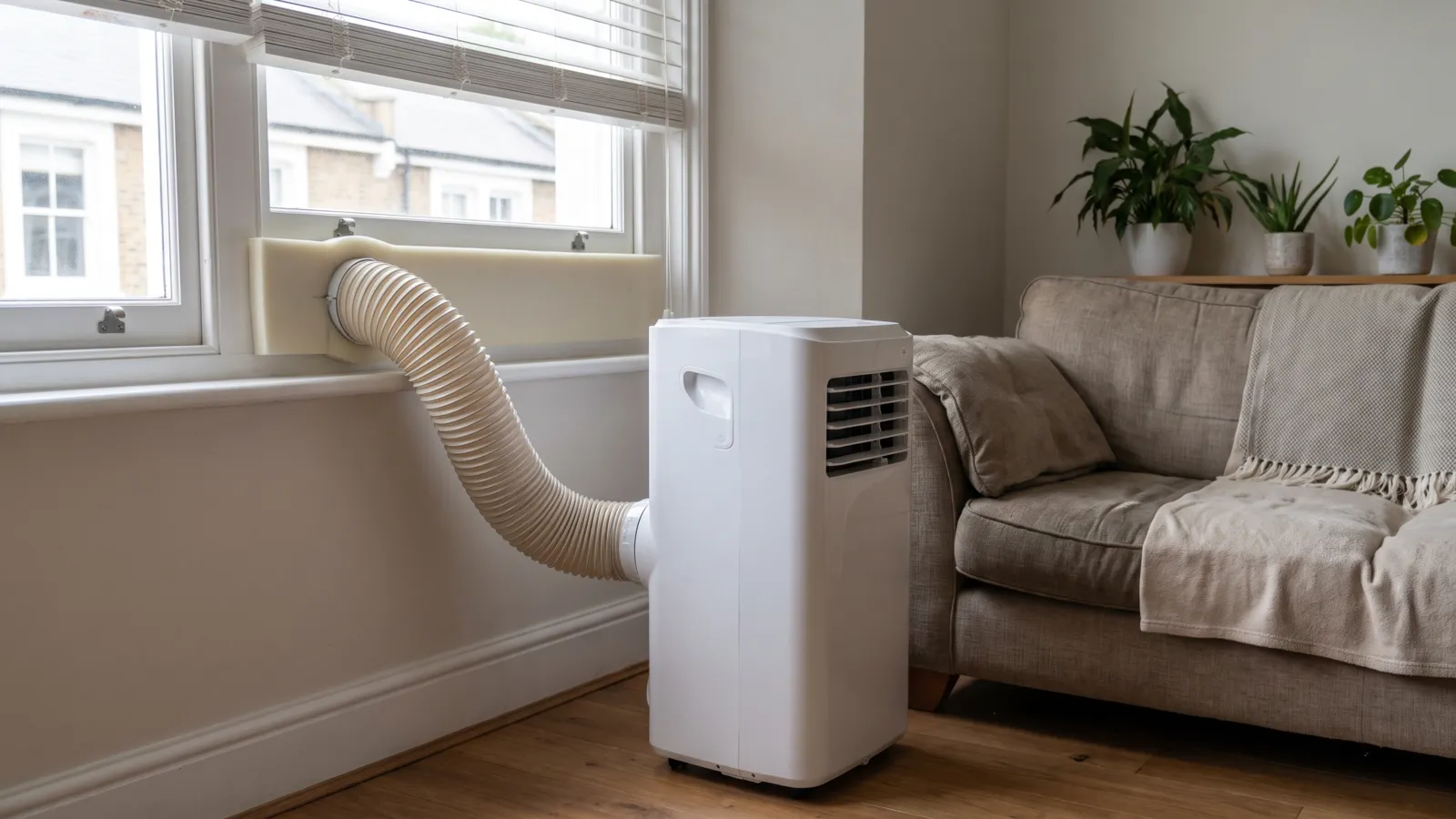
These are single-hose monobloc units: they draw in room air, cool part of it, and push the waste heat outside through one flexible hose. If that hose is not properly seated, some of that heat leaks back into the room. Fitting it is slightly counter-intuitive - the IG9901 manual instructs you to screw the hose into the exhaust hose connector by turning it anti-clockwise, then slide the assembly into the duct at the back of the unit until the connector clicks into place. If you have been turning it clockwise and it feels loose, that is why.
Igenix's instructions on the hose itself are specific and consistent across both generations. Extend it before fitting; it runs from 30cm to 150cm and should be kept as short as possible, because that minimises escaping expelled air and gives better results. Never extend it with any other product - the manual warns this can cause the unit to malfunction, since the hose length is designed around the appliance's specification. Avoid kinks, and avoid bends of more than 30 degrees, which Igenix flags not just for airflow but because blockages can lead to the unit overheating.
That last point has teeth. The IG9919 troubleshooting table lists bends or obstacles in the exhaust hose as a cause of the unit running for a short while and then switching off - so a badly routed hose doesn't only weaken cooling, it can cut the cycle short.
Positioning follows the same logic, and here the two generations differ slightly: the IG9901 and IG9904 ask for at least 50cm of clearance from walls, curtains, draperies and heat sources, while the IG9919 and IG9922 ask for 45cm. Both are clear that the exhaust must vent outside through a window, door or wall duct, with a wall duct recommended for best results - never into another room or an enclosed space.
Doors, windows and seals: why warm air keeps creeping back in
On every Igenix troubleshooting table across the range, an open door or window is the first listed cause of a unit that runs without cooling. It reads as too obvious to matter, and it is documented first for a reason: a single-hose unit is continuously expelling air it has to replace, so any easy route for outside heat undermines it.
The tables list two companions worth ruling out at the same time. Igenix asks you to remove any other appliance creating heat in the same room - the IG9900 guide states plainly that the unit will not operate correctly if there is a heat source in the same environment - and to check that air outlets and inlets are not blocked. A unit pushed against furniture, or sharing a small room with a tumble dryer or a games console, is fighting a load it wasn't rated for.
In practice: use a proper window-sealing kit around the hose rather than propping a window open and threading the hose through the gap, and keep other windows and doors in the room shut. If the room opens onto the rest of the house, closing internal doors makes a bigger difference than most people expect.
The filter: weekly or fortnightly, depending on your model
A dirty filter is the cause Igenix lists most consistently for reduced cooling, and it is the easiest to put right. The recommended frequency changed between generations, so check yours: the IG9901 and IG9904 manual recommends cleaning the air filters every two weeks, warning that filters blocked with dust will significantly affect performance, while the current IG9919 and IG9922 manual recommends cleaning the filter every week of operation.
The method is the same. Pull the filters out from the back and side of the unit, remove loose dust with a vacuum cleaner or by tapping the filter lightly, then wash them by immersing in lukewarm water with a neutral detergent. Rinse gently and dry thoroughly before refitting.
Two cautions from the manual are easy to miss. Igenix describes the filters as very delicate and asks for extreme care when cleaning them, so scrubbing or wringing risks damaging the mesh. And the instruction not to run the unit without its filters is unambiguous - it applies even temporarily while they dry. If it has been longer than the recommended interval since the unit last worked properly, clean the filter before anything else on this list. It takes about ten minutes and costs nothing.
Room size versus BTU: what Igenix actually rates the unit for
A common 'not cooling' complaint turns out to be a sizing mismatch rather than a fault - and Igenix now treats it as a diagnostic step in its own right. The IG9919 troubleshooting table explicitly asks you to check the room is the correct size for the recommended specification of the unit.
Igenix's published figures are: 20m² for the 9000 BTU IG9901, 15m² for the 7000 BTU IG9904, up to 20m² for the current 9000 BTU IG9919, and up to 25m² for the 12000 BTU IG9922. Igenix's own website repeats the 20m² figure for the IG9919. A unit run in a 30m² open-plan kitchen-diner, a room with a high ceiling or large south-facing glazing, or a loft conversion under a hot roof will run continuously and never quite reach the set temperature. That is a mismatch between room and rating, not a developing fault.
Not every model has a published figure. The larger 11500 BTU IG9903, for instance, appears on Igenix's data sheet with its cooling capacity and wattage but no room-size rating, so there is nothing official to check it against. If you are unsure whether the unit you own - or are about to buy - is sized for the room, it is worth settling that before assuming something is broken.
Settings that quietly stop the unit cooling
Several Igenix modes are designed not to cool at full effort, and it is easy to read that as a failure.
On the IG9901 and IG9904, Auto mode is the main culprit. The unit selects Cooling only when the room reads 24°C or above; below that it selects Fan mode, which moves air with no compressor running. On a day when a room feels warm but reads under 24°C, a unit left in Auto will blow room-temperature air and feel completely dead while doing exactly what it was set to do.
Sleep mode has a similar trap, and it works differently across generations. On the IG9901 and IG9904, the set temperature rises by 1°C after one hour and a further 2°C after two hours, then the unit switches off automatically after six hours. On the IG9919 and IG9922 - where Sleep can only be set from the remote control, not the main panel - the temperature rises by 1°C per hour across a two-hour period, holds for six hours, then switches off. Either way, a unit left on Sleep overnight has warmed the room and switched itself off well before morning, which reads as a dead unit at 6am.
Dehumidify is worth ruling out too. On the IG9901 and IG9904, the fan runs at a fixed low speed, the temperature cannot be adjusted at all, and the unit cycles eight minutes of compressor-and-fan operation with six minutes of fan only. It is built to remove moisture, not to deliver cold air. For cooling on demand, use Cool mode with a manually set temperature rather than Auto, Sleep or Dehumidify.
When it really is broken - and why the refrigerant circuit is not a DIY job
Once you have worked through the list - correct model identified, unit stood upright after any move, hose sealed and unkinked, other doors and windows shut, no extra heat source, filter clean, drain caps fitted, room within the rated size, and Cool mode set manually - a small number of units still will not cool. If the compressor is audibly running and there is real airflow, but the air is never meaningfully colder than the room, Igenix's own troubleshooting has nothing further to offer. Its documented next step is to contact customer services or an authorised service centre and quote the fault code.
What remains is a fault inside the sealed refrigerant circuit, and it is not something to open up yourself. Which rules apply depends on your model. The older IG9900, IG9901, IG9904 and IG9911 use R410A, a fluorinated gas: GOV.UK's guidance states that it is against the law to work with F gas if you do not have the correct qualifications, and small charge size is no exemption - the sub-3kg category is simply a different qualification tier, not a loophole. The current IG9919 and IG9922 use R290, which is not an F gas but is a flammable hydrocarbon refrigerant, so breaking into that circuit introduces a fire risk on top of everything else. Either way, this is qualified-engineer territory, and Igenix's terms void the guarantee if an unauthorised person carries out repairs or alterations.
Check your guarantee before paying anyone. Igenix's warranty terms give 12 months as standard from the date of purchase against mechanical and electrical defects, extended to 24 months only if you register the product - the manual asks for registration within 30 days of purchase. Marketing pages and data sheets tend to quote the two-year figure without that condition, so if you never registered, you may have 12 months rather than 24. In warranty, this is a claim to the retailer or Igenix. Out of warranty, a sealed-system repair on a budget portable unit is rarely economic against the price of replacing it.
Common questions
Why does my Igenix air conditioner not blow cold air for the first few minutes?
That is a deliberate compressor-protection delay, not a fault. Igenix's manuals state the compressor starts approximately three minutes after the unit is switched on, and instruct you to wait at least three minutes after switching off before restarting it. Separately, if the unit has just been delivered, moved or tilted, Igenix asks you to leave it standing for 12 hours before connecting it to the mains so the coolant can settle - plugging it straight in can leave it running without cooling properly.
What does error code E4 mean on an Igenix air conditioner?
On the IG9901, IG9904 and IG9911, E4 means the internal water tank is full rather than that the unit has failed. Switch off, unplug, and drain the tank through the drain point before restarting. Other generations report the same condition differently: the IG9900 lights a water-full indicator with no code, and the IG9919 and IG9922 show a full tank symbol. E2 and E3 are different - Igenix logs both as technical faults with no listed home fix, so those need customer services and the code itself.
How often should I clean the filter on an Igenix portable air conditioner?
It depends on the model. Igenix recommends every two weeks for the IG9901 and IG9904, and every week of operation for the current IG9919 and IG9922. Pull the filters from the back and side, remove loose dust with a vacuum or a light tap, then immerse them in lukewarm water with a neutral detergent, rinse gently and dry thoroughly before refitting. The filters are described as very delicate, so handle them carefully - and never run the unit without them fitted.
What room size will a 9000 BTU Igenix air conditioner actually cool?
Igenix rates the 9000 BTU IG9901 and the current 9000 BTU IG9919 for rooms up to 20m². The 7000 BTU IG9904 is rated to 15m², and the 12000 BTU IG9922 to 25m². A larger, open-plan, high-ceilinged or heavily glazed room will overwhelm that rating regardless of settings - that is a sizing issue, not a fault. Igenix's current troubleshooting guide lists checking the room size against the specification as a diagnostic step in its own right.
Can I regas my Igenix air conditioner myself if it still won't cool?
No. On the older R410A models - IG9900, IG9901, IG9904 and IG9911 - the refrigerant is a fluorinated gas, and GOV.UK states it is against the law to work with F gas without the correct qualifications; the small charge in a portable unit does not exempt you, it just changes which qualification tier applies. The current IG9919 and IG9922 use R290, which is not an F gas but is flammable, so opening that circuit adds a fire risk. In both cases it is a sealed system, it is qualified-engineer work, and Igenix voids the guarantee if an unauthorised person carries out repairs.
How long is the guarantee on an Igenix air conditioner?
Igenix's warranty terms give 12 months as standard from the date of purchase against mechanical and electrical defects, extendable to 24 months only if you register the product - the manual asks for registration within 30 days of purchase. Product pages and data sheets often advertise '2 Years' without stating that condition, so if you never registered, you may only have 12 months. The guarantee also excludes accidental damage, misuse and incorrect installation, and is void if an unauthorised person has carried out repairs.
Sources: Igenix IG9901 & IG9904 Air Conditioner user manual (PDF) · Igenix IG9919 & IG9922 4-in-1 Portable Air Conditioner user manual (PDF) · Igenix IG9900 Portable Air Conditioning Unit — troubleshooting guide (PDF) · Igenix IG9903 Portable Air Conditioner — official product data sheet (PDF) · Igenix IG9703 Air Cooler with LED Display — user manual (PDF) · Igenix IG9704 — 4 in 1 Evaporative Air Cooler manual listing · Igenix.co.uk — 4-in-1 Portable Air Conditioner, 9000 BTU (IG9919) product page · GOV.UK — Qualifications required to work on equipment containing F gas. PreparedBritain is independent and not affiliated with HM Government.
The Emergency Kit Checklist
The GOV.UK Prepare essentials on one printable page — tick them off as you go and keep it with the kit. Free, no catch.
Download it straight away. We'll also send the occasional briefing when something genuinely matters — severe weather, live incidents, real price drops. Nothing else.
Keep reading
All planning & the national picture guides →Aico vs Kidde carbon monoxide alarms: what the difference actually is
Aico and Kidde both certify to BS EN 50291-1:2018 — the real differences are sales channel, how each brand…
Can a log burner give you carbon monoxide poisoning?
Yes — a wood burner can produce dangerous carbon monoxide if the flue is blocked or the wood is wet. Here's how it…
Chip-pan and kitchen fires: what to do — and what never to do
How kitchen fires start, why water on hot oil is the worst move, when a fire blanket helps, when to simply get out —…