Chip-pan and kitchen fires: what to do — and what never to do
How kitchen fires start, why water on hot oil is the worst move, when a fire blanket helps, when to simply get out — and NHS burns first aid.
By Tom Calder · Updated 12 August 2026 · Sourced to Home Office fire statistics, UK fire services & the NHS
Almost half of house fires start with cooking
In the year ending March 2025, fire and rescue services in England attended 22,877 accidental dwelling fires. Cooking appliances were the source of ignition in 44% of them — the largest single category by a wide margin, ahead of electrical faults, smokers' materials and candles. Kitchen fires are not exotic events; they are ordinary evenings going slightly wrong.
They start in five predictable ways. First, the unattended pan: someone answers the door, checks a phone, settles a child — and the pan keeps heating. Second, overheated oil: fire services are blunt that oil which is smoking is too hot and close to igniting on its own, with no flame needed. Third, the grill: fat and crumbs build up in the tray and catch under the element. Fourth, combustibles near the hob: tea towels, kitchen roll, packaging and loose sleeves. Fifth, appliance faults — increasingly the countertop kind.
The air fryer has largely replaced the chip pan, which is genuinely good news, but it is not risk-free: several air-fryer models sold in the UK have been recalled over fire risk. Check yours against the GOV.UK product recalls database, register new appliances with the manufacturer, keep the vents clear, plug it into a wall socket rather than an extension lead, and never run it while you are out or asleep.
The never-do list — and the reasons why
Never put water on burning oil or fat. Water is denser than oil, so it sinks beneath the surface, flashes instantly to steam and expands to more than a thousand times its volume — blasting burning oil across the kitchen. Fire-service demonstrations show a single mug of water turning a chip pan into a fireball. The same physics is why fire services say never to use a fire extinguisher on a pan of burning oil either.
Never move a burning pan — not to the sink, not to the garden. Fire services' advice is to leave the pan exactly where it is: pans get dropped, handles get hot, and a moving pool of burning oil spreads fire faster than anything else you could do. Never lean across a burning pan to reach the hob controls — turn the heat off only if you can reach the knob from the side without stretching over flames.
Never open the door on an oven, grill or microwave fire. Keep it shut, switch the appliance off at the wall if you can do so safely, and let the lack of oxygen starve it — opening the door feeds it. If flames persist or smoke starts spreading, leave, close doors behind you and call 999. And never go back into a smoke-filled kitchen for anything, including to check whether it has gone out.
When a fire blanket helps — and when nothing in the kitchen does
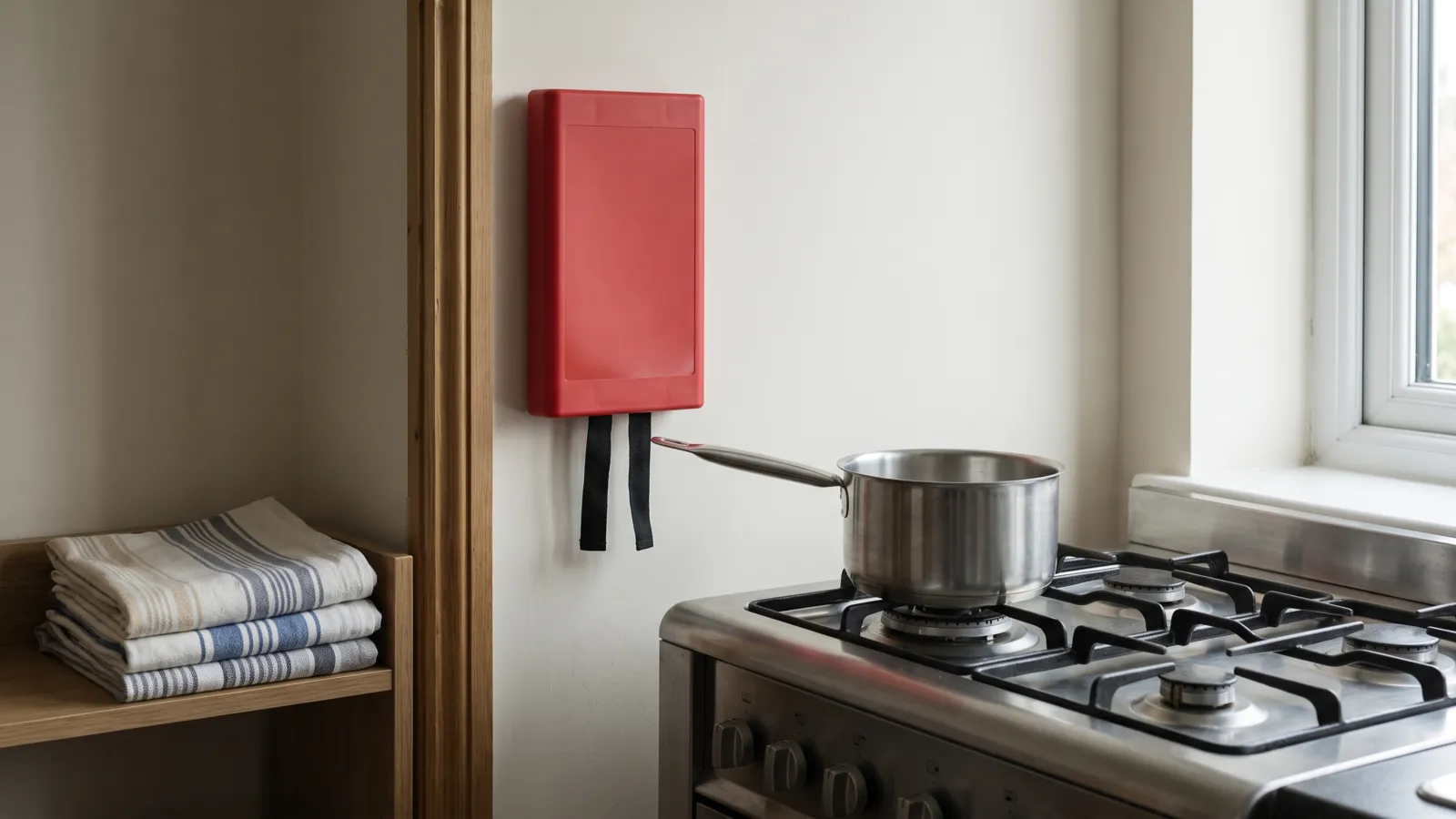
A fire blanket certified to BS EN 1869 is the right tool for exactly one job: a small, contained pan fire caught in its first moments. Turn off the heat if the control is safely reachable, wrap the top corners of the blanket over your hands, and place it — never throw it — over the pan, working away from yourself. Then leave the room, close the door, and do not touch anything until it is completely cold, at least half an hour later: hot oil reignites. Mount the blanket on the wall by the kitchen exit, never above the hob — you should not have to reach past a fire to fetch it, and it should be on your escape route, not behind the flames.
Be honest with yourself about the threshold. Fire services' first-line advice is simpler still: get out, stay out and call 999 — tackling a fire is always optional, and nobody will criticise you for skipping the blanket entirely. If flames are taller than the pan, if the fire has reached the extractor hood or a cupboard, or if you hesitate at all — you are past the point where anything in the kitchen helps. Close the kitchen door behind you if it is on your way, get everyone out, stay out, and call 999 from outside. A room fire grows in minutes, not tens of minutes, and fire crews would far rather attend a burnt-out pan than a casualty.
Smoke alarm in the hall, heat alarm in the kitchen
A smoke alarm does not belong in the kitchen: toast and steam set it off, someone eventually pulls the battery, and a silenced alarm protects nobody. The right setup — the one fire services recommend — is a heat alarm in the kitchen, which triggers on a rapid temperature rise rather than smoke or cooking fumes, plus smoke alarms in the hallway and landing on every level, interlinked if you are buying new so a kitchen fire wakes the bedrooms. Test them at least monthly. In England, landlords must ensure a smoke alarm is fitted on every storey with living accommodation.
The Home Office figures show why this is the part that decides outcomes: homes with no smoke alarm accounted for 24% of all dwelling fires in the year to March 2025, but 31% of the deaths. The alarm does not stop the fire — it buys the minutes in which leaving is still easy.
Prevention is boring, which is rather the point
The single most effective habit costs nothing: if you leave the kitchen, turn the hob off — even for a minute. After that, in rough order of value: clean the grill tray before fat builds up; keep towels, paper and packaging off the worktop beside the hob and roll your sleeves back; and if you deep-fry, use a thermostat-controlled fryer or the oven rather than an open chip pan. If you must use a chip pan, fill it no more than a third full with oil, dry the food first, and turn off the heat the moment the oil smokes.
Fire services also consistently warn against cooking when very tired, after drinking or on medication that makes you drowsy — late-night cooking features repeatedly in serious house fires. Chips at midnight after the pub is precisely the scenario the old chip-pan campaigns were built around; the safer answer has always been the toaster or a cold sandwich.
If someone is burned
Cool the burn under cool running water for 15 to 30 minutes, or until the pain genuinely eases — not a token rinse, and running water rather than ice or anything from the freezer. Remove jewellery and any clothing near the burn, unless it is stuck to the skin. Do not put creams, oils or butter on it, and do not burst blisters. Once the burn has cooled, lay cling film over it as a loose covering — laid on, never wrapped around a limb.
Call 999 or go to A&E for any burn that is very large or deep, any burn on the face, genitals or bottom, and every burn caused by chemicals or electricity. For a child under 5, the NHS advises calling 111 for advice — and 111 is the right call whenever you are unsure. If anyone has been breathing smoke, say so on the 999 call and let the crews check them over.
Common questions
Can I put out a small chip-pan fire with water if I'm quick?
No — never, at any size. Water sinks through burning oil, turns instantly to steam and ejects burning oil outwards as a fireball; even a splash is enough. Turn off the heat if you can reach the control safely from the side, cover the pan with a fire blanket, or leave, close the door and call 999.
Are chip pans banned in the UK?
No — there is no law against them, but fire services have spent decades discouraging them because an open pan of oil has no cut-off and will keep heating past its ignition point. A thermostat-controlled fryer, an air fryer or oven chips remove that failure mode. If you do use a chip pan: never more than a third full of oil, dry the food first, and never leave it unattended.
Do air fryers catch fire?
Rarely, but it happens — several models sold in the UK have been recalled over fire risk. Check yours on the GOV.UK product safety recalls database, register the appliance so recalls reach you, keep the air vents clear, plug it directly into a wall socket, and never run it while you are out of the house or asleep.
Where should I keep a fire blanket?
Wall-mounted at grab height beside the kitchen exit, on your escape route — never above or behind the hob, where reaching it means reaching past the fire. Buy one certified to BS EN 1869. Most domestic fire blankets are single-use: after any use, leave it in place until everything is completely cold, then replace it.
Why fit a heat alarm in the kitchen instead of a smoke alarm?
Smoke alarms false-alarm on toast and steam, which is how batteries end up removed. A heat alarm triggers on a rapid temperature rise rather than smoke particles, so it ignores cooking but catches a real fire. Pair it with smoke alarms in the hallway and landings — interlinked if you're buying new, so the kitchen alarm wakes the bedrooms.
What do I do about a fire inside the oven or microwave?
Keep the door shut — opening it feeds the fire with oxygen. Switch the appliance off at the wall if you can do so safely and let it smother itself. If flames persist, or smoke starts spreading into the room, leave, close doors behind you and call 999. Don't reopen the door until everything is cold.
Sources: Home Office — Detailed analysis of fires attended by fire and rescue services, England, April 2024 to March 2025 · Home Office — Make your home safe from fire (Fire safety in the home leaflet) · NHS — Burns and scalds · London Fire Brigade — Cooking: fire safety at home · Devon and Somerset Fire and Rescue Service — Fire safety in the kitchen · GOV.UK — Product safety alerts, reports and recalls (OPSS) · GOV.UK — Smoke and Carbon Monoxide Alarm (Amendment) Regulations 2022: guidance for landlords and tenants. PreparedBritain is independent and not affiliated with HM Government.
The Emergency Kit Checklist
The GOV.UK Prepare essentials on one printable page — tick them off as you go and keep it with the kit. Free, no catch.
Download it straight away. We'll also send the occasional briefing when something genuinely matters — severe weather, live incidents, real price drops. Nothing else.
Keep reading
All planning & the national picture guides →How to jump start a car: leads, jump packs and when not to try
The correct connection order for jump leads and jump packs, the stop-start and EV caveats most guides skip, and when…
Condensation, damp and mould: the winter guide (and when it's your landlord's job)
How to tell condensation from penetrating and rising damp, fix each properly, when a dehumidifier helps — and…
Will solar panels keep the lights on in a power cut?
The surprising answer is usually no — standard grid-tied solar shuts down in a blackout. Here's why, what battery…