Can a log burner give you carbon monoxide poisoning?
Yes — a wood burner can produce dangerous carbon monoxide if the flue is blocked or the wood is wet. Here's how it happens, what the law requires, and how to stay safe.
By Tom Calder · Updated 26 August 2026 · Sourced from GOV.UK Approved Document J and the 2022 circular announcing its new edition, HETAS, NHS, London Fire Brigade, the Scottish and Welsh governments, and the Ready to Burn scheme.
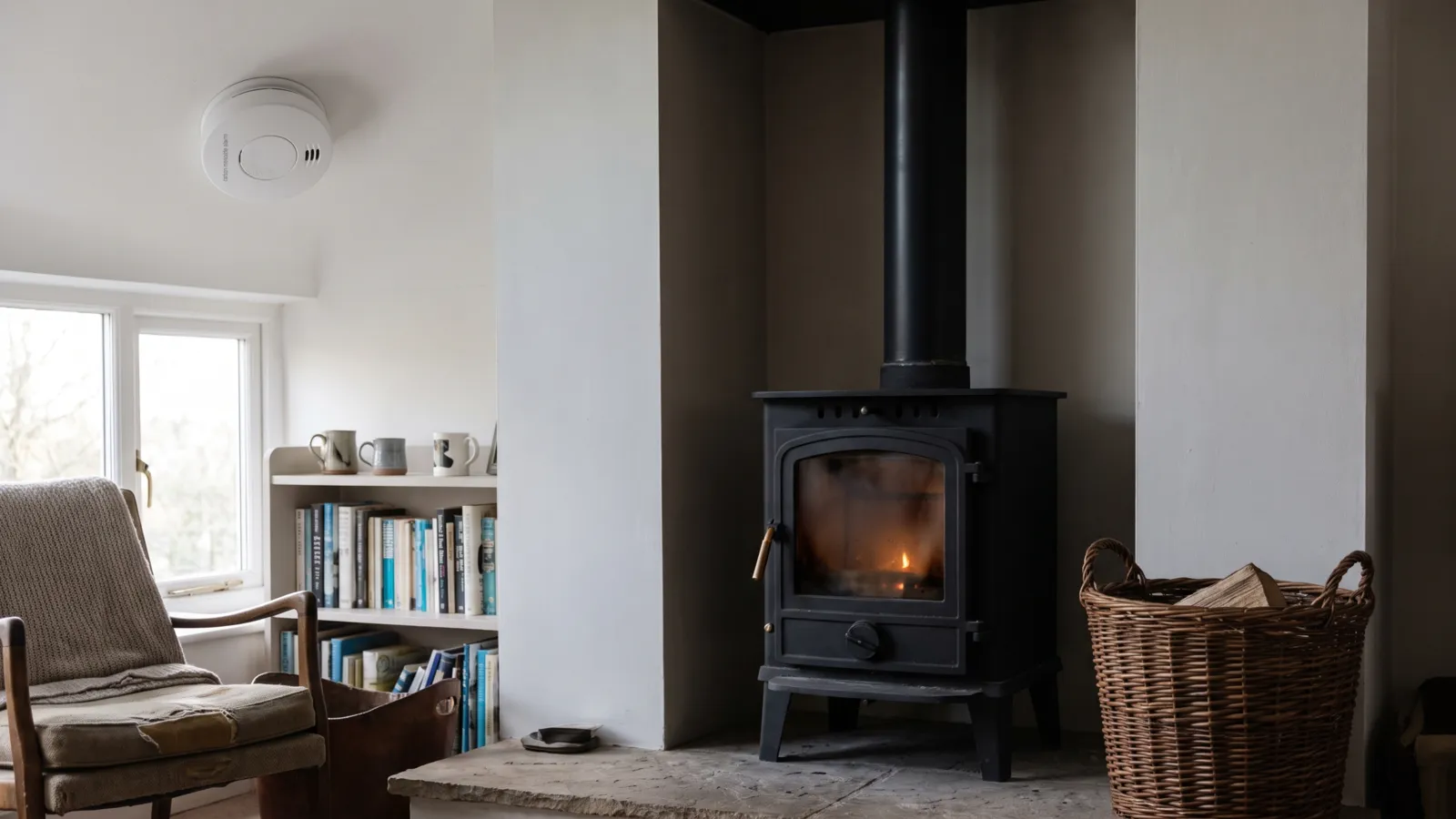
Yes — and here's how it happens
A wood-burning stove is a combustion appliance, and every combustion appliance produces carbon monoxide (CO). London Fire Brigade describes CO as the product of "the incomplete burning of fossil fuels (e.g. coal, gas, oil, wood)". In a correctly installed, correctly run stove that gas goes up the flue and out above the roofline, and the room never sees more than a trace. The danger isn't the stove — it's the gas failing to leave, or the fire producing far more of it than it should.
There are two failure modes, and it helps to keep them separate. The first is a flue problem: something stops the exhaust gases leaving the building, so they build up in the room or leak into it on the way up. The second is incomplete combustion: the fire itself burns badly and produces much more CO than a well-run fire would, even with a clear flue. In a neglected stove you often get both at once, because wet fuel, a starved fire and a dirty flue each make the others worse.
The flue: blockages and leaks
Chimneys block for reasons that have nothing to do with how carefully you run the stove. Nesting birds — jackdaws in particular, according to sweeps — fill unused or uncapped chimney pots with sticks and debris, and one nest is enough to seal a flue. Light a fire underneath it and the smoke and CO have to find another way out, which usually means into the room. This is exactly why HETAS advises a sweep before the start of the heating season and after any prolonged period when the stove hasn't been used. If yours has sat idle over summer, book that sweep before the first fire.
Creosote is the blockage you do have control over. It's the tarry residue that condenses out of wood smoke onto the flue walls, and it builds up fastest when the fire is cool and smoky — which is what happens with wet wood or a stove slumbered on a low setting to make logs last. Left to accumulate it narrows the flue, weakens the draw, and is a chimney fire risk in its own right. Regular sweeping is what keeps it in check.
Leaks are the quiet version of the same problem. A cracked liner, a badly sealed joint between stove and flue pipe, or a corroded flue pipe can let combustion gases seep into the room — or into a void behind a wall or in a loft — with no visible blockage at all. That's why installation quality matters as much as maintenance: a poorly fitted flue can be a CO risk from the first fire, invisibly, no matter how well you look after the stove afterwards.
The fire: wet wood and starved combustion
Wet wood burns badly. HETAS puts it plainly: "Wet wood means a large portion of energy is used just to boil water before your logs can properly burn." The fire runs cooler, combustion is less complete, and the result is less heat, more smoke and more creosote in the flue. This is the whole point of the Ready to Burn scheme — certification that wood has a moisture content of 20% or less. In England, wood sold in volumes under 2m³ must be certified Ready to Burn; the rules took effect in May 2021. Larger loads don't need certifying, but must come with advice on drying, storing and checking the wood.
Starving the fire of air does the same damage deliberately. Shutting the vents down to keep a load in overnight lowers the burn temperature, and HETAS is explicit about where that leads: "Lower air means lower temperatures, which means more incomplete combustion. This produces less heat, more smoke, and more dangerous gases – like carbon monoxide." If you want a longer burn, use a slower fuel or a smaller, better-managed load — not a throttled air supply.
Room ventilation is the third leg. A stove needs a supply of fresh air to burn properly and to keep the flue drawing. In England, Approved Document J guidance means appliances rated above 5kW generally need a permanently open air vent, and unusually airtight homes can need one at any output. Your installer sizes that vent as part of the job. The mistake to avoid is undoing it later — sealing or blocking a purpose-fitted vent because it draughts is how a compliant install becomes an unsafe one.
The legal bit: the CO alarm rules
In England, Building Regulations have required a carbon monoxide alarm with a new or replacement fixed solid fuel appliance since the 2010 edition of Approved Document J came into force on 1 October 2010. The often-quoted October 2022 date is a different change: the 2022 edition extended the requirement to gas appliances (other than those used solely for cooking) and oil appliances, and updated the guidance on alarm type and placement. If your stove was installed at any point since 2010, an alarm should have been part of the job.
The alarm must comply with BS EN 50291. Per the 2022 edition, it should be powered by a battery designed to last the alarm's working life, with a warning when that life is nearly up — or be mains-powered with fixed wiring (not a plug-in unit) and a sensor failure warning. Placement is specific: same room as the appliance, and either on the ceiling at least 300mm from any wall, or on a wall as high up as possible above doors and windows but not within 150mm of the ceiling — and between 1m and 3m horizontally from the stove. London Fire Brigade also suggests an alarm in the bedroom, on the grounds that it needs to be able to wake you. Our guide to choosing a [BS EN 50291 carbon monoxide alarm](/kit/carbon-monoxide-alarms) covers what to actually buy.
Building regulations are devolved, so the rest of the UK differs. Wales has its own Approved Document J (2010 edition incorporating the 2010 and 2024 amendments, effective 6 January 2025), which goes further than England's: an alarm to BS EN 50291-1:2018 when a new or replacement fixed flued combustion appliance of any fuel is installed, including fixed flued cookers. Scotland's rule isn't tied to installation at all — it applies to every existing home regardless of tenure, and the Scottish Government's guidance is blunt: "If you have a carbon-fuelled appliance like a boiler, open fire or wood burner, you must also have a carbon monoxide detector in the same room." Northern Ireland has its own building regulations; check with your district council's building control rather than assuming the England guidance applies.
One thing that holds everywhere: a CO alarm is not a substitute for a smoke alarm, or the other way round. They detect different things.
Sweeping, servicing and the wood you burn
HETAS recommends sweeping "at least twice a year when burning wood" — compared with at least once a year for smokeless fuels, because wood deposits creosote faster. The timing it suggests is one sweep just before the heating season starts or after the stove has stood unused for a prolonged period, and a second after the peak of the season. Burn heavily through the winter and more than that is reasonable; a sweep can tell you from the state of your flue whether twice is enough for how you actually use the stove.
Sweeping and servicing are different jobs and you want both. HETAS recommends the appliance is serviced "at least once annually, but this can vary depending on what you're burning", with an approved technician checking "things such as door rope seals, air intake and Carbon Monoxide alarms". You also get a record of the work, which insurers and buyers increasingly ask to see.
And burn Ready to Burn certified wood, or wood you've seasoned yourself and checked with a cheap moisture meter at 20% or below. It's the single biggest variable you control: it drives both how fast creosote coats your flue and how much CO your fire makes in the first place. Buying loose, uncertified logs from an unknown source is the most common way people end up burning wet wood without realising.
Symptoms, and when to act
Carbon monoxide poisoning is easy to miss. The NHS lists the symptoms as a headache, dizziness, feeling or being sick, feeling weak, tiredness and confusion, chest and muscle pain, shortness of breath, flushing, and loss of vision. The most useful tell is the pattern rather than any single symptom: the NHS notes that symptoms "may come and go", and that they "may get worse when you spend time in an affected room or building and get better when you leave or go outside".
If you suspect CO — whether or not the alarm has sounded — the NHS advice is to stop using the appliance you think is responsible if you can, go outside, and get medical advice as soon as possible, without going back into the building until you have. Don't relight the stove. Call NHS 111 if you think you have symptoms. Call 999 or go to A&E if anyone who may have been exposed is finding it hard to breathe, has suddenly become confused, has lost consciousness, feels weak, or has chest or muscle pain — and don't drive yourself: ask someone else to drive, or call 999 for an ambulance. Our full guide to [carbon monoxide poisoning symptoms](/guides/carbon-monoxide-poisoning-symptoms) goes through this in more detail.
Don't use the stove again until a HETAS-registered technician has serviced it and the flue has been swept and checked. London Fire Brigade's line is the right one: don't return to normal use until the source has been addressed by a qualified professional. Restarting before you know what caused it is how a near-miss becomes a repeat.
Common questions
Can a log burner give off carbon monoxide even with the door shut?
Yes. A closed door doesn't stop CO reaching the room — the issue isn't smoke escaping past the door, it's the flue gases failing to leave the building. If the chimney draws properly, virtually all of the combustion gas goes up and out. If the flue is blocked, cracked or badly jointed, or the room is starved of air, CO can be pushed back down the flue or seep through the flue pipe into the room with the stove door fully closed and the fire apparently burning normally.
Do I need a carbon monoxide alarm if I already have a smoke alarm?
Yes — they detect different things and neither substitutes for the other. A smoke alarm reacts to smoke particles; carbon monoxide is invisible and odourless and won't necessarily set one off. In England, Building Regulations Approved Document J has required a CO alarm complying with BS EN 50291 with any new or replacement fixed solid fuel appliance since 1 October 2010. The October 2022 edition of Approved Document J extended that requirement to gas (other than cooking-only appliances) and oil, and updated the guidance on alarm type and positioning.
How often should a wood-burning stove flue be swept?
HETAS recommends sweeping "at least twice a year when burning wood" — typically once before the heating season starts or after the stove has stood unused for a long period, and again after the coldest part of winter. That compares with at least once a year for smokeless fuels; wood needs the extra sweep because it deposits creosote faster. Heavy daily use through the winter can justify sweeping more often than twice.
What does 'Ready to Burn' mean, and does it matter for CO risk?
It certifies that the wood has a moisture content of 20% or less. Certification is run by Woodsure, and in England wood sold in volumes under 2m³ has had to be certified Ready to Burn since May 2021 (larger loads must instead come with advice on drying and storage). It matters for CO because wet wood burns cooler — HETAS notes that a large share of the energy goes into boiling off water before the log can properly burn — so combustion is less complete, more carbon monoxide is produced, and the extra smoke lays down creosote in the flue faster, which is itself a common cause of blockage. The rules are England-only; other UK nations differ.
What are the first signs of carbon monoxide poisoning from a stove?
The NHS lists headache, dizziness, feeling or being sick, weakness, tiredness and confusion, chest and muscle pain, shortness of breath, flushing and loss of vision. The pattern matters more than any one symptom: the NHS says symptoms may come and go, and may get worse in the affected room and improve when you leave or go outside. If you suspect it, stop using the appliance if you can, go outside, don't relight the stove, and get medical advice before going back in. Call NHS 111 if you think you have symptoms; call 999 or go to A&E if anyone is struggling to breathe, is suddenly confused, has lost consciousness, feels weak, or has chest or muscle pain — and don't drive yourself.
Sources: GOV.UK — Approved Document J: combustion appliances and fuel storage systems · GOV.UK — Circular letter: new edition of Approved Document J (30 September 2022) · GOV.WALES — Approved Document J (2010 edition incorporating 2010 and 2024 amendments) · GOV.SCOT — Fire and smoke alarms in Scottish homes · HETAS — Carbon monoxide guidance · HETAS — When should I get my chimney swept? · HETAS — Log burner efficiency explained · HETAS — Ready to Burn: what you need to know · HETAS — Log burner and biomass boiler servicing · NHS — Carbon monoxide poisoning · London Fire Brigade — Carbon monoxide safety. PreparedBritain is independent and not affiliated with HM Government.
The Emergency Kit Checklist
The GOV.UK Prepare essentials on one printable page — tick them off as you go and keep it with the kit. Free, no catch.
Download it straight away. We'll also send the occasional briefing when something genuinely matters — severe weather, live incidents, real price drops. Nothing else.
Keep reading
All planning & the national picture guides →Chip-pan and kitchen fires: what to do — and what never to do
How kitchen fires start, why water on hot oil is the worst move, when a fire blanket helps, when to simply get out —…
How to jump start a car: leads, jump packs and when not to try
The correct connection order for jump leads and jump packs, the stop-start and EV caveats most guides skip, and when…
Condensation, damp and mould: the winter guide (and when it's your landlord's job)
How to tell condensation from penetrating and rising damp, fix each properly, when a dehumidifier helps — and…