Aico vs Kidde carbon monoxide alarms: what the difference actually is
Aico and Kidde both certify to BS EN 50291-1:2018 — the real differences are sales channel, how each brand interlinks, battery format and price. Plus the sealed-battery rule that decides it in Scotland.
By Tom Calder · Updated 26 August 2026 · Every spec, standard, regulation and price below was checked in August 2026 against Aico's and Kidde's own product pages and datasheets, BSI's listing for BS EN 50291-1:2018, GOV.UK's landlord guidance, the Scottish Government's tolerable standard guidance, NHS advice, and live Screwfix listings.
Two brands, two different businesses
Aico is a trade brand first. Its main website states plainly that the site "is intended for electricians, engineers, social landlords and government bodies," and directs homeowners and private landlords to a separate site. The supporting structure follows: 32 relationship managers covering the UK, a free Fire Industry Association-accredited "Expert Installer" training scheme, and "Find a Distributor" and "Find an Installer" tools rather than a shop. That is why Aico's Ei-series alarms turn up so often in rented homes, housing association stock and new builds — an electrician specifies them, rather than an occupier picking one off a shelf.
Kidde works the other way round. Its UK carbon monoxide range — from the budget 2030-DCR and K5CO up to the sealed-lithium K10LLCO and K10LLDCO — is built for general retail: Screwfix and the wider DIY and online market stock it, and most models are designed to be bought, unboxed and fitted by the householder with no electrician involved. Its one mains-powered model, the K4MCO, is the exception, and it matters more than you would expect.
Neither business model tells you anything about detection quality. Both brands use electrochemical CO sensors, and both certify to the same British Standard. What the channel shapes is battery format, how each brand interlinks, and price.
The standard that actually matters: BS EN 50291-1
A CO alarm sold for a UK home should carry two things: a reference to BS EN 50291-1, and ideally the BSI Kitemark, which shows an independent laboratory tested it against that standard rather than the manufacturer self-declaring. The standard sets sensor sensitivity, how fast the alarm must sound as CO concentration rises, minimum sound output and the temperature range it must keep working across.
The current version is BS EN 50291-1:2018, listed by BSI as current and under review. It replaced BS EN 50291-1:2010, which Aico states was withdrawn by BSI on 26 September 2021 — alarms made after that date need the 2018 certification. Both brands' current models are up to date. Aico's product pages list "BS EN 50291-1:2018 / BS EN 50291-2:2019 / KM 86596" for the Ei208WRF and for the mains Ei3018, and Kidde states that "the entire Kidde range of battery-powered CO alarms is Kitemark approved by the British Standards Institution and complies with EN 50291-1:2018."
One practical wrinkle: old paperwork lingers. The Ei208WRF datasheet PDF still hosted on Aico's homeowner site is a 2019 revision and lists the superseded BS EN 50291-1:2010+A1:2012. The alarm itself is certified to 2018 — but it is a reminder to read the standard reference and Kitemark number printed on the unit and its box, not a datasheet you found online. An alarm certified only to the withdrawn 2010 standard is the worse buy whichever brand made it.
Power: sealed lithium vs replaceable batteries
Aico's range splits cleanly. The Ei208 series — Ei208, Ei208W, Ei208WRF and the display versions — runs on a sealed lithium cell powered for the alarm's life, paired with a 10-year electrochemical sensor. There is no battery compartment to open. The cheaper Ei207 series (Ei207, Ei207D) takes two replaceable AAA batteries. Aico's mains CO alarm, the Ei3018, is mains-powered with a 10-year rechargeable lithium back-up.
Kidde's range spans the same spectrum but is weighted the other way. The 2030-DCR, K5CO/K5DCO and K7CO/K7DCO take replaceable AA alkalines. Note the naming trap: the K7CO is sold as a "10 Year Carbon Monoxide Alarm" and carries a 10-year warranty, but it ships with two replaceable AA batteries — the ten years refers to the alarm and sensor life, not a sealed cell. Only the K10LLCO and K10LLDCO use a sealed 10-year lithium battery, as Aico's Ei208 does.
Sealed is not automatically better; it moves the maintenance burden. A replaceable-battery alarm costs less to buy but only protects you if the battery is actually changed on schedule. A sealed unit removes that job, at the cost of replacing the whole alarm rather than a battery at end of life. One caveat decides it outright for some buyers: Scottish guidance requires a battery-powered CO alarm to have a sealed battery lasting its full lifespan. More on that below.
End-of-life behaviour is covered by the standard, and neither brand's alarm expires quietly. Aico's Ei208 series uses an amber LED for fault and end of life alongside an audible warning, over a rated 10-year operational life. Kidde's units give an end-of-life alert to replace the alarm after ten years of protection. Warranties do not always match the rated life, so check if that matters to you: Aico's Ei208WRF carries a 5-year limited guarantee despite its 10-year battery and sensor, Kidde's K10LLDCO and K7CO carry ten years, and Kidde's mains K4MCO gives its end-of-life warning after seven years with a matching seven-year warranty.
Interlinking and price: what you're actually paying for
This is the real functional difference — but it is not "Aico interlinks and Kidde doesn't". Both do. They do it differently, and the difference is about wiring. Aico's Ei208WRF carries a RadioLINK+ radio module, so a battery-powered CO alarm can be interconnected wirelessly with Aico's other RadioLINK-enabled smoke, heat and CO alarms — no cabling. Aico's mains Ei3018 takes an Ei3000MRF module for wireless interconnection and is SmartLINK compatible. Kidde's interlinking is wired: the mains-powered K4MCO interconnects with other Kidde and Firex mains smoke, heat and CO alarms on a single wiring network using Smart Interconnect. Kidde's battery models are all standalone.
So the honest framing is that Aico's route retrofits into an existing house without disturbing the plaster, while Kidde's needs mains wiring and an electrician. That capability shows up in the price. Checked at Screwfix in August 2026 and approximate: the standalone Aico Ei208 lists at about £25, close to Kidde's sealed-lithium K10LLCO at about £27 and the K10LLDCO with display at about £29. The wirelessly interlinked Ei208WRF is about £77. You are not paying an Aico premium for the same alarm — you are paying for the radio module and the ecosystem it joins.
For a single room, a standalone alarm from either brand does the same job at much the same price. Interlinking only earns its cost in a multi-room property where every alarm should sound together — several bedrooms under one landlord, or a house where a CO alarm beside the boiler needs to wake someone two floors up. Our buying guide rounds up current standalone and interlinked options.
Owner-occupier, landlord, or Scotland — which fits
In England, the Smoke and Carbon Monoxide Alarm (Amendment) Regulations 2022 came into force on 1 October 2022. They require a CO alarm in any room used wholly or partly as living accommodation that contains a fixed combustion appliance — boiler, gas fire, wood burner, oil heater — across both private and social rented homes. Gas cookers are excepted. Separately, and often confused with those regulations, Building Regulations require a CO alarm whenever a new fixed combustion appliance is installed in any home, rented or owner-occupied. The regulations do not stipulate mains or battery power and name no brand, though government guidance for landlords recommends "alarms with 'sealed for life' batteries rather than alarms with replaceable batteries."
Scotland's rule is broader and applies to every home whatever the tenure, from 1 February 2022. A CO alarm is required in all rooms with a fixed combustion appliance other than one used solely for cooking, or with a flue. Two details decide the brand question. First, the Scottish Government's tolerable standard guidance is explicit that it "does not require carbon monoxide detectors to be interlinked, or to be interlinked with fire alarms" — so RadioLINK+ buys you nothing you are legally obliged to have. Second, a battery-powered alarm "must have a sealed battery for the duration of its lifespan." That rules out the replaceable-battery models on both sides — Aico's Ei207 series and Kidde's 2030-DCR, K5CO and K7CO — and points to a sealed unit such as the Ei208 or K10LLCO, or a hard-wired mains alarm with fixed wiring.
In practice the choice tracks who is buying. An owner-occupier fitting their own alarm can buy either brand off the shelf and self-install in minutes. Landlords and agents running several properties often lean towards Aico's installer channel — not because it detects CO any better, but because an electrician-commissioned installation produces dated paperwork that is useful on file if a tenant or an inspection ever asks.
Where it goes — and what to do if it sounds
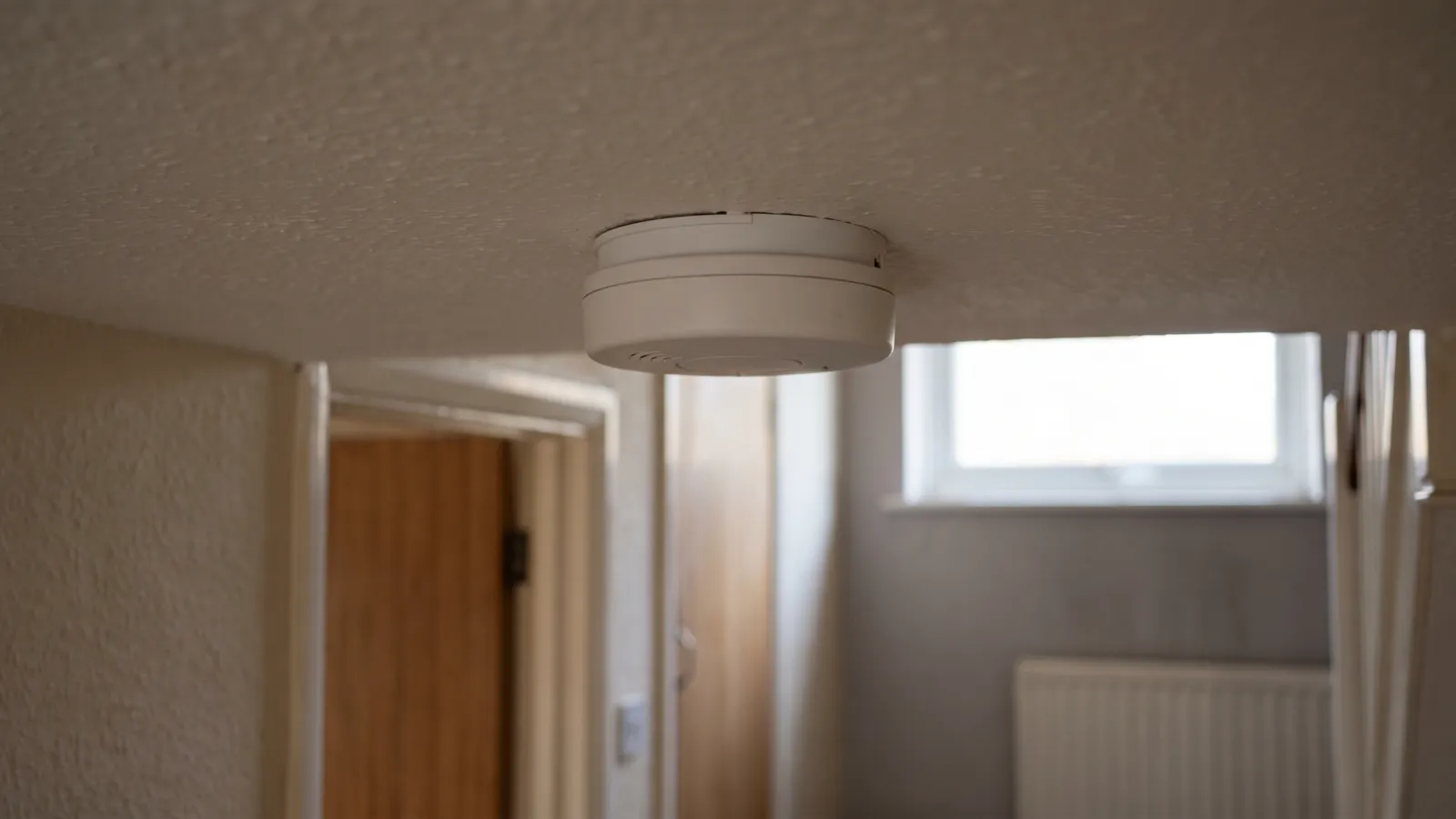
Placement is the decision worth taking care over, and both brands' instructions follow the same British Standard geometry. In a room with a fuel-burning appliance, site the alarm between 1 and 3 metres horizontally from it. Ceiling-mounted, keep it at least 300mm from any wall or light fitting. Wall-mounted, put it higher than any door or window but at least 150mm below the ceiling. Keep it out of cupboards and enclosed spaces, away from draughts, extractor fans, radiators and damp, and at least 1 metre from a cooking appliance. In a bedroom, or a room away from the appliance, mount it close to the occupants' breathing height. Always follow the instructions in the box.
Treat the alarm as a backstop, not a monitor. Response time scales with concentration: the illustrative table in Aico's Ei208 manual shows the alarm sounding within two minutes above 150 ppm, but taking 60 to 90 minutes at 43 to 80 ppm. It is no substitute for having gas appliances serviced annually by a Gas Safe registered engineer, and it does not make it safe to bring a barbecue, camping stove or petrol or diesel generator indoors, into a garage or into a tent. Never do that, alarm or no alarm.
If the alarm sounds or you suspect carbon monoxide, NHS advice is to stop using the appliance you think is producing it if you can do so safely, go outside, and get medical advice as soon as possible. Call the free National Gas Helpline on 0800 111 999 if you think a gas appliance is leaking carbon monoxide. Call 999 or go to A&E if anyone is finding it hard to breathe, has suddenly become confused, feels weak, has chest or muscle pain, or has lost consciousness.
If you want the symptom picture in more detail, or whether a wood burner adds risk that a sealed gas boiler does not, our related guides cover both.
Common questions
Is Aico or Kidde better for a carbon monoxide alarm?
Neither is inherently more accurate. Both use electrochemical sensors and both certify to BS EN 50291-1:2018 with BSI Kitemark approval. Aico sells mainly through electricians and distributors, with wireless RadioLINK+ interlinking available on battery alarms; Kidde sells through general retail, with standalone battery alarms and one mains model that interlinks by wire. Choose on how you are buying and installing, not on brand reputation.
Do Kidde CO alarms interlink with smoke alarms?
One of them does. The mains-powered Kidde K4MCO interconnects with other Kidde and Firex mains smoke, heat and CO alarms on a single wiring network using Smart Interconnect, so it needs mains wiring and an electrician. Every Kidde battery CO alarm is standalone. If you want interlinking without cabling, Aico's Ei208WRF uses a RadioLINK+ radio module to talk wirelessly to Aico's other RadioLINK-enabled alarms.
Does my carbon monoxide alarm need to be interlinked with my smoke alarm in Scotland?
No. The Scottish Government's tolerable standard guidance states that it does not require carbon monoxide detectors to be interlinked, or to be interlinked with fire alarms. The alarm needs to comply with BS EN 50291 and be sited in any room with a fixed combustion appliance other than one used solely for cooking, or with a flue.
Can I use a cheap replaceable-battery CO alarm in Scotland?
No. Scottish guidance is explicit that if a carbon monoxide alarm is battery-operated it must have a sealed battery for the duration of its lifespan, or you use a hard-wired mains alarm with fixed wiring. That excludes replaceable-battery models such as Aico's Ei207 series and Kidde's 2030-DCR, K5CO and K7CO, and points to sealed units like the Ei208 or K10LLCO. In England the regulations do not stipulate a power type, though government guidance for landlords still recommends sealed-for-life batteries.
Does "10 Year" on the box mean a 10-year sealed battery?
Not always, and it is the easiest mistake to make. Kidde's K7CO is sold as a 10 Year Carbon Monoxide Alarm with a 10-year warranty, but it ships with two replaceable AA alkaline batteries — the ten years refers to the alarm and sensor life. Only the K10LLCO and K10LLDCO have a sealed 10-year lithium cell, as Aico's Ei208 series does. If you are buying to meet Scotland's sealed-battery rule, check the battery, not the badge on the front.
How long do Aico and Kidde CO alarms last, and is the whole unit replaced?
On sealed-battery models from both brands the cell is built in for the alarm's rated life and cannot be swapped, so at end of life the whole alarm is replaced. Warranties do not always match that rated life. Aico's Ei208WRF carries a 5-year limited guarantee despite a 10-year sealed battery and sensor; Kidde's K10LLDCO and K7CO carry ten years; Kidde's mains K4MCO gives its end-of-life warning seven years from initial power-up and is warranted for seven. Worth checking the paperwork if that term matters to you.
Sources: Aico — Ei208WRF RadioLINK+ Battery CO Alarm (trade product page, approvals and guarantee) · Aico — Ei208WRF RadioLINK+ Battery CO Alarm (homeowner product page) · Aico — Ei208WRF technical datasheet (PDF) · Aico — Ei207/Ei208 Series CO alarm instructions, including siting guidance (PDF) · Aico — Ei3018 mains-powered carbon monoxide alarm · Aico — About Us (trade channel and Expert Installer scheme) · Aico — The increase in non-compliant alarms (BS EN 50291-1:2018 and the 2010 withdrawal) · Kidde UK — Carbon monoxide alarms range · Kidde UK — K10LLDCO 10 Year CO Alarm with Digital Display · Kidde UK — K7CO 10 Year Carbon Monoxide Alarm (2 x AA replaceable) · Kidde UK — K4MCO Interconnectable (mains) Carbon Monoxide Alarm · Kidde UK — Kidde Safety Europe launches redesigned carbon monoxide alarms (EN 50291-1:2018 Kitemark) · BSI Knowledge — BS EN 50291-1:2018 standard listing · GOV.UK — Smoke and Carbon Monoxide Alarm (England) Regulations: Q&A booklet for landlords and tenants · GOV.UK — Domestic smoke and carbon monoxide alarms: government response · gov.scot — Fire and smoke alarms in Scottish homes · gov.scot — Fire and smoke alarms: where and what to buy (sealed battery requirement) · gov.scot — Tolerable standard guidance, Chapter 17: Satisfactory Carbon Monoxide Detection · gov.scot — Carbon monoxide alarms in private rented properties: guidance · NHS — Carbon monoxide poisoning · Screwfix — Aico Ei208 Battery Standalone AudioLink 10-Year CO Alarm (£24.99, checked Aug 2026) · Screwfix — Aico Ei208WRF Battery Interlinked CO Alarm (£76.99, checked Aug 2026) · Screwfix — Kidde K10LLCO Battery Standalone 10-Year CO Alarm (£27.49, checked Aug 2026) · Screwfix — Kidde K10LLDCO Battery Standalone 10-Year CO Alarm with Display (£28.99, checked Aug 2026). PreparedBritain is independent and not affiliated with HM Government.
The Emergency Kit Checklist
The GOV.UK Prepare essentials on one printable page — tick them off as you go and keep it with the kit. Free, no catch.
Download it straight away. We'll also send the occasional briefing when something genuinely matters — severe weather, live incidents, real price drops. Nothing else.
Keep reading
All planning & the national picture guides →Can a log burner give you carbon monoxide poisoning?
Yes — a wood burner can produce dangerous carbon monoxide if the flue is blocked or the wood is wet. Here's how it…
Chip-pan and kitchen fires: what to do — and what never to do
How kitchen fires start, why water on hot oil is the worst move, when a fire blanket helps, when to simply get out —…
How to jump start a car: leads, jump packs and when not to try
The correct connection order for jump leads and jump packs, the stop-start and EV caveats most guides skip, and when…