Are there nuclear bunkers in the UK?
No — not for the public, and there never were. Britain's Cold War bunkers were built for government, the military and monitoring staff. Here is what actually exists, which ones you can visit, and what the official advice tells households to do instead.
By Tom Calder · Updated 21 September 2026 · Sourced to UKHSA and the museums' own pages.
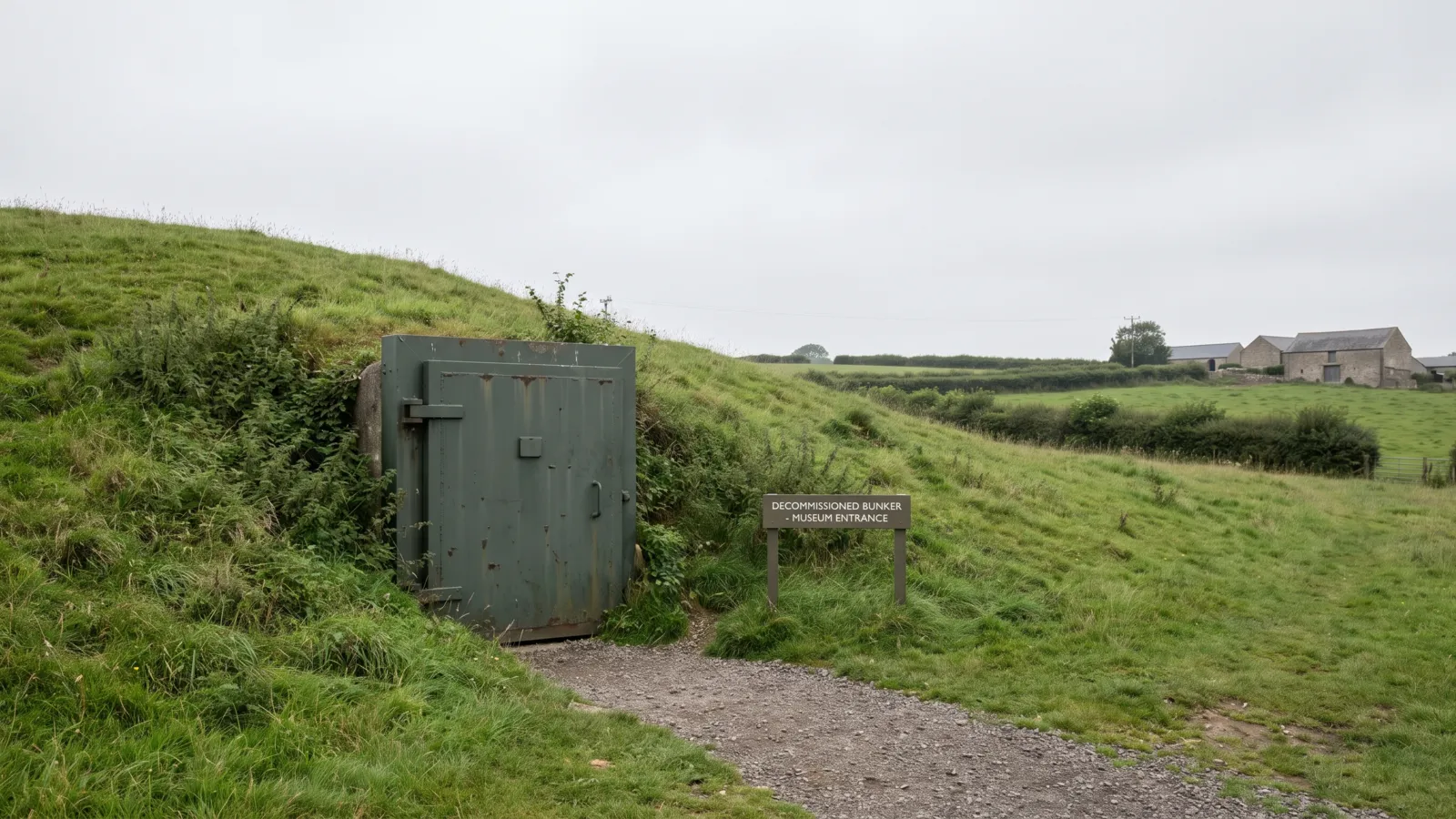
The short answer
No. The UK has never built nuclear shelters for the general public, and it does not have any today. Every Cold War bunker in Britain was built for one of three groups: central and regional government, the armed forces, or the volunteers of the Royal Observer Corps who would have measured the fallout. Ordinary households were never on the list.
That is not a gap someone forgot to fill. British civil defence planning took a different route from the start: people would shelter at home, in the most solid part of the house, and be told what to do by radio. That is still the official position today — the current UK Health Security Agency advice for a radiation emergency is three words long: go in, stay in, tune in.
What Britain actually built
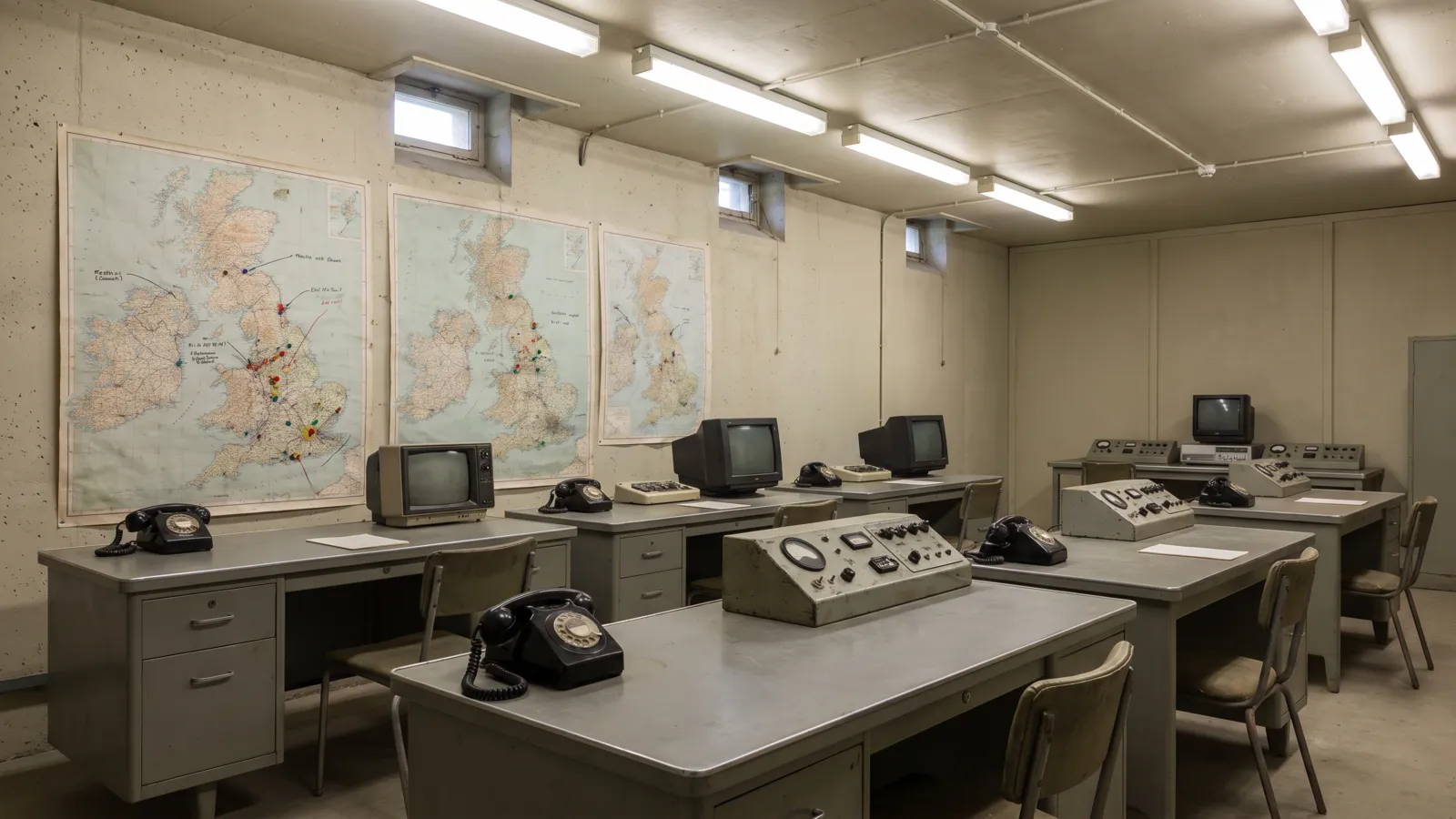
The big sites were for running the country, not sheltering it. The government's own wartime headquarters was carved into the old quarries under Corsham in Wiltshire, and a chain of regional government bunkers was built so that the country could be administered from below ground if London was lost. Several of those regional bunkers are the museums you can visit today.
Below them sat the monitoring network. The Royal Observer Corps ran hundreds of small underground posts across the country — three people in a concrete room the size of a garden shed, with instruments for measuring blast and fallout — reporting to group headquarters like the one preserved in York. The posts closed in 1991 and most were sealed or sold. Enthusiasts have catalogued nearly all of them, and many now sit quietly in the corner of a farmer's field.
What none of this ever included was room for the public. The 1980s leaflets that told households how to build an inner refuge at home were the civil defence plan for everyone else.
The bunkers you can visit
Several of the Cold War sites are now museums, and they are a genuinely good day out — sobering, oddly domestic in places, and the best way to understand what the plan actually was. Opening days change with the season, so check before you go.
Hack Green Secret Nuclear Bunker, near Nantwich in Cheshire, is a former regional government bunker with its rooms and equipment preserved. It opens 10am to 4pm and is closed on Mondays and Tuesdays outside bank and school holidays; an adult ticket is £17.50 and works as an annual pass.
York Cold War Bunker, run by English Heritage, was the Royal Observer Corps headquarters that would have tracked explosions and fallout across Yorkshire. It is open Friday to Sunday and bank holidays by pre-booked guided tour, and it is the best place to see the monitoring side of the story.
Scotland's Secret Bunker at Troywood, near St Andrews in Fife, is a regional bunker hidden beneath an ordinary-looking farmhouse. It is open to the public from February to November.
Kelvedon Hatch Secret Nuclear Bunker, near Brentwood in Essex, is the largest and best known of the regional bunkers and runs as a museum; its website carries the current opening days.
Churchill War Rooms in Whitehall is the Second World War government bunker rather than a Cold War one, preserved as it was in 1945. It is open daily except 24 to 26 December, 9.30am to 6pm, and an adult ticket is £34.
What the government tells you to do instead
The official advice for a radiation emergency is published by the UK Health Security Agency and updated in September 2024. It asks for three things: go in, stay in, tune in. Get inside a building — brick, stone or concrete is best — close the doors and windows, switch off fans and air conditioning and close vents, and stay in the middle of the building away from external walls. You might need to stay put for a day or two.
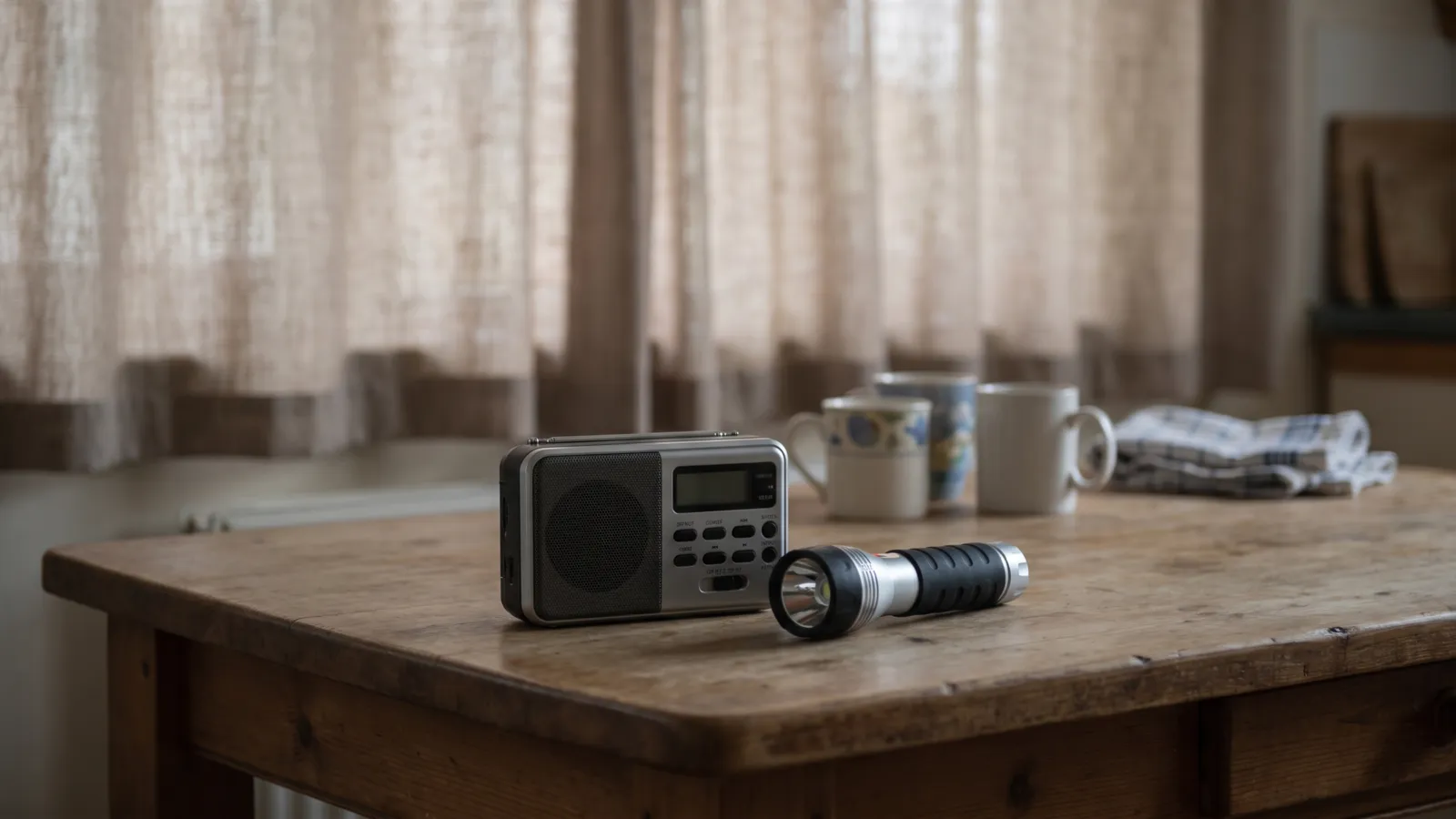
The third word matters as much as the first two. Any change to the advice would come through official channels — radio, television, the internet, social media or the police — which is why the government's own household list includes a battery or wind-up radio: if the power and the mobile network are down, it is the one channel that still reaches you.
That advice is the same shape as the advice for a storm, a flood or a long power cut. It does not ask you to leave, to head for a shelter, or to buy anything unusual.
What that means for your cupboard
The kit the government asks households to keep does not change because the headline mentions war. It is the same modest list as for any disruption: water, food that keeps and needs no cooking, a torch rather than candles, a radio, a charged power bank, a first aid kit, prescription medicines, copies of documents and some cash. The full list, item by item, and the reasoning behind each line, is in our kit guide.
If you want it sized to your household rather than a generic list, the kit builder works it out from the number of people, pets and days, using the official figures.
The Emergency Kit Checklist
The GOV.UK Prepare essentials on one printable page — tick them off as you go and keep it with the kit. Free, no catch.
Download it straight away. We'll also send the occasional briefing when something genuinely matters — severe weather, live incidents, real price drops. Nothing else.
Common questions
Are there public nuclear shelters in the UK?
No. The UK never built shelters for the general public. Cold War bunkers were for government, the military and the Royal Observer Corps. The official advice for a radiation emergency is to shelter in the building you are in.
What does 'go in, stay in, tune in' mean?
It is the UK Health Security Agency's advice for a radiation emergency: get inside a solid building, close doors, windows and vents and stay away from external walls, and follow official updates by radio, television, the internet or the police. You may need to stay indoors for one to two days.
Can I visit a nuclear bunker near me?
Probably. Hack Green in Cheshire, York Cold War Bunker, Scotland's Secret Bunker in Fife and Kelvedon Hatch in Essex are all open as museums, and Churchill War Rooms in London covers the Second World War. Opening days vary by season, so check each site before travelling.
Do I really need a radio?
It is on the government's own household list for exactly this reason: if the power and mobile network are down, official updates still reach a battery or wind-up radio. It is the cheapest item on the list and the one most people skip.
Should I build a shelter in my garden?
You can, but it is a serious construction job rather than a weekend dig: deep excavations collapse, buried utilities need checking first, and a sealed underground room needs proper ventilation. If you want the space, build it as a cellar or store room that happens to be solid. For the emergency itself, the official advice is the middle of your house.
Sources: UK Health Security Agency — What to do in a radiation emergency (updated 10 September 2024) · GOV.UK Prepare — Get prepared for emergencies · English Heritage — York Cold War Bunker · Hack Green Secret Nuclear Bunker — Plan your visit · Scotland's Secret Bunker · Kelvedon Hatch Secret Nuclear Bunker · Imperial War Museums — Churchill War Rooms. PreparedBritain is independent and not affiliated with HM Government.
Keep reading
All planning & the national picture guides →Is the UK government telling people to stockpile food and water?
A post claiming Britain is telling households to stockpile for war is going round. Here is what the government…
Igenix air conditioner not cooling: the fixes that actually work
The hose, seal, filter, drainage and settings checks from Igenix's own manuals — including three built-in behaviours…
Aico vs Kidde carbon monoxide alarms: what the difference actually is
Aico and Kidde both certify to BS EN 50291-1:2018 — the real differences are sales channel, how each brand…