Jackery power stations sold in the UK, compared (2026)
Jackery's UK range comes in two lines at each size, and the names hide the difference: an Explorer 1000 v2 and an Explorer 1000 Plus v2 weigh the same and hold about the same, but only the Plus takes extra batteries, switches to battery in half the time and is rated for more charge cycles. This page compares the five current Jackery power stations we list, from the 5.7kg Explorer 500 v2 for a router and phones to the 2kWh units that can carry the essentials through a day, on capacity, output, weight, switchover and expansion. Every figure is from Jackery's own UK product pages, and we say where one model is the better buy. Jackery UK also sells the larger Explorer 3000 v2 and two smaller units, the Explorer 300D and Explorer 100 Plus, which aren't on this page yet.
By Tom Calder · Updated 2 November 2026 · 5 products, all price-tracked
Our picks by size
Which size? ↓Not sure which size? Work it out ↓ Photo: Jackery
Jackery Explorer 1000 Plus v2
A 1kWh home backup that can grow: the fridge, router, phones and lights through a power cut now, with room to add batteries later.
 Photo: Jackery
Jackery Explorer 500 v2
Phones, a router, a laptop and lamps through an evening's power cut, in a unit you can carry with one hand.
 Photo: Jackery
Jackery Explorer 2000 Plus v2
A 2kWh home backup with the output for a microwave as well as the fridge, router and lights, and room to add batteries for longer cuts.
All 5 compared
| Power station | Capacity | Output | Weight | Price |
|---|---|---|---|---|
 1,070 Wh · 1,500 W · 10.8 kg Keeping the essentials going through a power cut — fridge, phones, router, lights and small medical devices. | 1,070 Wh | 1,500 W | 10.8 kg | £469 at Amazon as of 2 Nov 2026, 11:07 GMT · DetailsProduct prices and availability are accurate as of the date/time indicated and are subject to change. Any price and availability information displayed on Amazon.co.uk at the time of purchase will apply to the purchase of this product.Ships laterCheck price → |
Our verdictOur verdictResearched A well-judged, genuinely portable unit that covers most household outage needs without fuss. The long-life LiFePO4 battery and fast recharge make it a sensible one-off buy — just wait for it to drop from its inflated RRP. Best for Keeping the essentials going through a power cut — fridge, phones, router, lights and small medical devices. Good
Worth knowing
Who shouldn't buy it: Your goal is to run heating or a kettle during an outage — a 1,500W limit won't cope with a 2–3kW load. And if you only need to keep phones and a laptop alive, a £30–£90 power bank does that for a fraction of the price. Read the full review → | ||||
 2,042 Wh · 2,200 W · 17.5 kg Whole-home backup during power cuts, and off-grid trips | 2,042 Wh | 2,200 W | 17.5 kg | £899 at Amazon as of 2 Nov 2026, 11:07 GMT · DetailsProduct prices and availability are accurate as of the date/time indicated and are subject to change. Any price and availability information displayed on Amazon.co.uk at the time of purchase will apply to the purchase of this product.Ships laterCheck price → |
Our verdictOur verdictResearched A genuine step up on the outgoing 2000 Plus — noticeably lighter for the same 2kWh capacity, with a LiFePO4 cell rated for thousands of cycles. It isn't cheap, but it's built to still be working a decade from now. Its 2200W inverter briefly surges to 4400W for motor start-ups, and the LiFePO4 cells are rated for years of weekly cycling. Best for Whole-home backup during power cuts, and off-grid trips Good
Worth knowing
Who shouldn't buy it: Don't buy it if you want to scale capacity over time — the 2000 Plus it replaces took add-on battery packs up to 12kWh; this model doesn't, so buy for the capacity you'll actually need. Read the full review → | ||||
2,048 Wh · 2,400 W · 19.1 kg A 2kWh home backup with the output for a microwave as well as the fridge, router and lights, and room to add batteries for longer cuts. | 2,048 Wh | 2,400 W | 19.1 kg | £949 at Jackery Checked 2 NovIn stockCheck price → |
Our verdictOur verdictResearched A lot of power station for its sale price: 2,048Wh, 2,400W and a 10ms switchover in a 19.1kg unit you can carry, with expansion batteries if you want days rather than hours. Best for A 2kWh home backup with the output for a microwave as well as the fridge, router and lights, and room to add batteries for longer cuts. Good
Worth knowing
Who shouldn't buy it: You want to heat the house in a power cut: no portable unit does that for long. If your list is the fridge, router, lights and phones, a 1kWh unit is usually enough. | ||||
1,024 Wh · 1,800 W · 10.8 kg A 1kWh home backup that can grow: the fridge, router, phones and lights through a power cut now, with room to add batteries later. | 1,024 Wh | 1,800 W | 10.8 kg | £599 at Jackery Checked 2 NovIn stockCheck price → |
Our verdictOur verdictResearched The newest 1kWh Jackery, and the more future-proof of the two at this size: 1,800W output, a 10ms switchover for a router or PC, and the option to add batteries rather than replace the unit. Worth it over the 1000 v2 if you think you will want more capacity later. Best for A 1kWh home backup that can grow: the fridge, router, phones and lights through a power cut now, with room to add batteries later. Good
Worth knowing
Who shouldn't buy it: You only need to keep phones and a router going: a smaller unit or a big power bank does that for far less. And no unit this size runs electric heating for long. | ||||
512 Wh · 500 W · 5.7 kg Phones, a router, a laptop and lamps through an evening's power cut, in a unit you can carry with one hand. | 512 Wh | 500 W | 5.7 kg | £449 at Jackery Checked 2 NovIn stockCheck price → |
Our verdictOur verdictResearched Jackery's smallest current power station: 512Wh and 500W at 5.7kg, with the same long-life LiFePO4 cells and sub-10ms switchover as its bigger units. Enough to keep a router, phones and a couple of lamps going through an evening or a night. Jackery's page gives no surge figure, so don't count on it to start a fridge-freezer's compressor. Best for Phones, a router, a laptop and lamps through an evening's power cut, in a unit you can carry with one hand. Good
Worth knowing
Who shouldn't buy it: You want the fridge-freezer covered through a cut: that needs the 1kWh class, such as the Explorer 1000 v2. For phones alone, a large power bank costs far less. | ||||
ⓘ As an Amazon Associate, PreparedBritain earns from qualifying purchases. We may earn a commission when you buy, or a fee when you request a quote, through our links. When two products are close, commission can decide which one we pick. A clearly better product always wins. Amazon prices come from Amazon's own product data and show the date and time they were retrieved. Prices at other retailers are checked by us, less often. Prices and stock can change at any time, so always check the retailer's price before you buy.
Before you buy
Decode the range.
The number is roughly the capacity in watt-hours: the Explorer 500 v2 holds 512Wh, the 1000 v2 1,070Wh, the 1000 Plus v2 1,024Wh, the 2000 v2 2,042Wh and the 2000 Plus v2 2,048Wh. Every current model uses LiFePO4 cells. At 1kWh and 2kWh, the Plus v2 is the expandable one: Jackery says the 1000 Plus v2 grows to about 11kWh with add-on batteries and the 2000 Plus v2 to about 12kWh. The plain v2 models can't be expanded, so buy the size you need.
Size it on what you'd run.
A router, phones and a couple of lamps through an evening fit in the Explorer 500 v2. A fridge-freezer through much of a day's cut wants the 1kWh class, and the surge figure matters as much as capacity, because a compressor draws several times its rated power as it starts: Jackery gives 3,000W surge on the 1000 v2 and 3,600W on the 1000 Plus v2, but publishes no surge figure for the 500 v2. A fridge, lights, a laptop and a gas boiler's controls for a full day suit the 2kWh class. No portable unit heats a home for long: a 3kW heater empties 2kWh in under an hour.
Switchover, for routers and medical devices.
Jackery quotes 10ms or less on the 500 v2, 1000 Plus v2 and 2000 Plus v2, and 20ms on the 1000 v2 and 2000 v2. Either is fast enough for a router or a fridge. If you rely on a CPAP or oxygen concentrator, check with the device's maker and Jackery before treating any power station as a backup, and see our CPAP guide.
Weight decides where it lives.
The 500 v2 is 5.7kg, a one-handed carry; both 1kWh units are 10.8kg; the 2000 v2 is 17.5kg and the 2000 Plus v2 19.1kg, which is a two-handed lift. If the unit has to go upstairs to a bedroom at night or out to a car, the 1kWh class is about the limit for most people.
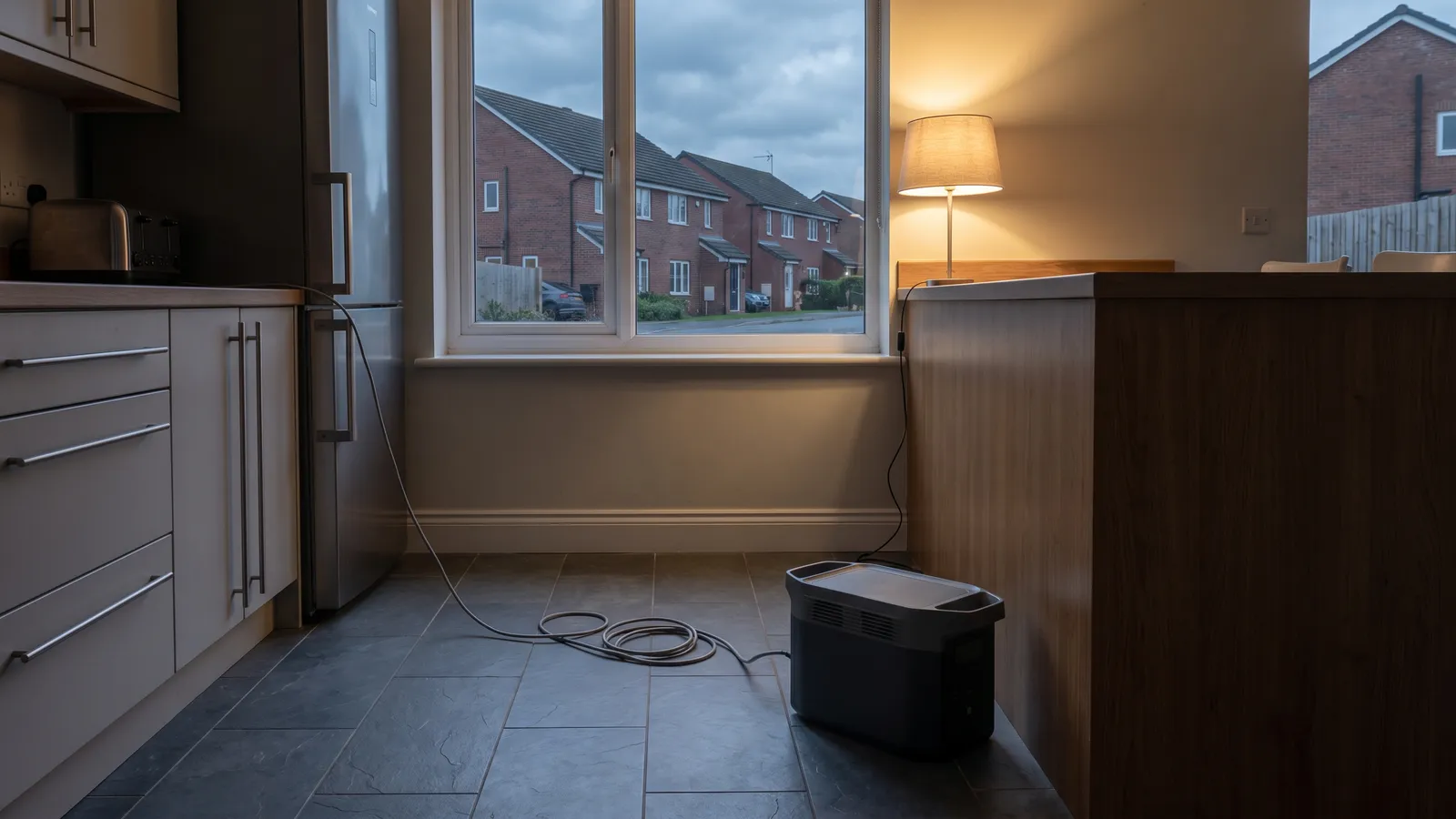
Unlike a generator, a power station gives off no fumes, so it can be used indoors.
Run fully unwound, not overloaded extension leads from it to what you need. Never feed its output into a wall socket or your consumer unit; that needs an electrician and a changeover switch. Charge it in a dry room, on a hard surface, away from escape routes and not while you sleep or are out. Stop using a unit that swells, overheats or smells, as fire services advise, and recharge it after every cut.
What it will run, and for how long
Each figure runs that one thing on its own from the AC socket, worked out the way BLUETTI’s UK pages do it: capacity × 90% usable × 85% inverter efficiency ÷ (the appliance’s average draw + about 10W the power station uses itself). A fridge-freezer is costed at its day-long average from the energy label, not the compressor’s peak. Routers and phones last longer on the USB or DC ports, which skip the inverter. Treat every figure as an estimate and plan on the low end.
| Running just this | Average draw | Small (512Wh) | 1kWh class (1,024Wh) | 2kWh class (2,048Wh) |
|---|---|---|---|---|
| Fridge-freezer (upright or American-style)needs a pure sine wave inverter: check the spec | 12–51W | may not start it (a compressor can need about 960W for a moment) | 13 to 36 hours | 26 to 71 hours |
| Chest freezerneeds a pure sine wave inverter: check the spec | 21–34W | 9 to 13 hours | 18 to 25 hours | 36 to 51 hours |
| CPAP (blower only: humidifier and heated tube off)needs a pure sine wave inverter: check the spec | 4–20W | 13 to 28 hours | 26 to 56 hours | 2 to 4 days |
| CPAP with heated humidifier (and heated tube)needs a pure sine wave inverter: check the spec | 21–73W | 4.5 to 13 hours | 9.5 to 25 hours | 19 to 51 hours |
| Gas combi boiler (electrical load)needs a pure sine wave inverter: check the spec | 35–123W | 3 to 8.5 hours | 6 to 17 hours | 12 to 35 hours |
| Broadband router/hub (e.g. BT Smart Hub 2) | 8.5–14.1W | 16 to 21 hours | 33 to 42 hours | 2 to 3 days |
| Laptop (mains-powered, in use) | 30–70W | 5 to 10 hours | 10 to 20 hours | 20 to 39 hours |
| LED light bulb (each) | 5–12W | 18 to 26 hours | 36 to 52 hours | 2 to 4 days |
| TV (LED/LCD, in use) | 33–217W | 1.5 to 9 hours | 3.5 to 18 hours | 7 to 36 hours |
| Electric blanket (single or double) | 40–80W | 4.5 to 8 hours | 8.5 to 16 hours | 17 to 31 hours |
Method: BLUETTI UK — Elite 200 V2 (runtime formula: DoD 90%, η 85%, self-consumption about 10W) · BLUETTI UK — Elite 100 V2 (self-consumption about 10W) · Jackery UK — runtime formula (capacity × 0.85 ÷ watts) · EcoFlow — test runtime before an emergency (0.80–0.90 for AC; DC ports for routers and phones). Appliance figures from makers’ spec sheets, manuals and UK energy labels; the fridge freezer, CPAP and gas boiler guides show the workings.
What size do you need? Work it out
Tick what you would keep running and for how long. Most cuts are over within hours; 12 hours is a sensible plan. It uses typical figures for each appliance, allows for what the power station uses itself and leaves 10% of the battery unused, and shows a cautious figure for older or larger appliances alongside.
You need about 1,005Wh of battery (up to 1,453Wh if your appliances are older or larger), and 369W of output if everything runs at once.
as of 2 Nov 2026, 11:07 GMT · Details
Product prices and availability are accurate as of the date/time indicated and are subject to change. Any price and availability information displayed on Amazon.co.uk at the time of purchase will apply to the purchase of this product.as of 2 Nov 2026, 11:07 GMT · Details
Product prices and availability are accurate as of the date/time indicated and are subject to change. Any price and availability information displayed on Amazon.co.uk at the time of purchase will apply to the purchase of this product.We verify every product's specifications against at least two independent sources, re-check its UK price and stock on a schedule where we can track it automatically, and cross-check safety-relevant claims against official guidance. Every review is labelled Researched or Used and reviewed by us: where we've bought a product, or been sent it free, and used it ourselves, its review says which; where we haven't, our verdict is a considered spec-and-evidence comparison, not a hands-on test. When two products are close, commission can decide which one we pick. A clearly better product always wins. Read our full methodology →
Related kit comparisons
Guides that go with this
Jackery or EcoFlow for UK power cuts? The Explorer 1000 v2 and 2000 v2 against the DELTA 3 Plus and DELTA 3 Ma…
BLUETTI or Jackery for a UK home? The Elite 100 V2 and 200 V2 against the Explorer 1000 v2 and 2000 v2 on outp…
Plain watt-hour arithmetic for UK homes — fridge-freezer, combi boiler, CPAP, router — three sizing tiers, and…
What a fridge freezer really draws, why a power station’s output rating decides whether the compressor starts,…
The blower alone is a small load; the humidifier and heated tube decide the size. What an NHS sleep service sa…
The free number to save today, what to have ready, food safety, staying warm safely, and the compensation you …
Common questions
Which Jackery power station should I buy?
For most homes, a 1kWh model: the Explorer 1000 v2 if 1,070Wh will always be enough, or the Explorer 1000 Plus v2 if you might add batteries later or want the faster 10ms switchover. For a router, phones and lamps only, the Explorer 500 v2. For a full day of the essentials, the Explorer 2000 v2, or the 2000 Plus v2 if you want 2,400W of output and room to expand. The pick cards above show our top choice in each size.
What's the difference between a Jackery v2 and a Plus v2?
At the same size, three things, on Jackery's figures. The Plus v2 takes add-on batteries (to about 11kWh on the 1000 Plus v2 and about 12kWh on the 2000 Plus v2); it switches to battery in 10ms against 20ms; and its cells are rated for 6,000 cycles against 4,000. The Plus v2 also gives more output: 1,800W against 1,500W at 1kWh, and 2,400W against 2,200W at 2kWh. The plain v2 is the simpler buy if you'll never expand.
Can a Jackery run a fridge-freezer in a power cut?
The 1kWh and 2kWh models can, if the surge rating covers the compressor's start-up. Divide the yearly kWh on your fridge-freezer's energy label by 365 for its daily use; a modern one is often well under 1.5kWh, so a 1kWh unit covers much of a day and a 2kWh unit a day or more. The Explorer 500 v2 is rated at 500W and Jackery gives no surge figure for it, so don't count on it to start a fridge-freezer. Our fridge-freezer guide works through the sums.
Does a Jackery work as a UPS?
Yes: plug the unit into the wall and your devices into it, and it switches to battery when the power cuts. Jackery quotes 10ms or less on the Explorer 500 v2, 1000 Plus v2 and 2000 Plus v2, and 20ms on the 1000 v2 and 2000 v2. That's fast enough for a router or a fridge. Check with the maker of any medical device before relying on a power station for it.
Can I add batteries to a Jackery?
Only to the Plus v2 models. Jackery says the Explorer 1000 Plus v2 takes up to five battery packs, to about 11kWh, and the 2000 Plus v2 grows to about 12kWh. The Explorer 500 v2, 1000 v2 and 2000 v2 have fixed capacity, so buy the size you need. The add-on batteries are a large extra cost, so expandability only pays if you'll really use it.
Can I plug a Jackery into my house wiring?
Not on your own. Feeding a home's circuits from a battery needs an electrician to fit a changeover switch, so the battery can never push power into the grid or meet the mains when supply returns. Never use a plug-to-plug lead to feed power back through a wall socket: it can electrocute you or someone working on the line. In a cut, run fully unwound extension leads from the unit to the fridge, router and lamps you need.
