Basic survival skills for UK walkers and drivers: staying warm, sheltered and found
The survival skills UK rescue teams actually ask for: plan and tell someone, stay warm and out of the wind, use a survival bag, spot hypothermia, call 999 for Police then Mountain Rescue, give your location, signal with six blasts, and stay with your car in snow.
In the UK, survival outdoors is mostly about not getting cold and being found quickly, not building camps or catching food. Mountain Rescue England and Wales says to let people know your route and when you expect to finish, and to carry warm, windproof and waterproof layers, a torch, a whistle and a survival bag. If you get into trouble, Scottish Mountain Rescue says to stay calm, check you are not in danger, keep warm, and decide whether to descend, find shelter or stay where you are. In an emergency, dial 999 and ask for the Police, then Mountain Rescue (on the coast, ask for the Coastguard), give your location, and do not move until the team contacts you. The whistle signal for help is six long blasts in a minute, then a minute's pause, repeated; a torch can flash the same pattern. The NHS lists shivering, pale cold skin, slurred speech, slow breathing and tiredness or confusion as signs of hypothermia. If your car gets stuck in snow, the Met Office says to stay with it.
By Tom Calder · Updated 4 November 2026 · Sourced to Mountain Rescue England and Wales, Scottish Mountain Rescue, Mountaineering Scotland, AdventureSmart, HM Coastguard, Relay UK, the NHS, the Met Office, the Highway Code, Ordnance Survey and the Food Standards Agency, read 4 November 2026
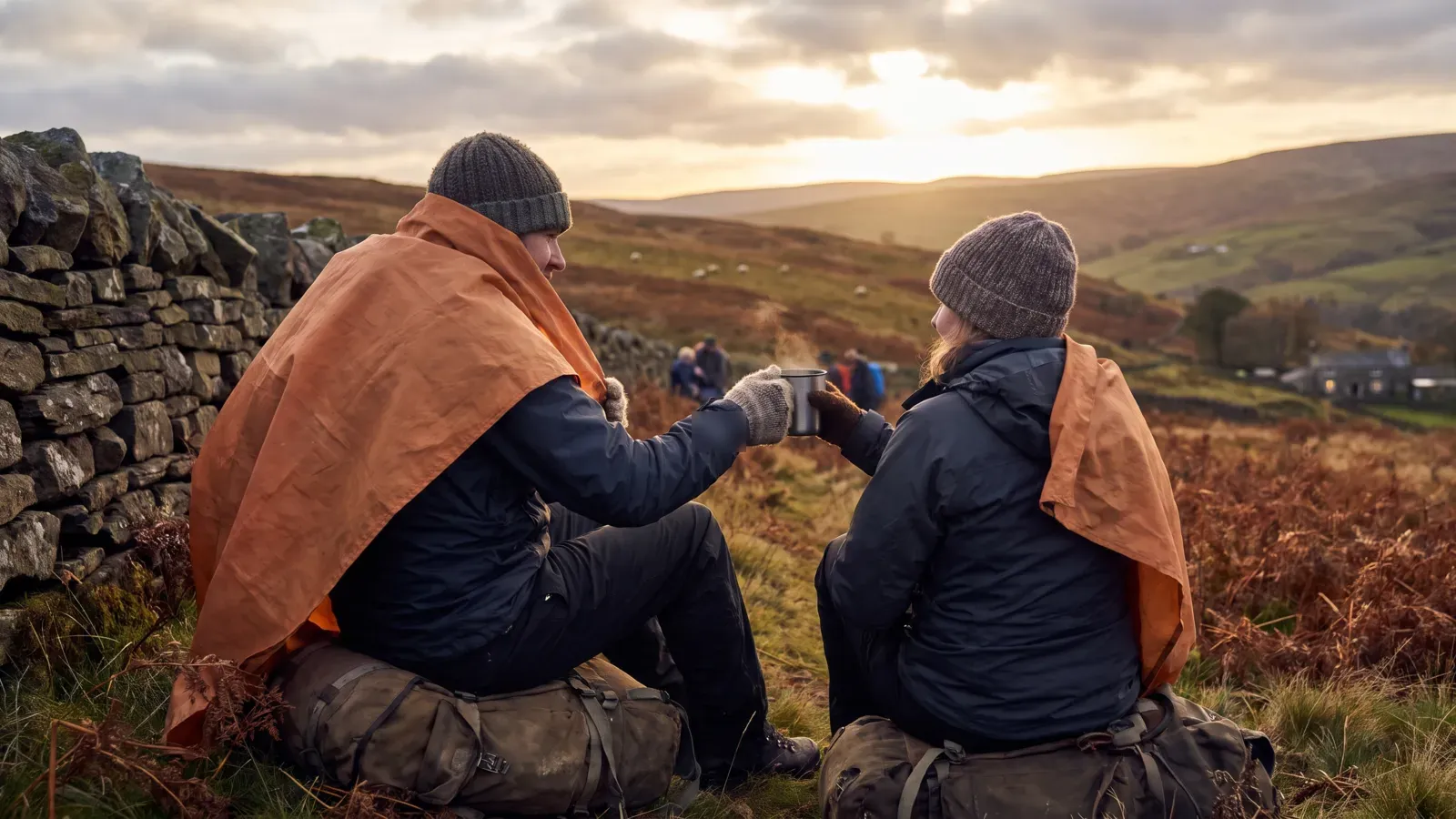
Survival skills in the UK: what rescue teams actually ask of you
Search for “survival skills” and most of what comes back is wilderness bushcraft: rubbing sticks together, building log shelters, finding food. In Britain that is rarely what keeps people safe. Help is usually within reach, and the volunteer rescue teams who go out to walkers ask for simpler things: plan the day, carry a few light items, keep warm while you wait, and make yourself easy to find.
This guide follows that advice, from Mountain Rescue England and Wales, Scottish Mountain Rescue, Mountaineering Scotland, AdventureSmart and HM Coastguard, with the NHS on hypothermia and the Met Office and the Highway Code for drivers. It covers hills, moors, the coast and a car stuck in snow. Where the official advice stops, we say so.
Before you go: plan, check the weather and tell someone
AdventureSmart, the UK outdoor safety campaign that Mountain Rescue England and Wales promotes, boils planning down to three questions: “Am I confident I have the KNOWLEDGE & SKILLS for the day?”, “Do I know what the WEATHER will be like?” and “Do I have the right GEAR?” One of its posts puts it well: “Choosing a shorter route isn't a failure.”
Tell someone where you are going. Mountain Rescue England and Wales says to leave details of your route plan, including “start and finish points, estimated time of return and contact details”. Scottish Mountain Rescue suggests leaving a route card with a responsible person, and reminds you to let them know when you are back safe.
Check the forecast for the hills, not the town below. The Met Office publishes mountain forecasts for the main upland areas, from the Northwest Highlands to the Lake District, Eryri and the Brecon Beacons, and updates them before 6am each day, so check on the morning you go. Allow time to be down before dark: Mountain Rescue England and Wales points out that “Many accidents occur towards the end of the day when both you and your phone are low on energy.”
Charge your phone, but do not rely on it. Mountain Rescue England and Wales warns that “many areas of the mountains have no signal”. Scottish Mountain Rescue suggests keeping it fully charged in an inside pocket, and both say to carry a map and compass; Scottish Mountain Rescue adds: know how to use them.
What to carry: the short list rescue teams give
Mountain Rescue England and Wales lists “Suitable clothing – warm, windproof and waterproof. Layers work best!” and “Spare clothing including hat and gloves – even in summer!”, plus a map and compass, a torch and head torch, a whistle and food and water. It says: “Without a torch, map and compass are useless after dark!” and “pack a survival bag.”
An instructor's winter advice on Mountaineering Scotland's site is similar: “Don't go on the hills without emergency survival bag/group shelter, extra insulated layer, sit mat, head torch, whistle, fully charged phone and extra food.”
Mountain Rescue England and Wales's list also includes a first aid kit with any essential medication, a watch, spare batteries and, in winter, an ice axe and crampons you know how to use. No knife, fire kit or water purifier appears on these lists. What the teams ask for fits in a daysack and makes a long wait bearable.
NewSee this for your own homeHome Alerts: your postcode's power cuts, warnings and floods, on one screen. Free for your own home. Sign up in a minute.Start free →If something goes wrong: stay warm, dry and out of the wind
Scottish Mountain Rescue's advice, if you get into difficulty, is to “Try to stay calm and take time to assess the situation and decide what is best to do”, make sure no one is in immediate danger, and then “Keep warm and decide whether to descend, find shelter or remain where you are and try and conserve mobile phone battery life.”
Warmth comes first, because waiting is cold. Mountaineering Scotland's ThinkWINTER pages ask: “If you have to wait on the emergency services getting to you, will you be warm enough?” Its advice for any stop applies to a wait too: “Stay standing or sit on your rucksack, put your back to the wind and put your hood up.” Put on your spare layer before you start to shiver, not after.
Get off the ground. Scottish Mountain Rescue's first aid advice is to “Insulate the casualty from the ground, add extra clothing”, and Scottish Mountain Rescue's hypothermia review (published by Mountaineering Scotland) says the same, “you can do this by sitting them on a rucksack”. A sit mat does the job too.
How to build a shelter: use a survival bag or group shelter
For a UK walker, an emergency shelter is something you carry, not something you build. Scottish Mountain Rescue's hypothermia review (published by Mountaineering Scotland) says to “provide shelter using a bothy bag or emergency shelter”. A survival bag, a large tough plastic bag you climb into, weighs little and keeps off wind and rain; a group shelter, or bothy bag, is a fabric tent with no poles that a group sits inside together, sharing body heat.
Get out of the wind first, behind a wall, boulder or bank if there is one nearby and getting there is safe. Then get into the bag or under the shelter, sit on your rucksack or mat, and keep your hat and hood on. If someone's clothes are wet, the same review says to “Replace their wet clothes if possible. If not, put a waterproof layer or foil blanket over the walker's wet clothes.”
Emergency bivvy bags and emergency sleeping bags are the same idea in a lighter, closer-fitting form. They are for a forced wait, not for planned nights out; for those, see our sleeping bag comparison.
Cold weather survival: the signs of hypothermia
The NHS describes hypothermia as “a dangerous drop in body temperature below 35C” and “a medical emergency that needs to be treated in hospital.” Its list of symptoms is: shivering; “pale, cold and dry skin – skin and lips may turn blue or grey”; slurred speech; slow breathing; and tiredness or confusion. You can get it, the NHS says, if you “do not wear enough clothes in cold weather”, “stay out in the cold too long”, “fall into cold water” or “have wet clothes and get cold”.
If you think someone has hypothermia, call 999. While you wait, the NHS says to “move the person indoors or somewhere sheltered as quickly as possible”, “remove any wet clothing, wrap them in a blanket, sleeping bag or dry towel, making sure their head is covered”, give them “a warm non-alcoholic drink and some sugary food like chocolate if they're fully awake”, keep them awake by talking to them, and make sure someone stays with them.
The NHS also lists what not to do, because it “will not help and could make things worse”: do not use a hot bath, hot water bottle or heat lamp to warm them up, do not rub their arms, legs, feet or hands, and do not give them alcohol to drink.
How to call for help: 999, then Police, then Mountain Rescue
In the hills, Mountain Rescue England and Wales says: “Dial 999. Ask for 'Police' then 'Mountain Rescue'”. Scottish Mountain Rescue gives the same instruction, and notes that Police Scotland deploys all mountain rescue teams in Scotland. On the coast, HM Coastguard says: “If you're in an emergency on the coast, call 999 and ask for the Coastguard.”
Have the details ready. Mountain Rescue England and Wales asks for your location (a grid reference if possible), the name, gender and age of anyone hurt, what the injuries or emergency are, how many are in your party, and your mobile number. Scottish Mountain Rescue also asks what equipment the group has, and the mobile numbers of others with you.
Then stay put. Mountain Rescue England and Wales says: “Do NOT change your position until contacted by the rescue team”, and if you need to call 999 again, repeat the same procedure. Save your phone battery for their call.
Some walkers on remote routes also carry a personal locator beacon or satellite messenger, which can send an alert without mobile signal; our comparison explains the difference.
Giving your location: grid references, OS Maps and what3words
Rescue teams ask for a grid reference where you can give one. Mountain Rescue England and Wales asks for one if possible, and Scottish Mountain Rescue asks for “ideally 6 figure grid reference or named location/feature”. If you cannot work one out from a map, Ordnance Survey's OS Maps app has a Locate Me feature that brings up a compass “with an OS grid reference” and, OS says, “does not require a mobile signal to function”. It replaced the older OS Locate app. You need location services switched on.
what3words gives a three-word address for any 3-metre square, and many people use it. Mountain Rescue England and Wales looked at how it was working in the Lake District: of 22 call-outs involving what3words locations between January and August 2020, “18 have been accurate”, but “four have been way out, sometimes more than 500 metres away from the actual location of the caller”. If you use it, read the words back carefully, and give a grid reference too if you can.
Phones and apps need battery. As Mountain Rescue England and Wales's Josh Warren put it in OS's announcement: “We'd still recommend a compass and paper map as a back-up as they don't need battery power.”
Texting 999: register before you need it
The emergencySMS service, run through Relay UK, lets “deaf, hard of hearing, or speech-impaired people in the UK” text 999 for the police, ambulance, fire or coastguard. Relay UK says: “You MUST REGISTER YOUR MOBILE NUMBER before you can use it.” To register, “Text the word 'register' to 999”, read the automatic reply, then reply “yes”. You will need to register again if you change your number.
Scottish Mountain Rescue's 2021 advice suggested hillwalkers register too, so they can text 999 where there is too little signal to call; Relay UK describes the service as for deaf, hard of hearing and speech-impaired people. A text still needs some signal. Relay UK says to use it only if you have no other option, because it takes longer than a voice call, and not to assume your message has arrived until you get a reply. HM Coastguard's advice to people who need the service is: “Don't wait until you need the emergency SMS service.”
Survival whistle and SOS signals: six blasts a minute
The signal for help in the UK hills is six, not three. Mountain Rescue England and Wales: “Six good long blasts in a minute. Stop for one minute. Repeat.” Both a whistle and a torch can be used, and the Cave Rescue Organisation, the Yorkshire Dales rescue team, says to use a torch “in the same pattern as for whistle blasts”, so six flashes in a minute at night.
Keep going. Mountain Rescue England and Wales says: “Continue until someone reaches you and don't stop because you hear a reply”, because “Your whistle blasts may be a direction finder.” The rescue teams' pages we read do not set out a reply signal; their advice is to carry on signalling whatever you hear.
Some rucksacks have a whistle built into the chest-strap buckle; if yours does, test it, or carry a separate one.
Water, food and fire: carry them, don't forage
Carry water and food. Mountain Rescue England and Wales says: “Always carry water – even in cool weather it's easy to become dehydrated.” Its kit list includes food, and the winter advice on Mountaineering Scotland's site includes extra food. A flask of something hot is worth its weight in winter.
Do not forage for food. The Food Standards Agency says wild mushrooms “are easy to misidentify, and some are very poisonous”, and: “Never forage or eat wild mushrooms if you are not certain of their identification.” You do not need to find food to be rescued: carry what you need.
None of the rescue teams' advice we read asks walkers to light a fire. Warmth comes from layers, shelter and a hot drink. Fire-starting kit belongs in a camping or home kit, used where fires are allowed.
Drivers: stay with the car if you get stuck in snow
The Highway Code (rule 228) says not to drive in snow and ice “unless your journey is essential”, and if you must, to “Take an emergency kit of de-icer and ice scraper, torch, warm clothing and boots, first aid kit, jump leads and a shovel, together with a warm drink and emergency food in case you get stuck or your vehicle breaks down.”
If you do get stuck, the Met Office's advice, written with National Highways, is: “If you get stuck, stay with your car and tie something brightly coloured to your aerial.” Your car gives you shelter while you wait. Put on the warm clothes before you get cold, and keep the phone charged.
The national guidance we read does not cover running the engine for warmth. Our car kit checklist covers this, including the carbon monoxide risk if snow blocks the exhaust.
Survival skills for kids: stay put and be seen
For children, the simplest rule is: if you are lost, stop and stay where you are. It echoes Mountain Rescue England and Wales's advice for anyone who has called for help, “stay safe and stay put”.
Make it simple and practise it before a day out. Agree with children that if they lose you they stay put, keep warm (hat and hood on, sit on their bag, out of the wind), and answer when they hear their name. Give each child a whistle and teach them to blow it in sixes. Bright clothing helps searchers see them. North American programmes teach this as “hug a tree”: pick a tree and stay by it. We found no UK rescue body that uses that phrase, but the idea is the same.
Mountain Rescue England and Wales also notes that “Children and older people are especially susceptible” to the cold, so the youngest in the group need the spare layers first.
Common questions
What are the most important basic survival skills in the UK?
Planning and telling someone your route and finish time, staying warm and out of the wind, using a survival bag or group shelter, recognising hypothermia, knowing how to call 999 and ask for the Police then Mountain Rescue (or the Coastguard on the coast), giving your location as a grid reference, and signalling with six whistle blasts or torch flashes a minute. That is what UK mountain rescue teams ask for.
What is the SOS signal with a whistle or torch?
In the UK hills, Mountain Rescue England and Wales gives it as six good long blasts in a minute, then stop for one minute, then repeat. A torch can flash the same pattern. Keep signalling until someone reaches you, even if you hear a reply, because rescuers may be using your signal to find you.
How do I call mountain rescue?
Dial 999 and ask for the Police, then Mountain Rescue. Give your location (a grid reference if you can), what has happened, how many are in your party and your mobile number, then stay where you are until the team contacts you. On the coast, call 999 and ask for the Coastguard.
Can I text 999 if there is not enough signal to call?
Only if your phone is registered, and a text still needs some signal. Relay UK runs emergencySMS for deaf, hard of hearing and speech-impaired people; Scottish Mountain Rescue's 2021 advice also suggested hillwalkers register. Text the word 'register' to 999 and follow the replies, before you set off. It is slower than a call, so wait for a reply before assuming help is coming.
Should I stay with my car if I get stuck in snow?
Yes. The Met Office's advice is to stay with your car and tie something brightly coloured to the aerial. The Highway Code recommends carrying warm clothing and boots, a torch, a shovel, a warm drink and emergency food in winter.
What should children do if they get lost outdoors?
Stop and stay where they are, keep warm, answer when they hear their name, and blow a whistle if they have one. Practise it with them before a day out.
Sources (16)
- Mountain Rescue England and Wales — Fact File 6: How to stay safe (no date shown)
- Mountain Rescue England and Wales — Wherefore what3words? (August 2020)
- Scottish Mountain Rescue — How to call for help: emergency in the hills (7 September 2021)
- The Cave Rescue Organisation (Yorkshire Dales) — Safety (no date shown)
- Mountaineering Scotland — Are you warm enough?, by Dave Slade (February 2021)
- Mountaineering Scotland — Hypothermia: a review, by Ken Crossley for Scottish Mountain Rescue (February 2022)
- AdventureSmart UK (no date shown)
- GOV.UK — HM Coastguard rescue coordination centre contact details (updated 9 July 2026)
- HM Coastguard — In an emergency (no date shown)
- Relay UK — Contact 999 using Relay UK (no date shown)
- NHS — Hypothermia (reviewed 9 June 2023)
- Met Office — Mountain weather forecasts (no date shown)
- Met Office — Travelling in heavy snow and ice, with National Highways (no date shown)
- GOV.UK — The Highway Code: driving in adverse weather conditions, rules 226 to 237 (updated 22 October 2025)
- Ordnance Survey — Major new safety feature in OS Maps could save your life (24 July 2024)
- Food Standards Agency, on GOV.UK — Guidance for safe foraging (27 January 2023)
PreparedBritain is independent and not affiliated with HM Government.
The Emergency Kit Checklist
The GOV.UK Prepare essentials on one printable page — tick them off as you go and keep it with the kit. Free, no catch.
Download it straight away. We'll also send the occasional briefing when something genuinely matters — severe weather, live incidents, real price drops. Nothing else.
Latest from our live data
All stories → News · 3 NovVampire devices: the '£200' is 13 gadgets added up; turning a home off standby saves about £45
 News · 2 NovCold Weather Payment opens: £25 a freezing week; last winter 40 of 71 stations triggered none
 News · 31 OctEarliest polar vortex breakdown on record forecast for November: what it means for the UK
Keep reading
All fire, gas & first aid guides →Asda, Aldi, Tesco and Sainsbury's recalls checked: what the official notices list, and when
We read the Food Standards Agency's alerts and the government's product safety list. Recalls naming Asda, Aldi,…
Run out of your medication? How to get an emergency supply in the UK
What to do if you run out of a regular medicine anywhere in the UK: the pharmacist's emergency supply, NHS 111, what…
'American Covid' XFG isn't new: England's COVID admissions are rising but below last autumn
Headlines this month describe a new 'American Covid' strain, XFG, with a hoarse voice as its sign. UKHSA's own…
