Best emergency shelter: tents, tarps & camp beds (2026)
Nobody plans to sleep outside their own bedroom — and then a flood, a fire next door, or a burst pipe makes the house unliveable for a few nights. In practice most displaced UK households go to family or a council rest centre, and that's the right first plan. Shelter kit is the backup that makes those nights dramatically less grim: a tent that pitches fast in a car park or garden, a camp bed that gets you off a village-hall floor, a £5 bag in the glovebox for the genuinely bad night. Calm insurance, chosen once.
By Tom Calder · Updated 20 September 2026 · 6 products, all price-tracked
Before you buy
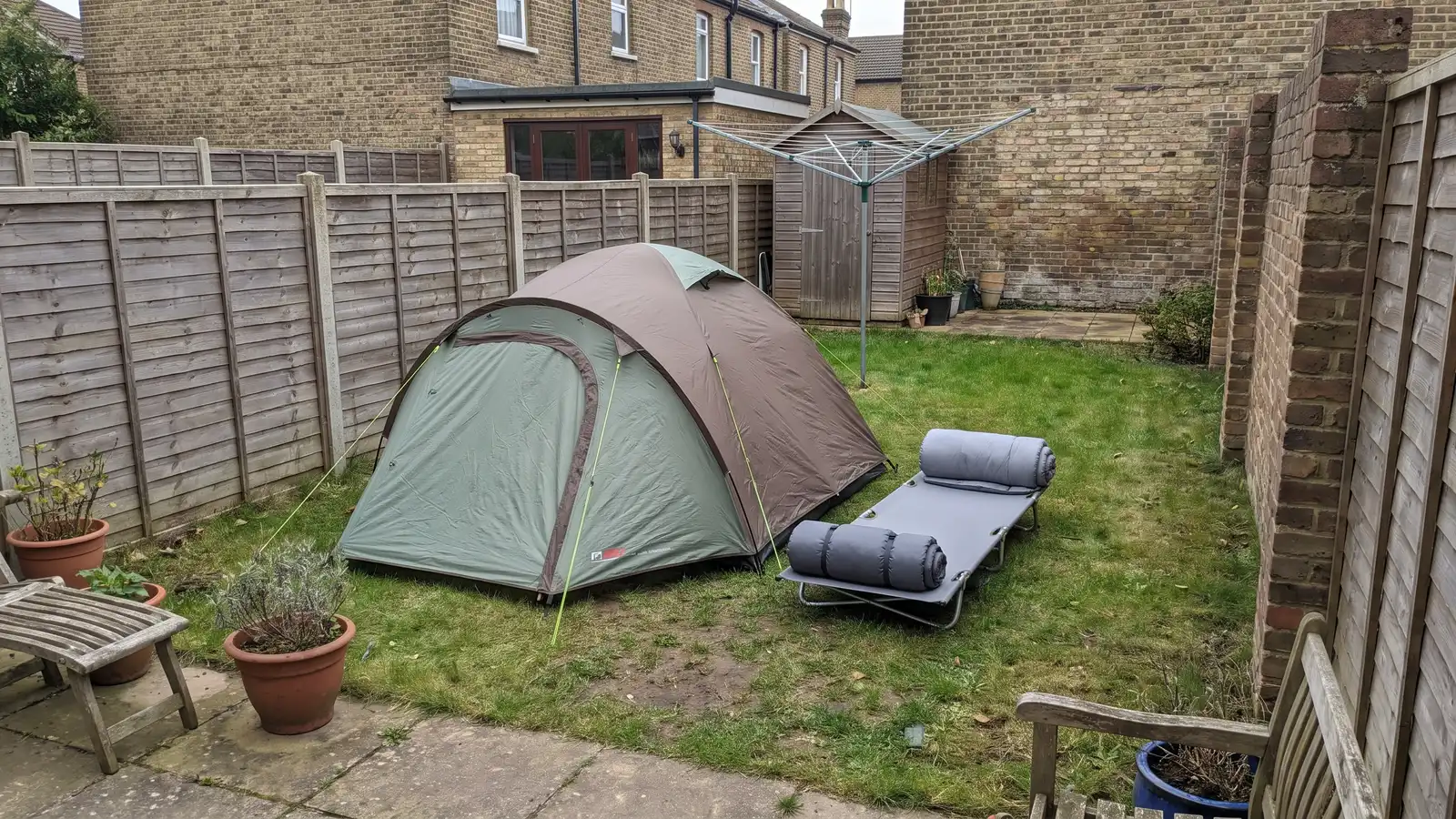
Match the kit to the realistic night. Displaced with the family for a few days: the quick-pitch Coleman plus camp beds turns a garden or campsite into liveable fallback. Solo, or keeping something permanently in the car: the 2.4kg Vango or a bivvy bag. Every car and grab bag: the £5.50 survival bag — no exceptions, it's the best insurance-per-pound on the site.
Prioritise pitch speed and waterproofing over space. Hydrostatic head is the waterproof number — 3,000mm handles sustained British rain. Pre-attached poles and a sub-15-minute pitch matter far more when you're stressed, tired and it's raining than an extra metre of floor.
Getting off the ground is half the battle. Cold floors steal heat faster than cold air — a camp bed or thick mat makes a rest centre, a tent or your own lounge floor genuinely sleepable, and it's the piece people skip. A tarp rounds out the kit: rigged as a porch or lean-to it keeps kit dry and doubles your covered space, but practise the knots once first.
Top pick: Coleman Skydome 4-Person Dark Room Tent. If a flood or a house emergency put your family out of the house for a few nights, this is the tent you'd want in the loft: genuinely quick to pitch, tall enough to stand in the middle, and with blackout bedrooms that help children actually sleep. Its 3,000mm waterproofing handles sustained British rain. Be clear what it is, though: a leisure tent engineered for a campsite, not a storm shelter — in severe winds you'd be in a rest centre, not under nylon.
| Shelter | Type | Sleeps | Waterproofing | Weight/pack | Price | |
|---|---|---|---|---|---|---|
| Coleman Skydome 4-Person Dark Room TentTOP PICK | Dome tent | 4-person | 3,000mm HH | ~9kg packed | — | Check price → |
| Vango Nyx 200 2-Person Tent | Compact dome tent | 2-person (snug) | 3,000mm HH | ~2.4kg packed | £74.99as of 20 Sep 2026, 12:29 BST · DetailsProduct prices and availability are accurate as of the date/time indicated and are subject to change. Any price and availability information displayed on Amazon.co.uk at the time of purchase will apply to the purchase of this product. | Check price → |
| DD Hammocks Tarp 3x3 | Square tarp | 1–2 under cover | 3,000mm PU-coated | 790g | £44.95as of 20 Sep 2026, 12:29 BST · DetailsProduct prices and availability are accurate as of the date/time indicated and are subject to change. Any price and availability information displayed on Amazon.co.uk at the time of purchase will apply to the purchase of this product. | Check price → |
| Highlander Folding Camp Bed | Folding camp bed | 1 (single) | — | ~5kg folded | £30.95as of 20 Sep 2026, 12:29 BST · DetailsProduct prices and availability are accurate as of the date/time indicated and are subject to change. Any price and availability information displayed on Amazon.co.uk at the time of purchase will apply to the purchase of this product. | Check price → |
| Highlander Hawk Bivi Bag | Bivvy bag | 1-person | Waterproof, taped seams | ~1kg | £59.07as of 20 Sep 2026, 12:29 BST · DetailsProduct prices and availability are accurate as of the date/time indicated and are subject to change. Any price and availability information displayed on Amazon.co.uk at the time of purchase will apply to the purchase of this product. | Check price → |
| Lifesystems Survival Bag (1–2 Person) | Emergency survival bag | 1–2 person | Waterproof polythene | ~110g | — | Check price → |
ⓘ As an Amazon Associate, PreparedBritain earns from qualifying purchases. We may earn a commission when you buy, or a fee when you request a quote, through our links — it never affects what we recommend. Amazon prices come from Amazon's own product data and show the date and time they were retrieved. Prices at other retailers are checked by us, less often. Prices and stock can change at any time, so always check the retailer's price before you buy.
Coleman Skydome 4-Person Dark Room Tent
4.6Who it's for: The family fallback — a proper tent a household can actually put up fast.
If a flood or a house emergency put your family out of the house for a few nights, this is the tent you'd want in the loft: genuinely quick to pitch, tall enough to stand in the middle, and with blackout bedrooms that help children actually sleep. Its 3,000mm waterproofing handles sustained British rain. Be clear what it is, though: a leisure tent engineered for a campsite, not a storm shelter — in severe winds you'd be in a rest centre, not under nylon.
- Fast pitch with pre-attached poles — achievable flustered, in rain
- Dark-room bedrooms genuinely help kids sleep anywhere
- Standing-height centre and a porch for wet kit
- A campsite tent, not a storm shelter — don't plan around it in severe weather
- ~9kg and bulky: fine in a car boot or loft, not on foot
Vango Nyx 200 2-Person Tent
4.4Who it's for: The keep-in-the-car tent — light, cheap and up in ten minutes.
Small enough to live permanently in a car boot, light enough to carry, and quick enough that one person can pitch it alone in fading light. As emergency shelter for one adult (or two at a real squeeze) it's the practical pick at a practical price from a brand with decades of UK weather behind it. The single door and 220×130cm floor mean it's honestly a one-person refuge with room for kit, not a comfortable two.
- 2.4kg and compact — genuinely keep-in-the-car kit
- Vango build quality and 3,000mm waterproofing at a budget price
- One-person pitch in about ten minutes
- '2-person' is optimistic — buy it as a roomy solo shelter
- Single door, minimal porch
as of 20 Sep 2026, 12:29 BST · Details
Product prices and availability are accurate as of the date/time indicated and are subject to change. Any price and availability information displayed on Amazon.co.uk at the time of purchase will apply to the purchase of this product.DD Hammocks Tarp 3x3
4.3Who it's for: The most shelter per pound and per gram — if you know how to rig it.
A 3×3m waterproof square with 19 attachment points that can be a lean-to, an A-frame, a porch for another tent or an emergency roof over a working area. Per gram and per pound it's the most versatile shelter here — with one big honest caveat: a tarp is only shelter if you have something to tie it to and the knots to do it. Trees, a fence line, a roof rack, walking poles — no anchor points, no shelter. Practise once in the garden before you ever need it in weather.
- Endlessly riggable — 19 attachment points, dozens of configurations
- 790g and packs smaller than a loaf
- Doubles as groundsheet, windbreak or emergency roof repair
- Needs anchor points and basic knots — useless flat-packed in a panic
- No floor, no bug protection: it's a roof, not a room
as of 20 Sep 2026, 12:29 BST · Details
Product prices and availability are accurate as of the date/time indicated and are subject to change. Any price and availability information displayed on Amazon.co.uk at the time of purchase will apply to the purchase of this product.Highlander Folding Camp Bed
4.2Who it's for: Off the floor changes everything — for guests, evacuation centres or a cold night at home.
The unglamorous piece that transforms displaced sleeping: getting off the ground keeps you warmer, drier and vastly more comfortable — in a tent, a village-hall rest centre, or your own living room when beds are out of action (think burst pipes or an upstairs flood). It folds flat, stores under a bed, and costs about £35. It's a basic frame bed — most people will want a foam mat or blanket on top — but the difference from floor-sleeping is night and day.
- Sleeping off the floor is warmer and drier by a wide margin
- Folds flat and sets up in seconds
- As useful for ordinary guests as for emergencies
- Basic — add a mat or duvet on top for real comfort
- Single size only; ~5kg is fine for a car, heavy for a walk
as of 20 Sep 2026, 12:29 BST · Details
Product prices and availability are accurate as of the date/time indicated and are subject to change. Any price and availability information displayed on Amazon.co.uk at the time of purchase will apply to the purchase of this product.Highlander Hawk Bivi Bag
4.1Who it's for: A waterproof shell for your sleeping bag — shelter that fits in a daysack.
A bivvy is the minimalist answer: a breathable waterproof shell that goes over your sleeping bag so you can sleep dry with no poles, no pitch and almost no pack space. As emergency kit — car, grab bag, or beside the sleeping bags in the loft — it's superb insurance per gram. Know what you're buying: there's no headroom, nowhere to sit out weather, and condensation is part of bivvy life. It keeps you alive and dry; it doesn't keep you comfortable.
- No pitching at all — pull it over your bag and you're sheltered
- Packs to a bottle-sized stuffsack
- Turns any sleeping bag into wet-weather-capable kit
- Zero living space — shelter of last resort, not a base
- Condensation builds in prolonged rain
as of 20 Sep 2026, 12:29 BST · Details
Product prices and availability are accurate as of the date/time indicated and are subject to change. Any price and availability information displayed on Amazon.co.uk at the time of purchase will apply to the purchase of this product.Lifesystems Survival Bag (1–2 Person)
4.0Who it's for: £5.50 of genuine insurance — one in every car, every grab bag.
A heavy-gauge orange polythene bag big enough to climb inside. That's it — and that's the point. It blocks wind and rain, holds body heat, and its bright orange is visible to searchers. At £5.50 and 110g there is no reason not to have one in each glovebox, grab bag and walking pack. It's genuinely last-resort kit: single-use in feel, sweaty in use, and no substitute for real shelter — but for a stranded night it can be the difference that matters.
- Costs less than a sandwich, weighs nothing, might save a life
- Windproof, waterproof, high-visibility orange
- Zero skill needed — climb in
- Effectively single-use
- Condensation-sweaty — it's survival kit, not sleeping kit
Get price-drop alerts on these
Prices for 364 tracked products are refreshed daily — last sweep 20 September 2026. Tell us which and we'll email you when one drops.
We verify every product's specifications against at least two independent sources, re-check its UK price and stock on a schedule where we can track it automatically, and cross-check safety-relevant claims against official guidance. Where we've bought and used a product ourselves we say so on its review; where we haven't, our verdict is a considered spec-and-evidence comparison, not a hands-on test — and commissions never change a ranking either way. Read our full methodology →
Guides that go with this
Know your risk, get warnings, and what to do before, during and after a flood — the practical checklist, sourc…
A simple, practical household emergency plan — the official GOV.UK Prepare approach: contacts, meeting points,…
The Government's recommended kit — with the best products for each item at every budget.
Common questions
What shelter do I actually need for emergencies at home?
Realistic list for most households: a survival bag per car (£5.50 each), a camp bed or two so nobody sleeps on a hall floor, and — if you'd want independence rather than a relative's sofa — one quick-pitch tent sized for the household. That covers flooded-out, boiler-dead-in-winter and helping displaced neighbours, without a survivalist cupboard.
Where do you actually go if your house floods in the UK?
First: family or friends. Failing that, your council must open emergency rest centres during significant flooding — register with your council's emergency alerts and check its website on the night. Your insurer may fund temporary accommodation, so call them early. The tent is for afterwards: staying near the house through the drying-out weeks, not riding out the storm itself.
What does hydrostatic head mean on a tent?
It's the waterproofing measure: the height of water a fabric holds back before leaking. 1,500mm is technically waterproof; 3,000mm handles sustained, wind-driven British rain with real margin. Both tents on this page are 3,000mm — a sensible floor for UK use.
Is a tarp or a tent better for emergencies?
A tent is a room: floor, door, bug mesh, works anywhere flat. A tarp is a roof: lighter, cheaper, endlessly riggable — but only if you have anchor points and know the knots. For most households the tent is the emergency pick and the tarp is the versatile extra; a tarp-only plan assumes skills and trees you may not have when it matters.
Are cheap survival bags actually any good?
For their job, yes. A £5.50 heavy-gauge polythene bag blocks wind and rain completely and traps body heat — for a stranded night in a car, a breakdown on a moor, or getting a wet casualty out of the wind, it genuinely earns its place. It's horrible to sleep in (condensation) and essentially single-use. Buy several; hope they stay in their wrappers.
What's the fastest tent to put up in bad conditions?
Among conventional tents, dome designs with pre-attached poles — like the Coleman here — go up in 10–15 flustered minutes. True instant/pop-up tents are faster still but trade away wind performance and pack size. Whatever you buy, one practice pitch in the garden halves the time and removes the panic; do it the week it arrives.