Why is my smoke alarm beeping or chirping? How to stop it, and how to test it
What a smoke alarm’s chirp, beeps and full alarm each mean, how to stop the chirping safely, how to find which interlinked alarm it is, and how often to test, clean and replace your alarms.
A loud, continuous alarm means it has sensed smoke or heat: check for fire, and if in doubt get out and call 999. A short chirp roughly every 40 to 60 seconds, with a flashing light, usually means the battery is low: the Home Office’s Fire Kills campaign says to replace the battery immediately; if the battery is sealed in, replace the whole alarm. A pattern of two or three chirps on a sealed ten-year alarm is usually the end-of-life warning, which means the alarm itself needs replacing. Short false alarms are usually dust, steam or cooking fumes. Test every alarm at least monthly by pressing its test button, replace alarms after ten years or by the date on them, and never take the battery out to stop the noise.
By Tom Calder · Updated 4 November 2026 · Sourced to the Home Office’s Fire Kills campaign, the NFCC, London, Scottish and Devon & Somerset fire services, and FireAngel, Kidde and Aico instructions
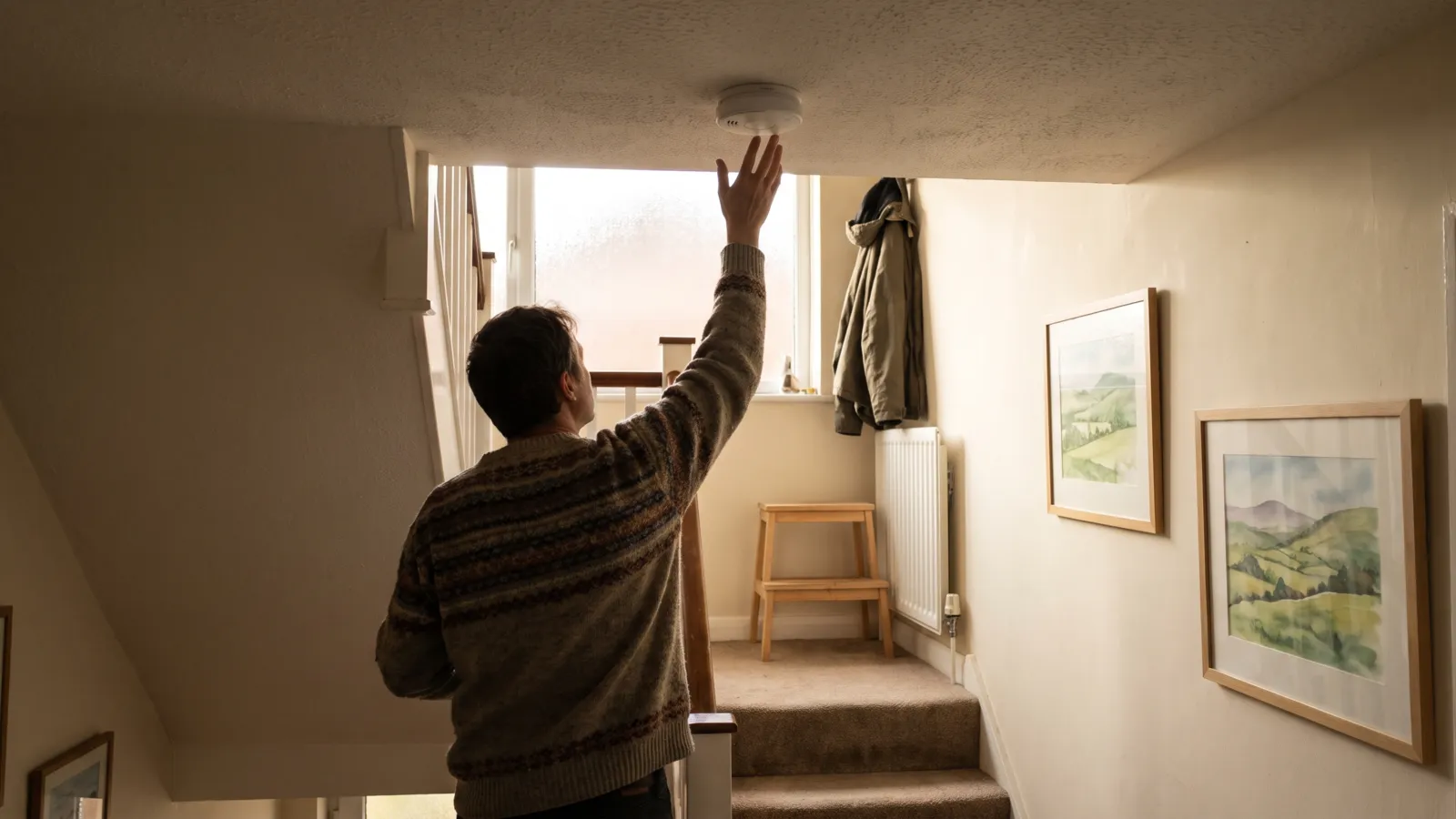
Why is my smoke alarm beeping? Chirp, alarm or end-of-life warning
Smoke alarms make three different noises, and they mean different things. A loud, continuous alarm means it has detected smoke (or heat, for a heat alarm). Treat it as a fire until you have checked: Kidde’s instructions say to check for fire first, and if a fire is discovered, get out and call the fire service; if there is any doubt about the cause, assume it is a real fire and get everyone out.
A single short chirp that repeats about every 40 to 60 seconds is the low-battery warning on most alarms. FireAngel says that if the battery is low, or a problem is detected, “the alarm chirps and the red LED flashes once every 40 to 60 seconds, depending on the model.” Aico calls “a single regular beep” the low battery warning, and Kidde’s 10Y29 chirps every 60 seconds when its battery is low.
Two or three chirps together, repeating, is the end-of-life signal on many sealed ten-year alarms. On Aico’s Ei3000 series it is three short chirps with three yellow LED flashes every 48 seconds; on the Kidde 10Y29 it is two chirps with an LED flash every 30 seconds; FireAngel lists “three beeps every 40 seconds” as end of life. The exact pattern varies by maker and model, so check the instructions for yours: most makers print a fault table in the manual and on their website.
How to stop a smoke alarm chirping: the low-battery warning
If the chirp is the low-battery warning, the fix depends on the battery. The Fire Kills campaign says: “If a smoke alarm starts to chirp on a regular basis, you need to replace the battery immediately.” FireAngel puts it in two lines: “Replaceable battery: replace it now. Sealed battery: replace the alarm.” Devon & Somerset Fire and Rescue Service says to replace the alarm or its battery immediately, and certainly within seven days.
A replaceable-battery alarm usually takes a 9V battery or AA cells; fit the type the alarm’s label or manual names, then press the test button to check it sounds. A sealed-battery alarm (most ten-year alarms) has no battery you can change, so a low-battery chirp means the alarm has reached the end of its battery life: Kidde’s instructions for the 10Y29 say to replace the alarm immediately when it gives the low battery chirp.
Pressing the test or hush button can quieten a low-battery chirp for a while, but it is only a delay. FireAngel says you can silence a low battery chirp with the test button up to 10 times, “but this only buys time”. Devon & Somerset Fire and Rescue Service says the alarm will still detect smoke during that pause. Change the battery or the alarm the same day if you can.
Ten-year sealed alarms: the end-of-life warning and the date on the back
Sealed ten-year alarms are built to be replaced whole. The Fire Kills campaign says: “If it is a ten-year sealed battery alarm, you will need to replace the alarm itself every ten years.” When the time is up, these alarms warn you with their end-of-life chirp, and that cannot be fixed with a new battery. Aico’s manual says “The entire Alarm must be replaced”.
You can check an alarm’s age without waiting for the chirp. Aico prints a “replace by” date on a label on the side of its alarms; Kidde puts a date code on the back of the 10Y29 and recommends replacing it ten years from that date. On some models you need to take the alarm off its base to read it; follow the manual. If you can’t find a date at all, the NFCC’s advice still applies: replace after 10 years, or sooner if the alarm is faulty.
NewSee this for your own homeHome Alerts: your postcode's power cuts, warnings and floods, on one screen. Free for your own home. Sign up in a minute.Start free →Hardwired smoke alarm chirping, including after a power cut
Mains (hardwired) alarms run on household electricity but have a backup battery so they keep working in a power cut, and that backup battery can chirp too. Devon & Somerset Fire and Rescue Service notes that the low-battery chirp “can also occur with hard-wired alarms”. Some mains alarms take a replaceable backup battery: the Kidde Firex KF20, FireAngel SW1-R and Aico Ei146e are listed with a 9V backup. Others, such as Aico’s Ei3000 series, have a sealed rechargeable cell that lasts the life of the alarm.
On a sealed rechargeable backup, a chirp after a long power cut can mean the cell has run down. Aico’s manual for the Ei3000 series says that, fully charged, the backup lasts up to six months without mains power (three months if a wireless module is fitted), gives one chirp every 48 seconds when it runs low, and that the action is to reconnect the mains power. Once the mains is back on, the chirps should stop within two hours as the battery charges; if they carry on for more than two hours with the green light on, the alarm needs to be returned for repair or replacement. A green light flashing every 48 seconds on these alarms means the mains supply is off. If your alarm takes a replaceable backup battery, replace it as the manual says.
If a mains alarm needs replacing, use an electrician: the Fire Kills campaign says mains-powered alarms “will need to be installed by a qualified electrician”, and FireAngel says every alarm on a system needs to be interlinked with alarms from the same range.
Interlinked alarms: finding which one is chirping, or which set it off
In an interlinked system every alarm sounds when one detects smoke, but a fault or battery chirp usually comes only from the alarm with the problem. Most alarms flash a light as they chirp (FireAngel’s red LED flashes with each low-battery chirp, for example), so stand under each alarm in turn and watch: the one flashing in time with the chirp is the one to deal with.
To find which alarm started a full alarm, look for the one behaving differently. Aico’s FAQ says that if there is no fire, find the alarm with the rapidly flashing red light. Aico’s Ei3000 series also has an alarm memory: for 24 hours after an alarm, the red light on the unit that triggered it flashes twice every 48 seconds, and pressing and holding the test/hush button shows its memory status. For repeated false alarms on a hardwired system, FireAngel suggests removing the alarm you suspect and seeing whether the false alarms stop. Put it back, or have it replaced, straight away afterwards.
How to test a smoke alarm, and how often you should check smoke alarms
The Fire Kills campaign says: “Test your smoke alarms at least monthly, no matter what type of alarm you have.” The NFCC also says to test once a month. The Scottish Fire and Rescue Service goes further and lists pressing the test button as a weekly job, and Kidde’s 10Y29 instructions also say to test weekly. Monthly is the minimum; the Scottish Fire and Rescue Service and Kidde suggest weekly.
To test, press and hold the test button until the alarm sounds. Kidde says to hold it for at least a second, or until the alarm sounds; Aico says to press it for up to 10 seconds. Test every alarm, and on an interlinked system check that the others sound too. Pressing the button tests the battery and the sounder; if nothing happens, replace the battery, or the alarm if it is sealed.
Don’t test with a flame or smoke. Kidde warns against using an open flame because “you could damage the alarm or ignite combustible materials and start a structure fire”, and Aico says “DO NOT TEST WITH FLAME” and does not recommend testing with heat or smoke.
Smoke alarm maintenance tips: cleaning, batteries and replacing the alarm
Clean alarms every few months, gently. Devon & Somerset Fire and Rescue Service suggests vacuuming or dusting every three months to prevent false alarms; Kidde’s 10Y29 manual says monthly; Aico says to clean regularly, and more often in dusty areas. Use a vacuum cleaner’s narrow nozzle around the vents. Aico says not to use cleaning agents, bleaches, detergents or polishes, including aerosols, and not to paint or cover the alarm.
For an alarm with a replaceable battery, the NFCC recommends changing the battery each year, even if it hasn’t started chirping. Whatever the type, the NFCC says all smoke alarms, including hardwired ones, should be replaced after 10 years, or by the replace-by date on the base, or earlier if they are found to be defective. The Scottish Fire and Rescue Service lists the same ten-year replacement.
If you rent in England, your landlord must make sure there is at least one smoke alarm on every storey used as living accommodation, working on the day your tenancy starts; the NFCC says that during a tenancy, the monthly test is for the tenant to do. In Scotland, every home has needed interlinked alarms since February 2022.
What never to do, and the free home fire safety visit
Never take the battery out to stop the chirping and leave it out. The Scottish Fire and Rescue Service lists this under “Never”: “Take the batteries out, even for a short time.” In our view the same applies to a mains alarm: twisting it off its base or having it disconnected to stop the noise leaves you unprotected. Fix the cause, or replace the alarm. Don’t paint over an alarm or cover it, and don’t fit a smoke alarm in the kitchen: London Fire Brigade says a heat alarm should go there instead.
The stakes are high. The Fire Kills campaign says you are around 11 times more likely to die in a fire if you do not have any working smoke alarms.
You may be able to get help for free. London Fire Brigade offers a free home fire safety visit and says it can fit free smoke alarms if yours aren’t up to scratch. The Scottish Fire and Rescue Service carries out Home Fire Safety Visits for people at the highest risk, with an online check to see if you qualify. Elsewhere, check your local fire and rescue service’s website; many offer visits, often aimed at people more at risk.
Common questions
Why is my smoke alarm chirping every minute?
A single chirp every 40 to 60 seconds or so is usually the low-battery warning. Replace the battery straight away, or the whole alarm if its battery is sealed in. If it chirps two or three times together, check the manual: on many sealed ten-year alarms that is the end-of-life warning, meaning replace the alarm.
How do I stop my smoke alarm beeping?
First make sure there is no fire. For a full alarm caused by cooking or steam, press the hush button, which quietens it for about 10 minutes on the Kidde and Aico alarms we checked, and clear the air. For a low-battery chirp, replace the battery, or the alarm if the battery is sealed. Never take the battery out and leave it out.
Why is my hardwired smoke alarm chirping after a power cut?
Mains alarms have a backup battery that powers them in a cut, and a long cut can run it down. On Aico’s Ei3000 series the backup is a sealed rechargeable cell: the manual says to reconnect the mains power; the chirps should stop within two hours as it recharges, and if they don’t, the alarm needs repair or replacement. If your alarm takes a replaceable backup battery, such as a 9V, replace it.
How do I test a smoke detector battery?
Press and hold the test button until the alarm sounds. That checks the battery and the sounder. If it doesn’t sound, fit a new battery and test again; if it still doesn’t sound, or the battery is sealed, replace the alarm. Don’t test with a flame.
How often should you check smoke alarms?
The Home Office’s Fire Kills campaign says to test at least monthly, whatever type of alarm you have. The Scottish Fire and Rescue Service suggests weekly. Clean them every few months, change replaceable batteries once a year, and replace the alarms after ten years.
How long do smoke alarms last?
About ten years. The NFCC says all smoke alarms should be replaced after 10 years, or by the replace-by date on the base, or earlier if found to be defective. The date is on a label on the back or side of the alarm.
Can I get a smoke alarm fitted for free?
Possibly. London Fire Brigade offers free home fire safety visits and can fit free alarms, and the Scottish Fire and Rescue Service runs Home Fire Safety Visits for people at the highest risk. Check your local fire and rescue service’s website. If you rent in England, your landlord must make sure there is at least one smoke alarm on every storey used as living accommodation, and must repair or replace faulty alarms.
Sources (15)
- Fire Kills (Home Office campaign): Detect, smoke alarms
- NFCC: Smoke alarm advice
- London Fire Brigade: Smoke alarms and heat alarms
- Scottish Fire and Rescue Service: Smoke and heat alarms
- Scottish Fire and Rescue Service: Home Fire Safety Visits
- Devon & Somerset Fire and Rescue Service: Problems with smoke alarms
- GOV.UK: The Smoke and Carbon Monoxide Alarm (England) Regulations, Q&A for landlords and tenants
- FireAngel: Why is my FireAngel smoke alarm beeping?
- FireAngel: How to stop a FireAngel alarm beeping
- Kidde: 10Y29 user guide
- Aico: Ei3024, Ei3016 and Ei3014 instructions
- Aico: Homeowner FAQs
- Aico: Ei146e optical smoke alarm
- Kidde Firex KF20 data sheet
- FireAngel: SW1-R data sheet
PreparedBritain is independent and not affiliated with HM Government.
The Emergency Kit Checklist
The GOV.UK Prepare essentials on one printable page — tick them off as you go and keep it with the kit. Free, no catch.
Download it straight away. We'll also send the occasional briefing when something genuinely matters — severe weather, live incidents, real price drops. Nothing else.
Latest from our live data
All stories → News · 3 NovVampire devices: the '£200' is 13 gadgets added up; turning a home off standby saves about £45
 News · 2 NovCold Weather Payment opens: £25 a freezing week; last winter 40 of 71 stations triggered none
 News · 31 OctEarliest polar vortex breakdown on record forecast for November: what it means for the UK
Keep reading
All fire, gas & first aid guides →Where to put smoke alarms, and hardwired vs interlinked alarms: the UK rules
Where to fit smoke and heat alarms in a UK home, the difference between hardwired, battery and sealed 10-year…
Basic survival skills for UK walkers and drivers: staying warm, sheltered and found
The survival skills UK rescue teams actually ask for: plan and tell someone, stay warm and out of the wind, use a…
Asda, Aldi, Tesco and Sainsbury's recalls checked: what the official notices list, and when
We read the Food Standards Agency's alerts and the government's product safety list. Recalls naming Asda, Aldi,…
