What should be in a home first aid kit: a UK checklist
A calm UK checklist for a home first aid kit — sensible quantities room by room, sourced to the NHS and British Red Cross, plus the kit you can skip.
By Tom Calder · Updated 21 July 2026 · Sourced to the NHS, St John Ambulance, the British Red Cross and the HSE
First, what a home kit is actually for
A home first aid kit is for the everyday: cuts and grazes, a minor burn, a splinter, a nosebleed, a twisted ankle. It is not meant to turn your kitchen into an A&E, and it shouldn't try to. The single most useful thing in any real emergency is knowing when to call 999 and being able to do basic CPR — no box of supplies is a substitute for either. Treat the kit like a smoke alarm: quietly present, occasionally essential, mostly ignored.
There is no legal list a household kit has to meet, and no need to overthink it. Most of what follows you probably already own, scattered across a bathroom cabinet and a kitchen drawer. The job is to gather it into one labelled box that everyone in the house can find, then keep it topped up. This page covers just the first aid part; our cornerstone guide covers the wider household kit around it.
The core kit: dressings, bandages and tools
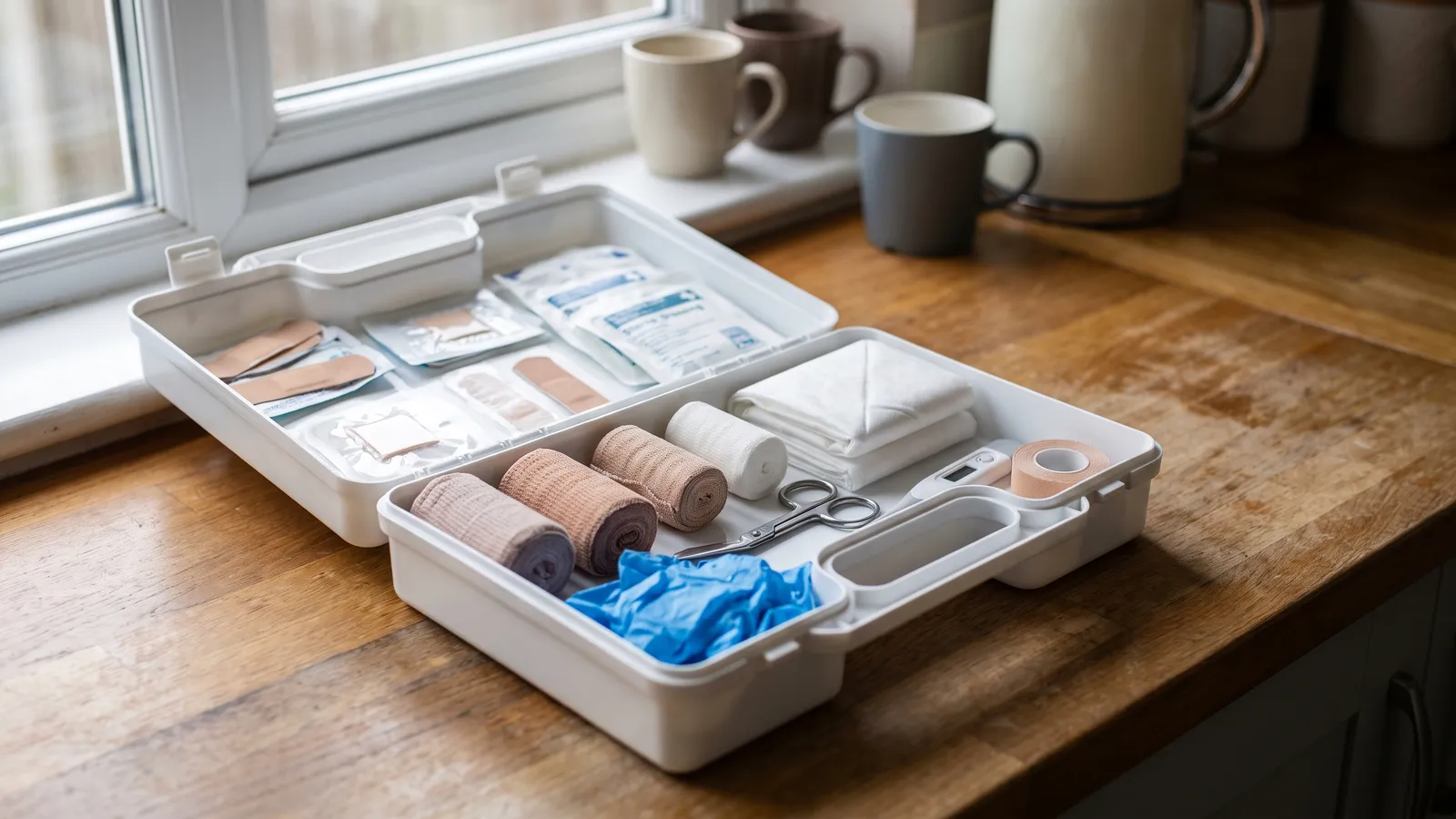
NHS and St John Ambulance guidance both centre a first aid kit on wound care rather than gadgets. A sensible core: assorted plasters including waterproof ones (a pack of around 20); a few sterile dressings in medium and large; two sterile eye pads; two triangular bandages, which double as slings; one or two crepe or conforming roller bandages; a pack of alcohol-free cleansing wipes; several pairs of disposable gloves; blunt-tipped 'tough cut' scissors; a roll of microporous tape; and safety pins. A foil blanket and a digital thermometer are worth adding.
Balance matters more than sheer quantity. One large box padded with fifty identical plasters is less use than a smaller one that actually contains gloves, a dressing, a bandage and scissors. If you'd rather buy ready-made than assemble your own, our comparison of home first aid kits sets out what the decent ones include and where the cheap ones cut corners.
The medicine side of the cabinet
Dressings deal with injuries; medicines deal with almost everything else, and it's cleaner to keep them as a separate group. A typical household keeps paracetamol and ibuprofen for adults, a children's paracetamol or ibuprofen if there are young children, an antihistamine for bites and mild allergic reactions, oral rehydration sachets, and an antiseptic cream. Anyone with a prescribed adrenaline auto-injector or reliever inhaler should keep it somewhere the whole household knows to look.
One firm safety rule: the NHS advises that aspirin must never be given to children aged 15 or under, because of the rare but serious risk of Reye's syndrome. Store all medicines in a cool, dry place out of the sight and reach of children, and check use-by dates when the clocks change. Out-of-date painkillers are the single most common thing people find missing at the moment they need them.
Room by room, plus a grab-bag copy
One well-stocked kit in an accessible spot — a kitchen or hallway cupboard, not locked away — does most of the work. Add a second, smaller kit to the car: it's standard motoring advice, and it's the one you'll actually reach for at the roadside. Our car emergency kit page covers what belongs alongside it, from a warning triangle to a torch and a blanket.
If you keep a grab-bag by the door for a flood or a quick evacuation, put a duplicate mini-kit and a few days of any regular medication in it, along with a written list of prescriptions and doses. The British Red Cross specifically recommends keeping essential medication and paper copies of key information in your emergency kit, in case a phone runs flat. Households with pets or babies should size the kit accordingly.
BS 8599 vs a household kit
You'll see kits advertised as 'BS 8599 compliant.' BS 8599-1 is the British Standard for workplace first aid kits, and the HSE's position is clear: there is no legal requirement to buy one, and contents should reflect a first aid needs assessment rather than a fixed list. A separate part of the standard covers motor-vehicle kits. For a home, a BS 8599 workplace kit is perfectly fine but often over-specified — it's sized for a small office, not a family bathroom.
The idea worth borrowing from the HSE is that needs assessment: match the kit to who is actually in the house. A home with toddlers wants more children's plasters and a thermometer; a keen gardener or DIYer wants more dressings and some eye wash; anyone on blood-thinning medication should read up in advance on managing a bleed. Build for your household, not for a catalogue.
What you don't need
Skip the novelty gear. Credit-card 'survival tools,' 200-piece kits bulked out with duplicate plasters, and military-style trauma kits — tourniquets, chest seals, haemostatic gauze — are not what an ordinary home needs. Catastrophic-bleeding equipment has a genuine place in high-risk workplaces and requires proper training to use safely; bought on impulse and left in a drawer, it does nothing useful. For almost every household incident, clean dressings, gloves, the ability to apply firm pressure, and a phone to call 999 will cover it.
Common questions
What are the most important items in a home first aid kit?
Assorted plasters, a couple of sterile dressings, disposable gloves, cleansing wipes, blunt-tipped scissors, tape and a triangular bandage cover the great majority of household injuries. NHS and St John Ambulance guidance both build the kit around wound care rather than gadgets — clean dressings and the ability to apply pressure matter far more than an oversized, feature-packed box.
Should I keep painkillers in my first aid kit?
Most households keep paracetamol and ibuprofen for adults, plus a children's version if there are young children, an antihistamine and an antiseptic cream. Keep them out of the sight and reach of children and check use-by dates regularly. One firm rule: the NHS says aspirin must never be given to children aged 15 or under, because of the rare risk of Reye's syndrome.
Do I need a first aid kit that meets British Standard BS 8599?
No. BS 8599-1 is the standard for workplace kits, and the HSE is explicit that there is no legal requirement to buy a compliant kit — contents should match a needs assessment. A BS 8599 kit is fine at home but is usually sized for an office. For a household, a well-organised general kit matched to who lives there is better value.
How often should I check and restock my home first aid kit?
Once or twice a year is enough for most homes. Replace anything you've used, bin out-of-date medicines, and check that dressings are still sealed. Tying it to the clocks changing — the same reminder used for smoke-alarm batteries — makes it a habit rather than an afterthought.
Where should I keep a first aid kit at home?
In one accessible, clearly known place — a kitchen or hallway cupboard works well — not locked away where nobody can find it under pressure. Keep medicines separately, out of the reach of children. It's also worth keeping a smaller duplicate kit in the car and a mini version in any grab-bag by the door.
Do I need a tourniquet or trauma kit at home?
For an ordinary household, no. Tourniquets, chest seals and haemostatic gauze are designed for high-risk settings and need proper training to use safely; left unused in a drawer they add nothing. If you've done a bleed-control course and want to carry that kit deliberately, that's a considered choice — but it isn't a default a typical home needs.
Sources: NHS 111 Wales — First aid kit essentials · St John Ambulance — What to put in a first aid kit · British Red Cross — Prepare an emergency kit · HSE — First aid in work: what to put in your first aid kit (BS 8599) · NHS — Aspirin for pain relief (do not give to under-16s). PreparedBritain is independent and not affiliated with HM Government.
The Emergency Kit Checklist
The GOV.UK Prepare essentials on one printable page — tick them off as you go and keep it with the kit. Free, no catch.
Download it straight away. We'll also send the occasional briefing when something genuinely matters — severe weather, live incidents, real price drops. Nothing else.
Keep reading
All fire, gas & first aid guides →Carbon monoxide poisoning: the symptoms and the six sources in your home
The NHS symptoms of carbon monoxide poisoning, the two tells that separate it from flu, the six sources in your…
Power cut food safety: is your fridge and freezer food still safe?
How long fridge and freezer food stays safe in a power cut — with an interactive checker, from official Food…
What to do in a house fire
The fire service's own advice: get out, stay out, call 999 — plus how to plan your escape, what to do if you're…