Sony ICF-506 review
Sony ICF-506 Analogue FM/AM Portable Radio (3 x AA or mains)
By Tom Calder

A straightforward analogue radio on three AA cells or the mains. Sony quotes about 35 hours on the speaker for both FM and AM, though it doesn't say which cells that assumes, and it has a 10cm speaker. For a power cut that's the whole job: ordinary cells, nothing to charge, a telescopic FM aerial and a built-in AM aerial. It has no DAB, torch or phone port, and tuning is by analogue dial, so stations take a little finding.
- Best for
- A plain FM and AM radio from a big name that runs from the mains or three ordinary AA cells, for a shelf, a kitchen table or a power-cut drawer.
- Skip it if
- You want DAB or something pocket-sized
We earn a commission if you buy through the retailer links on this page. It doesn't change our verdict. How we make money →
Researched, not used. We haven't used this product. This review is built from the maker's specifications, owner reports and our own sizing.
What we like
- Sony quotes about 35 hours on the speaker for FM and AM from three ordinary AA cells
- A 10cm speaker, a telescopic FM aerial, a ferrite bar AM aerial and a headphone socket
- A mains cord in the box, so it also runs from a socket while the power is on
Worth knowing
- FM and AM only, with no DAB, and analogue dial tuning
- No crank, solar panel, torch or phone port, and Sony doesn't say which cells its 35 hours assumes
Out of stock when we checked: our alternatives
Closest in size first, then by our score. None of them was showing out of stock when we last checked.

Best for A rugged home or shed radio: IP55, a user-replaceable battery Philips rates for up to 60 hours, a phone-charging port and four AAA cells as a fallback.
as of 2 Nov 2026, 16:07 GMT · Details
Product prices and availability are accurate as of the date/time indicated and are subject to change. Any price and availability information displayed on Amazon.co.uk at the time of purchase will apply to the purchase of this product.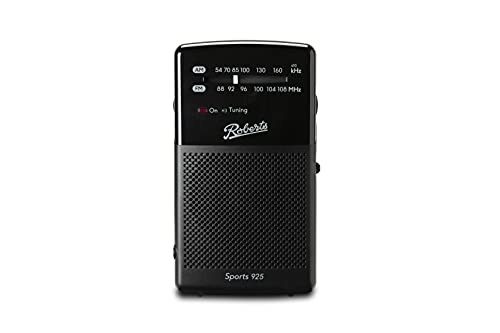
Best for The plain 'battery radio' answer to the GOV.UK kit list: a pocket FM/AM set from a UK radio brand that runs for days on two AA cells and has little to go wrong.
as of 2 Nov 2026, 16:07 GMT · Details
Product prices and availability are accurate as of the date/time indicated and are subject to change. Any price and availability information displayed on Amazon.co.uk at the time of purchase will apply to the purchase of this product.
Best for A tough household radio that can top up a phone from its own cell and keep going from the crank or the sun, if FM and AM are enough.
as of 2 Nov 2026, 16:07 GMT · Details
Product prices and availability are accurate as of the date/time indicated and are subject to change. Any price and availability information displayed on Amazon.co.uk at the time of purchase will apply to the purchase of this product.ⓘ As an Amazon Associate, PreparedBritain earns from qualifying purchases. We may earn a commission when you buy, or a fee when you request a quote, through our links. When two products are close, commission can decide which one we pick. A clearly better product always wins. Amazon prices come from Amazon's own product data and show the date and time they were retrieved. Prices at other retailers are checked by us, less often. Prices and stock can change at any time, so always check the retailer's price before you buy.
Our review
Sony's ICF-506 is a plain analogue FM and AM radio that runs from three AA cells or the mains cord in the box. Sony's manual quotes about 35 hours from alkaline cells. There is no DAB, no torch and nothing to recharge, which for a power cut is exactly the appeal.
What it is
Sony's manual gives FM from 87.5 to 108MHz and AM from 531 to 1,602kHz, tuned by a dial with a large pointer. It takes 230 to 240V AC through the supplied cord, or 4.5V from three AA cells. The speaker is about 10cm across and the audio output is 640mW, with a 3.5mm headphone socket. The body measures about 223 by 127 by 62mm and weighs about 860g with cells, which is a sit-on-the-counter radio rather than a pocket one. Headphones are not included.
Battery life and the mains switch
Sony quotes about 35 hours of FM or AM listening through the speaker on its LR6SG alkaline cells, and warns that rechargeable cells, volume and conditions change that a good deal. Two points from the manual matter in a power cut. The set switches to mains automatically whenever the cord is connected, so to run on cells you must unplug the cord from both the wall and the radio. And Sony says to use only the supplied cord for mains operation. Keep a spare packet of AA cells beside it and it will outlast most rechargeable sets on this page.
Three AA cells is also the cheapest radio power there is: a packet of ten from a supermarket keeps this set going for more than a hundred hours by Sony's figure, and the same cells run a torch. Rechargeable AA cells work but give fewer hours per charge, as Sony's note says.
What you give up
No DAB, so stations that broadcast only on digital are out of reach, though every BBC national station and most local ones are still on FM. Analogue tuning means finding a station by ear and nudging the dial, and there are no presets. There is no torch, no phone port and no crank, so this covers one line of the government's Be Ready checklist, a battery or wind-up FM radio, and nothing else. For that job it is hard to fault.
How it compares
On our battery radio comparison the Roberts Play 10 adds DAB+ on four AA cells for a little more, and the Panasonic RF-P50D does the same FM and AM job in a pocket on two AA cells with a quoted run time of several days. The Sony's edge is its 10cm speaker and a mains cord, so it earns its place as the everyday kitchen radio that also works when the lights go out.
Our verdict
Buy it if you want one radio for the kitchen that needs no charging and takes the same AA cells as your torch. Skip it if you listen to digital-only stations, want presets, or need a radio for a bag; a pocket set is lighter and the Roberts covers DAB+. Store the cells outside the radio if it will sit unused for months, since Sony's manual warns against leaving flat cells inside.
A researched review, built from the maker's specs, manual and UK listings; facts checked 2 Nov 2026. Sources: Sony: ICF-506 operating instructions and specifications (hosted by ManualsLib); UK Government Be Ready: emergency kit checklist.
Who shouldn't buy this
Don't buy it if you want DAB or something pocket-sized. The Roberts Play 10 adds DAB on four AA cells, and the Roberts Sports 925 quotes 60 hours on two AA cells at about 150g.
Key specs
| Power sources | 3 x AA cells or mains (AC cord in the box) |
| Bands | FM 87.5-108MHz, AM 531-1602kHz, analogue tuning |
| Phone charging | No |
| Built-in torch | No |
This is a Researched review: we haven't used this product. We check every specification against at least two independent sources, re-check the UK price on a schedule where we can track it automatically, and say plainly who it isn't for. Commissions never change a rating.
Questions
How long does the Sony ICF-506 run on batteries?
About 35 hours on FM or AM through the speaker, by Sony's manual, using three Sony LR6SG alkaline AA cells. Rechargeable cells and loud listening shorten that.
Does the Sony ICF-506 have DAB?
No. It is FM and AM only, with analogue dial tuning and no presets. BBC national and most local stations remain available on FM.
Can the ICF-506 run on batteries while plugged in?
No. Sony's manual says the set switches to mains whenever the cord is connected, so unplug the cord from the wall and the radio to use the cells.
What comes in the box with the Sony ICF-506?
The radio and an AC power cord. Batteries and headphones are not included, so buy three AA cells with it.
Free alerts for your home
Home Alerts emails you when a power cut, a Met Office warning or a flood warning covers your postcode. Free for your own home. Sign up in a minute.
Start free →