Midland ER300 Pro review
Midland ER300 Pro Bluetooth Emergency Radio and 10,000mAh Power Bank (AM/FM)
By Tom Calder

Midland's manual gives a 10,000mAh cell, up to 100 hours of use (conditions not stated) and a USB-C port that outputs up to 3A, far more phone charging than most radios here offer. The catch is in the same manual: while it charges another device the radio drops to clock mode, so you can't charge and listen at once. For a cell this size the crank and solar panel are slow refills, with at best 10 minutes of recharge per hour of direct sun by Midland's figure. There's no DAB, no published IP rating and no AA fallback.
- Best for
- Mostly a power bank with a radio attached: a large internal cell for topping up phones through a long cut, with AM/FM and a Bluetooth speaker mode when you want sound.
- Skip it if
- You need DAB+, or want the radio to keep playing while it charges a phone
We earn a commission if you buy through the retailer links on this page. It doesn't change our verdict. How we make money →
Researched, not used. We haven't used this product. This review is built from the maker's specifications, owner reports and our own sizing.
What we like
- A 10,000mAh cell with a USB-C output up to 5V/3A; Midland says it can fully recharge a flat phone
- Midland quotes up to 100 hours of use from the 10,000mAh cell, though it doesn't say what that use is or under what conditions
- Crank, solar panel or USB-C charging, a 130-lumen torch with SOS, and Bluetooth speaker mode
Worth knowing
- The radio pauses while the unit charges another device, per the manual; AM/FM only, no DAB
- No AA or AAA fallback, no IP rating published, and slow crank and solar refills for a cell this size
Out of stock when we checked: our alternatives
Closest in size first, then by our score. None of them was showing out of stock when we last checked.

Best for A rugged home or shed radio: IP55, a user-replaceable battery Philips rates for up to 60 hours, a phone-charging port and four AAA cells as a fallback.
as of 2 Nov 2026, 13:07 GMT · Details
Product prices and availability are accurate as of the date/time indicated and are subject to change. Any price and availability information displayed on Amazon.co.uk at the time of purchase will apply to the purchase of this product.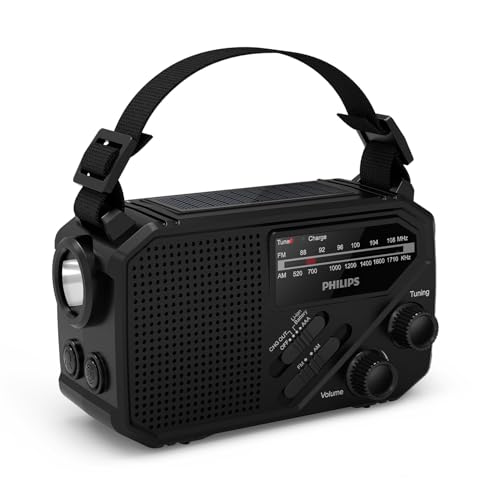
Best for Most UK households: a mainstream-brand FM/AM set with its own rechargeable battery, three AAA cells as a fallback, and a crank and solar panel behind those.
as of 2 Nov 2026, 13:07 GMT · Details
Product prices and availability are accurate as of the date/time indicated and are subject to change. Any price and availability information displayed on Amazon.co.uk at the time of purchase will apply to the purchase of this product.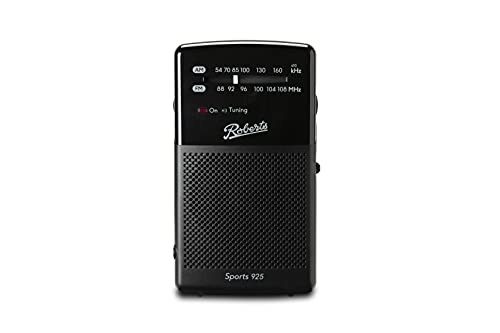
Best for The plain 'battery radio' answer to the GOV.UK kit list: a pocket FM/AM set from a UK radio brand that runs for days on two AA cells and has little to go wrong.
as of 2 Nov 2026, 13:07 GMT · Details
Product prices and availability are accurate as of the date/time indicated and are subject to change. Any price and availability information displayed on Amazon.co.uk at the time of purchase will apply to the purchase of this product.ⓘ As an Amazon Associate, PreparedBritain earns from qualifying purchases. We may earn a commission when you buy, or a fee when you request a quote, through our links. When two products are close, commission can decide which one we pick. A clearly better product always wins. Amazon prices come from Amazon's own product data and show the date and time they were retrieved. Prices at other retailers are checked by us, less often. Prices and stock can change at any time, so always check the retailer's price before you buy.
Our review
Midland's ER300 Pro is better understood as a 10,000mAh power bank that also plays AM and FM. The cell and the fast USB-C output are the strengths. The trade-off is printed in the manual: the radio goes silent and shows only the clock whenever it is charging a phone, so you charge or listen, not both.
What the manual says
Midland's English manual gives a 3.7V, 10,000mAh lithium cell and says it ensures up to 100 hours of use, without saying what kind of use. Recharging over USB-C takes about five hours in good conditions, and the input accepts 5V, 9V or 12V. The output to other devices is up to 3A at 5V, 2A at 9V or 1.5A at 12V, which is proper fast-charge territory; Midland's own store page says that is enough for up to two full smartphone charges.
The bands are AM (531 to 1,629kHz) and FM (87.5 to 108MHz), with a Bluetooth speaker mode and earphone and audio sockets. There is a Cree LED torch with two levels and an SOS beacon, and a dual-tone alarm. It weighs 609g and measures 200 by 86 by 70mm, and Midland rates it to work from -20 to 55°C. The box holds the radio, a USB-C to USB-C cable and a lanyard.
Charge or listen
The manual states that while it is charging an external device, the ER300 Pro switches to clock or standby mode and the radio is disabled. In a long power cut that shapes how you use it: listen to the news at set times, then charge phones in between. It also lacks presets and any published water rating, and there is no slot for AA or AAA cells, so once the 10,000mAh cell is flat the only refills are the crank, the sun or a socket somewhere else.
Crank and solar are slow
Midland quotes a charging current of about 600 from cranking at 120 turns a minute (the manual prints the unit as mAh) and says an hour of direct sun gives 10 minutes of recharge. Against a cell this size, neither will refill it in any useful time, so treat them as a way to get a little radio when everything else is gone. Lithium cells keep best part-charged and away from heat; our lithium battery safety guide covers storage and charging.
How it compares
On our emergency radio comparison no other radio offers this much stored charge. The Philips TAR3500 has a 1A USB port, IP55 and four AAA cells as backup; the Sangean MMR-99 cranks better by its own figures and is also IP55. If phones are the priority, compare it with a plain power bank and a battery radio: the INIU B5 holds twice the capacity.
Our verdict
Buy it if you want one box that keeps a couple of phones going through a cut and gives you AM and FM news between charges. Skip it if you want DAB, the radio playing while phones charge, or a set that runs on spare cells. For a home that already owns a power bank, a simpler battery radio does the radio job for less.
A researched review, built from the maker's specs, manual and UK listings; facts checked 2 Nov 2026. Sources: Midland: ER300 Pro user manual (English section, via distributor DND); Midland Europe: ER300 Pro product page; UK Government Be Ready: emergency kit checklist; Electrical Safety First: power bank safety.
Who shouldn't buy this
Don't buy it if you need DAB+, or want the radio to keep playing while it charges a phone. For DAB+ look at the Sangean MMR-88 DAB+ or the Nedis; the Philips TAR3500 adds an AAA fallback.
Key specs
| Power sources | Built-in 10,000mAh Li-ion, solar panel, crank, USB-C |
| Bands | AM/FM plus Bluetooth speaker mode; no DAB |
| Phone charging | Yes - USB-C out up to 3A; radio pauses meanwhile |
| Built-in torch | Yes - 130-lumen LED with SOS beacon |
This is a Researched review: we haven't used this product. We check every specification against at least two independent sources, re-check the UK price on a schedule where we can track it automatically, and say plainly who it isn't for. Commissions never change a rating.
Questions
Can the Midland ER300 Pro play the radio while charging a phone?
No. Midland's manual says that while it charges an external device the unit switches to clock or standby mode and the AM/FM radio is disabled until charging stops.
How big is the Midland ER300 Pro battery?
Midland gives 10,000mAh at 3.7V and says up to 100 hours of use, without stating the conditions. A full USB-C recharge takes about five hours.
How fast does the Midland ER300 Pro charge a phone?
Its USB-C output is rated up to 3A at 5V, 2A at 9V or 1.5A at 12V. Midland's store page says that gives up to two full smartphone charges.
Does the Midland ER300 Pro take AA batteries?
No. It runs only from its built-in cell, refilled by USB-C, the hand crank or the solar panel. Midland says an hour of direct sun gives about 10 minutes of recharge.
Free alerts for your home
Home Alerts emails you when a power cut, a Met Office warning or a flood warning covers your postcode. Free for your own home. Sign up in a minute.
Start free →