One place for the paperwork after a death
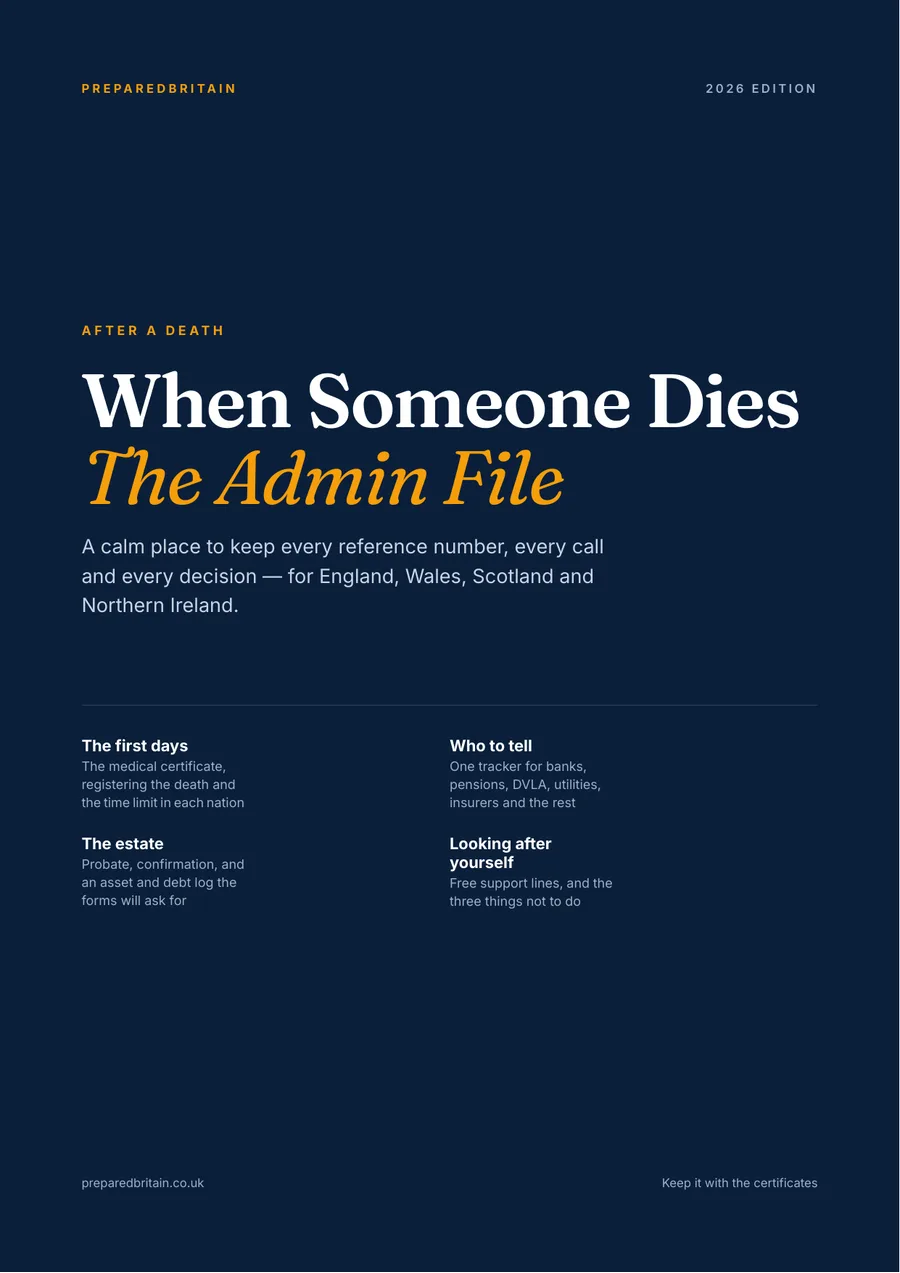
A 21-page fillable A4 workbook for whoever is sorting out the admin after a death in England, Wales, Scotland or Northern Ireland. Each job has its own section: the medical certificate and registering the death, the details banks and pension providers ask for, a who-to-tell tracker, the funeral, probate or confirmation, an asset and debt log and a letters-and-calls log. Type into it on screen, or print it and keep it with the certificates.
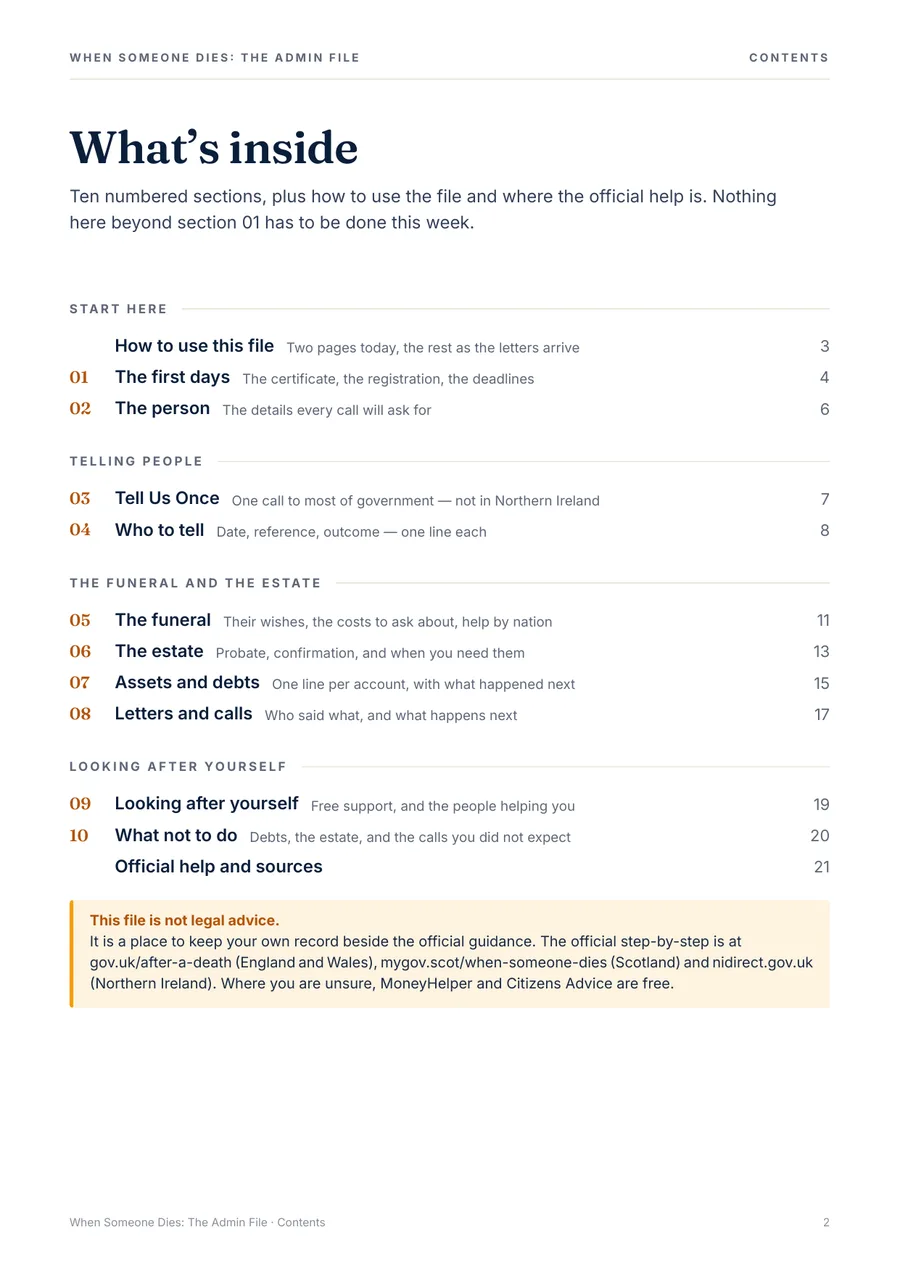
- Ten numbered sections and 558 fillable fields across 21 A4 pages, with short notes on what the official guidance asks for.
- Written for all four nations: the registration time limit in each, Tell Us Once alongside the Northern Ireland Bereavement Service, probate alongside Scottish confirmation, and help with funeral costs nation by nation.
- Room to write it all down: 15 lines for assets, 10 for debts and 33 for letters and calls, plus a page on the three things not to do.
Secure card payment by Stripe. It downloads the moment you pay, so by buying you ask for it straight away and there’s no 14-day cancellation. Terms of sale.

When twenty organisations ask for the same details
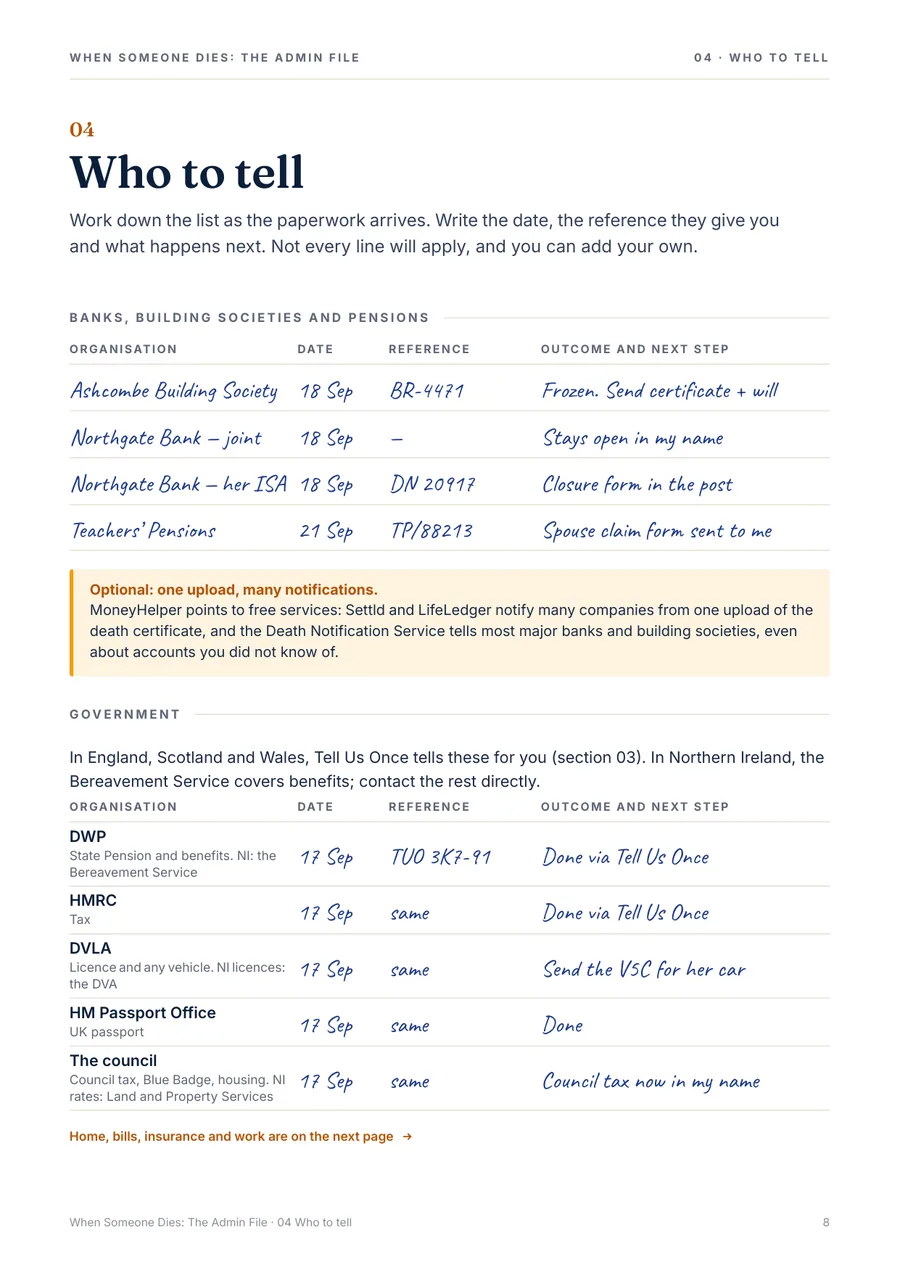
Banks, pension providers and government departments ask for the same handful of facts. Section 02 keeps them on one page. The who-to-tell tracker in section 04 then gives each organisation a line for the date, the reference they give you and what happens next, from banks and pensions to the mortgage lender, insurers, the GP surgery and Royal Mail redirection.
When you are not sure which rules apply where you are
The rules are not the same in each nation, so the file sets them side by side. The time limit to register is five days in England, Wales and Northern Ireland and eight in Scotland, counted from different points. Tell Us Once is available in England, Scotland and Wales; Northern Ireland has the Bereavement Service instead. Scotland has confirmation through the sheriff court where the other three have probate. Before anything is shared out, England, Wales and Northern Ireland use a deceased estates notice, and in Scotland executors normally wait six months from the death. The file points back to named official sources, checked 23 September 2026, and says the official page is right if the two ever disagree.
When more than one person is helping
One paper copy kept in one place helps stop the same call being made twice. There is a short table for who has taken on what, a letters-and-calls log with 33 lines, and a place to write down the decisions that can wait. Section 10 sets out the three things that catch people out in the weeks after a death: paying their debts from your own money, sharing out the estate before the debts are settled, and acting on a call or message you did not expect.
Look inside
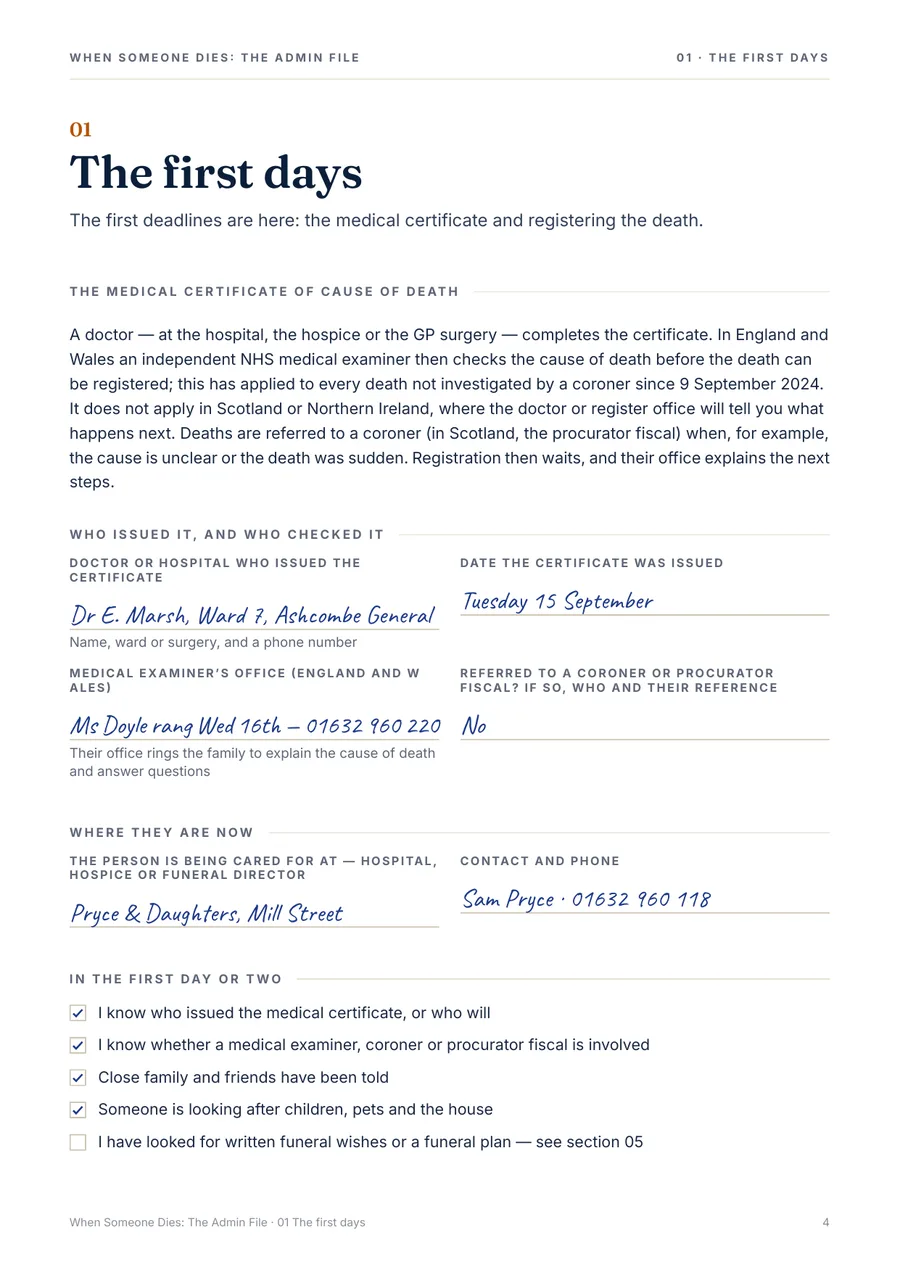
Shown filled in, in a made-up household’s handwriting. Yours arrives blank, with every line ready to type into.
What’s inside
10 sections across 21 pages. Fill in what applies and skip what doesn’t.
When not to buy this
You do not need this if a solicitor is administering the estate and you have only a handful of calls to make, or if a notebook and a folder already work for you. It covers England, Wales, Scotland and Northern Ireland only, and it does not cover a death that happened abroad. It is a record, not a guide to a complicated estate: a trust or a business gets a single box and a note to take advice before doing anything. The process itself is explained free on the official step-by-step guides: GOV.UK's what to do after someone dies pages for England and Wales, mygov.scot's what to do when someone dies guide for Scotland, and the nidirect pages for Northern Ireland. This file sits beside those as your own record. It does not replace them.
Questions
Is this legal advice, or a legal document?+
No. It is a place to keep your own record beside the official guidance. It says it is not legal advice on the contents page, on the how-to-use page and again in section 10. Filling it in does not give anyone authority over the estate. Where you are unsure it points to free help from MoneyHelper and Citizens Advice, and a solicitor can act for the estate.
Can I fill it in on screen?+
Yes. Open the PDF in Adobe Acrobat Reader or Apple Preview, type into the fields and save. Or print it on A4 and write in it. The file asks you never to write PINs or passwords in it; note where they are kept instead.
Do I have to work through it all at once?+
No. The tightest deadlines, counted in days, are in section 01: the medical certificate and registering the death. The person's details in section 02 are worth filling in once, early. The file suggests leaving the estate sections until after the funeral, and it marks the later deadlines, such as benefit claims, where they appear.
What exactly do I get?+
A PDF file, A4, that you download straight after paying. Every line is a real form field: open it in Adobe Acrobat Reader or Apple Preview, type into it and save. Or print it and write by hand. We also email you a link to your downloads.
Does it work in Scotland, Wales and Northern Ireland?+
Yes. Where the rules or services differ between the four nations, the file says so and points to the right official service for each.
Will it go out of date?+
It names the official service to check rather than printing fees or amounts that change. If we update the file, your download link gives you the current version.
Can I get a refund?+
Because it downloads the moment you pay, the 14-day cancellation period doesn’t apply to digital files you’ve asked to receive straight away. If a file won’t open or something is wrong with it, email us and we’ll sort it out.
Secure card payment by Stripe. It downloads the moment you pay, so by buying you ask for it straight away and there’s no 14-day cancellation. Terms of sale.
When Someone Dies: The Admin File is general information to help you organise your household’s records. It is not legal, financial or medical advice. Written by Tom Calder for PreparedBritain, an independent publisher not affiliated with HM Government.