
Roberts SolarDAB 99 vs Philips TAR3500: DAB+ or a longer-running FM radio?
Two IP55 crank-and-solar radios compared: the Roberts SolarDAB 99 for DAB+ and Bluetooth, the Philips TAR3500 for 60 hours per charge and an AAA backup. What each maker publishes, and who each suits.
Pick the Philips TAR3500 if the radio is mainly for power cuts: Philips rates it for up to 60 hours per charge, three times the Roberts’ figure on paper, it runs on four AAA cells when the lithium battery is flat, and its phone socket is rated 5V 1A. Pick the Roberts SolarDAB 99 if you want DAB+ and Bluetooth for everyday listening from a British brand and will keep it charged; Roberts lists no battery slot. Both are IP55 with a crank, solar panel, torch and FM.
By Tom Calder · Updated 14 November 2026 · Sourced to Roberts, Philips’ manual and datasheet, What Hi-Fi and the government’s Be Ready checklist
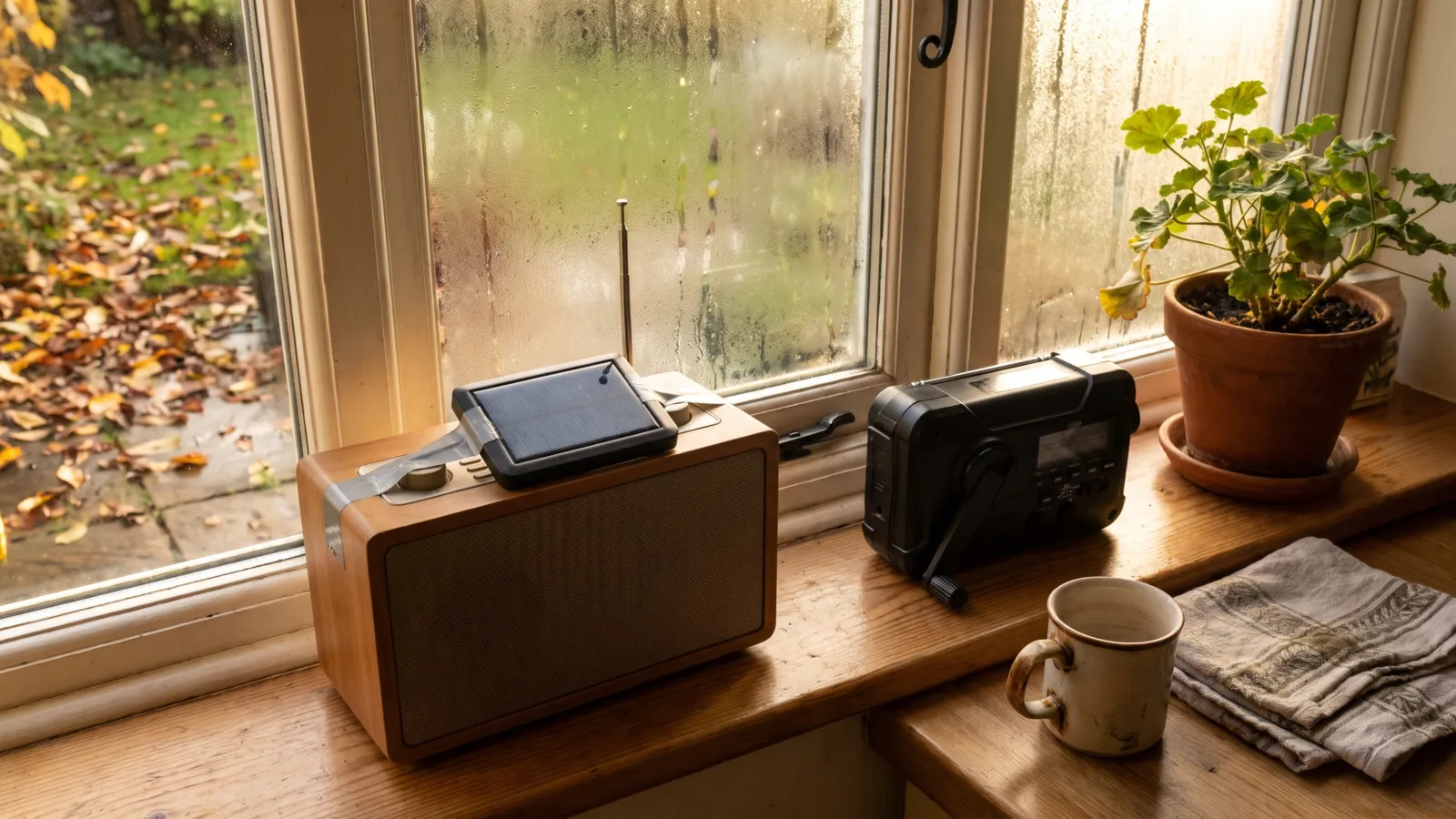
Same rating, different priorities
On paper these two are close. Both are rated IP55 against dust and water jets, both have a hand crank, a solar panel, a torch and a siren, and both recharge over USB-C. The split is what each puts first: Roberts builds the SolarDAB 99 around DAB+ and Bluetooth for everyday listening, and Philips builds the TAR3500 around running for a long time and never quite running out.
We haven’t used either radio. The figures below come from Roberts’ product page, Philips’ datasheet and manual, and in one case a launch report. See our Roberts SolarDAB 99 review and Philips TAR3500 review for more, and emergency radios compared for every set we track.
| Roberts SolarDAB 99 | Philips TAR3500 | |
|---|---|---|
| Bands | DAB, DAB+ and FM | FM and AM |
| Presets | 20 DAB, 20 FM | 20 FM, 20 AM |
| Bluetooth | Yes | No |
| Main battery | Built-in rechargeable; capacity not published | Replaceable lithium, 3.65V 5,200mAh |
| Disposable cells | None listed | 4 × AAA (not supplied) |
| Play time | Up to 20 hours | Up to 60 hours at volume 5 |
| USB-C recharge | Time not published | About 3.5 hours |
| Hand crank | No figure on Roberts’ page; launch claim of up to 7 minutes per minute of cranking (What Hi-Fi) | No figure published |
| Solar | No figure published | No figure published |
| Phone charging | USB socket; rating not published | USB-A, 5V 1A |
| Torch | LED torch, SOS lights and siren | Torch, reading light, SOS siren and light |
| Headphone socket | Yes | Yes, 3.5mm |
| Water rating | IP55 | IP55 |
| Weight | 837g | 670g |
| Size | 20.3 × 11.4 × 8.9cm | 18.6 × 10.3 × 7.7cm |
Roberts’ product page (read 2 and 14 November 2026) and Philips’ TAR3500 datasheet and manual. Neither maker gives a torch brightness.
DAB+ or FM: what you actually need
The government’s Be Ready checklist asks for an FM radio, battery or wind-up, and suggests writing down the frequencies of the stations you use for news. Both radios meet that: the SolarDAB 99 has FM alongside DAB and DAB+. What DAB+ adds is everyday convenience, with stations by name and more of them, and the Roberts adds Bluetooth so it doubles as a speaker for a phone. If the radio will live on the kitchen windowsill and be used every day, that is a real reason to choose it.
The TAR3500 has AM as well as FM and no DAB at all. Its tuning is digital, with 20 presets for each band, so it is not a fiddly dial radio. Our guide to which radio works in a power cut explains why FM is the band to rely on whichever you choose.
Power: the TAR3500’s clear lead
Philips rates the TAR3500 for up to 60 hours of continuous play at volume 5, three times the SolarDAB 99’s up to 20 hours on paper, though Philips’ figure is at volume 5 of 16 and Roberts gives no condition. More important in a long cut, the TAR3500 runs on four AAA cells when its lithium battery is flat, and Philips says that battery is replaceable. Roberts lists no slot for disposable cells on the SolarDAB 99: once its built-in battery is empty, the only refills are the sun, the crank or a socket somewhere else.
Neither maker publishes a solar figure, and Philips gives none for the crank. Roberts’ product page doesn’t give one either; What Hi-Fi’s launch report relayed Roberts’ claim of up to seven minutes of playback per minute of cranking. Philips’ manual says to use the crank and solar panel only in an emergency. On both, the sensible routine is the same: keep the main battery topped up from a USB-C charger so the radio starts any cut full.
For phones, Philips rates the TAR3500’s USB-A socket at 5V 1A, a slow but genuine charge. Roberts publishes no rating for its USB socket. Philips’ datasheet does give the TAR3500 two different capacities, 5,200mAh in one place and a 2,600mAh power bank in another, so treat either radio’s socket as a top-up and keep a power bank for proper charging.
NewSee this for your own homeHome Alerts: your postcode's power cuts, warnings and floods, on one screen. Free for your own home. Sign up in a minute.Start free →Weather, weight and availability
Both carry an IP55 rating, which Philips’ datasheet defines as protection from limited dust and from low-pressure water jets from any direction. Philips’ manual still says not to expose the TAR3500 to dripping or splashing, so treat IP55 as protection against a passing shower, not somewhere to leave it outdoors. The Roberts is the heavier and larger of the two, at 837g against 670g. Neither is a rucksack radio.
When we checked on 14 November 2026, Roberts’ own shop listed the SolarDAB 99 only as a refurbished item. The box above shows live stock for both.
Which suits who
The Philips TAR3500 is good enough for most households, and it is the simpler choice for a power cut: three times the Roberts’ rated play time on paper, ordinary AAA cells as a second line, a rated phone socket and the same IP55 rating, in a lighter case. Choose it if the radio is mainly for emergencies.
The Roberts SolarDAB 99 suits someone who wants a DAB+ radio they will use every day, with Bluetooth, from a British radio brand, and who will keep it charged on a windowsill. Accept the shorter running time and that Roberts lists no battery slot, and keep a pack of spare cells for a torch rather than the radio.
If you want something smaller than either, Philips TAR1609 vs TAR3500 compares the TAR3500 with Philips’ 390g set.
Common questions
Roberts SolarDAB 99 or Philips TAR3500: which is better in a power cut?
On published figures, the Philips TAR3500: up to 60 hours per charge at volume 5 against the SolarDAB 99’s up to 20, plus four AAA cells as backup. Roberts lists no disposable-cell fallback. Choose the Roberts if you want DAB+ and Bluetooth for everyday listening; both have FM.
Does the Roberts SolarDAB 99 take batteries?
Not as far as Roberts says. It lists only a built-in rechargeable battery, topped up by USB-C, the solar panel or the hand crank. The Philips TAR3500 takes four AAA cells as well as its lithium battery.
Are the Roberts SolarDAB 99 and Philips TAR3500 waterproof?
Both are rated IP55: protected against limited dust and low-pressure water jets from any direction. That is protection against a shower, not against being left out in the rain or dropped in water.
Does the Philips TAR3500 have DAB?
No. It tunes FM and AM digitally, with 20 presets for each. The Roberts SolarDAB 99 has DAB, DAB+ and FM, with 20 DAB and 20 FM presets.
Can the Roberts SolarDAB 99 charge a phone?
It has a USB socket, but Roberts publishes no output rating for it. Philips rates the TAR3500’s USB-A socket at 5V 1A. Treat both as a top-up and keep a charged power bank.
Sources (7)
- Roberts — SolarDAB 99 product pageDAB, DAB+ and FM; 20 FM and 20 DAB presets; Bluetooth; auxiliary input; headphone socket; IP55; built-in rechargeable battery, solar panel, hand-crank dynamo; emergency lights and siren; 20.3 × 11.4 × 8.9cm; 837g; listed as ‘SolarDAB 99 - Refurbished’ on 14 November 2026
- Roberts — SolarDAB 99 product page as read on 2 November 2026 for our review (up to 20 hours of play; USB-C charging; LED torch with high and low settings, red and white SOS lights, siren); the old address now redirects to the page above
- What Hi-Fi — Roberts SolarDAB 99 launch report, July 2026Roberts’ claim of up to seven minutes of playback per minute of cranking
- Philips — TAR3500/00 datasheet, issue date 10 April 20263W mono, 2.25in driver; 3.5mm headphone jack; auto digital tuning, 20 FM + 20 AM presets, no RDS, no Bluetooth; Li-ion 3.65V 5,200mAh, replaceable; 4 × AAA (LR3) not included; 60 hours on battery; 3.5-hour charge; IP55, defined as protection from limited dust ingress and low-pressure water jets from any direction; hand crank and solar charging; torch, siren, reading light; 0.67kg; 18.6 × 10.3 × 7.7cm; feature text also calls it a 2,600mAh power bank
- Philips — TAR3500 user manual, English, May 2026about 3.5 hours to charge fully; up to 60 hours continuous play at volume 5; four alkaline AAA batteries; use solar and hand crank charging only in an emergency; USB-A out 5.0V 1.0A; FM 87.5–108MHz, AM 520–1,710kHz; 186 × 103 × 77mm; 670g
- Philips UK — TAR3500/00 emergency radio product page
- UK Government Be Ready — emergency kit checklistFM radio, battery or wind-up; write down the frequencies of the stations you use for news; a charged power bank for phones
PreparedBritain is independent and not affiliated with HM Government.
The Power Cut Action Card
One page for the kitchen drawer: what to do first, what to have ready, how long food keeps, and how to stay warm without risking carbon monoxide. Free, no catch.
Download it straight away. We'll also send the occasional briefing when something genuinely matters — severe weather, live incidents, real price drops. Nothing else.
Latest from our live data
All stories → News · 15 NovYellow cold-health alert for North East, North West and Yorkshire and The Humber, 15 to 19 Nov
 News · 15 NovCould UK flights be grounded like the US? What failed in 2023, 2025 and 2026, and what to carry
 News · 15 NovUS flights grounded: your rights if your flight to or from America was cancelled or delayed
For the children this Christmas


Keep reading
All power cuts & energy guides →Philips TAR1609 vs TAR1659: is there any difference?
The Philips TAR1609 and TAR1659 crank radios compared line by line from Philips’ own manuals: what the second model…
Philips TAR1609 vs TAR3500: which Philips emergency radio should you buy?
Philips’ two crank-and-solar FM/AM radios side by side: battery, AAA backup, phone charging, water rating and…
We counted every power cut in Britain since September: the worst-hit areas, and who may be owed money
Our outage ledger has read every unplanned power cut Britain's electricity networks published since 29 September:…
