
We counted every power cut in Britain since September: the worst-hit areas, and who may be owed money
Our outage ledger has read every unplanned power cut Britain's electricity networks published since 29 September: 17,910 of them. Most were short. 1,118 had homes still off past the point where a Guaranteed Standards payment is due, and storms Austen and Boelo account for most of the spike. The worst-hit areas, by count and for their size, and how to check whether a payment should reach you.
Since 29 September, Britain's electricity networks have published 17,910 unplanned power cuts, by our count across six networks. About three in four could not have lasted long enough for a payment, on the networks' own times. 1,118 cuts still had homes off past the Guaranteed Standards threshold, normally 12 hours, affecting 36,499 homes by the networks' own counts. At least £3.58 million in first payments may be due for those, and Ofgem says networks make these payments automatically. 703 of the 1,118 started in the ten days from 20 to 29 October, when storms Austen and Boelo passed. Cornwall had the most cuts, 749, and the highest rate for its size. At midday on 12 November, the networks' live maps showed 187 cuts open and 7,025 homes off, the most at one reading since 27 October; 96 were planned work. If your power was off for more than 12 hours, you may qualify: our free check on the [power cut compensation tracker](/trackers/power-cuts/compensation) shows the long cuts by area.
By Tom Calder · Updated 12 November 2026 · Our own count, from the outage ledger behind our power cut trackers: every fault six GB network operators published between 29 September and 9 November 2026 (read at 21:25 GMT on 9 November). Payment rules from Ofgem and the 2015 Regulations. Live reading from the six networks' outage maps at 12:12 GMT on 12 November 2026
Earlier changes
12 Nov Added the 12 November live reading: 187 cuts open and 7,025 homes off, the most at one reading since 27 October, 96 of them planned work.
Long cuts: who may qualify for a payment
Under Ofgem's Guaranteed Standards, your electricity network pays £100 to a home whose power is off for more than 12 hours in normal weather, and £45 for every further 12 hours. Where 5,000 or more homes are off from the same fault, the first payment comes after 24 hours. Ofgem says the network pays these automatically, so for most people the job is checking it arrived.
Of the 17,910 cuts, 1,118 still had homes off past that threshold by the networks' own figures: 36,499 homes in all. At least £3.58 million in first payments may be due for them. That is the first payment the rules give, times those homes, with no later payments counted. 412 of those cuts still had homes off at 24 hours. The longest ran for at least 13 and a half days, on the network's own start and restore times.
Another 3,070 cuts may also count, but the times can't settle it, mostly because networks reconnect homes in stages. They are not in the figures above.
If your power was off for more than 12 hours and nothing has arrived, the power cut compensation tracker has a free postcode check and shows the long cuts by council. A payment that hasn't come can be chased within three months of the power coming back; for the earliest long cuts in our count, that window closes on 29 December. Our power cut compensation guide explains every rule.
Most cuts were short, and the storms explain the spike
Most of these cuts were short. 13,722 of the 17,910, about three in four, could not have lasted long enough for a payment on the networks' own start and restore times.
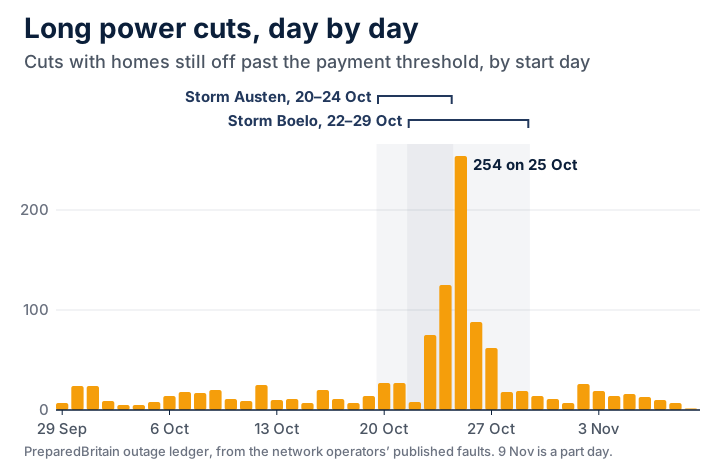
The long ones cluster around two storms. Our ledger's storm windows run from 20 to 24 October for Storm Austen and from 22 to 29 October for Storm Boelo, so the two overlapped. In those ten days, 703 of the 1,118 long cuts started, nearly two in three. The busiest day was 25 October, with 254 long cuts affecting 10,725 homes. Outside the storms, no day had more than 26.
At 12:12 GMT on 12 November, the six networks' live maps listed 187 cuts open and 7,025 homes off, the most at one reading since 27 October (256 cuts, 9,139 homes). 96 of the 187 were planned work, and the homes figure includes them; SP Energy Networks doesn't publish homes off. Most of our readings are taken in the evening, so a midday reading isn't a like-for-like comparison. At the storm peak, on the evening of 25 October, the maps showed 1,009 cuts and 64,517 homes off. No Met Office weather warning was in force at the time. The live power cut map shows the latest.
Our earlier stories cover what Storm Austen did and the Highland cuts after Storm Boelo.
The worst-hit areas
Our town pages count every new unplanned cut each network lists in 99 towns, cities and counties, every day since 29 September. Cornwall had the most: 749 cuts in 41 days, with at least one cut on 40 of them. Its busiest day was 23 October, with 389. At least 556 of its cuts came in the ten days of the two storms; on a typical day without a named storm, National Grid listed six new cuts there.
Big places have more cuts simply because they have more homes and more cable, so the table also gives each area's rate: new cuts a day for every 100,000 people. Cornwall is highest on both, at 3.1 a day. London had the second most cuts, 542, but for its size one of the lowest rates, 0.1 a day, lower than 87 of the 99 areas. By rate, the next after Cornwall are Dorset (1.8), Somerset (1.7), Northumberland (1.5) and Herefordshire (1.4).
| Area | Network | Cuts, 29 Sep to 8 Nov | A day per 100,000 people | Days with a cut |
|---|---|---|---|---|
| Cornwall | National Grid | 749 | 3.1 | 40 of 41 |
| London | UK Power Networks | 542 | 0.1 | 41 of 41 |
| Somerset | National Grid | 398 | 1.7 | 39 of 41 |
| North Yorkshire | Northern Powergrid | 365 | 1.4 | 41 of 41 |
| Dorset | SSEN | 284 | 1.8 | 38 of 41 |
| County Durham | Northern Powergrid | 273 | 1.2 | 39 of 41 |
| Wiltshire | SSEN | 269 | 1.3 | 37 of 41 |
| Northumberland | Northern Powergrid | 199 | 1.5 | 37 of 41 |
| East Riding of Yorkshire | Northern Powergrid | 190 | 1.3 | 35 of 41 |
| Leeds | Northern Powergrid | 185 | 0.5 | 41 of 41 |
The 10 areas with the most new unplanned cuts listed, 29 September to 8 November 2026 (41 days). A cut whose postcodes we can't yet place in a council area is left out, so these are minimums. One fault can affect many streets, so this is how often cuts happen in an area, not how often a given home loses power.
Home Alerts members
The full picture, for your home
Each week, what's happening across Britain set against your own address: your water company, your power network, fuel for your car and the gaps in your kit. Free for your own home. Sign up in a minute.
Start free →Britain's figures from our live trackers, 13 November.
By network
By network, SSEN had the most cuts that qualify, 381, affecting 13,622 homes. National Grid had 303 (8,525 homes), UK Power Networks 264 (4,352 homes), Northern Powergrid 93 (7,713 homes) and Electricity North West 77 (2,287 homes).
SP Energy Networks shows none, but that is a gap in its data, not a clean record. It doesn't publish how many homes a cut reaches, so its cuts can't be counted in homes or money. 324 of its cuts may have run long enough, and 109 certainly did.
We have read SP Energy Networks and Electricity North West only since 14 October, so their figures cover less time. NIE Networks, in Northern Ireland, is not in this count.
When you do need to claim
The ordinary payments for a long cut are automatic in England, Scotland and Wales. Three cases still need you to act. If your home has four or more separate cuts of at least three hours in one regulatory year (1 April to 31 March), you're due £100, but only if you claim it by 30 June after the year ends; cuts that earned their own payment don't count towards the four. Planned work counts only if you weren't given the notice the rules require, which only you know.
In Northern Ireland, NIE Networks' payments are lower and never automatic: £50 if your power isn't back within 24 hours, claimed within one month. The compensation guide has the details and the calculator works out the amounts.
How we counted
Our outage ledger reads every network's published list of power cuts every 10 minutes and keeps each fault. It covers UK Power Networks, Northern Powergrid, National Grid and SSEN from 29 September 2026, and SP Energy Networks and Electricity North West from 14 October. Planned work isn't counted. It is a count of the faults the networks publish, not of every home that lost power.
A cut qualifies only when the shortest the power can have been off, from the network's own start and restore times, is past the threshold, and the network's own count still showed homes off at that point. In a storm the network classes as severe weather, other rules apply, and a cut counts only if it passed every rule that might. Networks reconnect homes in stages, so the homes are those still listed off at the threshold, not the most ever listed off; where a job showed homes off long after its stated start, we time it from when it first did. "Unsure" cuts may also count, but the times can't settle it. A cut that crossed several postcode areas is counted nationally but not mapped.
The area table comes from our town pages, which count new cuts by the council area of their postcodes. The national and area figures are separate counts and don't add up to each other. All figures were read at 21:25 GMT on 9 November 2026 and will move as the ledger grows: the compensation tracker and the town pages always show the latest.
Common questions
How many power cuts have there been in the UK since September?
Britain's electricity networks published 17,910 unplanned power cuts between 29 September and 9 November 2026, by our count. That covers six GB networks (two of them only from 14 October), not Northern Ireland. About three in four could not have lasted long enough for a payment.
Which areas have had the most power cuts?
Of the 99 areas we track, Cornwall had the most, 749 new unplanned cuts from 29 September to 8 November, then London (542), Somerset (398), North Yorkshire (365) and Dorset (284). For its size, Cornwall also had the highest rate, 3.1 cuts a day for every 100,000 people; London's rate was one of the lowest.
Am I owed money for a long power cut?
You may qualify if your power was off for more than 12 hours in normal weather (24 if 5,000 or more homes were off from the same fault). In England, Scotland and Wales the network should pay £100 automatically. Our free check on the power cut compensation tracker shows the long cuts near you. If nothing has arrived, you can chase it within three months of the power coming back.
Do I need to make a claim?
Not for the ordinary payment after a long cut: Ofgem says networks pay it automatically. You do need to claim the £100 for four or more cuts of three hours or more in one regulatory year, and any payment in Northern Ireland, where NIE Networks pays only on a claim made within a month.
Why does SP Energy Networks show no qualifying cuts?
Because it doesn't publish how many homes each cut reaches, so none of its cuts can be counted in homes or money. 324 of its cuts may have lasted long enough for a payment, and 109 certainly did.
Sources (4)
- PreparedBritain outage ledger: power cut compensation trackercuts with homes off past the threshold, by council and network; read 9 November 2026
- PreparedBritain town power cut pages: new unplanned cuts per area, 29 September to 8 November 2026
- Ofgem, Adjustments to the Guaranteed Standards of Performance: 2026 (payment amounts for 2026/27)
- The Electricity (Standards of Performance) Regulations 2015 (SI 2015/699), as amended
PreparedBritain is independent and not affiliated with HM Government.
See our checks first on Google. Add PreparedBritain as a preferred source and Google will show our stories to you more often in Top Stories.

The Power Cut Action Card
One page for the kitchen drawer: what to do first, what to have ready, how long food keeps, and how to stay warm without risking carbon monoxide. Free, no catch.
Download it straight away. We'll also send the occasional briefing when something genuinely matters — severe weather, live incidents, real price drops. Nothing else.
Latest from our live data
All stories →

Keep reading
All power cuts & energy guides →Home battery storage in the UK: cost, power-cut backup and how long it runs a house
What a home battery costs, what it saves, why most UK systems don't power the house in a power cut without extra…
When the mobile network goes down: how to stay in contact in the UK
In a long power cut the local mast can go quiet. What still works, how long masts last on Ofcom's own figures, and…
Off-peak electricity times in the UK: Economy 7, Economy 10 and smart tariffs
There is no off-peak on a standard single-rate tariff: a unit costs the same at 3am as at 6pm. Off-peak times only…