Best security lights UK (2026)
A security light is one of the cheapest deterrents you can add to a house, and the UK range now runs from a budget mains floodlight to a camera-and-lighting system that also needs a bridge and a subscription. The decision that matters most isn't brightness — it's how the light is powered, because that determines whether you can fit it yourself in an afternoon or need to budget for an electrician on top of the purchase price. This comparison covers seven UK-available security lights from Ring, Philips Hue, LAP, Luceco, GoodHome and Steinel, checked against each manufacturer's or first-party retailer's own documentation and price-tracked from UK listings on 24 July 2026.
By Tom Calder · Updated 20 September 2026 · 7 products, 4 of 7 price-tracked
Before you buy
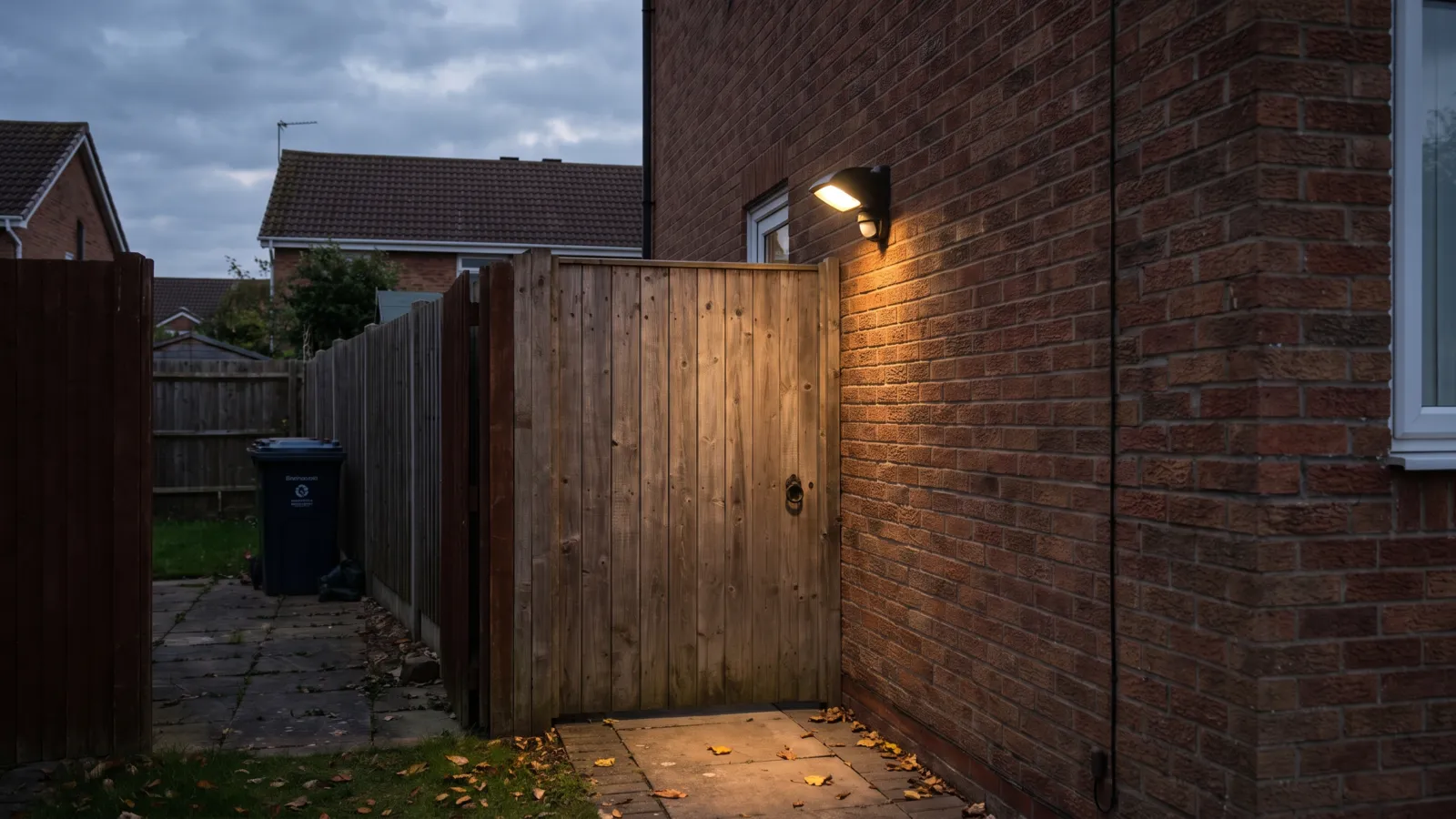
Start with how the light is powered, because that decides more than anything on the spec sheet. The two solar units here — the Luceco Solar Guardian and the GoodHome Piceo — have no mains connection, no wiring and no electrician, so a householder can genuinely fit them with a bracket, screws and wall plugs. The other five are fixed mains-wired fittings. On the regulatory position it is worth being precise rather than alarming: in England, since the 2013 amendment to Part P of the Building Regulations, adding an outdoor light to an existing circuit is not notifiable work — only a new circuit, a consumer-unit change, or work in a special location is. In Wales, outdoor and garden lighting remains notifiable even on an existing circuit. Either way the installation must comply with BS 7671, which is why a registered electrician is the sensible route, and why that labour cost belongs in the budget alongside the fitting itself.
Match the output to the job rather than buying the biggest number available. At the top end, the LAP Weyburn's 5000 lumens is genuinely a lot of light for a domestic boundary and suits a driveway, yard or large rear garden where you can aim it well away from anyone else's windows. Around 2000 lumens — the Luceco Castra, the Ring Floodlight Cam Wired Plus, and near enough the Philips Hue's 2250 lumens — is a sensible brightness for most houses: enough to be noticed, unlikely to cause complaints. Below that, the GoodHome Piceo's 800 lumens and the Luceco Solar Guardian's 550 are for sheds, side passages and fences, while the Steinel L 810 SC's 679 lumens is amenity lighting for a front door rather than security floodlighting. Aim matters as much as output — a well-positioned sensor light at a sensible brightness deters as effectively as a floodlight several times brighter pointed badly.
Check the IP rating against where the light is actually going. IP65 means protection against jetting water, so the LAP Weyburn, Luceco Castra and Luceco Solar Guardian are fine on a fully exposed wall or gable. IP44 means splashing water only, which is adequate under an eave, porch or overhang but not ideal in driving rain: that covers the GoodHome Piceo, the Philips Hue's floodlight body (its camera module is separately rated IP65), and the Steinel L 810 SC, whose IP44 figure comes from UK reseller listings rather than Steinel's own documentation. Ring is the outlier — it publishes no IP rating at all for the Floodlight Cam Wired Plus, describing it as 'weather resistant' in its own marketing wording alongside a quoted −20°C to 50°C operating range. That is not a rated standard, and it is worth knowing before siting one somewhere fully exposed. None of the seven products publishes a BSI, UKCA or CE certificate number; IP figures, energy labels and guarantee terms are the only rated or contractual numbers on offer.
Finally, decide how you want the light triggered, and whether you want a camera at all. A PIR sensor detects body heat moving across its field and is the most dependable trigger in the dark — five of the seven lights here use one, with the Screwfix and B&Q units quoting a 120° angle and 8 to 10 metres of range, and Ring's covering a wider 270° zone. The Philips Hue instead uses camera-based video analytics, which brings smarter alerts but does not fire as reliably as a PIR in low light. The Steinel uses an invisible iHF high-frequency sensor, which detects through thin materials like glass and plastic and is less affected by ambient temperature than a PIR, though that same sensitivity can trigger it on movement you cannot see. If you do want footage as well as light, budget for the ongoing cost honestly: recording and history on the Ring sit behind a Ring Home subscription, and Philips Hue has subscription tiers for extended video history on top of requiring a Hue Bridge just to operate. The two Screwfix mains units and both solar lights have no account, hub or subscription of any kind.
Top pick: LAP Weyburn Outdoor LED Floodlight With PIR Sensor Black 50W 5000lm. The value pick of this comparison by a wide margin: 5000 lumens, an IP65 rating and a 3-year manufacturer's guarantee for very little money, with no app, no camera and nothing to subscribe to. It is genuinely very bright for a domestic boundary, so siting and aim matter more here than on anything else on this page — point the head down at your own ground. Screwfix-exclusive, so it is not available on Amazon.
| Light | Type | Brightness | Power | Detection | Price | |
|---|---|---|---|---|---|---|
| LAP Weyburn Outdoor LED Floodlight With PIR Sensor Black 50W 5000lmTOP PICK | Mains PIR LED floodlight — no camera, no smart features | 5,000 lm | Mains 220–240 V, fixed fitting to a spur or lighting circuit | PIR, 120°, up to 10 m; adjustable sensitivity, time and lux | £16.98Checked 20 Sep · indicative — not price-tracked | Check price → |
| Luceco Castra Smart Outdoor LED Floodlight With PIR Sensor Black 20W 2000lm | Mains PIR floodlight with WiFi/Bluetooth app control, no hub | 2,000 lm | Mains 220–240 V, fixed fitting to a spur or lighting circuit | PIR, 120°, 10 m; app dusk-till-dawn and nightglow override | — | See price on Amazon → |
| Luceco Solar Guardian Flood Light with PIR - 5W | Solar PIR floodlight with integrated panel and battery | 550 lm | Solar — 3.7V rechargeable battery, no mains and no wiring | PIR motion detector | £24.40as of 20 Sep 2026, 12:29 BST · DetailsProduct prices and availability are accurate as of the date/time indicated and are subject to change. Any price and availability information displayed on Amazon.co.uk at the time of purchase will apply to the purchase of this product. | Check price → |
| Ring Floodlight Cam Wired Plus | Mains floodlight with 1080p camera, two-way talk and 105dB siren | 2,000 lm | Hardwired mains 100–240 VAC — no battery option | PIR, 270° zone; camera view 140° × 80° | £159.99as of 20 Sep 2026, 12:29 BST · DetailsProduct prices and availability are accurate as of the date/time indicated and are subject to change. Any price and availability information displayed on Amazon.co.uk at the time of purchase will apply to the purchase of this product. | Check price → |
| Philips Hue Secure Floodlight Camera | Mains smart floodlight with 1080p camera; needs a Hue Bridge | 2,250 lm | Mains 220–240 V (Class I); camera module 12/24 V DC SELV | Camera-based video analytics, not PIR; approx. 141° view | £194.99as of 20 Sep 2026, 12:29 BST · DetailsProduct prices and availability are accurate as of the date/time indicated and are subject to change. Any price and availability information displayed on Amazon.co.uk at the time of purchase will apply to the purchase of this product. | Check price → |
| GoodHome Piceo Non-adjustable Black Solar-Powered Integrated LED PIR With Motion Sensor Square Outdoor Wall Light | Solar PIR wall light, dusk-to-dawn; non-adjustable head | 800 lm | Solar — included 18650 rechargeable battery, no mains wiring | PIR, 120°, 8 m range, with dusk-to-dawn activation | £45.00Checked 20 Sep · indicative — not price-tracked | Check price → |
| Steinel L 810 SC LED Sensor Outdoor Wall Light, Anthracite | Mains sensor wall light, up/down beam, Bluetooth app networking | 679 lm | Mains-wired 230 V, 9.8 W, Class II | iHF high-frequency sensor (not PIR), 160°, 1–5 m range | £128.36as of 20 Sep 2026, 12:29 BST · DetailsProduct prices and availability are accurate as of the date/time indicated and are subject to change. Any price and availability information displayed on Amazon.co.uk at the time of purchase will apply to the purchase of this product. | Check price → |
ⓘ As an Amazon Associate, PreparedBritain earns from qualifying purchases. We may earn a commission when you buy, or a fee when you request a quote, through our links — it never affects what we recommend. Amazon prices come from Amazon's own product data and show the date and time they were retrieved. Prices at other retailers are checked by us, less often. Prices and stock can change at any time, so always check the retailer's price before you buy.
Who it's for: Lighting a driveway, yard or large rear garden on a tight budget, where there is room to aim a bright head well away from neighbours.
The value pick of this comparison by a wide margin: 5000 lumens, an IP65 rating and a 3-year manufacturer's guarantee for very little money, with no app, no camera and nothing to subscribe to. It is genuinely very bright for a domestic boundary, so siting and aim matter more here than on anything else on this page — point the head down at your own ground. Screwfix-exclusive, so it is not available on Amazon.
- 5000 lm at a budget price — far more light for the money than anything else here
- IP65 rated, so it copes with jetting water and full weather exposure, not just splashes
- 3-year manufacturer's guarantee (T&Cs apply), the longest term in this comparison
- 5000 lm is a lot for a typical domestic boundary — badly aimed it creates glare and neighbour complaints rather than useful light
- Fixed mains wiring to a spur or lighting circuit, so an electrician's time is part of the real cost
- Kingfisher International Products is the UK responsible person, not a certification body, and no BSI, UKCA or CE certificate number is published
Don't buy if Skip it if you are lighting a small side passage or a front door — 5000 lumens will be overwhelming there, and the 2000 lm Luceco Castra or 679 lm Steinel suit close quarters far better.
Who it's for: Most domestic boundaries — a sensible 2000 lumens with app scheduling and no camera, hub or subscription to think about.
The best-balanced choice here for a typical house: 2000 lumens is bright enough to be a real deterrent without lighting up the street, it is IP65 for full exposure, and the WiFi and Bluetooth app control needs no separate hub and carries no subscription. Dusk-till-dawn and nightglow override give you most of the practical benefit of a smart light with no cloud video fees attached. The one grumble is the 1-year guarantee, notably shorter than the LAP's three years despite costing 70% more.
- 2000 lm is a sensible domestic output — deterrent brightness without the glare of a 5000 lm head
- App control over WiFi and Bluetooth with no separate hub and no subscription of any kind
- IP65 rated, with app-adjustable dusk-till-dawn and nightglow override modes
- 1-year guarantee against 3 years on the cheaper LAP unit
- Fixed mains wiring to a spur or lighting circuit — an electrician's job, not a DIY fit
- The IP rating and energy label (E) are the only rated figures published; no BSI, UKCA or CE certificate number is stated
Don't buy if Skip it if you want video as well as light — this has no camera at all, so the Ring Floodlight Cam Wired Plus is the closer fit.
Who it's for: Sheds, side passages, fences and anywhere with no power run — places a light is useful but a cable is not practical.
The genuinely fit-it-yourself option: solar with a 3.7V rechargeable battery, no mains connection, no wiring and no Part P question anywhere in the UK, on an adjustable bracket. IP65 and a claimed 25,000-hour LED life make it a solid outdoor product for £33. Be clear about what it is, though — at 550 lumens it produces roughly one-ninth of the light of the LAP unit, so it is a convenience and siting product rather than a serious deterrent floodlight.
- No mains connection at all — no electrician, no Part P question, genuinely DIY on an adjustable bracket
- IP65 rated with a polycarbonate housing and a claimed 25,000-hour LED life
- Solves the awkward locations: sheds, fences and side passages with no power nearby
- 550 lm is around one-ninth of the LAP unit's output — convenience lighting, not deterrent floodlighting
- Solar output falls in a British winter: expect reduced runtime December to February, and the panel needs a genuinely unshaded, south-facing position
- 1-year warranty, and 'zero electricity costs' and 'easy installation' are Luceco's own marketing phrases with no standard behind them
Don't buy if Skip it if you are lighting a driveway or a main approach — that needs mains and far more output, which is what the LAP Weyburn and Luceco Castra are for.
as of 20 Sep 2026, 12:29 BST · Details
Product prices and availability are accurate as of the date/time indicated and are subject to change. Any price and availability information displayed on Amazon.co.uk at the time of purchase will apply to the purchase of this product.Who it's for: Households already in the Ring or Alexa ecosystem who want a floodlight and a camera in a single mains-wired fitting.
Two thousand adjustable lumens, a 270° PIR zone and a 1080p camera with two-way talk and a 105dB siren, all in one fitting — a genuinely convenient package if you are already in the Ring ecosystem. Two caveats before you buy: Ring publishes no IP rating for this unit, describing it only as 'weather resistant' in its own wording, and the recording and video history that make the camera useful sit behind a Ring Home subscription. Note too that this is the 1080p model, not the 1536p Floodlight Cam Pro.
- 2000 adjustable lumens plus a 1080p camera, two-way talk and a 105dB siren in one fitting
- PIR detection across a 270° zone with customisable motion zones — wider than the camera's own 140° view
- Ring quotes a −20°C to 50°C operating range on its own UK page, comfortably beyond British weather
- Ring publishes no IP rating — 'weather resistant' is its own marketing wording, not a rated standard
- Recording and video history require a Ring Home subscription; the hardware alone gives you a live view
- Hardwired mains only with no battery version of this model, so it needs existing AC power at the light position and an electrician to connect it
Don't buy if Skip it if you only want deterrence rather than footage — the LAP Weyburn gives you two and a half times the light for a fraction of the price.
as of 20 Sep 2026, 12:29 BST · Details
Product prices and availability are accurate as of the date/time indicated and are subject to change. Any price and availability information displayed on Amazon.co.uk at the time of purchase will apply to the purchase of this product.Who it's for: Existing Philips Hue owners who want outdoor camera coverage that behaves like the rest of their lighting.
The brightest camera unit here at 2250 lumens, and the only one that doubles as full Hue colour and scene lighting rather than a plain white floodlight — appealing if you already run a Hue system. Two things to weigh: it needs a Hue Bridge to work at all, roughly £50 more if you do not own one, and it detects motion using camera analytics rather than a PIR sensor, so it does not trigger as reliably in the dark as the PIR units on this page. The floodlight body is IP44; only the camera module is IP65.
- 2250 lm at 4000K, the highest output of any camera unit here, with full Hue colour and scene control
- Camera module is rated IP65 and runs at Class III safe extra-low voltage
- Behaves as part of an existing Hue system rather than as a separate security app
- Requires a Philips Hue Bridge to operate at all — budget roughly £50 more if you do not already own one
- The floodlight body is only IP44 (splash-resistant), so it wants an eave or overhang rather than full exposure
- Amazon's 'easy to install' wording is marketing — this is Class I earthed mains work that needs a competent electrician
Don't buy if Skip it if you are not already invested in Hue — the Bridge requirement on top of the camera's own price makes little sense for a single outdoor light.
as of 20 Sep 2026, 12:29 BST · Details
Product prices and availability are accurate as of the date/time indicated and are subject to change. Any price and availability information displayed on Amazon.co.uk at the time of purchase will apply to the purchase of this product.Who it's for: A tidy square wall light on a front elevation or porch, where how it looks matters as much as what it lights.
A neat solar wall light whose square form factor suits a front elevation better than a bare floodlight head, backed by a 2-year warranty — double the Luceco Solar Guardian's. The numbers are less kind: 800 lumens at IP44 here, against 550 lumens at the better IP65 from the cheaper Luceco Solar Guardian, and 5000 lumens at IP65 from the far cheaper mains LAP Weyburn. Buy this for kerb appeal plus function, not for value or output.
- 800 lm with dusk-to-dawn activation and an included 18650 rechargeable battery
- 2-year warranty, double the Luceco Solar Guardian's
- No mains connection, so it is genuinely DIY — masonry fixings supplied
- IP44 is the lowest rating in this comparison — splash protection only, so site it under an eave or porch rather than fully exposed
- The head is non-adjustable, so mounting height and position must be right first time, including aiming light away from neighbours
- B&Q's 'Green Star' label is a retailer's own marketing badge, not a certification or environmental standard
Don't buy if Skip it if you need weather-exposed mounting or better value — the Luceco Solar Guardian is IP65 for £12 less.
Who it's for: A front door or entrance where build quality and the look of an up/down beam matter more than raw output.
A well-made aluminium up/down wall light with a discreet, invisible sensor and Bluetooth networking — bought for appearance and build quality rather than security floodlighting. At 679 lumens for £123.90 it is comfortably the worst light-per-pound here, and its iHF high-frequency sensor works differently from a PIR: it detects through thin materials like glass and plastic and is less affected by ambient temperature, but that same sensitivity can trigger it on movement you cannot see. If deterrence is the goal, the LAP or one of the camera units is the honest answer.
- Genuinely premium aluminium housing with an up/down beam that suits a front elevation
- Invisible iHF high-frequency sensor with 160° coverage, tuned to human movement patterns
- Bluetooth app networking via Steinel Connect, with no hub or subscription
- 679 lm for £123.90 is the worst output-per-pound in this comparison by a wide margin
- The iHF sensor detects through thin materials, which can cause false triggers from movement out of sight
- IP44 is stated by UK resellers rather than confirmed on Steinel's own page — treat it as splash protection, site it under cover, and budget for an electrician as it is fixed mains work
Don't buy if Skip it if you are buying for security rather than appearance — the LAP Weyburn produces over seven times the light.
as of 20 Sep 2026, 12:29 BST · Details
Product prices and availability are accurate as of the date/time indicated and are subject to change. Any price and availability information displayed on Amazon.co.uk at the time of purchase will apply to the purchase of this product.Get price-drop alerts on these
Prices for 364 tracked products are refreshed daily — last sweep 20 September 2026. Tell us which and we'll email you when one drops.
We verify every product's specifications against at least two independent sources, re-check its UK price and stock on a schedule where we can track it automatically, and cross-check safety-relevant claims against official guidance. Where we've bought and used a product ourselves we say so on its review; where we haven't, our verdict is a considered spec-and-evidence comparison, not a hands-on test — and commissions never change a ranking either way. Read our full methodology →
Guides that go with this
A simple, practical household emergency plan — the official GOV.UK Prepare approach: contacts, meeting points,…
The free number to save today, what to have ready, food safety, staying warm safely, and the compensation you …
Common questions
Do I need an electrician to fit an outdoor security light?
For a mains-wired light, a registered electrician is the sensible route. The regulatory position is often stated too broadly, so to be precise: in England, since the 2013 amendment to Part P of the Building Regulations, adding an outdoor light to an existing circuit is not notifiable work — only a new circuit, a consumer-unit change, or work in a special location is. In Wales, outdoor and garden lighting is notifiable even on an existing circuit. In both cases the installation must comply with BS 7671, which is why the job belongs with a competent electrician rather than casual DIY. Solar units like the Luceco Solar Guardian and the GoodHome Piceo have no mains connection at all, so there is no electrical work and no Part P question anywhere in the UK — those you can genuinely fit yourself.
How many lumens do I actually need for a security light?
Usually fewer than people buy. The deterrent effect comes from the light switching on unexpectedly when someone approaches, not from raw output. Around 2000 lumens — the Luceco Castra, the Ring Floodlight Cam Wired Plus, and near enough the Philips Hue's 2250 — suits most domestic boundaries. The LAP Weyburn's 5000 lumens is genuinely a lot for a house and belongs on a driveway or large rear garden where you can aim it well clear of neighbours. For a shed, side passage or fence, the 550 to 800 lumens of the Luceco Solar Guardian or GoodHome Piceo is enough to be useful.
Can a security light shining into a neighbour's window cause legal problems?
It can, though it rarely gets that far. Artificial light from premises has been a statutory nuisance under section 79(1)(fb) of the Environmental Protection Act 1990 since April 2006, inserted by the Clean Neighbourhoods and Environment Act 2005. The test is whether the light unreasonably and substantially interferes with someone's use or enjoyment of their home, or injures their health; a council that agrees can serve an abatement notice under section 80. In practice, aiming the head down at your own ground and choosing a sensible brightness settles almost every case long before it becomes a complaint. Worth noting that the GoodHome Piceo's head is non-adjustable, so with that one the mounting position has to be right first time.
What IP rating does an outdoor security light need?
It depends where you are mounting it. IP65 means protection against jetting water and is fine on a fully exposed wall — that covers the LAP Weyburn, Luceco Castra and Luceco Solar Guardian here. IP44 means splashing water only, which is adequate under an eave, porch or overhang but not in driving rain; that is the GoodHome Piceo, the Philips Hue floodlight body (its camera module is separately rated IP65), and the Steinel L 810 SC, whose IP44 figure comes from UK reseller listings rather than Steinel's own documentation. Ring publishes no IP rating at all for the Floodlight Cam Wired Plus — 'weather resistant' is its own wording rather than a rated standard, alongside a quoted −20°C to 50°C operating range.
Do solar security lights work through a British winter?
Less well than in summer, and it is worth planning for. Short days and low sun angles mean reduced runtime from December to February, and the panel needs a genuinely unshaded position facing south to charge properly. Both solar units here — the Luceco Solar Guardian at 550 lumens and the GoodHome Piceo at 800 — are modest-output lights in any case, so they are best treated as convenience lighting for sheds, passages and porches rather than as a main approach light. If you need dependable output all winter on a driveway or front path, mains is the honest answer.
Do I have to pay a subscription for a floodlight with a camera?
For the two camera units here, effectively yes if you want more than a live view. Ring's recording and video history sit behind a Ring Home subscription, and Philips Hue has subscription tiers for extended video history — on top of requiring a Hue Bridge, roughly £50 more, simply to operate. The five non-camera lights on this page have no account, hub or subscription of any kind. The Luceco Castra even handles app scheduling over WiFi and Bluetooth with no separate hub, which is the middle ground if you want smart control without cloud video fees.
What is the difference between a PIR sensor and the high-frequency sensor on the Steinel?
A PIR (passive infrared) sensor detects the heat of a body moving across its field, and it is the most reliable trigger in the dark — five of the seven lights here use one. The Steinel L 810 SC instead uses an invisible iHF high-frequency sensor, which detects movement electromagnetically across a 160° angle at 1 to 5 metres and is tuned to human movement patterns. It can sense through thin materials such as glass and plastic and is less affected by ambient temperature than a PIR, but that same sensitivity can trigger the light on movement you cannot see. The Philips Hue is different again: it uses camera-based video analytics rather than a dedicated sensor, which is smarter about what it flags but does not fire as dependably in low light.