Is there going to be a war in England? What the official record says, and what it doesn't
None of the official sources we read says a war in England is coming or gives a date. The National Risk Register plans for an attack on the UK mainland as a worst case, not a prediction, and the household advice is Be Ready's three days.
None of the official sources we read says a war in England is coming, and none gives a date for one. The government's National Risk Register 2026 does include a "conventional attack on the UK mainland" among the risks it plans for, but it says its scenarios are "not a prediction of what is most likely to happen", and it publishes no likelihood score for that one. The 2025 National Security Strategy says the UK must "actively prepare for the possibility" of the homeland coming under direct threat. On 12 November the Defence Secretary said the aim is for the armed forces to be ready by 2030, "Not because war is inevitable". The official household advice is Be Ready, launched on 22 October, which asks for three days of water, food and basics and gives severe weather as the reason. It does not mention war. You don't need to buy anything because of this question.
The three things most homes are missing
Our top pick from each comparison
as of 15 Nov 2026, 11:07 GMT · Details
Product prices and availability are accurate as of the date/time indicated and are subject to change. Any price and availability information displayed on Amazon.co.uk at the time of purchase will apply to the purchase of this product.
as of 15 Nov 2026, 11:07 GMT · Details
Product prices and availability are accurate as of the date/time indicated and are subject to change. Any price and availability information displayed on Amazon.co.uk at the time of purchase will apply to the purchase of this product.
as of 15 Nov 2026, 11:07 GMT · Details
Product prices and availability are accurate as of the date/time indicated and are subject to change. Any price and availability information displayed on Amazon.co.uk at the time of purchase will apply to the purchase of this product.If you already have these, you're most of the way there. As an Amazon Associate, PreparedBritain earns from qualifying purchases. We may earn a commission when you buy, or a fee when you request a quote, through our links. When two products are close, commission can decide which one we pick. A clearly better product always wins. Amazon prices come from Amazon's own product data and show the date and time they were retrieved. Prices at other retailers are checked by us, less often. Prices and stock can change at any time, so always check the retailer's price before you buy.
By Tom Calder · Updated 13 November 2026 · Sourced to the Cabinet Office's National Risk Register 2026, the National Security Strategy 2025, the Cabinet Office's Be Ready launch release (22 October 2026), the Be Ready checklist, the Defence Secretary's speech of 12 November 2026 and GOV.UK Emergency Alerts, all read on 13 November 2026
Is there going to be a war in England?
It is a question many people are typing into search engines, after months of headlines about defence spending, Russia and a new government emergency campaign. This page answers it from the official record only: what the government's own risk assessment, its security strategy, its household advice and its ministers have said, with dates.
The short answer: none of those sources says a war in England is coming or gives a date for one. Nor do they rule one out. The government plans for an attack on the UK as one risk among many, and says plainly that planning for a risk is not predicting it. The sources speak of the UK, not England alone. Our standing guide, Is the UK preparing for war?, keeps the full dated record of what has and hasn't happened.
What the National Risk Register says
The National Risk Register is the public version of the government's National Security Risk Assessment, its assessment of "the most serious risks facing the UK". The 2026 edition, from the Cabinet Office, was first published on 14 July 2026. It covers 95 risks in total, from floods to cyber attacks.
One of its chapters, Conflict and instability, lists five risks. One is a "Conventional attack on the UK mainland or Overseas Territories". Its scenario is an adversary nation attacking the UK mainland "using a combination of conventional missiles and cyber operations", leading NATO allies to invoke Article 5. The register says a separate nuclear attack scenario "is held internally at a higher classification".
The register publishes no likelihood or impact score for the attack on the UK mainland. It does not say how likely it is. It says each scenario is the "worst plausible manifestation" of a risk, "not a prediction of what is most likely to happen", and that "all risks in the NSRA are relatively low likelihood events." Our guide to the National Risk Register covers the risks most likely to touch a home, such as power cuts.
What the government's strategy and ministers have said
The sentence behind many headlines is in the National Security Strategy, published on 24 June 2025: "For the first time in many years, we have to actively prepare for the possibility of the UK homeland coming under direct threat, potentially in a wartime scenario." It is a statement about planning for a possibility, in the government's own words.
The latest ministerial word came on 12 November 2026, in a speech by the Defence Secretary, Wes Streeting, published by the Ministry of Defence. He said strengthening the armed forces "is crucial to making us war-fighting ready by 2030. Not because war is inevitable but because the more ready we are to fight and win, the less likely war becomes." The speech gave no instruction to the public.
Our search of GOV.UK for statements since 1 October 2026 found none saying an attack on the UK is expected or imminent, and no official instruction to the public about war.
Home Alerts members
The full picture, for your home
Each week, what's happening across Britain set against your own address: your water company, your power network, fuel for your car and the gaps in your kit. Free for your own home. Sign up in a minute.
Start free →Britain's figures from our live trackers, 15 November.
What the household advice says
The government's advice to households is Be Ready, which the Cabinet Office launched on 22 October 2026. Its launch release frames it around "events such as severe weather, which can occasionally affect services like power, water, and the internet", citing "storms last winter and the wildfires this summer". The release does not mention war, conflict or attack. The Be Ready homepage names emergencies "From severe weather to cyber attacks".
The checklist asks for "Bottled water for 3 days", at "3 litres per person per day for drinking", "Non-perishable food for 3 days", a torch, a battery or wind-up FM radio, a charged power bank and some cash. It says "Check your cupboards first" and "You don't need to do it all at once". Our Be Ready explainer goes through it item by item.
How you would be told in an emergency
The register's advice for any emergency is to "pay attention to official sources of information", including messages to your phone from the government's Emergency Alerts service. GOV.UK says Emergency Alerts "provides warning and advice in a life threatening emergency", and: "When you get an alert, stop what you're doing and follow the instructions in the alert."
Depending on the incident, the register says, people may be asked to "go in, stay in and tune in" to local radio or check official sources online. That is why Be Ready's battery or wind-up radio, and writing down your local station's frequency, are worth having for any kind of emergency.
What a household can calmly do
The register's own five steps for households are small: check whether you can join your gas, electricity and water suppliers' Priority Service Register; test smoke alarms monthly; write down important numbers on paper, including 105 for a power cut; teach children how and when to call 999; and check your flood risk and sign up for flood and weather warnings.
Add Be Ready's three days of water, food and basics, built up gradually during your normal shopping. These are the same steps whatever the emergency, and none of them depends on predicting a war.
Common questions
Is there going to be a war in England?
None of the official sources we read on 13 November 2026 says one is coming or gives a date. The National Risk Register 2026 includes an attack on the UK mainland as a worst-case planning scenario, and says its scenarios are not a prediction of what is most likely to happen. It publishes no likelihood score for that risk.
Does the National Risk Register include an attack on the UK?
Yes. Its Conflict and instability chapter includes a "Conventional attack on the UK mainland or Overseas Territories", modelled as missiles and cyber operations. It gives no likelihood or impact score for it, and says a separate nuclear attack scenario is held at a higher classification.
Has the government told people to prepare for war?
Not in its official household advice. Be Ready, the government's household campaign launched on 22 October 2026, asks for three days of supplies and gives severe weather as the reason; its launch release does not mention war. On 12 November the Defence Secretary said making the armed forces war-fighting ready by 2030 is "Not because war is inevitable".
How would I be warned in an emergency?
Through official sources: the government's Emergency Alerts service, which sends a message to your mobile phone in a life-threatening emergency, plus local radio, TV and official websites. The National Risk Register says people may be asked to "go in, stay in and tune in".
What should I have at home?
Be Ready's list: bottled water for three days (3 litres per person per day for drinking), food for three days that needs no fridge or cooking, a torch, a battery or wind-up FM radio, a charged power bank and some cash. Check your cupboards first; you don't need to do it all at once.
Sources (8)
- Cabinet Office, National Risk Register 2026first published 14 July 2026, updated 12 August 2026, read 13 November 2026
- Cabinet Office, National Risk Register 2026 (PDF): reasonable worst-case scenarios (p.9), likelihood scale (p.15), household steps (pp.23–24), Conventional attack on the UK mainland or Overseas Territories (p.222)
- HM Government, National Security Strategy 2025: Security for the British People in a Dangerous World (24 June 2025)
- Ministry of Defence, Defence Secretary Wes Streeting speech at Atlantic Future Forum (12 November 2026)
- Cabinet Office, Households encouraged to take small, simple steps to stay prepared in an emergency (22 October 2026)
- GOV.UK Be Ready, Be ready for emergencies checklist (read 13 November 2026)
- GOV.UK Be Ready homepage (read 13 November 2026)
- GOV.UK, Emergency Alerts (read 13 November 2026)
PreparedBritain is independent and not affiliated with HM Government.
See our checks first on Google. Add PreparedBritain as a preferred source and Google will show our stories to you more often in Top Stories.

The Emergency Kit Checklist
The GOV.UK Prepare essentials on one printable page — tick them off as you go and keep it with the kit. Free, no catch.
Download it straight away. We'll also send the occasional briefing when something genuinely matters — severe weather, live incidents, real price drops. Nothing else.
Latest from our live data
All stories → News · 15 NovYellow cold-health alert for North East, North West and Yorkshire and The Humber, 15 to 19 Nov
 News · 15 NovCould UK flights be grounded like the US? What failed in 2023, 2025 and 2026, and what to carry
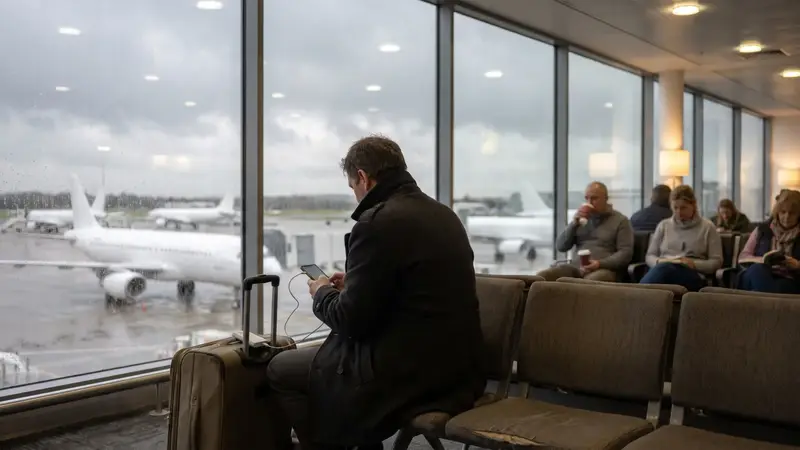 News · 15 NovUS flights grounded: your rights if your flight to or from America was cancelled or delayed
For the children this Christmas

Keep reading
All planning & the national picture guides →Microsoft outage: Outlook.com and OneDrive affected, and what to keep offline at home
Microsoft's status page now shows Outlook.com, OneDrive and its other home services as operational, with no open…
Will there be a shortage of water in the UK? What reservoirs and drought data show
England is short of rain, not tap water: reservoirs are 60.1% full, 17% below average, 11 areas are in drought and…
Why are we being told to prepare for an emergency? What the government says it's for
Headlines say UK households are being urged to prepare for emergencies and 'attacks'. The government's own reasons…