Mesh radios in the UK: how to text without phone signal in a power cut
LoRa mesh radios, sometimes called blackout radios, send short texts between handsets with no phone signal or mains power. What they are, Meshtastic and MeshCore, the UK rules, realistic range, and who should buy a battery radio first.
A LoRa mesh radio, often called a blackout radio, sends short text messages to other radios like it with no phone signal, wifi or mains power. Most pair with your phone over Bluetooth; some have their own screen and keyboard. Messages can be relayed by other radios (in Meshtastic) or by fixed repeaters (in MeshCore), so a group can reach further than one radio alone. Meshtastic and MeshCore are the two main free, open-source systems, and they don't talk to each other. In the UK, buy the 868MHz version, not the 915MHz US one, and set the region to EU_868; that band is for licence-exempt, low-power short-range devices used within Ofcom's IR2030 conditions. Range depends on hills and buildings. It only helps if the people you want to reach have one, and it can't call 999. For most homes, a battery radio and a power bank come first.
By Tom Calder · Updated 18 November 2026 · Sourced to Ofcom, the Meshtastic and MeshCore documentation, makers' product pages and GOV.UK Be Ready
What is a LoRa mesh radio?
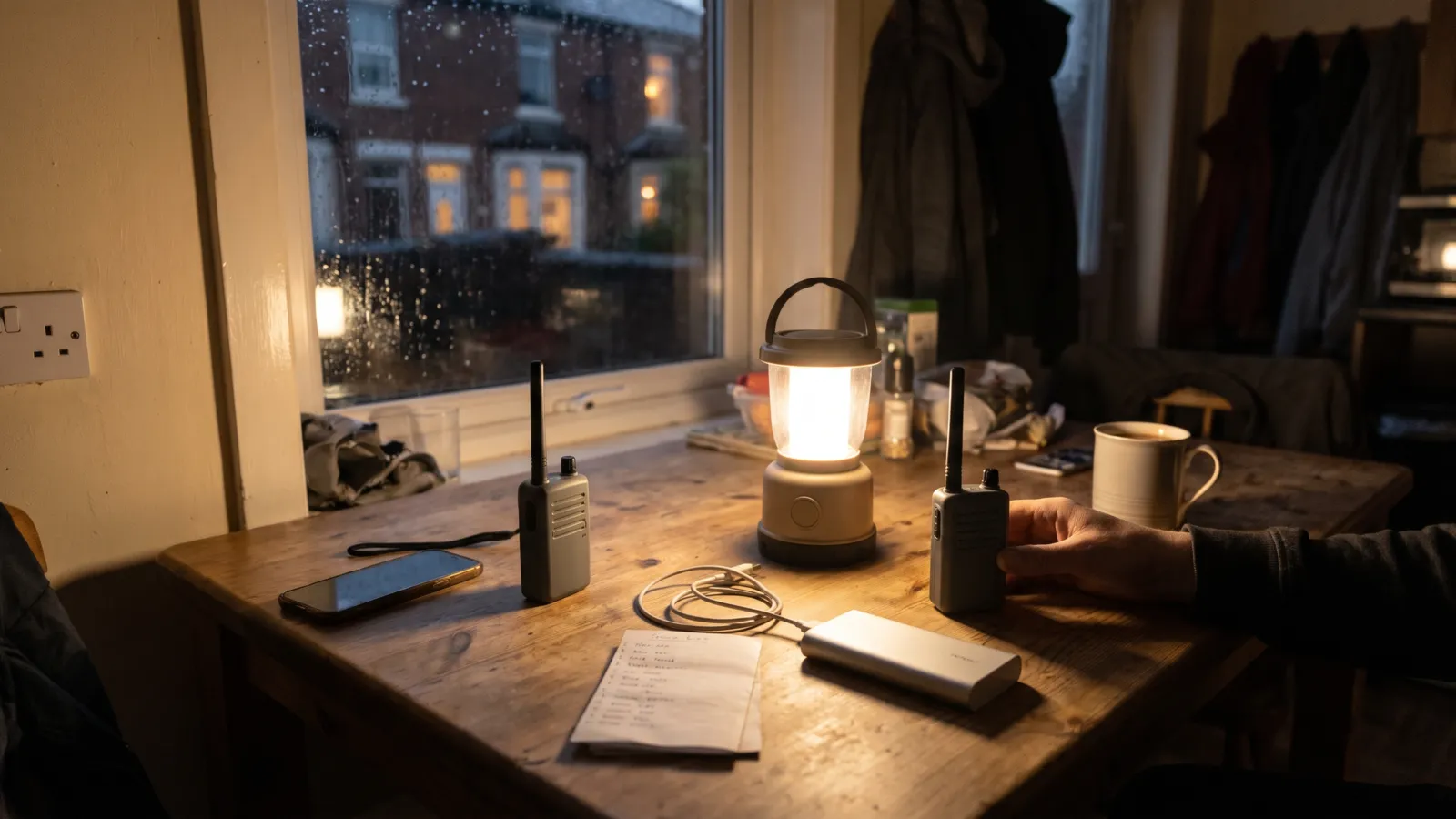
LoRa is a low-power radio technology that sends small amounts of data a long way. A LoRa mesh radio uses it to send short text messages directly to other radios, without a mobile mast, wifi or the internet. Meshtastic, the best-known system, describes itself as a way to use inexpensive LoRa radios as a long-range off-grid communication platform.
There are two kinds of handset. The most common is a small box with no screen that pairs with your phone over Bluetooth: you type in a free app, and the radio does the sending. The other kind has its own screen and keyboard, so it works with no phone at all. Either way, the 'mesh' part means messages can be relayed from radio to radio to reach someone beyond your own radio's range: in Meshtastic every radio can relay, in MeshCore only dedicated repeaters do.
Meshtastic and MeshCore
Both are free, open-source firmware: the software that runs on the radio. Meshtastic says its radios are designed to rebroadcast the messages they receive, forming a mesh, and that no phone is required for the mesh itself. By default a message can be passed on up to three times, and at most seven.
MeshCore describes itself as a system for secure text-based communications over LoRa. It works differently: dedicated repeaters pass messages on, while handheld 'companion' radios don't, which its developers say stops radios flooding the airwaves with collisions that keep messages from getting through. Its FAQ says it supports the 868MHz band in the UK and Europe.
The two cannot message each other. Elecrow, which sells a handset in both versions, says only one of Meshtastic or MeshCore can be used, so choose one with the people you want to reach before anyone buys.
Are mesh radios legal in the UK?
Yes, if you buy the right version and set it up correctly. In the UK these radios use the 868MHz short range device band. Ofcom describes a short-range device as one 'designed to operate usually on a licence-exempt basis, over short range and at low power levels', and says such devices 'are only permitted to operate on a non-protected/non-interference basis'. In plain terms, you need no licence, but you must not cause interference and you get no protection from it. The detailed conditions are in Ofcom's Interface Requirement IR2030: for the 869.40 to 869.65MHz part of the band that these radios use in Europe, it allows up to 500mW e.r.p. with a duty cycle of no more than 10% (or equivalent ways of sharing the band).
Two things matter. First, buy the 868MHz version, often labelled EU868. Many radios are sold in 433, 868 and 915MHz versions from the same page, and 915MHz is the version for the US. Second, set the region to EU_868 in the app. Meshtastic's documentation says a radio with no region set will not transmit at all, and that its EU_868 setting uses 869.4 to 869.65MHz with a 10% hourly duty cycle, which is why a European radio may pause after a burst of messages.
How far will a message go?
Less than the headlines suggest, and it depends on where you are. LoRa needs a fairly clear path: hills, buildings and trees all cut its reach, and height helps more than anything. Seeed quotes 2 to 5km for its SenseCAP T1000-E, depending on the antenna, installation and surroundings. Meshtastic lists a 331km record, which shows what a clear line of sight can do rather than what you'll get from a kitchen.
Between houses in a town, plan on much less than the makers' figures. Every radio in between that relays your message extends the reach, which is why community networks put fixed relays on rooftops and hills. MeshCore's FAQ points to a public map at map.meshcore.io showing radios whose owners have chosen to add them, which gives an idea of whether there is a network near you.
Short texts, and who can read them
These are text-only radios: no voice calls. Messages are short; Meshtastic's Android app limits a message to 200 bytes, about 200 characters of plain text, and its radios can also share your location if they have GPS.
Meshtastic encrypts the contents of every message, but its default public channel uses a published key, and its own documentation says anything sent on that channel can be read by anyone. For family messages, create a private channel and share its key only with your household, or use direct messages, which Meshtastic encrypts for each recipient. MeshCore also offers private channels and direct messages; its default public channel key is published too, so use a private channel for family messages.
Battery life
Most makers give a battery size but not a running time, because it depends on how much you send and whether GPS and the screen are on. Batteries in the radios we compared run from 700mAh in the card-sized SenseCAP T1000-E to 2000mAh in the LILYGO T-Deck Plus. Elecrow claims more than 48 hours for its ThinkNode M1, and 2 to 3 days on standby for its larger M9 handset. A radio that pairs with your phone also needs the phone charged, so keep a power bank with it.
It only works if the other person has one
A mesh radio can only message other mesh radios on the same system. Buying one on its own does nothing unless there is an active network near you. In practice, the people who get value from them are families or neighbours who buy them together, set them up on one evening, agree a private channel, and practise every few months so everyone remembers how.
It also does not reach 999. A mesh radio has no link to the phone network or the emergency services. In an emergency, call 999 or 112: GOV.UK Be Ready says emergency calls automatically roam onto any available mobile network, so try even if your own network is down. If you can't get through, try a landline (it may not work in a power cut unless it has battery back-up) or go for help.
Mesh radios, walkie-talkies and a battery radio
PMR446 walkie-talkies are the simpler alternative. They are licence-free, need no setup or phone, and let you talk rather than type; Ofcom limits them to 0.5 watts, so, like mesh radios, their range depends heavily on buildings and terrain. They suit a household spread across a village or a walk. Mesh radios are better if you want written messages that can be relayed further, and are happy to set them up.
A battery or wind-up FM radio does a different job: it brings you the news. GOV.UK Be Ready asks every household to keep one, with spare batteries, and to write down the frequencies of local and national stations on paper. Neither walkie-talkies nor mesh radios replace it.
Some people look at mesh radios after reading about cyber attacks on infrastructure. Our guide to the National Cyber Security Centre's warnings explains what they mean for households, and the practical advice is the same as for any power cut: a radio, a charged power bank, cash and a plan on paper.
Who mesh radios are worth it for
They make sense for families or neighbours who will set them up together and practise; for rural homes where mobile signal is patchy even on a good day; for groups who walk or camp beyond signal; and for anyone who enjoys a radio project. Expect to spend an evening on setup and to learn a little about the app.
For most households, though, they come after the basics: a battery or wind-up radio, a charged power bank, torches and your important numbers written down. If you do want to try mesh radios, our comparison covers five radios sold on Amazon UK in the 868MHz version, from ready-to-use radios to a keyboard handset you set up yourself.
Common questions
What is a blackout radio?
It's a popular name for a LoRa mesh radio: a small handset that sends short text messages to other radios like it with no phone signal, wifi or mains power. Messages can hop between radios to reach further. The two main systems, Meshtastic and MeshCore, are free and open source.
How can I text without phone signal in the UK?
With a LoRa mesh radio, which texts other mesh radios directly, or with a satellite messenger. A mesh radio only reaches people who have one on the same system, so they work best bought together by a family or group. For talking rather than texting, licence-free PMR446 walkie-talkies need no network either.
Is Meshtastic legal in the UK?
Yes, on the 868MHz band. Ofcom says short-range devices usually operate licence-exempt and at low power, on a non-interference, non-protected basis, within the conditions in its IR2030. Buy the 868MHz (EU868) version, not the 915MHz US version, and set the region to EU_868 in the app.
What is the difference between Meshtastic and MeshCore?
Both are free firmware for LoRa radios. In Meshtastic, radios rebroadcast what they hear to form the mesh; in MeshCore, dedicated repeaters do the relaying and handheld radios don't. They can't message each other, so everyone in a group needs the same one.
Can a mesh radio contact the emergency services?
No. It only talks to other mesh radios and has no link to 999. In an emergency, call 999 or 112 on a mobile (emergency calls roam onto any working mobile network), or on a landline if it has back-up power. If you can't get through, go for help.
Sources (13)
- Ofcom, Short-range devices (published 20 July 2010, last updated 4 June 2026): SRDs 'operate usually on a licence-exempt basis, over short range and at low power levels' and 'are only permitted to operate on a non-protected/non-interference basis' (read 18 Nov 2026)
- Ofcom, IR2030: UK Interface Requirements for licence-exempt short range devices (published 23 October 2026): IR2030/1/19, 869.40–869.65MHz, 500mW e.r.p., duty cycle ≤10% or equivalent techniques (read 18 Nov 2026)
- Ofcom, Business Radio Guidance (5 December 2025): PMR446 is licence-exempt, maximum ERP 0.5 watts
- Meshtastic docs, Introduction: 'a long range off-grid communication platform'; radios 'rebroadcast messages they receive, forming a mesh network'; 331km record (read 6 Nov 2026)
- Meshtastic docs, LoRa configuration: region must be set or the radio won't transmit; EU_868 869.4–869.65MHz, 10% duty cycle; hop limit default 3, maximum 7 (read 6 Nov 2026)
- Meshtastic docs, Encryption: default channel key 'is published'; 'Anything sent on a channel with the default key can be read by anyone' (read 6 Nov 2026)
- Meshtastic docs, Android messages and channels: maximum length 200 bytes (read 6 Nov 2026)
- MeshCore on GitHub, README and FAQ: secure text-based communications over LoRa; repeaters and companion radios; 868MHz in the UK/EU; map.meshcore.io (read 6 Nov 2026)
- Elecrow, ThinkNode M9: 'Only one of Meshtastic/MeshCore can be used'; 2300mAh, '2-3 days' standby (read 6 Nov 2026)
- Seeed Studio wiki, SenseCAP T1000-E: 700mAh, 2 to 5km communication distance (read 6 Nov 2026)
- Elecrow wiki, ThinkNode M1: 1200mAh, battery life 'more than 48 hours' (read 18 Nov 2026)
- LILYGO: T-Deck Plus, 2000mAh (read 18 Nov 2026)
- GOV.UK Be Ready, Power cuts: emergency calls roam onto all available networks; keep a battery or wind-up radio; write down station frequencies
PreparedBritain is independent and not affiliated with HM Government.
The Power Cut Action Card
One page for the kitchen drawer: what to do first, what to have ready, how long food keeps, and how to stay warm without risking carbon monoxide. Free, no catch.
Download it straight away. We'll also send the occasional briefing when something genuinely matters — severe weather, live incidents, real price drops. Nothing else.
Latest from our live data
All stories →
For the children this Christmas

Keep reading
All power cuts & energy guides →Is there going to be a blackout in 2027? What the grid record and risk register say
No official body has announced or forecast a blackout for 2027. NESO says it is not forecasting blackouts this…
Is there going to be a blackout on 19 November? What National Grid said about the rumour
No. National Grid says a social media post claiming a National Grid outage on Thursday 19 November is false, and…
Will the polar vortex cause power cuts in the UK? What the ‘outdoor item’ stories leave out
Headlines say UK households are urged to use an outdoor item indoors to survive polar vortex power cuts. What the…
