Will the polar vortex cause power cuts in the UK? What the ‘outdoor item’ stories leave out
Headlines say UK households are urged to use an outdoor item indoors to survive polar vortex power cuts. What the Met Office and the grid operator say, what our power-cut count shows, and the safe version of the advice.
None of the official sources we checked says it will. The Met Office said on 11 November that this month’s colder spell “is not being caused by the polar vortex”, and no official source we checked links it to power cuts. NESO, which runs Great Britain’s grid, said on 23 October that electricity supplies are expected to remain secure this winter, and our grid-warnings tracker showed no notice in force on 16 November. The one warning we found that mentions power cuts is Tuesday’s yellow snow warning for parts of northern England, the Midlands and southern Scotland, which gives “a small chance of power outages”. The ‘outdoor item’ is a camping tent pitched in the warmest room, a tip from 4Patriots, a US preparedness firm, not a UK body. UK official advice is simpler: gather in one room to share warmth. And never use a camping stove or barbecue indoors, or any fuel-burning heater inside a tent.
The three things most homes are missing
Our top pick from each comparison
as of 19 Nov 2026, 03:07 GMT · Details
Product prices and availability are accurate as of the date/time indicated and are subject to change. Any price and availability information displayed on Amazon.co.uk at the time of purchase will apply to the purchase of this product.
as of 19 Nov 2026, 03:07 GMT · Details
Product prices and availability are accurate as of the date/time indicated and are subject to change. Any price and availability information displayed on Amazon.co.uk at the time of purchase will apply to the purchase of this product.
as of 19 Nov 2026, 03:07 GMT · Details
Product prices and availability are accurate as of the date/time indicated and are subject to change. Any price and availability information displayed on Amazon.co.uk at the time of purchase will apply to the purchase of this product.If you already have these, you're most of the way there.
By Tom Calder · Updated 16 November 2026 · Sourced to the Met Office (its 11 November polar vortex article, its 16 November forecast news and its UK warnings page), NESO’s 23 October Winter Outlook release, NESO system warnings on Elexon BMRS, GOV.UK Be Ready, the UK Chief Medical Officers’ power-outage advice, the NHS, the NFCC and Cheshire Fire and Rescue Service, with our own grid-warnings and power-cut trackers, all read on 16 November 2026
Will the polar vortex cause power cuts in the UK?
The question follows the Daily Express headline “UK households urged to use outdoor item indoors to survive Polar Vortex power cuts”, published at 7am on 16 November, with a version in the Daily Record. The articles talk about “potential power cuts” this winter. They do not say any are forecast, and they cite no grid operator or electricity network.
The Met Office’s answer on the polar vortex was published on 11 November. To its own question of whether the polar vortex is behind the colder weather, it said: “The short answer is no.” It said there has been some stratospheric warming and a weakening of the winds around the vortex, with a brief reversal possible, but that forecasts indicate “this disruption may be short-lived, with the vortex returning closer to its average state as December approaches.” It added that any effect nearer the ground “can take several weeks to develop and is never guaranteed.” Our polar vortex explainer has the background and what followed past breakdowns.
What the grid operator and our trackers show
The National Energy System Operator (NESO) published its Winter Outlook on 23 October. It forecasts a 9.5% buffer, or 5.9 gigawatts, above peak electricity demand, and says Britain’s electricity supplies “are expected to remain secure throughout winter 2026/27”. Dr Deborah Petterson, NESO’s Director of Whole Energy System Resilience, said margins are enough to meet demand “even during periods of colder weather and higher system stress.” NESO also says there may still be periods of tighter margins, as in all winters.
Our grid warnings tracker, which reads NESO’s system warnings on Elexon’s BMRS, showed no warning in force on the morning of 16 November. The last Electricity Margin Notice was for the morning of 9 November, and NESO cancelled it. NESO says such notices “do not indicate a risk to electricity supplies”. BMRS has listed no margin notice since.
Our power cuts tracker reads the live feeds of Great Britain’s six electricity network operators. At 6:20am on 16 November it counted 91 cuts in progress, 42 unplanned and 49 planned, with 2,061 customers off supply on the networks that publish a count. That is within the range of our daily readings since 2 November, from 49 to 119, though those were taken at different times of day. Northern Ireland’s network is not in these figures.
Tuesday’s snow: the one warning that mentions power cuts
The Met Office has a yellow warning for snow from midnight to 11am on Tuesday 17 November, last updated at 9:24am on Monday 16 November to trim the area and bring the end forward. It covers parts of the East and West Midlands, the North East, the North West, Yorkshire and the Humber, and southern Scotland. Under what to expect, it lists longer journey times and says: “There is a small chance of power outages or degradation of mobile phone service”. It also says ice building up on power lines “is also a possibility.”
Its Chief Forecaster, Dan Suri, said on 16 November that the best chance of settling snow is above 200 metres, and: “Away from higher ground, and so for many people, rain rather than snow will be the main story”. The Met Office listed no warnings for Wednesday 18 to Sunday 22 November when we checked, though its page carried a notice that warnings may be out of date. Our story on torches and batteries before Tuesday’s snow covers what a home needs for that warning.
Home Alerts members
The full picture, for your home
Each week, what's happening across Britain set against your own address: your water company, your power network, fuel for your car and the gaps in your kit. Free for your own home. Sign up in a minute.
Start free →Britain's figures from our live trackers, 19 November.
The ‘outdoor item’, and what UK advice says instead
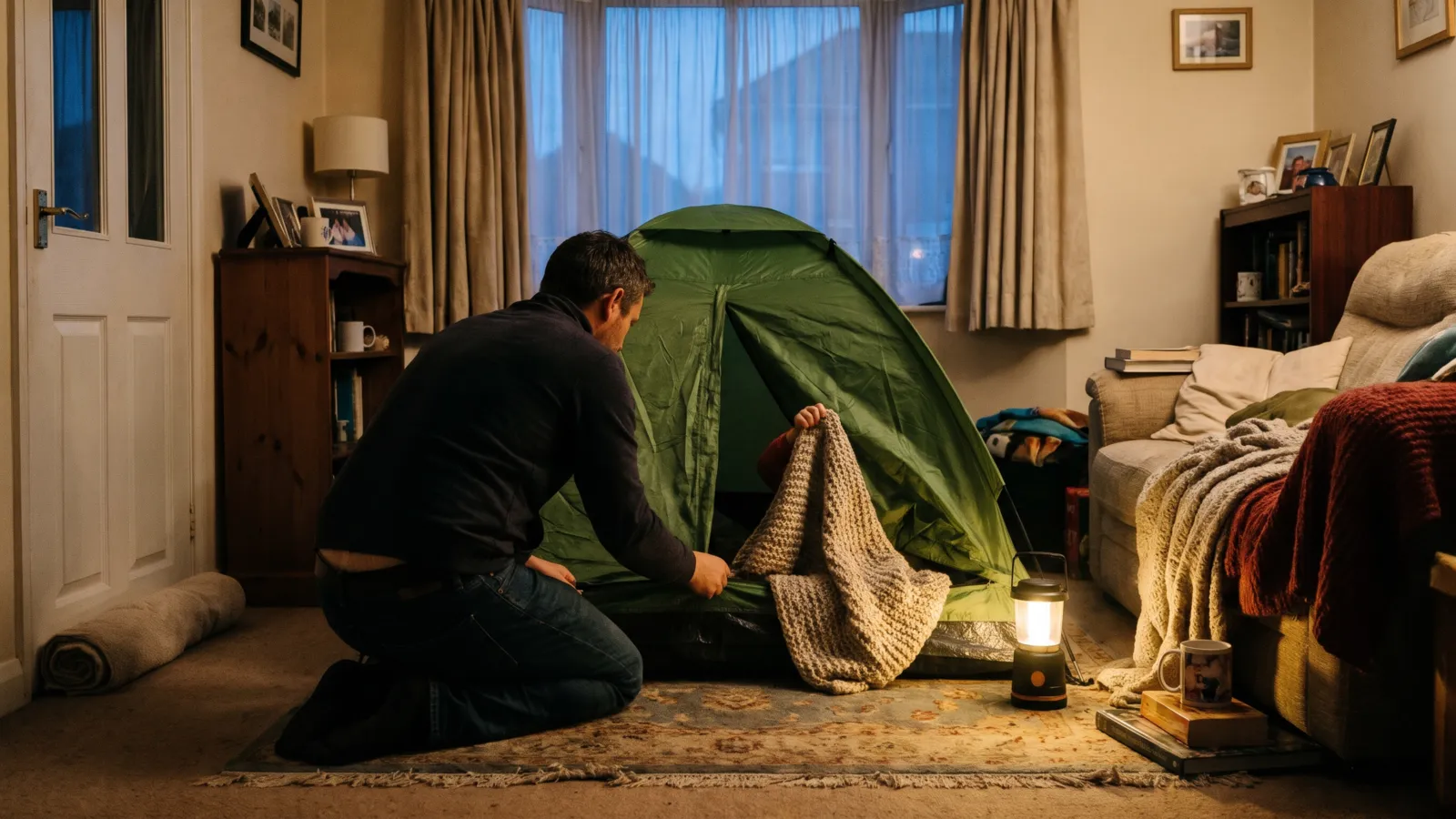
The item is a camping tent. The Express says 4Patriots, a US preparedness firm, suggests heating the people rather than the house in a power cut: pick a central room with the fewest windows, close off the rest, block draughts, and set up “a simple camping tent” in the warmest room to trap body heat overnight. It also recommends three layers of clothing.
The UK Chief Medical Officers’ advice for keeping warm, published on GOV.UK for the unlikely event of a national power outage, makes the same point without a tent. It says to wear several thin layers, to “Get everyone in the house to gather in one room to share warmth”, to put a towel or sheet under the doors of rooms you are using, and to close curtains when it gets dark. Be Ready’s power-cut page says to keep warm with blankets and layered clothing and to keep the doors of unused rooms closed. Our guide to keeping warm without the heating has more.
The part to get right: heaters and stoves
The Express adds that “Propane or kerosene heaters can help”, if rated for indoor use and paired with a carbon monoxide detector. UK advice goes further. The NHS lists gas or paraffin heaters among appliances that can produce carbon monoxide. The National Fire Chiefs Council says to use gas or paraffin heaters only in well-ventilated areas, having checked they are suitable for indoor use, with a carbon monoxide alarm in the same room. The Chief Medical Officers’ advice covers a portable gas heater that uses gas bottles and is “approved for indoor use”, and says to make sure the room is well ventilated and follow all instructions carefully.
None of that makes a fuel-burning heater safe in a tent. Cheshire Fire and Rescue Service says never to use fuel-burning devices, including “disposable barbecues, camping stoves, camping heaters, lanterns, and charcoal grills”, inside a tent. The NHS says: “do not use a barbecue or camping stove indoors or inside a tent”. If you think a gas appliance is leaking carbon monoxide, the NHS says to call the free National Gas Helpline on 0800 111 999. Our guides to camping stoves indoors and carbon monoxide symptoms have the detail.
If the power does go off
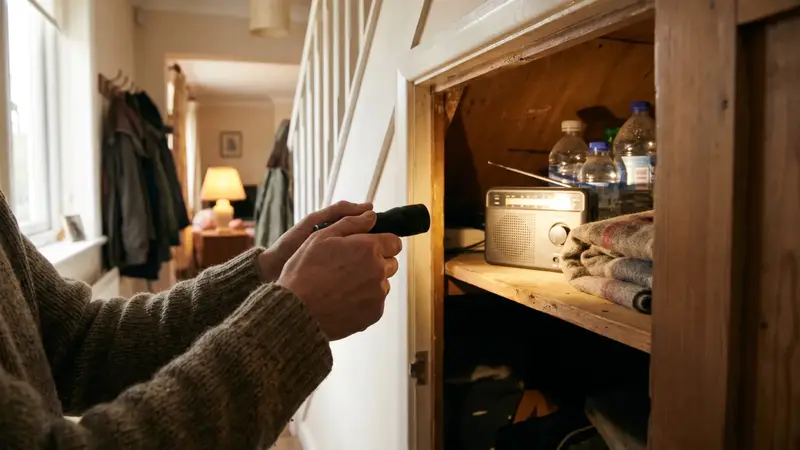
Be Ready says: “Most power cuts are short-lived and occur locally, but more widespread and longer outages can happen.” To report or check a cut, call 105 in England, Scotland and Wales, or 03457 643643 in Northern Ireland. Be Ready’s basics are a battery or wind-up torch and radio with spare batteries, three days of bottled water and food that needs no cooking. It adds: “Torches are safer than candles.”
If someone at home relies on powered medical equipment, or is older or unwell, our Priority Services Register guide explains the free extra help from your network. Our guide to checking for an outage in your area lists the network maps.
Common questions
Will the polar vortex cause power cuts in the UK?
None of the official sources we checked says so. The Met Office said on 11 November that this month’s colder spell is not caused by the polar vortex. NESO said on 23 October that Great Britain’s electricity supplies are expected to remain secure this winter, and no grid warning was in force on 16 November. Local cuts from snow, ice and faults still happen.
What is the outdoor item households are urged to use indoors?
A camping tent, pitched in the warmest room to trap body heat overnight. The tip comes from 4Patriots, a US preparedness firm, as reported by the Daily Express and the Daily Record. No UK official body has suggested it. The UK Chief Medical Officers’ advice is to gather everyone in one room to share warmth.
Is it safe to use a gas heater inside a tent?
No. Cheshire Fire and Rescue Service says never to use fuel-burning devices, including camping heaters, inside a tent, and the NHS says not to use a barbecue or camping stove indoors or inside a tent. Carbon monoxide is colourless and does not smell, so you cannot tell it is there.
Is there a power cut warning for this week?
The Met Office’s yellow snow warning for midnight to 11am on Tuesday 17 November gives “a small chance of power outages or degradation of mobile phone service”, mainly on higher ground in parts of northern England, the Midlands and southern Scotland. The Met Office listed no other warning for 16 to 22 November when we checked, though its page noted warnings may be out of date.
Who do I call in a power cut?
Call 105, free, in England, Scotland and Wales, or 03457 643643 in Northern Ireland. Be Ready suggests writing the number down and keeping it somewhere easy to find in the dark.
Sources (11)
- Met Office, Deep Dive: From fog to frost: Is the polar vortex responsible? (11 November 2026)
- Met Office, Snow warning in force as unsettled weather continues (11:13 UTC, 16 November 2026)
- Met Office, UK weather warningsyellow snow warning for 17 November, last updated 09:24 UTC on 16 November 2026
- NESO, British electricity supplies secure this winter despite global instability (23 October 2026, read 16 November 2026)
- NESO system warnings on Elexon BMRS (no warning in force on 16 November 2026)
- GOV.UK Be Ready, Power cuts (read 16 November 2026)
- GOV.UK, Public health advice from the UK Chief Medical Officers during a national power outage: keeping warm or cool in extreme weather
- NHS, Carbon monoxide poisoning
- NFCC, Cost of living: steps to stay fire safe (leaflet, 2023)
- Cheshire Fire and Rescue Service, Camping safety
- Daily Express, UK households urged to use outdoor item indoors to survive Polar Vortex power cuts (16 November 2026), the headline checked
PreparedBritain is independent and not affiliated with HM Government.
See our checks first on Google. Add PreparedBritain as a preferred source and Google will show our stories to you more often in Top Stories.

The Power Cut Action Card
One page for the kitchen drawer: what to do first, what to have ready, how long food keeps, and how to stay warm without risking carbon monoxide. Free, no catch.
Download it straight away. We'll also send the occasional briefing when something genuinely matters — severe weather, live incidents, real price drops. Nothing else.
Latest from our live data
All stories →
For the children this Christmas
Keep reading
All power cuts & energy guides →Is a 3-day blackout planned for the UK in 2026? There is no date, and the three days means something else
No blackout is planned for 2026 and no official source gives a date. The three days comes from the government’s Be…
The Spain and Portugal blackout: what sold out, and what a UK home should already have
On 28 April 2025 mainland Spain and Portugal lost power, in some places until the next morning. Card machines,…
Sangean MMR-99 vs Midland ER300 Pro: a better radio or a bigger power bank?
Two crank-and-solar AM/FM radios that put their batteries to different uses: the IP55 Sangean MMR-99 for listening,…