Do I need torches and batteries before Tuesday's snow? What the Met Office warnings say
The Met Office has a yellow snow warning for parts of northern England, the Midlands and southern Scotland until 11am on Tuesday. What it says, and the few things a home needs.
Not specially. Torches and batteries are on the government's Be Ready list for any home, but there is no new instruction to stock up. The Met Office has a yellow snow warning, below amber and red, from midnight to 11am on Tuesday 17 November, for parts of northern England, Derbyshire, Staffordshire and southern Scotland. It trimmed the area on Monday morning. It says 1 to 5cm is likely where snow settles, mainly at 100 to 200 metres or higher, with 5 to 15cm in places above 300 to 400 metres, not the "deep snow" of some headlines, and "a small chance of power outages or degradation of mobile phone service". Its main concern is travel. Be Ready's list also includes a charged power bank, food that needs no cooking, water and warm clothing; most homes already have these. If you live outside the warning area, the Met Office had no warning for Tuesday when we checked, though it says warnings can change quickly.
The three things most homes are missing
Our top pick from each comparison
as of 19 Nov 2026, 03:07 GMT · Details
Product prices and availability are accurate as of the date/time indicated and are subject to change. Any price and availability information displayed on Amazon.co.uk at the time of purchase will apply to the purchase of this product.
as of 19 Nov 2026, 03:07 GMT · Details
Product prices and availability are accurate as of the date/time indicated and are subject to change. Any price and availability information displayed on Amazon.co.uk at the time of purchase will apply to the purchase of this product.
as of 19 Nov 2026, 03:07 GMT · Details
Product prices and availability are accurate as of the date/time indicated and are subject to change. Any price and availability information displayed on Amazon.co.uk at the time of purchase will apply to the purchase of this product.If you already have these, you're most of the way there.
By Tom Calder · Updated 16 November 2026 · Sourced to the Met Office (its UK warnings page and warnings feed, and its snow advice page), the government's Be Ready checklist and National Highways, read on 16 November 2026; the warning rechecked after its 09:24 update
Earlier changes
16 Nov Updated: on Monday morning the Met Office trimmed the warning area and moved its end to 11am on Tuesday; the ice warning has ended; the 'deep snow' and 10-inch reports checked against the Met Office's 5 to 15cm on high ground.
What the Met Office warning says
The Met Office issued a yellow warning of snow at 17:15 on Sunday 15 November and updated it at 09:24 on Monday 16 November, "to trim southern and eastern extent of warning area and bring forward cessation time". It now runs from midnight to 11am on Tuesday 17 November, an hour shorter than first issued. The warning's headline is now: "Snow may cause travel disruption over higher ground early Tuesday." The Met Office rates it a high (50 to 75%) likelihood and a moderate impact, which is why it is yellow, not amber.
The Met Office says a band of rain moving north on Monday night will turn to snow for a time as it meets colder air, "mainly affecting locations at 100-200 m altitude or higher". It adds: "Any snow falling below this level will likely be temporary and quickly melt." Where snow settles, it says 1 to 5cm is likely, and some places above 300 to 400 metres could see 5 to 15cm. It expects the snow to turn back to rain through Tuesday morning. The Met Office's chief forecaster, Dan Suri, said on Monday: "Away from higher ground, and so for many people, rain rather than snow will be the main story".
Under what to expect, the warning lists two things: "Some roads and railways likely to be affected with longer journey times by road, bus and train services", and "a small chance of power outages or degradation of mobile phone service". It also mentions a strong easterly wind that could cause some drifting on higher routes, and ice building up on power lines as "a possibility".
Where the snow warning covers
The Met Office lists these council areas for Tuesday's snow warning, after Monday's update. In the East Midlands, Derbyshire. In the West Midlands, Staffordshire. In Yorkshire and the Humber, North, South and West Yorkshire. In the North West, Blackburn with Darwen, Cheshire East, Cumbria, Greater Manchester and Lancashire. In the North East, Durham and Northumberland. In Scotland, Dumfries and Galloway, Midlothian, the Scottish Borders, East Ayrshire, South Ayrshire and South Lanarkshire. Nottinghamshire, Stoke-on-Trent, Darlington, Gateshead and Newcastle upon Tyne were in Sunday's version and are no longer listed.
Our weather warnings tracker counted 14 Met Office warning entries on the morning of 16 November. That is two warnings, not 14: the Met Office feed lists each warning once for every region it covers. One is Tuesday's snow warning, across seven regions. The other is a yellow ice warning for parts of Scotland and northern England, which runs until 10am on Monday 16 November, and the Met Office expects "some injuries from slips and falls on icy surfaces". By Monday afternoon the ice warning had ended, and the feed listed seven entries: one warning, Tuesday's snow, across seven regions. When we checked, there was no amber or red warning, and the Met Office listed no warnings for Wednesday 18 to Sunday 22 November.
Where 'stock up on torches' comes from
The headline telling UK households to stock up on torches and batteries before Tuesday uses words from the Met Office's snow safety tips page, which the warning links to, not from the warning itself. The warning's own advice is about travel, including essentials to carry in the car. That page says: "Act now and be prepared, by getting the essentials together that you could need", and lists "Torches and batteries", candles and matches or lighters, and "Plenty of blankets and warm clothing." The page is written for anyone who could be cut off by snow "for a number of days". Tuesday's warning is for a morning of snow, mostly on higher ground.
Some reports have mentioned much bigger snow totals than the warning gives. A Mirror report headlined "act now" before "deep snow" on Tuesday said that "according to reports", depths of up to around 10 inches were forecast in places, without naming the source. The Met Office's warning does not use the words "deep snow". The figures to go by are the Met Office's: 1 to 5cm where it settles, and 5 to 15cm (about 2 to 6 inches) only in places above 300 to 400 metres. The Met Office says to be prepared for warnings to change quickly, so check its warnings page or our tracker on Monday evening; it already changed this one once on Monday morning.
Home Alerts members
The full picture, for your home
Each week, what's happening across Britain set against your own address: your water company, your power network, fuel for your car and the gaps in your kit. Free for your own home. Sign up in a minute.
Start free →Britain's figures from our live trackers, 19 November.
What a home needs for a day or two of snow
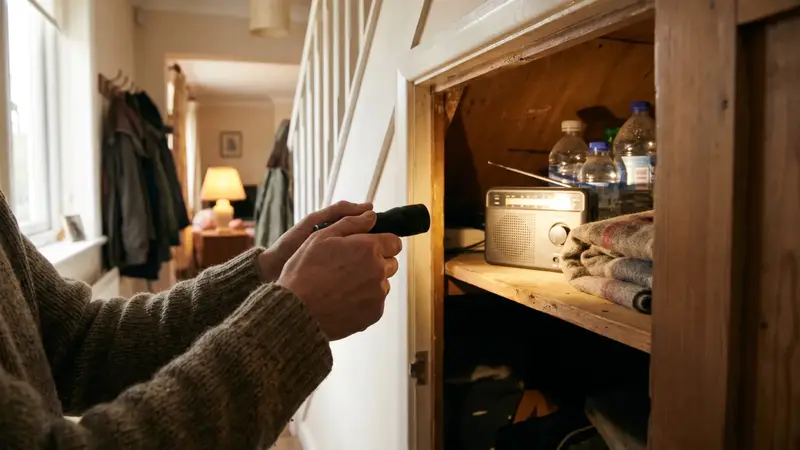
The government's Be Ready checklist is written for any emergency and covers three days. For light, it says: "Torch (and spare batteries)", and adds: "Torches are safer than candles." For phones, it lists a "Charged power bank", to charge phones or compatible medical devices. For food, it suggests food "that doesn't need refrigeration or cooking", and for water, "3 litres per person per day for drinking".
For a morning of snow, that comes down to three things most homes already have. Check the torch works and the spare batteries fit it. Charge your phone and a power bank on Monday evening. Have some food in that you can eat without cooking; Be Ready's examples are tinned meat, fish or vegetables, dried fruit and nuts, and it says it's best to buy food you'd usually eat. If anyone at home takes regular medicine, Be Ready says it's important to request prescriptions up to 5 working days before you need them. Our emergency kit list has the full checklist.
The Met Office's snow page also lists candles and matches or lighters. Be Ready's checklist is clear that a torch is the safer choice of light.
If the power goes off
The warning gives only a small chance of power cuts. If one happens in England, Scotland or Wales, the Met Office says: "Call 105 for information, it's a free service for people in England, Scotland and Wales." It also suggests checking whether your neighbours have lost power too; if they still have it, your own trip switch may have gone. Our guide to checking for an outage in your area lists the network maps and phone status pages.
To keep warm, the Met Office says to wrap up and close internal doors to keep the heat in. It also warns: "Never use a hob or oven to heat your home, they can increase carbon monoxide levels". Our carbon monoxide guide lists the symptoms. If someone at home relies on powered medical equipment, our Priority Services Register guide explains the free extra help from your network.
Driving on Tuesday morning
Travel is where the warning expects most trouble, especially on higher routes. National Highways says: "If snow or ice is expected, consider delaying your journey until it clears." It adds: "Slow down - it can take 10 times longer to stop in icy conditions." Its list of winter supplies for the car includes a "Fully charged mobile and car charger" and a "Torch".
The Met Office suggests a fully charged mobile phone with an in-car charger or battery pack, and warm clothing, food, water and a blanket in the car. Our driving in snow and ice guide has the Highway Code rules and when not to travel, and our guide to reading 'snow bomb' headlines explains how to tell a forecast map from a warning.
Common questions
Do I need torches and batteries before Tuesday's snow?
Not specially. A working torch with spare batteries is on the government's Be Ready list for every home, so it is worth checking yours. But Tuesday's Met Office warning is yellow, covers one morning, and gives only "a small chance" of power cuts. There is no official instruction to stock up.
Where is the Met Office snow warning on Tuesday 17 November?
Parts of the East and West Midlands, Yorkshire and the Humber, North West and North East England, and southern Scotland, from midnight to 11am. The Met Office trimmed the area on Monday morning: Nottinghamshire, Stoke-on-Trent, Darlington, Gateshead and Newcastle upon Tyne are no longer in it. The council areas are listed above and on the Met Office's warnings page.
How much snow is forecast? Is it deep snow?
The Met Office says 1 to 5cm is likely where snow settles, mainly at 100 to 200 metres or higher, and 5 to 15cm in some places above 300 to 400 metres. It says snow below that level will likely be temporary and quickly melt. That is up to about 6 inches on high ground, not the 10 inches some reports mentioned.
What does a yellow warning mean?
Yellow is below amber and red in the Met Office's three warning colours. The Met Office says it is important to read each yellow warning to see what it covers. This one is rated high likelihood and moderate impact, mainly for travel.
Who do I call in a power cut?
Call 105, which the Met Office says is free for people in England, Scotland and Wales.
Sources (6)
- Met Office, UK weather warnings: yellow warning of snow, 00:00 to 11:00 Tuesday 17 November 2026 (issued 17:15 UTC, 15 November; updated 09:24 UTC, 16 November), and yellow warning of ice to 10:00 Monday 16 November, read 16 November 2026
- Met Office, warnings feed for the UK (one entry per warning per region), read 16 November 2026
- Met Office, Snow warning in force as unsettled weather continues (11:13 UTC, 16 November 2026)
- Met Office, 5 tips for staying safe in snow, read 16 November 2026
- GOV.UK Be Ready, Be ready for emergencies (the three-day checklist), read 16 November 2026
- National Highways, Travelling in snow and ice, read 16 November 2026
PreparedBritain is independent and not affiliated with HM Government.
See our checks first on Google. Add PreparedBritain as a preferred source and Google will show our stories to you more often in Top Stories.

The Emergency Kit Checklist
The GOV.UK Prepare essentials on one printable page — tick them off as you go and keep it with the kit. Free, no catch.
Download it straight away. We'll also send the occasional briefing when something genuinely matters — severe weather, live incidents, real price drops. Nothing else.
Latest from our live data
All stories →
For the children this Christmas
Keep reading
All planning & the national picture guides →What should you stockpile, and what shouldn't you? The UK list checked against official advice
The government's Be Ready checklist is the UK list: 15 lines, from bottled water to pet food. The 'do not stockpile'…
Will the government send a UK alert for wildfires? What the fire-danger data shows
People are searching for a government wildfire alert. GOV.UK showed no current alerts on 15 November 2026. Emergency…
Could UK flights be grounded like the US? What failed in 2023, 2025 and 2026, and what to carry
After the US ground stop of 13 November: UK air traffic control has failed before, in August 2023, July 2025 and…