Can you use a camping stove indoors? The UK safety answer for a power cut
Can a camping or butane stove be used indoors in a UK power cut? What the NHS, fire services and the makers’ manuals say, how to use and store gas safely outside, and the indoor option that burns nothing.
No. The NHS says “do not use a barbecue or camping stove indoors or inside a tent”, London Fire Brigade says it is “never safe” to use outdoor cooking equipment like a BBQ or camping stove indoors, and the UK Chief Medical Officers’ power-cut advice says the same, because a gas stove can give off carbon monoxide, which you cannot see or smell. The manuals for the portable butane hobs we checked agree: Campingaz says its Camp’Bistro DLX “should only be used outside premises”, Outwell’s manual says “Use only outdoors” and Cadac’s says “For outdoor use only!”. In a power cut, cook on a gas stove in the open air and bring the food in, or cook indoors on something that burns nothing: an electric hob run from a portable power station big enough for it, or a flask filled before the cut. Change and store gas cartridges outside or somewhere well ventilated, never in a cellar, and fit an audible carbon monoxide alarm in every room with a fuel-burning appliance.
By Tom Calder · Updated 3 November 2026 · Sourced to the NHS, the UK Chief Medical Officers, UKHSA, the HSE, London, Scottish & Cheshire fire services and the stove makers’ own manuals
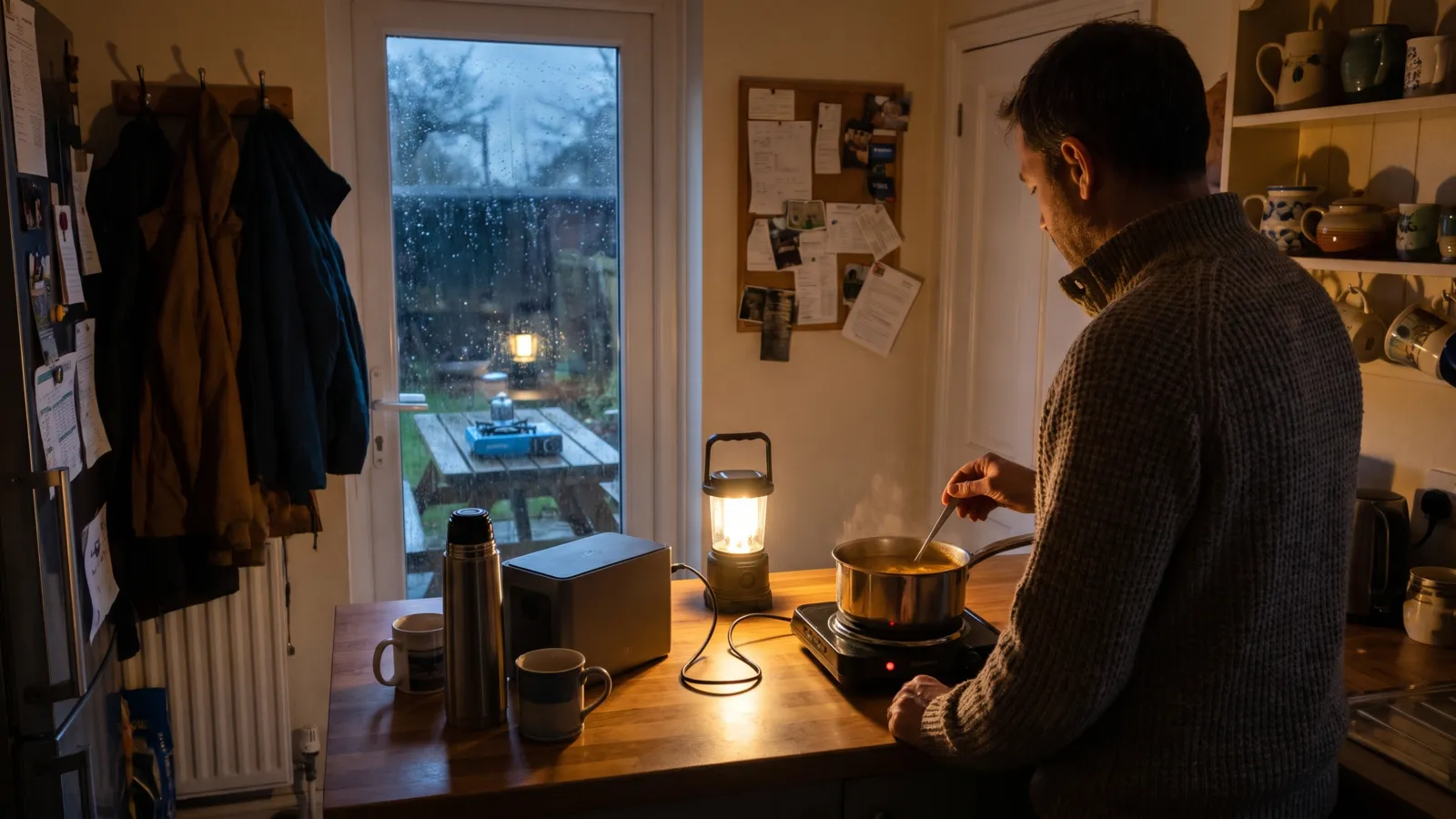
The short answer: cook on a camping stove outdoors, not in the house
People search for an “emergency stove for indoor use” for a sensible reason: the power is off, the electric hob is dead, and a camping stove is sitting in the cupboard. The official answer is clear and it is the same everywhere we looked. The NHS says: “do not use a barbecue or camping stove indoors or inside a tent.” London Fire Brigade says: “It’s never safe to use any type of outdoor cooking equipment like a BBQ or camping stove indoors. Doing so poses a serious risk of fire and deadly carbon monoxide poisoning.” The UK Chief Medical Officers’ advice on keeping warm in a national power outage says: “Do not use camping stoves and barbecues indoors as there is a risk of carbon monoxide poisoning, which can kill.”
The reason is carbon monoxide (CO). The HSE describes it as a “colourless, odourless, tasteless, poisonous gas produced by incomplete burning of carbon-based fuels”, and the NHS lists using barbecues or camping stoves inside among the things that can cause it to build up. Carbon monoxide gives no smell to warn you, and none of the official advice says an open window makes indoor use acceptable. Writing about tents, campers and other enclosed shelters, Cheshire Fire and Rescue Service puts it plainly: “Opening tent flaps, doors, or windows is insufficient to prevent build-up of CO concentrations from these devices.”
None of this means a power cut leaves you without hot food. It means the gas stove does its cooking outside, and anything you use indoors should be something that burns nothing.
What the stove makers’ own manuals say
Portable butane cartridge stoves, especially the flat single-burner hobs that take a slim cartridge, look like kitchen appliances, so it is easy to assume they are made for indoors. We read the English instructions for three sold in the UK (two tabletop hobs and a compact cartridge barbecue-cooker), and none of them says that.
Campingaz’s manual for the Camp’Bistro DLX says: “The stove should only be used outside premises and kept away from inflammable materials.” It adds: “It is imperative NOT to use the stove in caravans, cars, tents, huts, sheds or any small enclosed areas”, and explains that the stove uses oxygen and “gives off certain substances and gas, which could be dangerous such as carbon monoxide.” Outwell’s manual for the Etna Solo says “Use only outdoors” and “Only use in well-ventilated areas”. Cadac’s manual for the Safari Chef 30 Compact says “For outdoor use only!”, and that it “may not be used in an exterior enclosed balcony, porch or entertainment area!”
We looked for a portable butane hob whose own manual allows indoor cooking in a home and did not find one among the manuals we could read. We did find a UK retailer listing for a catering cartridge stove that mentions “indoor use in a well ventilated area”. A shop’s description is not the maker’s instructions, and it is not what the NHS, the Chief Medical Officers or the fire services advise for a home. If you already own a stove, read its manual: if it says outdoors, it means outdoors.
Using a gas stove safely outside in a power cut
Cook in the open air: a garden, yard or patio, not a garage, shed, porch or conservatory. Campingaz names “huts, sheds or any small enclosed areas” as places not to use its stove, and Cadac rules out an enclosed balcony or porch. Stand the stove on a stable, level surface away from anything that can burn; Outwell’s manual shows minimum clearances of 25cm around the stove and 120cm above; Cadac asks for 600mm at the rear and sides and 1.2m above, so check your own.
Use the pan the manual allows. Campingaz says not to use pans smaller than 12cm or larger than 26cm across on the Camp’Bistro DLX, and Outwell recommends 160mm to 260mm for the Etna Solo. Stay inside your own stove’s stated pan range. Do not block the ventilation hole in the cartridge compartment, which Campingaz also warns against. Campingaz says the stove “should not be used while sleeping or left unattended.”
Then carry the food indoors. The cooking happens outside and the eating happens in, which is the same pattern our cooking-without-power guide uses for every fuel-burning option.
NewSee this for your own homeHome Alerts: your postcode's power cuts, warnings and floods, on one screen. Free for your own home. Sign up in a minute.Start free →Changing and storing gas cartridges
Change cartridges outside. The Scottish Fire and Rescue Service says: “If you are using a camping stove outdoors, never change gas cartridges indoors or near ignition sources.” Campingaz says to fit or remove a cartridge “in a well-ventilated area, preferably outside and never in the presence of a flame, heat source or spark”, at a good distance from other people and flammable material.
Store them somewhere cool and ventilated, and never below ground. Campingaz’s instructions are to “Store the stove and the cartridge in a cool, dry and well-ventilated area, out of reach of children. Never store in a basement or cellar”, and to take the cartridge out of the stove for storage or transport. The HSE’s description of LPG explains why low spaces are a risk: it is “flammable and heavier than air so that it will settle and may accumulate in low spots such drains and basements.” For camping, Cheshire Fire and Rescue Service advises storing cylinders outside, “away from direct sunlight and freezing temperatures”.
What you can cook on indoors: something that burns nothing
If you want to cook in the kitchen during a power cut, the answer is electric, run from a battery. An electric hob gives off no exhaust, so the carbon monoxide question does not arise. A portable induction hob plugged into a portable power station is the closest thing to an “indoor emergency stove” that the evidence supports.
The catch is power. Morphy Richards rates its Portable Single Induction Hob at 2kW, and it is suitable for induction-safe pans 12cm to 20cm across. EcoFlow’s DELTA 2, a common 1kWh-class power station, is rated at 1,800W total AC output, below that hob’s rating, EcoFlow says its X-Boost technology lets the unit “prevent overloading from devices up to 2400W”, but it does not say an induction hob will cook normally that way. On our own arithmetic, even at its full 1,800W rating a 1,024Wh battery would be flat in a little over half an hour, before conversion losses, and induction hobs cycle on and off, so real use varies. Check the hob’s rating plate against the power station’s rated AC output before you rely on it, and turn the hob down where you can.
For many households the cheaper answer is a vacuum flask filled from the kettle as soon as a cut is forecast. A power station is still a large lithium battery, so charge and store it as its manual says. If you have a fitted gas hob, that is an installed appliance and a different question; our cooking-without-power guide covers when it still works in a cut.
Barbecues, charcoal, heaters and generators: what stays outside
London Fire Brigade says: “Never take portable or disposable BBQs, grills or charcoal fuel burners into your home or any confined spaces such as a tent, houseboat or caravan.” It adds that an extinguished BBQ “can continue to produce CO for many hours after it has been extinguished”, so a barbecue that looks finished still stays outside, well away from the building.
Gas heaters need care too. London Fire Brigade lists portable heaters using LPG among the things that can produce carbon monoxide, and the only gas heater the Chief Medical Officers’ power-cut advice mentions using indoors is one that “uses gas bottles and is approved for indoor use”, with the room well ventilated and all instructions followed carefully. A patio heater is sold for outdoor use: unless its manual says it is approved for indoor use, it stays outside. The Scottish Fire and Rescue Service adds: never use portable gas cylinder heaters in high-rise flats. The same advice says: “Do not use petrol or diesel generators or other similar fuel driven equipment indoors”.
A carbon monoxide alarm, and what to do if it sounds
The NHS advises getting “a carbon monoxide alarm that makes a loud sound if there’s carbon monoxide present”, one “for each room of your home containing appliances that burn gas, oil, coal or wood”. London Fire Brigade says to buy only alarms certified to British Standard EN50291 with an approval mark such as the Kitemark, and to choose audible alarms rather than colour-change or black-spot indicators. UKHSA adds that an alarm will not go off at lower levels of carbon monoxide, so it is no substitute for regular servicing of appliances. It is a backstop, not permission: no source we read says an alarm makes it acceptable to use a camping stove indoors.
The NHS lists the symptoms of carbon monoxide poisoning as including a headache, dizziness, feeling sick, weakness, confusion and shortness of breath, and says they may get better when you leave or go outside. If you suspect CO, London Fire Brigade says to leave the property; if someone has collapsed or is showing signs of poisoning, get them outside, call 999 and ask for an ambulance. The NHS says to call 111 if you think you might have symptoms, and 999 or go to A&E if someone exposed is finding it hard to breathe, has suddenly become confused, has lost consciousness, is feeling weak or has chest or muscle pain. Do not drive yourself to A&E. If your alarm sounds or you suspect CO, UKHSA says to call the National Gas Emergency Service on 0800 111 999, and London Fire Brigade says to call it before you go back in, even if the source was not a gas appliance.
Common questions
Is there any camping stove that is safe to use indoors in the UK?
Not one we can point you to. The NHS, London Fire Brigade and the UK Chief Medical Officers all say not to use camping stoves indoors, and the manuals for the portable butane stoves we read (Campingaz Camp’Bistro DLX, Outwell Etna Solo, Cadac Safari Chef 30 Compact) say outdoors only. One retailer listing we found mentions indoor use in a well-ventilated area for a catering stove, but that is shop copy, not the maker’s instructions or the official advice for a home.
Can I use a butane stove indoors if I open a window?
No. The NHS and London Fire Brigade say not to use a camping stove indoors at all, with no exception for an open window, and carbon monoxide has no smell, so you cannot tell if it is building up. Cheshire Fire and Rescue Service, writing about tents and other enclosed shelters, says opening flaps, doors or windows is insufficient to prevent CO building up. Cook outside and bring the food in.
What is the safest way to cook indoors in a power cut?
Use something that burns nothing: an electric or induction hob run from a portable power station whose rated output covers the hob, or hot water from a flask you filled before the cut. Check the wattage first, because a 2kW hob is more than some popular power stations are rated to supply.
Can I cook in the garage or porch with the door open?
No. Campingaz’s manual rules out “huts, sheds or any small enclosed areas”, Cadac’s rules out an enclosed balcony, porch or entertainment area, and Cheshire Fire and Rescue Service, writing about tents and other enclosed shelters, says opening doors or windows is not enough to stop CO building up. Cook in the open air.
Where should I keep spare gas cartridges?
Somewhere cool, dry and well ventilated, out of reach of children, and never in a basement or cellar, as Campingaz’s instructions say. The HSE explains that LPG is heavier than air and can collect in low spots. Take the cartridge out of the stove for storage, and change cartridges outside, away from flames.
Does a carbon monoxide alarm make it OK to use a stove indoors?
No. An alarm warns you once carbon monoxide is already there, and UKHSA notes it will not go off at lower levels. Fit an audible alarm certified to EN50291 in every room with a fuel-burning appliance, and still keep camping stoves and barbecues outside.
Sources (15)
- NHS: Carbon monoxide poisoning
- GOV.UK: Public health advice from the UK Chief Medical Officers during a national power outage, keeping warm or cool in extreme weather (scripts for broadcast media)
- UKHSA: Carbon monoxide, general information
- HSE: Carbon monoxide, domestic gas safety
- HSE: About LPG
- London Fire Brigade: Cooking safety
- London Fire Brigade: Carbon monoxide safety
- Scottish Fire and Rescue Service: Power cuts
- Cheshire Fire and Rescue Service: Camping safety
- Campingaz: Camp’Bistro DLX instructions (English section)
- Outwell: Appetizer / Etna Solo user manual
- Cadac: Safari Chef 30 Compact instructions (English section)
- Smart UK: Bright Spark BS100 portable gas cartridge stove (retailer listing)
- Morphy Richards: Portable Single Induction Hob (452000)
- EcoFlow UK: DELTA 2 specifications
PreparedBritain is independent and not affiliated with HM Government.
The Power Cut Action Card
One page for the kitchen drawer: what to do first, what to have ready, how long food keeps, and how to stay warm without risking carbon monoxide. Free, no catch.
Download it straight away. We'll also send the occasional briefing when something genuinely matters — severe weather, live incidents, real price drops. Nothing else.
Latest from our live data
All stories → News · 2 NovCold Weather Payment opens: £25 a freezing week; last winter 40 of 71 stations triggered none
 News · 31 OctEarliest polar vortex breakdown on record forecast for November: what it means for the UK
 News · 31 OctAsda, Aldi, Tesco and Sainsbury's recalls checked: what the official notices list, and when
Keep reading
All power cuts & energy guides →Gas standing charges to be scrapped: what the Budget means for your energy bill
The government plans to remove standing charges from household gas bills in Great Britain for around 23 million…
Jackery's Halloween sale, checked: two bundles cost less than the power station on its own
Jackery's UK sale runs until 31 October. We put the headline deals in a basket: the Explorer 1000 v2 and 2000 v2…
Highland homes hit by fresh power cuts: 125 faults since Saturday, 47 still with homes off
Since Storm Boelo's first warning for Highland came into force at noon on Saturday, SSEN has listed 125 unplanned…
